Brighton Open Market: The Real Brighton Behind the Tourist Trail
Tucked between London Road and Ditchling Road, Brighton Open Market is a covered community market with over a century of history and more than 40 independent traders. Free to enter and open most days, it offers a grounded, local counterpoint to the more curated shopping streets nearby.
Quick Facts
- Location
- Marshalls Row, Brighton BN1 4JU (between London Road and Ditchling Road, opposite The Level)
- Getting There
- Brighton station (10-min walk) or London Road (Brighton) station (10-min walk); multiple bus routes stop on London Road
- Time Needed
- 30 to 60 minutes for a browse; longer if you stop for food or coffee
- Cost
- Free entry; individual trader prices vary
- Best for
- Local food shopping, independent coffee, everyday Brighton life away from the seafront crowds
- Official website
- www.brightonopenmarket.co.uk
What Brighton Open Market Actually Is
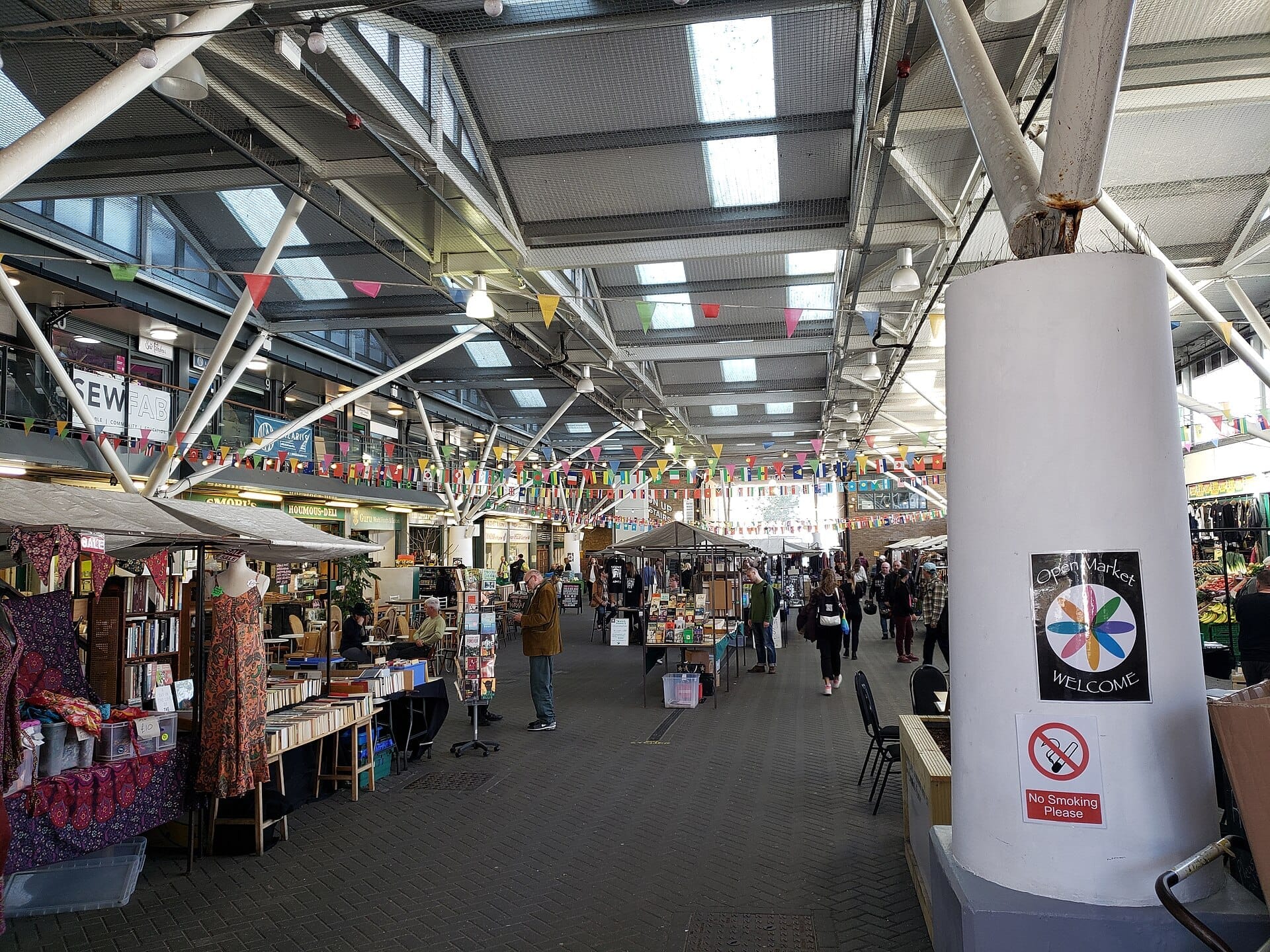
Brighton Open Market sits at Marshalls Row, a short, covered concourse running between London Road and Ditchling Road at the northern edge of North Laine. It is not a weekend pop-up or a farmers market that packs away by noon. It trades most days of the week, with a mix of permanent shops and market stalls that collectively give it the feel of a small, self-contained indoor village. Entry is free.
The market holds more than 40 traders at any one time, selling a range of goods that skews practical: fresh produce, butchers, fishmongers, bakeries, coffee, hot food, vintage clothing, household goods and craft supplies. There is no single theme. That is part of what makes it feel genuinely local rather than staged for visitors.
ℹ️ Good to know
Opening hours: Monday to Friday 07:00–19:00, Saturday 07:00–17:00 (most stalls from 10:00), Sunday 10:00–17:00. Individual trader hours vary, so a few units may be closed when others are open. Verify current hours at brightonopenmarket.co.uk before visiting.
A Century of Trading: The Market's History
The Open Market's origins go back to 1919, when traders set up an informal street market in nearby Oxford Street. By 1926, they had relocated to the gardens of Marshalls Row, establishing a more permanent presence on the site it still occupies today. For decades it operated as an open-air market, shaped by the ordinary commercial needs of the surrounding streets rather than any particular vision.
The current form of the market dates from a major redevelopment completed in 2014. The project introduced a covered concourse with a lightweight roof structure, bringing weather protection without fully enclosing the space. The result is something between an indoor market and a covered street: there is natural light, air movement, and a sense of being outdoors even when it is raining. The redevelopment retained the community-facing character of the original market rather than repositioning it as a boutique destination.
The market sits at the edge of the North Laine conservation area, which the local authority defines as a dense Victorian urban neighbourhood noted for independent shops, cafes and cultural venues. The Open Market fits that description more literally than most of the surrounding streets.
Tickets & tours
Hand-picked options from our booking partner. Prices are indicative; availability and final rates are confirmed when you complete your booking.
Brighton city lights flight with welcome drink
From 21 €Instant confirmationCycle along the beachfront with Brighton Beach Bikes hire
From 7 €Instant confirmationFree cancellationTour Brighton's highlights with an exploration game mobile app
From 10 €Instant confirmationFree cancellationExplore Brighton self-guided walking tour using an app
From 11 €Instant confirmation
How It Feels to Visit: Morning vs Afternoon
Mornings on weekdays are the most functional time to visit. The concourse smells of fresh bread and ground coffee before 9am. Traders arranging produce create a low-level soundtrack of crates, conversation and espresso machines. The customers at this hour are largely local: people picking up groceries, workers grabbing breakfast, regulars who know the stallholders by name. There is very little sense of performance. The market is simply operating.
By midday, particularly on Fridays and Saturdays, the pace changes. The hot food traders come into their own, and the narrow concourse fills up enough that movement slows. The smell shifts from coffee and bread to cooked food. Seating is limited, so people eat standing at counters or along the covered edges of the space. It is not uncomfortable, but it is genuinely busy, and not ideal if you are looking for a relaxed lunch.
Sunday mornings are quieter and have a different character entirely. Fewer traders are open, but those who are tend to draw a more unhurried crowd. The light through the roof is softer in the mornings, and the market feels more spacious than at other times. If the goal is to take stock of what the market offers without being jostled, Sunday before noon is the best time to do it.
💡 Local tip
Weekday mornings before 10am offer the best combination of full trader availability and low crowds. Saturday afternoons are the busiest period and the least comfortable for browsing.
What the Traders Actually Sell
The trader mix at Brighton Open Market is anchored in food. There are fresh fruit and vegetable stalls with competitively priced produce, a fishmonger, a butcher, a bakery, and several hot food and coffee outlets. The quality varies by stall, as it does in any market, but the food offer is functional and fairly priced relative to the surrounding neighbourhood.
Beyond food, the market carries vintage and second-hand clothing, craft supplies, plants, household goods and a small number of specialist independent shops that have permanent units within the concourse. The mix shifts gradually as traders come and go, so no two visits a year apart will feel quite the same. There is no jewellery district, no street food festival aesthetic, no curated artisan branding. What is there is closer to a working market serving local residents.
If you are specifically looking for upmarket crafts, designer vintage or the kind of independent retail that defines The Lanes, this is not that. Brighton Open Market occupies a different register entirely, which is precisely what makes it interesting as a complement to the rest of Brighton's shopping areas.
Getting There and Getting Around
The market has two main entrances: one on London Road and one on Ditchling Road. Both are at street level, making the concourse step-free from both sides. The London Road entrance is slightly more prominent and easier to find if you are approaching from the city centre or Brighton station.
On foot from Brighton main station, the walk takes roughly ten minutes heading north up London Road. London Road (Brighton) station, a smaller station on the same line, sits roughly equidistant in the other direction and is similarly walkable. By bus, a large number of routes serve the London Road corridor directly: services including the 5, 5A, 5B, 17, 21, 22, 24, 25, 26, 37, 46, 49, 50 and others stop nearby. Check current Brighton and Hove Buses timetables before travelling.
For cyclists, there are bike racks near the Ditchling Road entrance. Drivers will find the London Road car park approximately two minutes walk away. The market itself is compact enough that once inside, navigation is straightforward: the concourse is essentially a single covered lane with offshoots, and it is not possible to get lost.
💡 Local tip
The Level park is directly opposite the market on Ditchling Road. If you are visiting with children or want somewhere to sit after shopping, it is a useful extension to the trip.
Is It Worth Your Time? An Honest Assessment
Brighton Open Market is not Brighton's most visually dramatic attraction, and it does not try to be. The 2014 redevelopment is functional and clean without being architecturally exceptional. There is no single showpiece stall, no famous food item associated with the place, and no obvious photo opportunity.
What it offers is a genuine slice of how a significant part of Brighton's resident population shops and eats on an ordinary day. For travellers who find that kind of ground-level authenticity valuable, it rewards a visit. For those primarily seeking the seafront experience or heritage sights, it is probably not a priority.
The market pairs naturally with a walk through North Laine's independent shops before or after. It is also well-placed for a detour if you are heading to or from the Royal Pavilion or exploring the wider city on foot. Given the free entry, the threshold for dropping in is low.
Visitors who will not enjoy it: anyone expecting a themed food market, a craft fair atmosphere, or the kind of polished independent retail that characterises other parts of North Laine will find the market underwhelming. It is also not the right choice for anyone with significant mobility requirements beyond step-free access, as the official site does not confirm detailed accessibility provisions such as accessible toilets or specific surface information.
Photography and Practical Notes
The covered roof structure provides diffused natural light throughout most of the day, which makes the market reasonably photogenic without requiring harsh flash. Mornings offer warmer, lower-angled light through the entrances at either end. The narrow concourse means wide-angle shots tend to work better than telephoto ones. Always ask before photographing individual traders or their stalls.
If the Open Market forms part of a longer itinerary, consider combining it with a visit to Brighton Museum and Art Gallery or a walk down through North Laine toward the seafront. The full guide to things to do in Brighton covers how the market fits within a broader day.
Insider Tips
- The produce stalls near the London Road entrance tend to have the most competitive prices on fruit and vegetables in this part of the city. Worth comparing before buying at nearby supermarkets.
- Several of the food traders operate a cash-preferred policy, though card is accepted at most units. Having some cash (GBP) avoids any inconvenience.
- If you want the market at its least crowded, visit on a weekday morning before 10am. You will also get better access to the fresh food stalls before daily stock runs low.
- The market is directly opposite The Level, one of Brighton's larger public green spaces. Combining the two makes for a practical half-morning without spending anything.
- Individual trader hours within the market do not always match the official opening times for the site. A few permanent shops open later and close earlier than the stated concourse hours. Check ahead with specific traders if your visit depends on a particular stall being open.
Who Is Brighton Open Market For?
- Travellers who want to experience Brighton as a lived-in city rather than a tourist destination
- Self-catering visitors looking for affordable, fresh local produce
- Anyone combining North Laine exploration with a practical food or coffee stop
- Families looking for a low-cost, covered activity that works in any weather
- Visitors interested in the social history and ongoing life of working-class urban markets in England
Nearby Attractions
Other things to see while in North Laine:
- Brighton Toy and Model Museum
Tucked into four Victorian railway arches directly under Brighton Station, the Brighton Toy and Model Museum holds more than 10,000 exhibits spanning over a century of childhood. From intricate model railways to rare tin toys, it rewards curious adults as much as it delights children.
- St Bartholomew's Church
St Bartholomew's Church on Ann Street is one of the most architecturally remarkable buildings in Brighton, a soaring brick nave that rises higher than Westminster Abbey's interior. Free to enter during opening hours and quietly tucked into the North Laine grid, it rewards anyone willing to look up from the vintage shops for five minutes.
- The Level
The Level is Brighton's most historically loaded patch of open ground. Free to enter, flat underfoot, and sitting at the northern edge of North Laine, it has served as a cricket ground, a fairground, a protest space, and a festival site across three centuries. Here's what the park actually looks and feels like today.