St Bartholomew's Church, Brighton: The Victorian Giant You Probably Walked Past
St Bartholomew's Church on Ann Street is one of the most architecturally remarkable buildings in Brighton, a soaring brick nave that rises higher than Westminster Abbey's interior. Free to enter during opening hours and quietly tucked into the North Laine grid, it rewards anyone willing to look up from the vintage shops for five minutes.
Quick Facts
- Location
- Ann Street, Brighton, BN1 4GP (North Laine)
- Getting There
- Brighton Railway Station (10 min walk); multiple Brighton & Hove bus routes on London Road
- Time Needed
- 20–45 minutes
- Cost
- Free admission
- Best for
- Architecture lovers, history enthusiasts, quiet reflection mid-sightseeing day
- Official website
- www.stbartholomewsbrighton.org.uk
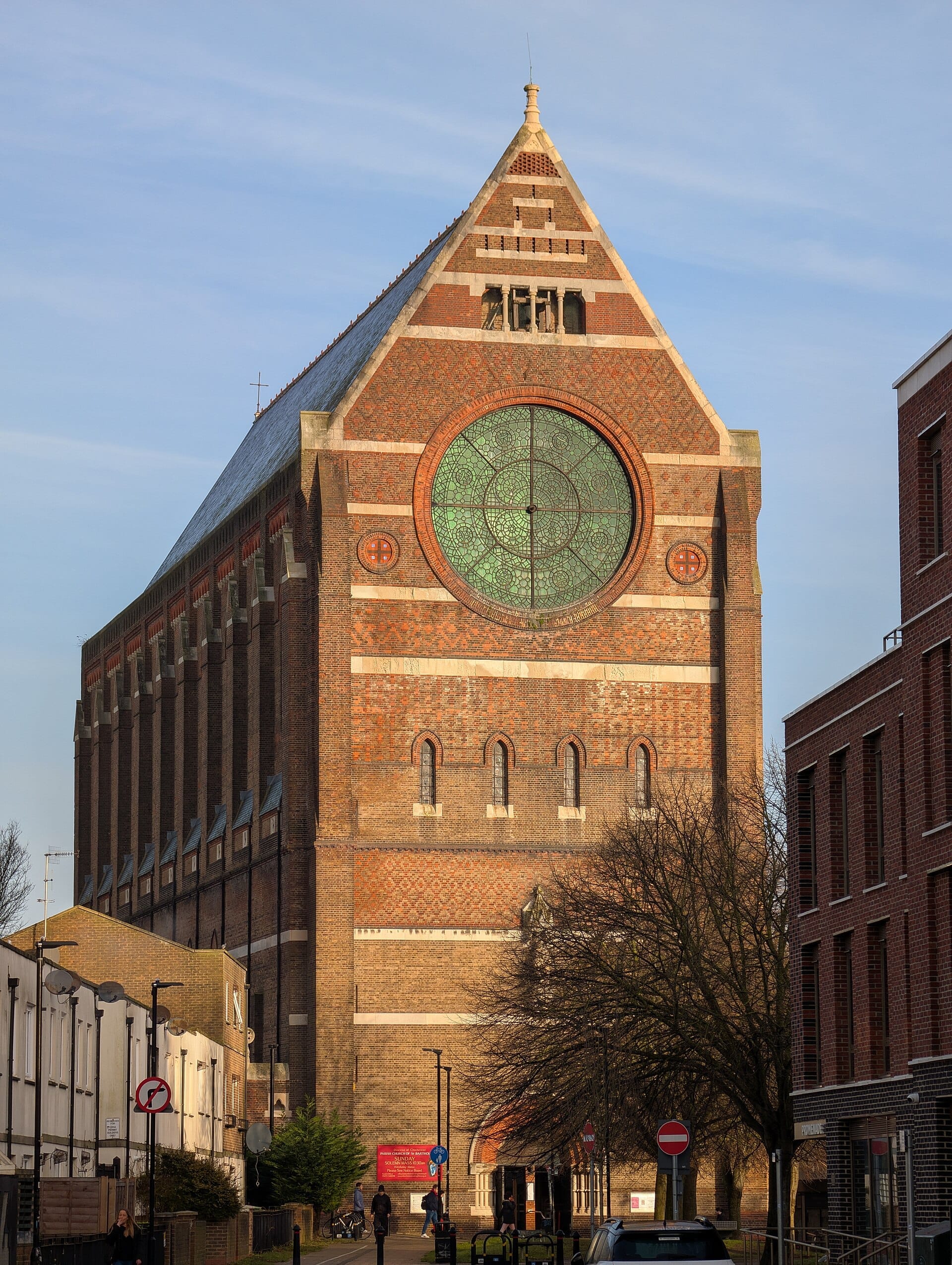
Why This Church Stops People in Their Tracks
Most visitors arrive at St Bartholomew's Church by accident, rounding a corner in North Laine and suddenly confronting a wall of dark brick that seems to rise indefinitely. The nave of this Anglican church, completed in 1874, reaches approximately 44 metres internally. From the street, without the visual relief of a tower or spire, the sheer vertical mass is almost difficult to process. It looks less like a church and more like an industrial building that has been consecrated.
That comparison is not entirely unfair. Architect Edmund Scott designed St Bartholomew's in a stripped Gothic Revival style using stock brick, at a time when Victorian church-builders typically reached for stone, ornament, and spires. The result is a building that feels radical even now, more than 150 years later. Historic England awarded it Grade I listed status, the highest tier of protection in England, reserved for buildings of exceptional interest.
💡 Local tip
The best exterior view is from a slight distance along Ann Street, looking south. Step back far enough to take in the full height of the gable end, ideally in morning light when the brickwork glows warm orange-brown.
The Interior: Scale and Silence
Walking through the west door, the first thing most people do is stop and look straight up. The nave interior is almost aggressively vertical. There are no aisles in the conventional sense, and the walls climb without apparent interruption to a roof that feels improbably far overhead. The proportions are so extreme that the space reads as narrow despite having significant width at floor level. Sound behaves differently here too: voices drop instinctively, footsteps echo in a long, slow decay, and the ambient noise of North Laine outside disappears entirely.
The interior contains several significant furnishings added after the nave was completed, including a high altar canopy and mosaic work that was developed over the late 19th and early 20th centuries. The decorative scheme adds warmth and colour that the brick shell alone would not provide. Look carefully at the floor tiles, the metalwork, and the way light enters through the high windows at different hours: in the afternoon, patches of diffuse light travel slowly across the brick, making the texture of the walls visible in a way that morning visits do not reveal.
The church is genuinely quiet during visiting hours on weekdays. Unlike major tourist churches in London, there are no audio guides, no crowd-management ropes, and no queues. You can sit in a pew and simply look. For anyone doing a full day of Brighton sightseeing, the silence alone has practical value.
Tickets & tours
Hand-picked options from our booking partner. Prices are indicative; availability and final rates are confirmed when you complete your booking.
Brighton city lights flight with welcome drink
From 21 €Instant confirmationCycle along the beachfront with Brighton Beach Bikes hire
From 7 €Instant confirmationFree cancellationTour Brighton's highlights with an exploration game mobile app
From 10 €Instant confirmationFree cancellationExplore Brighton self-guided walking tour using an app
From 11 €Instant confirmation
History and Context: Why This Exists at All
St Bartholomew's was built between 1872 and 1874 to serve the working-class population that had expanded rapidly into the streets north of Brighton's station in the mid-Victorian period. The funding came largely through the efforts of Father Arthur Wagner, a significant figure in Brighton's Anglo-Catholic movement, who had already funded several local churches. Wagner's religious outlook shaped the church's liturgical character: it was built for a high-church, ritual-centred form of Anglican worship, which explains both the intense verticality of the nave and the subsequent investment in elaborate altar furnishings.
The neighbourhood around the church, now known as North Laine, was in the 1870s a dense grid of artisan housing rather than the independent retail quarter it is today. The church was intended as an anchor for a community, not an architectural statement for posterity. That it has become the latter is partly a function of Edmund Scott's ambition and partly the accident of its survival in an area that gentrified rather than redeveloped.
The Grade I listing by Historic England confirms the national significance of the building. Fewer than 3% of listed buildings in England hold this designation. For a non-cathedral church in a secondary city, that places St Bartholomew's in genuinely rare company.
Visiting in Practice: Hours, Access, and What to Expect
The church is open to visitors Monday to Thursday from 10:00 to 13:00, and Friday to Saturday from 10:00 to 16:00. Sunday access is centred on worship services, so if you are coming specifically to see the interior on a Sunday, it is worth checking the church's website in advance. There is no admission charge.
The address is Ann Street, Brighton, BN1 4GP. Brighton Railway Station is approximately a ten-minute walk away, heading north along the London Road corridor. Multiple Brighton & Hove bus routes stop on London Road, within a few minutes' walk. If you are already exploring North Laine on foot, the church sits naturally into a circuit that might also include the independent shops on Gardner Street or Sydney Street.
⚠️ What to skip
Opening hours are subject to change around services, events, and seasonal variations. Verify current hours at stbartholomewsbrighton.org.uk before making a special trip, particularly on public holidays or during Holy Week.
No specific accessibility information is available from the church's published materials at the time of writing. Visitors with mobility requirements are advised to contact the church directly before visiting to confirm ground-floor access and facilities.
Photography: What Works and What Doesn't
The exterior presents an unusual photographic challenge. The building is so tall relative to the width of Ann Street that capturing the full height requires a very wide-angle lens or significant distance, neither of which is easy to achieve from directly in front. Smartphone cameras struggle with the full gable elevation. The best approach is to move to the north side of the street and frame the upper portion of the facade against the sky, which typically renders better than attempts at a full-building shot.
Inside, the absence of strong directional light for most of the day means photographs often look flatter than the experience feels. The exception is late afternoon on the Friday and Saturday extended hours, when low sun angles create raking light across the brick. Bring or use a camera that handles mixed, low-level interior light well. Flash photography is not appropriate during services and is generally not the most effective technique here in any case.
How It Fits Into a Broader Brighton Visit
St Bartholomew's is most naturally paired with other architectural and cultural stops in central Brighton. The Royal Pavilion is the obvious counterpoint, being Brighton's most famous building and a study in decorative excess that sits at the opposite stylistic pole from St Bartholomew's austere brick. Visiting both on the same day is entirely feasible and makes the contrast instructive rather than arbitrary.
For those drawn to Brighton's architectural layers, the Brighton Regency architecture guide provides context for the earlier building phases that preceded the Victorian expansion into North Laine. The church itself represents the moment when Brighton's population growth moved decisively away from the seafront Regency terraces and into the working-class hinterland to the north.
After visiting the church, the immediate area repays exploration on foot. The Brighton Open Market is nearby, and the independent character of North Laine's streets rewards slow walking rather than itinerary-driven movement. If you are interested in other historic buildings in Brighton, St Nicholas Church offers a very different architectural experience, being medieval rather than Victorian and positioned on a hill above the station with views over the city.
Honest Assessment: Who This Is For, and Who It Isn't
St Bartholomew's is not a conventional tourist attraction and does not try to be. There are no gift shops, no interpretation boards explaining the history in digestible panels, no cafes, and no organised tours running regularly. The experience is essentially architectural and contemplative. Visitors expecting an active, curated experience will find the church underwhelming.
It is also worth being direct about the exterior: in overcast conditions, which are frequent in Brighton from October through March, the dark brick reads as oppressive rather than dramatic. The building earns its keep most clearly in good light. If your visit falls during a grey winter week, the interior remains worth seeing, but managing expectations about the streetscape impact is fair.
For anyone with genuine interest in Victorian architecture, Anglican liturgical history, or simply the experience of being inside a space with genuinely extraordinary proportions, St Bartholomew's delivers something that larger, more famous churches often cannot: the chance to experience it in near-total quiet, without crowds, without booking, and without cost.
Insider Tips
- Friday afternoons offer the best combination of extended opening hours (until 16:00) and low-angle late light inside the nave. This is the single best time to visit for both photography and atmosphere.
- The exterior gable is visible from several streets away if you approach from the south. Looking north from that direction gives you an unexpected long view of the building rising above the Victorian terrace rooflines, which is a more dramatic introduction than arriving directly on Ann Street.
- The church has an active parish, not just a heritage function. If you visit during or near a service, the liturgical character of the space is amplified considerably: the acoustic properties that make it feel grand when empty become genuinely powerful with choral music.
- Dress in layers. The interior retains a chill year-round, noticeably colder than the street outside even on warm summer days, because of the thermal mass of the brick and the absence of modern heating visible to visitors.
- If you are combining this visit with North Laine shopping, do it beforehand rather than after. The church has a genuine decompression effect, and the contrast between the commercial street energy outside and the silence inside is more striking when you enter from the noise rather than leave into it.
Who Is St Bartholomew's Church For?
- Architecture enthusiasts interested in Victorian Gothic Revival and the work of Edmund Scott
- Visitors seeking a few minutes of genuine quiet mid-sightseeing without paying for a museum ticket
- Photographers working with architectural subjects who want an uncrowded interior with exceptional proportions
- Anyone on a Brighton history itinerary who wants to understand the city beyond its Regency seafront identity
- Travellers visiting on a limited budget who want culturally substantive stops that cost nothing
Nearby Attractions
Other things to see while in North Laine:
- Brighton Open Market
Tucked between London Road and Ditchling Road, Brighton Open Market is a covered community market with over a century of history and more than 40 independent traders. Free to enter and open most days, it offers a grounded, local counterpoint to the more curated shopping streets nearby.
- Brighton Toy and Model Museum
Tucked into four Victorian railway arches directly under Brighton Station, the Brighton Toy and Model Museum holds more than 10,000 exhibits spanning over a century of childhood. From intricate model railways to rare tin toys, it rewards curious adults as much as it delights children.
- The Level
The Level is Brighton's most historically loaded patch of open ground. Free to enter, flat underfoot, and sitting at the northern edge of North Laine, it has served as a cricket ground, a fairground, a protest space, and a festival site across three centuries. Here's what the park actually looks and feels like today.