Baan Tawai Woodcarving Village: Chiang Mai's Artisan Quarter
Baan Tawai, located about 15 kilometers south of Chiang Mai's Old City, is Thailand's most concentrated hub of traditional woodcarving craft. Dozens of workshops and export-grade showrooms line the main road, selling everything from intricate teak Buddha images to furniture-scale carvings. It rewards those who walk slowly and look closely.
Quick Facts
- Location
- Baan Tawai village, Hang Dong district, ~15 km south of Chiang Mai Old City
- Getting There
- Songthaew south on Hang Dong Road, or hire a private driver / red truck from Chiang Mai; a dedicated BTTS Baan Tawai bus now runs from Chiang Mai
- Time Needed
- 2–4 hours depending on browsing depth; allow a full half-day if you visit multiple workshops
- Cost
- Free entry to the village; individual workshop and showroom prices vary
- Best for
- Craft collectors, interior design enthusiasts, shoppers wanting authentic Thai handicrafts
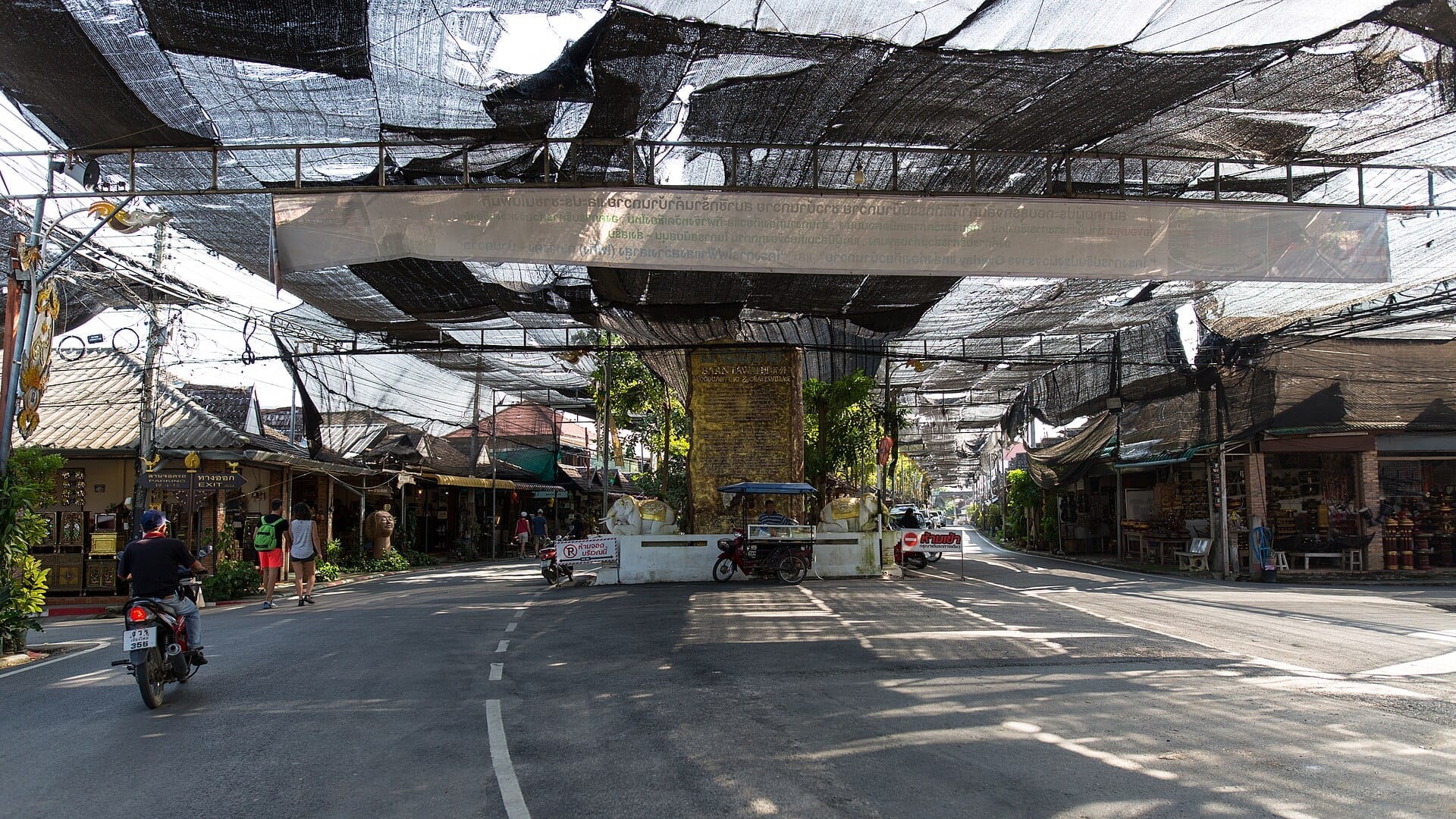
What Baan Tawai Actually Is
Baan Tawai Woodcarving Village is not a curated tourist attraction with an entrance gate and a gift shop. It is a working production village that has evolved, over several decades, into the largest woodcarving trade hub in northern Thailand. The main road through the village is flanked by hundreds of shops, ranging from family-run workshops where sawdust covers the floor and chisels still ring at midday, to polished export showrooms stocking container-load quantities of finished furniture and decorative pieces.
The scale is genuinely surprising. First-time visitors often expect a modest street market, and instead find what amounts to a small industrial district dedicated entirely to carved wood. Teak, rain tree, mango wood, and lacquered bamboo are all worked here. The products range from pocket-sized decorative elephants to six-foot carved panels destined for hotel lobbies. Understanding that mix, craft production sitting alongside wholesale export trade, helps set the right expectations before you arrive.
ℹ️ Good to know
Baan Tawai is both a retail destination and a wholesale export hub. Many showrooms are geared toward bulk buyers and interior designers. Prices are generally fair, but bargaining is expected in the smaller stalls. Large showrooms tend to have fixed or semi-fixed prices.
The Layout of the Village
The village stretches along a single main road with a handful of side lanes branching off it. The biggest, most photogenic showrooms tend to anchor the main thoroughfare. These display room-sized arrangements of carved teak furniture, gilded temple ornaments, life-size animal sculptures, and reproduction antiques. Some showrooms occupy multiple buildings and feel closer to a warehouse than a shop.
The more interesting craft experience tends to happen on the side lanes, where smaller family workshops operate with fewer intermediaries. Here you can watch artisans at work: a man bent over a half-finished teak panel, carving floral motifs with a mallet and a narrow chisel, shavings curling onto the concrete floor. The smell of fresh-cut teak, slightly sweet and resinous, is strong in these spaces. The sound of hammering and grinding runs almost continuously during business hours.
A useful strategy is to walk the full length of the main road first to orient yourself, note the shops that caught your eye, and then double back. Many visitors make the mistake of buying at the first interesting stall and then finding better quality or lower prices further along.
Tickets & tours
Live prices and dates from our booking partner. If you book, we may earn a commission at no extra cost to you.
Chiang Mai - Chiang Dao Cave and 5 Hill Tribe villages
From 42 €Instant confirmationFree cancellationHalf-day tour to Doi Suthep and White Hmong Hill Village
From 146 €Instant confirmationFree cancellationHalf-day private van tour to Doi Suthep and Doi Pui Hmong Village from Chiang Mai
From 93 €Instant confirmationFree cancellationFull day van charter, Chiang Rai and Long Neck Village
From 184 €Instant confirmationFree cancellation
What You Can Buy and What to Look For
The range of products is broad enough to be confusing. At the lower end are mass-produced decorative items: painted wooden elephants, lacquerware bowls, and novelty carvings churned out in volume. These are fine as souvenirs, but they represent the industrial side of the trade rather than the craft tradition. The pieces worth seeking out are those made in smaller runs with visible hand-tool marks, non-uniform grain, and the occasional imperfection that confirms human involvement.
Teak is the prestige material, and genuinely old-growth teak is now heavily restricted in Thailand. Most teak products today use plantation teak or recycled timber from old houses and buildings, which is both legal and, in many cases, more characterful. If a vendor claims their teak is antique or old-growth without documentation, treat that claim skeptically. Rain tree wood, with its dark swirling grain, is widely used for bowls, platters, and smaller decorative pieces and tends to be more affordable than teak.
- Carved teak panels and architectural details: high-quality, heavy, and worth shipping if you love them
- Rain tree wood bowls and serving pieces: good quality-to-price ratio, easier to carry
- Lacquerware boxes and trays: a separate craft tradition, often sold alongside woodcarvings
- Reproduction Buddhist iconography: Buddhas, Naga serpents, deity figures in various sizes
- Furniture: tables, chairs, and cabinets that many export showrooms will ship internationally
💡 Local tip
Several large showrooms in Baan Tawai offer international shipping and export documentation. If you fall in love with a large piece, ask directly about freight options before walking away. Shipping costs can be surprisingly competitive for heavy carved items, which are expensive to replicate elsewhere.
Timing Your Visit
The village operates on daytime hours, with most shops open roughly from 9:00 in the morning until around 5:00 in the evening. Weekday mornings are the quietest and the most productive time to visit. Workshops are actively producing, artisans are focused on their work rather than on selling, and the road is not crowded with tour groups.
Weekend afternoons bring domestic Thai shoppers and tour groups from Chiang Mai, which makes the main road noticeably more congested. The atmosphere is livelier but browsing becomes harder. Midday during the hot season, roughly March through May, is uncomfortable. The workshops and showrooms are only partially air-conditioned, and spending two or three hours in the heat while examining heavy furniture is tiring. A morning visit before 11:00 AM avoids both the crowds and the worst heat.
⚠️ What to skip
During the burning season (roughly February to April), air quality around Chiang Mai and its surrounding districts can deteriorate significantly. If haze is heavy on a given day, outdoor time in Hang Dong district will be affected. Check air quality indices before planning an outdoor-heavy visit.
For more on managing your trip around seasonal conditions, the Chiang Mai burning season guide covers what to expect and how to adapt your plans.
Getting There and Getting Around
Baan Tawai sits in Hang Dong district, approximately 15 kilometers south of Chiang Mai's Old City. The most practical ways to reach it independently are to use the dedicated BTTS Baan Tawai bus or hire a red songthaew (shared pickup truck taxi) from central Chiang Mai, negotiate a return fare with a defined waiting time, or arrange a tuk-tuk or private driver for a half-day. Ride-hailing apps including Grab operate in Chiang Mai and can get you there, though confirming a return ride from a village location can be less reliable.
Baan Tawai is often combined with other nearby attractions in the Hang Dong area. The Royal Park Rajapruek is roughly in the same direction and makes a logical half-day pairing, particularly if you are traveling by hired vehicle.
Once inside the village, everything is walkable. The main road is about a kilometer long, and the side lanes add another 30 minutes of exploration if you follow them. There is no dedicated pedestrian infrastructure, so you are walking alongside slow-moving vehicles and the occasional delivery truck. Comfortable, closed-toe shoes are better than sandals given the uneven ground in the workshop areas.
Cultural Context and the Craft Tradition
Woodcarving in northern Thailand has deep roots in the Lanna kingdom's tradition of ornamental temple architecture. The intricate carved gables, window frames, and ceiling panels seen in Chiang Mai's historic temples represent the high end of a craft tradition that Baan Tawai has adapted into a commercial form over the past several decades. The village's growth into a major trade hub accelerated in the 1980s and 1990s as international demand for Thai handicrafts rose and Chiang Mai developed as a tourism and export center.
For context on the temples that inspired these craft traditions, Wat Chedi Luang and Wat Phra Singh in the Old City both display exceptional carved woodwork in their original temple contexts, which helps you appreciate what the village artisans are drawing from.
The village today is a blend of tradition and industry. Some families have been carving here for multiple generations. Others have shifted primarily to retail or export management, with the physical carving contracted out to workshops elsewhere. The craft is alive, but it exists within a commercial structure that makes it different from, say, a small atelier producing limited pieces for select collectors. This is woodcarving at scale, which has both advantages and trade-offs.
Who Will Enjoy This and Who Might Not
Baan Tawai rewards visitors who genuinely like craft, materials, and the process of making things. If you enjoy watching skilled manual work, comparing quality across different producers, and taking time to examine how something is constructed, this place offers a half-day of genuine interest. Shoppers looking for higher-quality, longer-lasting souvenirs than what is available in central Chiang Mai's night markets will also find it worthwhile.
Travelers on a tight three-day itinerary who have not yet seen Chiang Mai's major temples and markets should probably prioritize those first. The Chiang Mai 3-day itinerary puts attractions in a useful sequence for first-time visitors. Baan Tawai makes more sense as an add-on once the city center has been explored.
Visitors with no particular interest in craft or home furnishings may find the repetition of the village, shop after shop of carved wood in various forms, monotonous after the first 45 minutes. It is not a place with narrative arc or visual drama; it is a place where the pleasure is in the details, and if the details do not interest you, the main road becomes samey quite quickly. Children under ten tend to lose interest fast unless they can be engaged in watching the workshop carving process.
Insider Tips
- Walk the entire main road before buying anything. The range of quality and pricing varies more than you expect, and the best workshops are not always the most prominently located.
- Ask workshop staff to show you pieces in progress rather than only finished stock. Most will, and seeing raw carvings mid-process helps you assess skill level and understand what you are actually buying.
- If you want to ship furniture or large carvings internationally, ask at least two or three showrooms for freight quotes. The logistics infrastructure is well-established here, and competitive quotes are common.
- Early weekday mornings are ideal: workshops are producing at full pace, tour groups have not yet arrived, and shop owners are more willing to discuss the craft and negotiate on price.
- Bring cash. While larger export showrooms may accept cards, smaller workshops and family stalls operate on cash only, and ATMs in the village itself are limited.
Who Is Baan Tawai Woodcarving Village For?
- Craft collectors and design enthusiasts looking for quality Thai woodwork beyond souvenir grade
- Interior designers and buyers sourcing decorative pieces or furniture for projects
- Curious travelers who want to see traditional Lanna craft in a production context
- Shoppers seeking larger or more meaningful take-home pieces than night markets typically offer
- Visitors combining Hang Dong district attractions into a dedicated half-day south of the city
Nearby Attractions
Other things to see while in Handicraft Villages (San Kamphaeng Road):
- Bo Sang Umbrella Village
Bo Sang is a working artisan village 9 kilometres east of Chiang Mai where families have been producing hand-painted parasols, fans, and lacquerware for generations. Visitors walk an open workshop street, watch painters at their benches, and buy directly from the makers — no factory floor, no tour-group script.
- San Kamphaeng Hot Springs
Located about 34 kilometers east of Chiang Mai near the town of San Kamphaeng, these natural hot springs offer geysers reaching up to 3 meters, thermal foot baths, egg-boiling pools, and private spa facilities. It is one of the most accessible geothermal sites in northern Thailand and works well as a half-day trip combined with the nearby handicraft villages.
Planning a trip? Discover personalized activities with the Nomado app.