Extraterrestrial Highway: The Area 51 Road Trip from Las Vegas
Nevada State Route 375, officially designated the Extraterrestrial Highway in 1996, is a 98-mile desert drive skirting the perimeter of the most famous restricted military installation on Earth. It costs nothing to drive, demands serious preparation, and delivers a genuinely remote American landscape that few Strip visitors ever see.
Quick Facts
- Location
- Nevada State Route 375, starting at Crystal Springs junction, approx. 107 miles north of Las Vegas via I-15 N and US-93 N
- Getting There
- Private vehicle only. No public transit serves this route. Take I-15 North to Exit 64 (US-93 N), continue ~107 miles to the Crystal Springs junction near SR 318
- Time Needed
- Full day minimum (8-10 hours round trip from Las Vegas); overnight in Rachel recommended for a complete experience
- Cost
- Free to drive. Budget for fuel (fill up in Las Vegas and again at Alamo or Ash Springs), food, and optional souvenirs at roadside stops
- Best for
- Road trip enthusiasts, UFO culture fans, photographers, anyone wanting to escape the Strip for raw Nevada desert
- Official website
- travelnevada.com/road-trips/extraterrestrial-highway
What the Extraterrestrial Highway Actually Is
Nevada State Route 375, the Extraterrestrial Highway, is a real public road cutting through the high desert of Lincoln and Nye counties in central Nevada. It runs approximately 98 miles (158 km) northwest from its southern junction with US-93 near Crystal Springs to US-6 near Warm Springs. The highway skirts the perimeter of what is formally known as the Nevada Test and Training Range, including the restricted area the U.S. government publicly confirmed as real in 2013 and the world knows as Area 51.
To be direct about something many visitors misunderstand: Area 51 itself is an active military installation with no public access. The perimeter is patrolled, fenced, and signed with warnings that use of deadly force is authorized. You will not get inside. What you can do is drive the remote two-lane highway that runs closest to its boundaries, stop at a handful of quirky roadside landmarks, absorb a genuinely vast and silent desert landscape, and participate in one of the more unusual cultural road trips the American West offers.
⚠️ What to skip
Do not approach or cross any restricted area boundaries along or near SR 375. Roads leading toward the base perimeter are clearly marked. Trespassing is a federal offense and enforcement is active. The allure is real — the consequences of crossing the line are also real.
The Drive: What You See on the Road
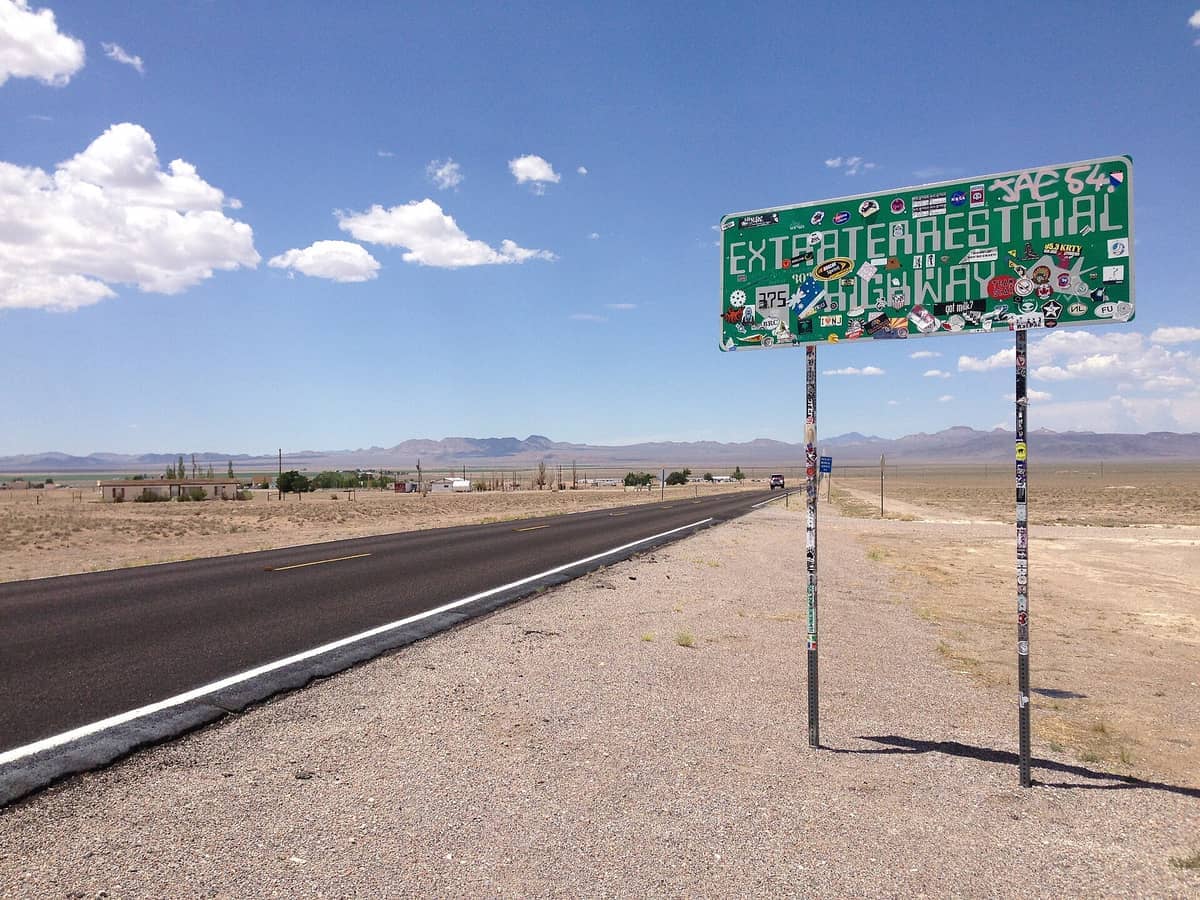
The highway begins at an elevation that already feels far removed from Las Vegas. Once you leave US-93 and turn onto SR 375, the landscape opens into a wide basin ringed by low, sun-bleached mountain ranges. The road is arrow-straight for long stretches, with the kind of silence that amplifies small sounds — the crunch of gravel at a pull-off, the distant call of a hawk, the hiss of wind across scrub brush. Traffic is sparse enough that you may drive 20 minutes without seeing another vehicle.
The color palette is muted and honest: pale yellow desert floor, grey-green sage, rust-brown ridgelines, and a sky that at midday becomes an almost aggressive shade of blue. The road surface is generally decent but narrow, with minimal signage beyond the occasional alien-themed marker installed as part of Nevada's 1996 designation. The highway was named that year partly as a promotional tie-in with the release of the film Independence Day, a fact that gives the whole enterprise a slightly self-aware quality the locals have leaned into enthusiastically.
The most visited stop along the route is Rachel, Nevada, a community of a few dozen residents that serves as the de facto hub of Extraterrestrial Highway tourism. The Little A'Le'Inn diner and motel is the main gathering point: a corrugated metal building with alien memorabilia covering every surface, a menu serving burgers and pie, and bulletin boards papered with UFO sighting reports and visitor notes from around the world. It is exactly what it looks like, and that is part of its charm.
Tickets & tours
Hand-picked options from our booking partner. Prices are indicative; availability and final rates are confirmed when you complete your booking.
Go City | Las Vegas All-Inclusive Pass
From 140 €Instant confirmationFree cancellationGolden Eagle West Rim helicopter tour with Hoover Dam and Lake Mead
From 401 €Instant confirmationFree cancellationGrand Canyon 6-in-1 tour
From 417 €Instant confirmationFree cancellationHighlights Over the Grand Canyon air tour from Las Vegas
From 195 €Instant confirmationFree cancellation
Timing and Light: When to Make the Drive
Spring (March through May) and autumn (September through November) are the most comfortable seasons for this trip. Daytime temperatures in the valley are moderate, nights are cool, and the desert has a clarity to it that summer heat haze eliminates. If you drive out in April, the early morning light on the surrounding ranges is particularly sharp, and the road is less crowded than during summer holiday peaks.
Summer is possible but demanding. Temperatures in this part of Nevada can exceed 100°F (38°C) in July and August, your car's cooling system will be working hard, and the highway has no shade and no reliable services for long stretches. If you go in summer, leave Las Vegas before sunrise. The desert at dawn in June has a specific beauty — cool air, long shadows, total quiet — but by 11am the experience becomes about endurance rather than enjoyment.
Winter driving is possible but carry chains or know your vehicle's limitations. The highway sits at moderate elevation and conditions can turn icy without much warning. The reward is that winter delivers some of the deepest quiet on the route and, on clear nights, a star field that requires no explanation.
💡 Local tip
For night sky photography, the Extraterrestrial Highway sits in one of the darkest areas of the continental United States. A new moon night in autumn, with the Milky Way overhead and zero light pollution on the horizon, is an experience that is genuinely difficult to replicate. Bring a tripod and a wide-aperture lens.
Planning the Logistics: Fuel, Food, and Cell Service
This is not a casual detour. The round trip from Las Vegas covers roughly 230-250 miles depending on how far along SR 375 you drive, and the infrastructure along the route is minimal by design — this is one of the least-populated regions of the contiguous United States. Fill your tank completely before leaving Las Vegas, and plan to refuel at Alamo or Ash Springs, the last reliable fuel stops before you turn onto SR 375. Running low on fuel in the basin has no good outcomes.
Cell coverage drops out soon after you leave US-93 and may not return reliably until you rejoin a major highway. Download offline maps before you leave. Carry water — at minimum one gallon per person for a day trip, more in summer. A basic emergency kit (jumper cables, a spare tire you know how to change, a flashlight) is sensible on any remote Nevada highway.
Food options along the highway are limited almost entirely to the Little A'Le'Inn in Rachel and ET Fresh Jerky near the southern junction at Hiko, which also sells souvenirs and basic supplies. Neither operates on extended urban hours, so check current schedules before you go and do not arrive expecting a full-service restaurant experience. Pack food and snacks from Las Vegas if you have specific dietary needs.
If you want to build the trip into a longer Nevada adventure, the Extraterrestrial Highway connects naturally to other destinations in the region. Check the day trips from Las Vegas guide for context on how to combine this drive with other Nevada and Great Basin destinations within a multi-day itinerary.
The Cultural Layer: Why This Road Matters
The U.S. government officially acknowledged the existence of Area 51 in declassified CIA documents released in 2013, confirming what aviation historians had long documented: the site was used for testing experimental aircraft including the U-2 and SR-71 reconnaissance planes during the Cold War. The extraordinary secrecy around those programs, combined with the remote location and the inevitable sightings of unusual aircraft by civilian witnesses, generated decades of UFO lore that Nevada has now made into something close to an official cultural export.
The 1996 designation of SR 375 as the Extraterrestrial Highway was a calculated tourism move that worked. The highway sign at the Rachel junction has been photographed so many times it has become a minor American landmark. The 2019 'Storm Area 51' event, which was organized as an internet joke and drew an estimated 1,500-3,000 people to the region (far fewer than the 2 million who indicated interest online), underscored how potent the mythology remains and how seriously federal authorities take the restricted perimeter.
For visitors who want to engage with the history of secrecy, surveillance, and Cold War-era government programs without driving three hours into the desert, Las Vegas offers a strong alternative in the form of the National Atomic Testing Museum, which covers Nevada Test Site history with genuine depth and includes exhibits directly related to classified programs in the region.
Photography and What to Look For
The highway itself is the main photographic subject. Stop at the marked pull-offs and look back at the road receding to a point in the distance — it is a classic American West composition that never quite gets old. The 'Black Mailbox' (now actually white, after the original was replaced) on SR 375 near milepost 29.5 is a traditional stop and has its own mythology as a supposed drop-point for UFO researchers in the 1990s.
The distant mountain ranges shift color significantly throughout the day. Early morning produces purples and deep blues; midday bleaches everything toward tan and grey; late afternoon restores warm amber tones to the rock faces. If you can time your return drive to catch the last hour of sunlight on the Groom Range to the west of the restricted area, the landscape justifies the trip by itself.
Desert road trips require some preparation specific to landscape photography. The same principles that apply to shooting at Valley of Fire State Park — golden hour timing, wide lenses, and a polarizing filter to manage the intense sky — apply here. The light on SR 375 is similarly unforgiving at noon and extraordinary at the edges of the day.
Who Will Get the Most From This Trip (and Who Should Reconsider)
The Extraterrestrial Highway rewards people who genuinely enjoy driving for its own sake, who find something interesting in remote American landscapes, and who are comfortable with a certain amount of nothing-happening-ness. The stops are few, the distances are large, and the payoff is atmospheric rather than action-packed. Travelers expecting a theme park experience, organized tours with guides, or a facility with visitor amenities will find the reality underwhelming.
Visitors with limited time in Las Vegas should think carefully before committing a full day to this drive. A weekend in the city already competes with options like the Red Rock Canyon Scenic Drive, which is only 20 miles from the Strip and delivers dramatic desert scenery with far less logistical overhead. The Extraterrestrial Highway makes more sense if you have at least two full days available or are building it into a longer Nevada road trip.
Families with young children should consider whether a 4-5 hour drive each way with minimal stops and no reliable facilities fits their travel style. Those looking for structured outdoor experiences closer to Las Vegas might find Mount Charleston or the hiking trails at Red Rock a better fit for a day out of the city.
Insider Tips
- The last guaranteed fuel before SR 375 is at Ash Springs, roughly 12 miles south of the highway junction. Do not skip it regardless of how much you think you have left in the tank — the next fuel is in Rachel, and the Little A'Le'Inn's supply is not always reliable.
- The highway entrance sign at the Rachel junction is frequently photographed, but the more striking image is actually the one looking northeast from the same spot, with the road disappearing into the basin. Turn around from the sign for the better shot.
- If you want to see the actual perimeter warning signs around the restricted area boundary, take Groom Lake Road (a dirt track) from SR 375. You can drive a few miles toward the perimeter legally, where you will see the orange warning posts and surveillance equipment. Stop before the posted boundary. Camera crews park here regularly.
- Little A'Le'Inn in Rachel occasionally hosts events and is sometimes closed for private bookings. Check their social media before you make it the centerpiece of your trip. The drive is worthwhile either way, but arriving to find it shut is disappointing.
- Cell service returns inconsistently along the route. If you are using Google Maps offline, download the full Lincoln County, Nevada area before you leave Las Vegas, not just the highway itself. The route back via US-93 covers territory that offline maps sometimes exclude if you only cache the direct path.
Who Is Area 51 & Extraterrestrial Highway For?
- Road trip enthusiasts who enjoy long, remote drives through open American desert
- UFO culture and Cold War history buffs drawn to the mythology of Area 51
- Night sky photographers seeking one of the darkest, most accessible locations within a day's drive of Las Vegas
- Travelers on a longer Nevada itinerary who want to combine the highway with Great Basin or Valley of Fire
- Anyone looking to spend a full day completely off the Strip in genuine Nevada backcountry
Nearby Attractions
Combine your visit with:
- Antelope Canyon
Antelope Canyon is a series of sculpted slot canyons carved into Navajo Sandstone near Page, Arizona, and one of the most visually striking natural formations in the American Southwest. Accessible only on guided tours led by licensed Navajo guides, it requires advance planning but rewards visitors with an experience unlike anywhere else within day-trip range of Las Vegas.
- AREA15 Immersive Entertainment Complex
AREA15 is a 35-acre immersive entertainment and events district just off the Las Vegas Strip, packed with art installations, bizarre interactive experiences, bars, and ticketed attractions like Omega Mart. Daytime entry is free, but the real substance costs extra — and it's worth understanding the pass tiers before you arrive.
- Death Valley National Park
Just two hours from the Las Vegas Strip, Death Valley National Park is the hottest, driest, and lowest national park in the United States. From the salt flats of Badwater Basin to the sculpted dunes of Mesquite Flat, it rewards early risers and well-prepared visitors with landscapes found nowhere else on Earth.
- Fire Wave Trail
Fire Wave Trail leads hikers across open desert to a swirling formation of red, pink, and white Aztec Sandstone bands inside Valley of Fire State Park. At roughly 1.5 miles round trip, the hike itself is short, but the landscape it crosses is severe and spectacular. Located about 50 miles northeast of Las Vegas, this is one of the most visually arresting short hikes within reach of the city.