Death Valley National Park: The Ultimate Day Trip from Las Vegas
Just two hours from the Las Vegas Strip, Death Valley National Park is the hottest, driest, and lowest national park in the United States. From the salt flats of Badwater Basin to the sculpted dunes of Mesquite Flat, it rewards early risers and well-prepared visitors with landscapes found nowhere else on Earth.
Quick Facts
- Location
- Furnace Creek, Death Valley, California — approx. 120 miles from Las Vegas
- Getting There
- Drive only. No public transit serves the park. Take NV-160 West to CA-190 West; approx. 2 hours from the Strip
- Time Needed
- Full day (8–10 hours) for a meaningful visit; overnight stays allow for stargazing
- Cost
- USD $30 per private vehicle (7-day pass); $15 per person on foot or bicycle; $25 per motorcycle. America the Beautiful passes accepted.
- Best for
- Nature lovers, photographers, geology enthusiasts, and travelers seeking genuine desert solitude
- Official website
- www.nps.gov/deva/index.htm
What Death Valley Actually Is
Death Valley National Park is not a detour. It is a destination that demands full commitment and rewards it with some of the most disorienting, beautiful terrain on the planet. Covering approximately 3.4 million acres (around 13,750 km²), it is the largest national park in the contiguous United States. It also holds a record most travelers feel viscerally: Badwater Basin, located within the park, sits at 282 feet (86 meters) below sea level, the lowest point in North America. On summer days, ground temperatures here have been recorded above 200°F (93°C).
The park was first designated a national monument in 1933 and elevated to full national park status in 1994 under the California Desert Protection Act. That history matters: the land has been federally protected for nearly a century, and it shows. The silence in the backcountry is absolute. The geological formations are intact. You will not find commercial noise here.
ℹ️ Good to know
Death Valley National Park is open 24 hours a day, year-round. However, specific facilities, visitor centers, and some roads may close seasonally or due to weather. Check current conditions at nps.gov/deva before you leave Las Vegas.
The Drive from Las Vegas: What to Expect
From the Las Vegas Strip, the most common route takes you southwest on NV-160 through the small town of Pahrump, then west toward Death Valley Junction. From there, CA-190 West carries you into the park and down to the Furnace Creek area, the heart of the visitor experience. Total distance is roughly 120 miles, and under normal traffic conditions, you are looking at about two hours of driving.
The drive itself serves as a gradual introduction to the landscape. Leaving Las Vegas, the Mojave Desert opens up quickly. The Spring Mountains flank you to the west. By the time you reach Pahrump, the last significant town before the park, the horizon has widened considerably. Fuel up here. Gas stations inside the park exist but charge significantly more, and some areas have no services at all for long stretches.
There is currently no public transportation serving the interior of the park, so a rental car is essential. If you would rather join an organized group, several Las Vegas-based tour operators run guided day trips. For context on planning your broader Las Vegas visit around day trips like this, the day trips from Las Vegas guide covers multiple options and distances.
⚠️ What to skip
Fill your gas tank before entering the park. Carry at least one gallon of water per person per hour of planned outdoor activity. Cell coverage is extremely limited or absent throughout most of the park.
Tickets & tours
Hand-picked options from our booking partner. Prices are indicative; availability and final rates are confirmed when you complete your booking.
Las Vegas Death Valley premium tour
From 243 €Instant confirmationFree cancellationDeath Valley day tour from Las Vegas
From 238 €Instant confirmationFree cancellationUltimate Death Valley self-guided driving audio tour
From 15 €Instant confirmationFree cancellationAudio-Guided Driving Tour to Death Valley National Park
From 17 €Instant confirmation
Key Sites Inside the Park
Badwater Basin
The salt flats of Badwater Basin are the park's most iconic feature, and in person, they are genuinely strange. The white crystalline surface extends to the horizon in every direction. The patterns in the salt crust, hexagonal polygons formed by evaporation cycles over thousands of years, crunch faintly underfoot. Standing here, 282 feet below sea level, while looking up at a small sign marking sea level on the cliff face above, gives a concrete sense of just how deep this basin runs.
The best time to visit Badwater Basin is at sunrise or just after, when the light turns the salt surface gold and the crowds have not yet arrived. By mid-morning in any season except deep winter, the basin floor reflects heat intensely. In summer, it becomes genuinely dangerous to walk on.
Mesquite Flat Sand Dunes
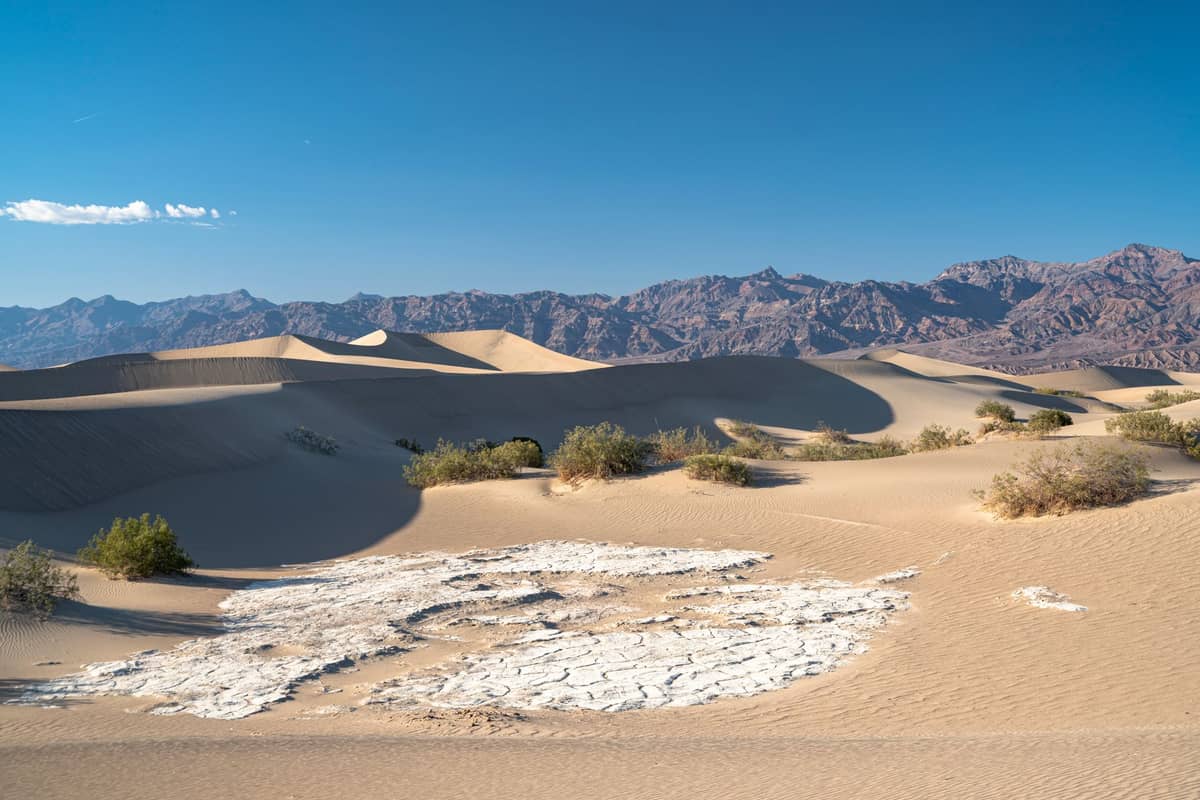
Located near Stovepipe Wells, these dunes reach up to 100 feet high and are the most accessible dune field in the park. They are most photogenic at first light, when the raking sun carves sharp shadows along the ridgelines and footprints from the previous day's visitors have been smoothed over by overnight winds. The soft sand makes walking harder than it looks. Wear closed shoes, not sandals.
Zabriskie Point
Zabriskie Point is a short walk from a parking area and delivers a panoramic view over badlands eroded from ancient lake bed sediments. The layered browns, golds, and ochres shift dramatically with the angle of the sun. Sunrise here is particularly compelling: the sky lightens behind you while the formations glow from the west. It is also one of the most visited spots in the park, so early arrival is not optional if you want the space to yourself.
Artist's Drive and Artist's Palette
This 9-mile one-way scenic loop through the Black Mountains is best driven in the late afternoon, when the light intensifies the mineral colors in the hillsides: pinks, greens, yellows, and purples from oxidized metals in the volcanic rock. The road is narrow and unsuitable for large RVs. The Artist's Palette viewpoint about halfway through the loop is where most visitors stop, but continuing to the end reveals more varied terrain.
Furnace Creek Visitor Center
The Furnace Creek Visitor Center is the logical first stop for any visitor. Staff here provide current road conditions, trail closures, and safety briefings. The exhibits on geology, ecology, and the area's history as a borax mining center are genuinely informative, not just obligatory. Seasonal opening hours vary, so check nps.gov before arrival.
When to Go: A Frank Assessment
The timing of a Death Valley visit is not a minor logistical detail. It is the single most important decision you will make.
October through April is when most travelers should go. Spring (February to April) brings the best light, moderate temperatures, and in some years a wildflower bloom across the valley floor that can be spectacular if winter rains have been sufficient. November through January sees cool, clear days suitable for long hikes, though nights can drop near freezing in the higher elevations.
Summer visits are not recommended for most travelers. Daytime air temperatures routinely exceed 120°F (49°C). The National Park Service explicitly warns that hiking outside of early morning or late evening hours in summer months can be fatal. This is not hyperbole. People die in Death Valley from heat-related illness every year. If you visit between June and September, limit outdoor exposure to before 10 a.m. and after 5 p.m., and treat any signs of heat exhaustion immediately.
For context on how Death Valley's timing fits into a broader Las Vegas trip, see the best time to visit Las Vegas guide, which covers both the city and surrounding desert conditions by month.
⚠️ What to skip
Summer heat in Death Valley is a medical emergency risk, not just discomfort. The NPS records multiple heat-related deaths annually. Do not underestimate the danger, particularly between June and September.
Photography and Sensory Details
Death Valley is extraordinary for photography, but it punishes unprepared gear and photographers. Heat can damage camera electronics and batteries; keep equipment shaded and avoid leaving cameras in parked cars. At Badwater Basin, the reflective salt surface acts like a giant reflector, blowing out highlights on a clear day if you are not careful with exposure. Polarizing filters are genuinely useful here.
The smells of the park are subtle but memorable. The dry air carries almost no scent until you reach the rare spring or seep, where the presence of water registers as a faint, almost vegetative coolness. At dusk, when the rocks begin releasing the day's stored heat, there is a faintly mineral quality to the air. At Mesquite Flat, if the wind picks up, fine sand is visible as a low haze across the dune surface, audible as a soft sibilant hiss.
Night skies at Death Valley are among the darkest in the continental United States. The park is designated an International Dark Sky Park, and the Milky Way is visible to the naked eye on moonless nights. If an overnight stay is possible, the stargazing alone justifies it.
Practical Walkthrough: Planning Your Day
Leave Las Vegas no later than 6 a.m. for a full day visit. Arriving at Furnace Creek by 8 a.m. gives you time to cover Zabriskie Point at good light, walk Badwater Basin before midday heat peaks, and drive Artist's Drive in the early afternoon before crowds peak on the return side.
Wear light-colored, loose-fitting clothing. Sun protection is non-negotiable: wide-brimmed hat, sunscreen with SPF 50 or higher, and UV-protective eyewear. The park's UV index is exceptionally high due to the low elevation and minimal air filtration. Closed shoes with socks are better than sandals on any trail or the dunes.
Food and water inside the park are available at Furnace Creek, but limited and expensive. Pack a full cooler from Las Vegas. Plan for at least one liter of water per person per hour of outdoor activity, more in summer. Start your return drive no later than 4 p.m. to avoid fatigue driving back into Las Vegas during the evening rush.
If this is your first time planning a major day trip from Las Vegas, the broader Las Vegas attractions guide can help you prioritize between the park and other nearby options like Valley of Fire State Park, which is closer to the city and more manageable in warmer months.
Who Should Skip Death Valley
Death Valley is not the right choice for every traveler. If you are visiting Las Vegas in July or August and do not want to limit outdoor activity to the early morning hours, consider a different day trip. The park offers almost no shade, and the heat at midday is brutal enough to make even casual sightseeing from a parking lot unpleasant.
Visitors with significant mobility limitations should be aware that many of the most dramatic landscapes require walking on uneven, soft, or rocky terrain. The NPS accessibility page details which facilities and overlooks are accessible, and some, like Zabriskie Point, have reasonable paved access to viewpoints. But the overall park infrastructure is sparse, and the distances between sites are long.
Families with young children can visit successfully in cooler months, but summer trips with children are genuinely dangerous and should not be attempted without extreme caution and planning. The park is a wilderness environment. Services are minimal. Emergency response times are long.
Insider Tips
- Park your car at Zabriskie Point the night before sunrise if you are staying at Furnace Creek Ranch. Arriving before first light means you watch the sky change color for 20 minutes before the first tour vans pull in.
- The drive into the park on CA-190 includes a long descent toward Furnace Creek with a dramatic reveal of the valley floor. Pull over at the signed overlook near Hell's Gate for a photograph that most visitors miss entirely.
- If you have an America the Beautiful annual interagency pass (available from the NPS for USD $80), it covers Death Valley's entrance fee and is worth buying if you plan to visit two or more national parks in a year.
- Stovepipe Wells Village, about 25 miles from Furnace Creek, is a less-visited base with a small store, restaurant, and campground. It also puts you closer to the Mesquite Flat dunes for early morning walks before the heat builds.
- Cell coverage is effectively zero through most of the park. Download an offline map through Google Maps or maps.me before leaving Las Vegas, and tell someone your intended itinerary before you go.
Who Is Death Valley National Park For?
- Photographers who want stark, otherworldly landscapes and extreme light conditions
- Geology and natural history enthusiasts drawn to volcanic formations, ancient salt flats, and eroded badlands
- Hikers and outdoor travelers visiting between October and April who want genuine desert wilderness
- Night sky observers: Death Valley is one of the premier dark sky destinations in the continental US
- Travelers who want a one-of-a-kind day trip that is completely unlike any other destination near Las Vegas
Nearby Attractions
Combine your visit with:
- Antelope Canyon
Antelope Canyon is a series of sculpted slot canyons carved into Navajo Sandstone near Page, Arizona, and one of the most visually striking natural formations in the American Southwest. Accessible only on guided tours led by licensed Navajo guides, it requires advance planning but rewards visitors with an experience unlike anywhere else within day-trip range of Las Vegas.
- Area 51 & Extraterrestrial Highway
Nevada State Route 375, officially designated the Extraterrestrial Highway in 1996, is a 98-mile desert drive skirting the perimeter of the most famous restricted military installation on Earth. It costs nothing to drive, demands serious preparation, and delivers a genuinely remote American landscape that few Strip visitors ever see.
- AREA15 Immersive Entertainment Complex
AREA15 is a 35-acre immersive entertainment and events district just off the Las Vegas Strip, packed with art installations, bizarre interactive experiences, bars, and ticketed attractions like Omega Mart. Daytime entry is free, but the real substance costs extra — and it's worth understanding the pass tiers before you arrive.
- Fire Wave Trail
Fire Wave Trail leads hikers across open desert to a swirling formation of red, pink, and white Aztec Sandstone bands inside Valley of Fire State Park. At roughly 1.5 miles round trip, the hike itself is short, but the landscape it crosses is severe and spectacular. Located about 50 miles northeast of Las Vegas, this is one of the most visually arresting short hikes within reach of the city.