Red Rock Canyon Scenic Drive: What to Expect on the 13-Mile Loop
The Red Rock Canyon Scenic Drive is a 13-mile one-way road through one of the Mojave Desert's most geologically dramatic landscapes, located about 17 miles west of Las Vegas. From cream-colored limestone cliffs to rust-red sandstone formations, it delivers a complete change of scene from the Strip — and requires almost no hiking to appreciate.
Quick Facts
- Location
- 1000 Scenic Loop Drive, Las Vegas, NV 89161 (Red Rock Canyon NCA)
- Getting There
- Private vehicle via SR-159 west of Las Vegas; no public transit serves the Scenic Drive loop itself
- Time Needed
- 1.5–3 hours for the drive alone; half day with stops or hikes
- Cost
- $20 per vehicle / $10 motorcycle / $8 bicycle / $5 pedestrian (2026 rates) plus $2 timed-entry reservation fee Oct 1–May 31, 8am–5pm
- Best for
- Road trippers, geology enthusiasts, photographers, families, early risers
- Official website
- www.blm.gov/nevada/red-rock-canyon-nca
What the Scenic Drive Actually Is
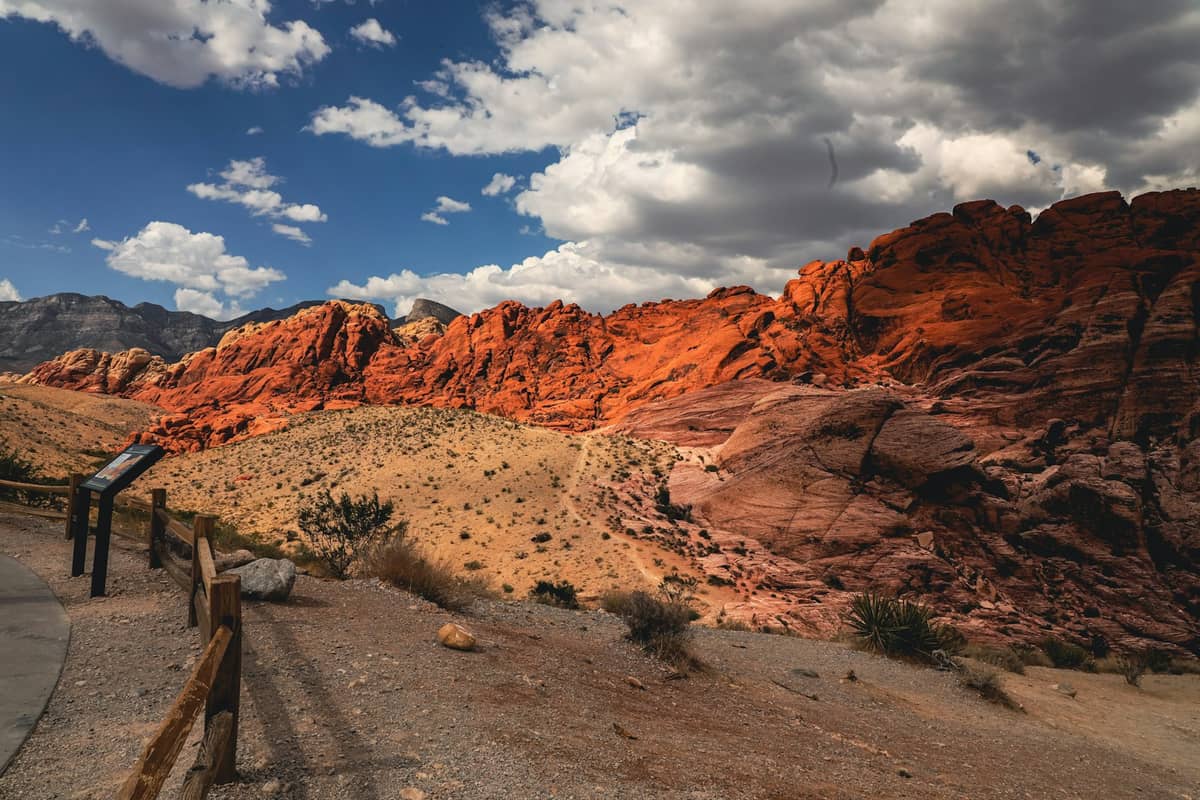
The Red Rock Canyon Scenic Drive — commonly referred to as the 13-Mile Scenic Drive by the Bureau of Land Management — is a paved, one-way loop road through Red Rock Canyon National Conservation Area. It begins near the Visitor Center and curves through desert terrain at the base of the Keystone Thrust fault, one of the most accessible examples of large-scale tectonic collision in the American Southwest. The road is open to private vehicles, motorcycles, and cyclists, and features more than a dozen named pullouts and trailheads along its length.
This is not a passive scenic highway where you stay in your car the whole time. Most visitors stop at three to five pullouts, walk short interpretive trails, or begin longer hikes directly from roadside parking areas. The drive itself takes around 45 minutes if you move without stopping, but that misses the point entirely. Budget at least 90 minutes for a minimal experience, and closer to three hours if you want to stretch your legs.
ℹ️ Good to know
Timed-entry reservations are required for entry between October 1 and May 31, from 8:00 a.m. to 5:00 p.m. Book in advance at Recreation.gov. Without a reservation, you risk turning back at the gate during peak season.
The Geology: Why These Colors Exist
The canyon's signature palette — rust-red and orange sandstone layered against pale grey-white limestone — is the result of two completely different geological processes colliding in slow motion. The grey Keystone limestone is older (Paleozoic, hundreds of millions of years old) and was thrust westward over younger red Aztec sandstone during a tectonic event around 65 million years ago. Younger rock sitting on top of older rock is geologically unusual, and the Keystone Thrust fault line is one of the clearest exposures of this phenomenon anywhere in North America.
The red and orange tones come from iron oxide in the Aztec sandstone — essentially desert rust, baked into the rock over millions of years. On overcast mornings, the colors appear muted and layered. In direct afternoon sun, the red formations almost glow. This is not an exaggeration: the warm light of late afternoon bounces off the sandstone faces in a way that changes the entire mood of the canyon, which is one reason photographers specifically plan afternoon visits to certain pullouts.
Tickets & tours
Hand-picked options from our booking partner. Prices are indicative; availability and final rates are confirmed when you complete your booking.
Hoover Dam and Red Rock Canyon Self-Guided Driving Audio Tour
From 21 €Instant confirmationFree cancellationRed Rock Canyon Self-Guided Driving Audio Tour
From 13 €Instant confirmationFree cancellationSelf-guided e-bike tour of Red Rock Canyon
From 86 €Instant confirmationFree cancellationRed Rock Canyon classic tour
From 97 €Instant confirmationFree cancellation
The Drive: Pullout by Pullout
The road begins just west of the Visitor Center, where you can pick up a printed map and watch a 17-minute interpretive film that provides useful geological context. The early section of the drive moves through open desert scrub — creosote, blackbrush, Joshua trees at higher elevations — with the Calico Hills appearing to the northeast as you curve around the loop. These hills are the most photographed section of the park: layered bands of red, orange, and cream sandstone stacked at dramatic angles.
Several of the most popular pullouts are spaced along the first half of the loop. Calico Hills Overlook gives a wide panoramic perspective. The Sandstone Quarry area — historically used as a building material source in the late 19th and early 20th centuries — has a short, flat walk across exposed rock. High Point Overlook, near the loop's apex, offers the broadest view of the canyon interior. If you want a more committed hike from the road, the trailhead for Calico Hills is accessible directly from the drive.
The second half of the loop descends back toward the exit through quieter terrain with fewer stops. The crowds thin noticeably past the High Point Overlook. If you are trying to avoid congestion at pullouts, the back half of the drive rewards patience with more solitude and open desert views.
Best Time to Go: Hour by Hour
Opening time for the Scenic Drive is 6:00 a.m. year-round (with closing hours varying seasonally), and arriving in the first hour is the single most effective strategy for a better experience. Before 8:00 a.m., the parking areas at Calico Hills are mostly empty, the light is soft and directional from the east, and the temperature is genuinely comfortable even in summer. Desert birds are active at this hour — canyon wrens, phainopeplas, cactus wrens — and the silence at the pullouts is something you will not find at midday.
By 10:00 a.m. on weekends, parking at popular pullouts can fill completely. The timed-entry reservation system (required October through May) manages the volume of vehicles entering the park, but it does not prevent individual pullouts from getting crowded once everyone is inside. Weekday visits at any hour are noticeably calmer than weekends.
Summer visits require real planning. Daytime temperatures in the canyon regularly exceed 100°F (38°C) from June through August. If you go in summer, arrive at opening, carry significantly more water than you think you need, and plan to exit before 10:00 a.m. The drive itself is fine from a car, but short walks on exposed rock become genuinely dangerous by late morning. October through April offers the most comfortable conditions and the richest photographic light.
⚠️ What to skip
The Scenic Drive closes for flash floods and snowstorms without advance notice. In summer (monsoon season, roughly July–September), check the BLM's Red Rock Canyon social channels or call ahead before making the drive. Closures can happen suddenly.
Getting There: No Public Transit Option
The park is located approximately 17 miles west of the Las Vegas Strip via SR-159 (West Charleston Boulevard). A car is required. There is no bus or scheduled public transit that serves the Scenic Drive loop itself. Driving time from the Strip is typically 25 to 35 minutes under normal traffic conditions, though weekend mornings can see congestion on SR-159 approaching the park entrance.
Cyclists can access the park on the Scenic Drive for $8. The loop itself is one-way, which helps with vehicle-bicycle interaction, but the road has no dedicated bike lane and motor traffic can be heavy in mid-morning. Serious cyclists often start from the town of Blue Diamond or use the wider road shoulder on SR-159 as a warm-up before entering the loop.
If you are planning a broader day out of the city, the canyon makes a natural pairing with a stop at Calico Hills or as part of a wider look at Mount Charleston, which sits roughly 30 miles to the north and offers a completely different high-elevation desert ecosystem.
Photography: What Works and What Does Not
The canyon photographs best in three specific conditions: early morning with soft directional light from the east, late afternoon (about 60–90 minutes before sunset) when the sandstone catches warm raking light, and overcast days when the colors saturate without harsh shadows. Midday sun bleaches the red formations and creates flat, contrasty images — it is the worst possible light for this landscape, and most social media photos taken at noon look disappointing compared to the real-life view.
The Calico Hills pullout offers the classic wide-angle composition with layered formations in the middle distance. For telephoto work, the High Point Overlook gives cleaner sightlines into the canyon's deeper rock faces. If you have a drone, note that UAV use in the National Conservation Area requires advance authorization from the BLM and is not freely permitted at the roadside pullouts.
Accessibility and Visitor Center
The Visitor Center near the drive entrance is wheelchair accessible and includes a gift shop, outdoor exhibits, restrooms, and the 17-minute film about the canyon's geology and ecology. The Visitor Center is open daily from 8:00 a.m. to 4:30 p.m. The film is genuinely useful context for first-time visitors and takes less than 20 minutes. Several of the roadside pullouts have paved or compacted-gravel surfaces suitable for wheelchairs, though the terrain on informal trails varies significantly.
Red Rock Canyon sits within easy range of other natural areas worth considering on a longer desert trip. Valley of Fire State Park is about an hour northeast and offers similarly dramatic sandstone geology in a less crowded setting. Further afield, hiking near Las Vegas covers the broader range of options across the region.
Who This Is Not For
If you are expecting a dramatic canyon experience similar to the Grand Canyon or Zion, Red Rock will feel different in scale: it is a wide desert basin with striking rock formations on its edges rather than a deep gorge you descend into. The views are horizontal and expansive, not vertical and overwhelming. That is its character, not a flaw, but travelers hoping for something towering or immersive in the classic Southwest canyon sense may feel underwhelmed.
Visitors who are not driving and are relying entirely on ride-hailing will face a practical problem: Uber and Lyft drivers typically do not wait at trailheads inside the park, and the loop road is one-way with no drop-off point that allows easy pickup later. Without a car, a guided tour is the only realistic option for seeing the Scenic Drive.
Insider Tips
- Book your timed-entry reservation on Recreation.gov the moment your travel dates are confirmed — slots for weekend mornings in spring and fall sell out weeks in advance, not days.
- The America the Beautiful Annual Pass ($80) covers admission to Red Rock Canyon and pays for itself after four visits to any federal recreation site. If you plan any other national park stops on your trip, buy it before entering.
- The back half of the Scenic Drive loop (past High Point Overlook) sees dramatically fewer parked cars than the Calico Hills section. If pullout congestion is frustrating you, continue driving and you will typically find open parking within a mile.
- Bring at least two liters of water per person even for a drive-only visit. Even short walks on exposed sandstone in warm months dehydrate you faster than expected, and there are no water refill stations on the loop itself.
- The Visitor Center opens at 8:00 a.m. and closes at 4:30 p.m., after the drive opens at 6:00 a.m. If you arrive at the gate at opening time, you can start the loop before the center opens — pick up a paper map from the fee station or download the BLM's digital map beforehand.
Who Is Red Rock Canyon Scenic Drive For?
- Road trippers who want a meaningful natural break from the Strip without a full hiking commitment
- Photography enthusiasts, especially those willing to arrive before 8:00 a.m. or return near sunset
- Families with young children who need manageable short walks rather than strenuous trails
- Geology or natural history enthusiasts interested in tectonic fault structures
- Travelers building a day-trip itinerary that includes a mix of desert landscapes outside the city
Nearby Attractions
Other things to see while in Red Rock Canyon Area:
- Calico Hills
Calico Hills is a stretch of dramatically banded red and cream sandstone formations along the Scenic Loop Drive in Red Rock Canyon National Conservation Area. Accessible by car, foot, or bike, it offers some of the most photogenic desert scenery within striking distance of Las Vegas, with trails ranging from easy wanders to rocky scrambles.
- Ice Box Canyon Trail
Ice Box Canyon Trail delivers one of the most rewarding short hikes in Red Rock Canyon National Conservation Area, combining a well-marked desert path with boulder scrambling, cool canyon shade, and a seasonal waterfall. At roughly 2.5 to 3 miles round trip, it delivers a lot of scenery for a short hike for scenery and adventure.
- Pine Creek Canyon Trail
Pine Creek Canyon Trail cuts into one of Red Rock Canyon's most visually dramatic corridors, delivering towering Aztec sandstone walls, a seasonal creek lined with cottonwoods, and remnants of a historic homestead, all within a manageable 2-mile round trip. Located inside the Red Rock Canyon National Conservation Area about 17 miles west of the Las Vegas Strip, it rewards hikers of most fitness levels with outsized scenery relative to the effort involved.