Pine Creek Canyon Trail: Red Rock's Most Rewarding Short Hike
Pine Creek Canyon Trail cuts into one of Red Rock Canyon's most visually dramatic corridors, delivering towering Aztec sandstone walls, a seasonal creek lined with cottonwoods, and remnants of a historic homestead, all within a manageable 2-mile round trip. Located inside the Red Rock Canyon National Conservation Area about 17 miles west of the Las Vegas Strip, it rewards hikers of most fitness levels with outsized scenery relative to the effort involved.
Quick Facts
- Location
- Red Rock Canyon NCA, Scenic Loop near mile marker 11, Nevada
- Getting There
- Drive west on W Charleston Blvd (NV-159); trailhead roughly 10–11 miles past the fee booth. No direct public transit to trailhead.
- Time Needed
- 1.5 to 3 hours depending on route and pace
- Cost
- Included with Red Rock Canyon entry: $20/vehicle, $10/motorcycle, $8/bicycle, $5/walk-in
- Best for
- Nature lovers, photographers, families with older kids, beginner to moderate hikers
What Pine Creek Canyon Actually Is
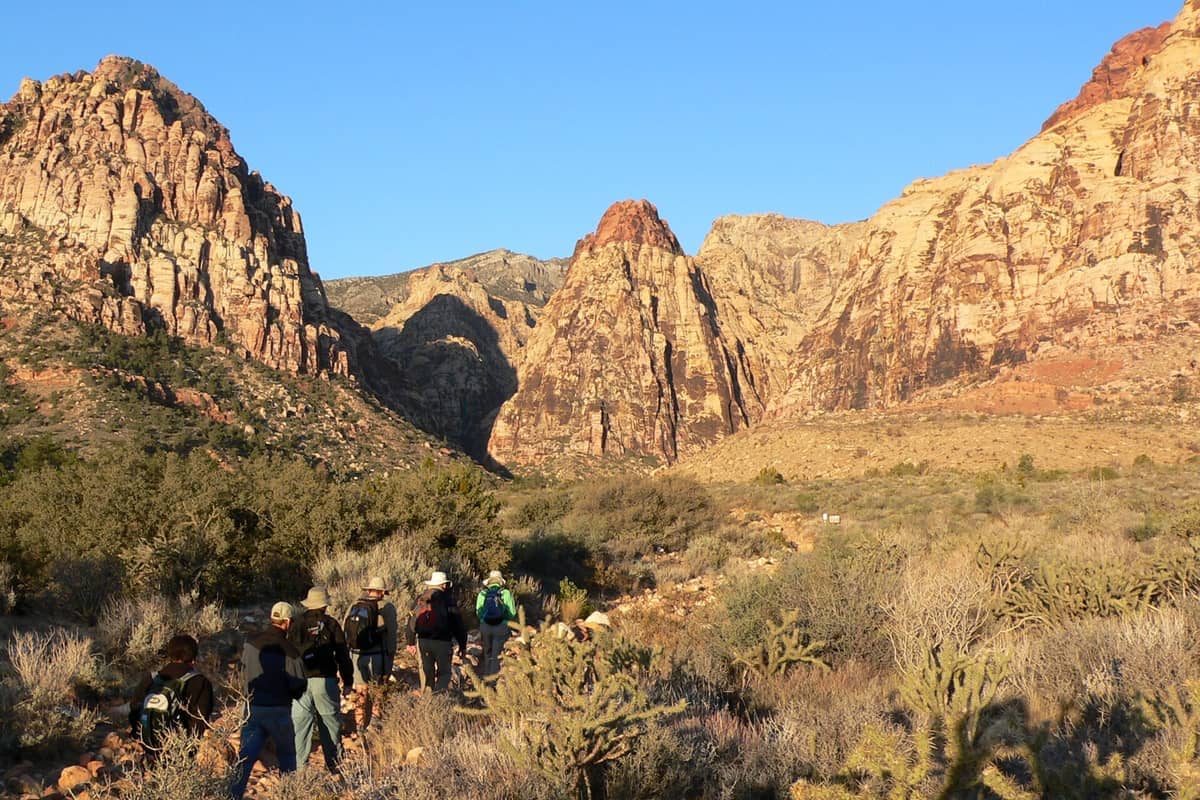
Pine Creek Canyon Trail is a Bureau of Land Management (BLM) managed hiking route inside Red Rock Canyon National Conservation Area, roughly 15 miles west of Las Vegas. The trail descends gently from the trailhead parking area into a canyon corridor framed by some of the tallest Aztec sandstone formations in the park. The rock here cycles through deep reds, burnt oranges, and pale cream tones depending on light angle and time of day, making it one of the most photogenic hikes in the region without requiring serious backcountry effort.
The BLM trail sheet lists the route as 2 miles round trip with approximately 300 feet of elevation gain. A separate loop option (the Fire Ecology Loop) adds roughly 0.8 miles and circles through an area recovering from an older wildfire, offering a different ecological perspective. Most visitors combine sections to create a walk between 2 and just over 3 miles total, which feels about right for the terrain.
ℹ️ Good to know
No water is available at the trailhead or along the trail. Two vault toilets are provided at the parking area. Bring more water than you think you need, especially between May and October.
The Trail Experience: What You Will See and Feel
From the parking area, the trail drops gradually across open desert scrub before the canyon walls begin to close in. The air shifts noticeably cooler once you are inside the canyon, and the smell of sage and desert dust gives way to something faintly earthy and green near the wash. In late winter and spring, a seasonal creek flows through the canyon bottom, fed by snowmelt from the Spring Mountains above. When it is running, the sound of moving water in a dry desert setting is genuinely striking.
Ponderosa pines, which give the canyon its name, grow at the upper reaches and contribute real shade in the middle section of the trail. Alongside them, Fremont cottonwoods line the creek bed, turning brilliant gold in October and early November. That autumn color window is one of the more unusual sights available near Las Vegas and draws photographers who time their visits carefully.
About halfway along the main trail, you pass the foundation remains of the Wilson homestead, a late‑1920s ranch that operated briefly before the land was incorporated into public ownership. The stone chimney and scattered concrete pads are still visible and add a layer of human history to what is otherwise a purely geological experience. Informational signs explain the site's context.
The canyon walls themselves reach several hundred feet above the wash in places, and the Aztec sandstone shows cross-bedding patterns that record ancient dune fields from roughly 180 million years ago. For geological context and comparison, the Calico Hills area at the park's entrance offers a closer look at the same formations at lower elevation and with easier access.
Tickets & tours
Hand-picked options from our booking partner. Prices are indicative; availability and final rates are confirmed when you complete your booking.
Go City | Las Vegas All-Inclusive Pass
From 140 €Instant confirmationFree cancellationGolden Eagle West Rim helicopter tour with Hoover Dam and Lake Mead
From 401 €Instant confirmationFree cancellationGrand Canyon 6-in-1 tour
From 417 €Instant confirmationFree cancellationHighlights Over the Grand Canyon air tour from Las Vegas
From 195 €Instant confirmationFree cancellation
How the Experience Changes by Time of Day
Early morning arrivals, ideally before 8:00 AM, get the canyon almost entirely to themselves. The eastern walls catch the first light at a low angle, which intensifies the red and orange tones of the sandstone to their most saturated. Temperatures are significantly cooler, shadows are long, and wildlife activity peaks: you are more likely to see mule deer, coyotes, and various lizard species in the first two hours after sunrise.
By mid-morning on weekends, the trailhead parking lot fills quickly, especially during peak season (October through April). The trail itself is wide enough in most sections to handle moderate foot traffic without feeling crowded, but the canyon walls funnel sound, and the solitary quality disappears. Midday visits in summer are genuinely uncomfortable: temperatures inside the canyon can exceed 100°F (38°C), and the exposed approach section offers no shade at all.
Late afternoon light, around 4:00 to 5:30 PM, produces softer, warmer tones on the western-facing walls and is arguably the best window for photography. The crowds have usually thinned by then, but check the seasonal gate closure times before planning a late visit. From November through February, the park closes at 5:00 PM, which leaves limited margin for a late-afternoon hike.
Getting There and Park Logistics
The Pine Creek Canyon trailhead sits inside the Red Rock Canyon Scenic Loop, roughly 10–11 miles past the fee booth and just before mile marker 11. The Scenic Loop itself is one-way, so there is no option to backtrack by car. If you miss the trailhead entrance, you will need to complete the full 13-mile loop before returning. The parking area is dedicated and reasonably sized, but it reaches capacity early on weekend mornings during spring and fall.
There is no direct public transit to the trailhead. From Las Vegas, the standard approach is to drive west on West Charleston Boulevard, which becomes Nevada State Route 159. The entrance to Red Rock Canyon NCA is clearly signed. For a broader orientation to driving and getting around the region, the guide to getting around Las Vegas covers rental car logistics and ride-hailing options that can get you to the park entrance, though the final stretch to the trailhead requires a personal or rental vehicle.
The entry fee covers access to the entire NCA for the day, so combining Pine Creek with another stop on the Scenic Loop, such as the Calico Hills overlook or the Ice Box Canyon trailhead, makes strong logistical sense.
💡 Local tip
Arrive before 7:30 AM on weekends between October and April to secure trailhead parking. The lot fills before 9:00 AM on popular days. Weekday visits in the same season offer a noticeably more relaxed experience.
Seasonal Considerations and Weather
Spring (March through May) brings the most rewarding conditions: moderate temperatures, the highest likelihood of the creek running, and occasional wildflower blooms on the canyon floor. Fall (mid-September through November) is the other prime window, offering the cottonwood color change and cooling temperatures after summer.
Summer hiking is not recommended unless you start before 7:00 AM and exit before 10:00 AM. The desert floor heats rapidly, and Pine Creek Canyon offers limited shade on the approach section. Heat-related illness is a documented risk in Red Rock Canyon during summer months and should not be underestimated.
Winter visits are often underrated. When the Spring Mountains receive snow, the contrast between white peaks and red sandstone walls is exceptional. Temperatures are mild during daylight hours, crowds are minimal, and the shorter gate hours (closing at 5:00 PM from November through February) are manageable if you plan accordingly. Be aware that brief rain events can make the wash slippery and occasionally cause flash flood conditions, though these are rare and usually forewarned by visible upstream clouds.
For a broader look at how season affects outdoor activity across the Las Vegas region, the best time to visit Las Vegas guide covers the full year in detail.
What to Wear and Bring
Trail shoes or light hiking boots are adequate for most of the route. The path crosses the wash several times, and while it is usually dry or easily stepped over, the rocky surface is uneven. Sandals or flat-soled shoes become genuinely uncomfortable on the boulder sections near the canyon's interior. Trekking poles are not necessary but useful for older hikers on the return uphill stretch.
- Water: minimum 2 liters per person; more in summer or if extending the route
- Sunscreen and a hat: the approach section is fully exposed
- Layers: canyon temperatures drop noticeably in winter and shade sections
- Snacks: there are no facilities of any kind beyond vault toilets at the trailhead
- A charged phone with an offline map: cell coverage inside the canyon is unreliable
Photography Notes
The canyon's orientation means the interior walls are best lit in early morning from the east-facing perspectives and late afternoon from the west. Midday light is flat and harsh, washing out the color gradients in the sandstone. The cottonwood grove near the creek bed is the most consistently photogenic spot at almost any hour, particularly in October when the leaves are yellow.
For comparison with other viewpoint-focused hikes nearby, the Ice Box Canyon Trail offers tighter walls and a waterfall (seasonally) that creates a very different photographic subject within the same park.
Who This Trail Is Not For
Visitors expecting a maintained, paved, or clearly marked path throughout will find sections of Pine Creek Canyon rough and less structured than popular urban trails. The wash crossings and boulder areas are minor but real obstacles for anyone with significant mobility limitations. The trail is not wheelchair accessible, and the terrain is too uneven for strollers beyond the first quarter mile.
Travelers who are primarily interested in Las Vegas for its casinos, shows, and nightlife may find the 30-minute drive and the physical requirements of the hike not worth the effort relative to other day options. That said, Pine Creek is one of the easier canyon hikes in Red Rock Canyon, and visitors who make the effort almost universally find it a worthwhile contrast to the Strip environment.
Insider Tips
- The trailhead parking lot has a second, overflow section to the right as you enter. On busy mornings, most drivers miss it and leave assuming the lot is full. Check the overflow area before giving up.
- The seasonal creek usually runs from late February through April depending on snowpack in the Spring Mountains. Checking recent trail reports on AllTrails or the BLM Red Rock Canyon social media pages within a week of your visit will tell you whether water is flowing.
- Combining Pine Creek Canyon with the Red Rock Canyon Scenic Drive as a full half-day loop is the most efficient use of your entry fee. Plan Pine Creek as your first stop before the lot fills, then drive the rest of the loop afterward.
- The Wilson homestead ruins are about 0.9 miles in. Even if you do not want to complete the full trail, walking to the homestead and back gives a strong sense of the canyon's character in under 90 minutes.
- In October and early November, arrive at the cottonwood grove around 9:00 to 10:00 AM when the angle of light reaches the canyon floor. The gold leaves against red sandstone is one of the more genuinely striking color contrasts available within day-trip range of Las Vegas.
Who Is Pine Creek Canyon Trail For?
- Hikers looking for rewarding scenery with moderate physical commitment
- Photographers targeting desert landscapes, geological formations, or autumn foliage
- Las Vegas visitors wanting a half-day nature break from the Strip
- Families with children aged 8 and up who are comfortable on uneven terrain
- Geology and natural history enthusiasts interested in Jurassic-era sandstone formations
Nearby Attractions
Other things to see while in Red Rock Canyon Area:
- Calico Hills
Calico Hills is a stretch of dramatically banded red and cream sandstone formations along the Scenic Loop Drive in Red Rock Canyon National Conservation Area. Accessible by car, foot, or bike, it offers some of the most photogenic desert scenery within striking distance of Las Vegas, with trails ranging from easy wanders to rocky scrambles.
- Ice Box Canyon Trail
Ice Box Canyon Trail delivers one of the most rewarding short hikes in Red Rock Canyon National Conservation Area, combining a well-marked desert path with boulder scrambling, cool canyon shade, and a seasonal waterfall. At roughly 2.5 to 3 miles round trip, it delivers a lot of scenery for a short hike for scenery and adventure.
- Red Rock Canyon Scenic Drive
The Red Rock Canyon Scenic Drive is a 13-mile one-way road through one of the Mojave Desert's most geologically dramatic landscapes, located about 17 miles west of Las Vegas. From cream-colored limestone cliffs to rust-red sandstone formations, it delivers a complete change of scene from the Strip — and requires almost no hiking to appreciate.