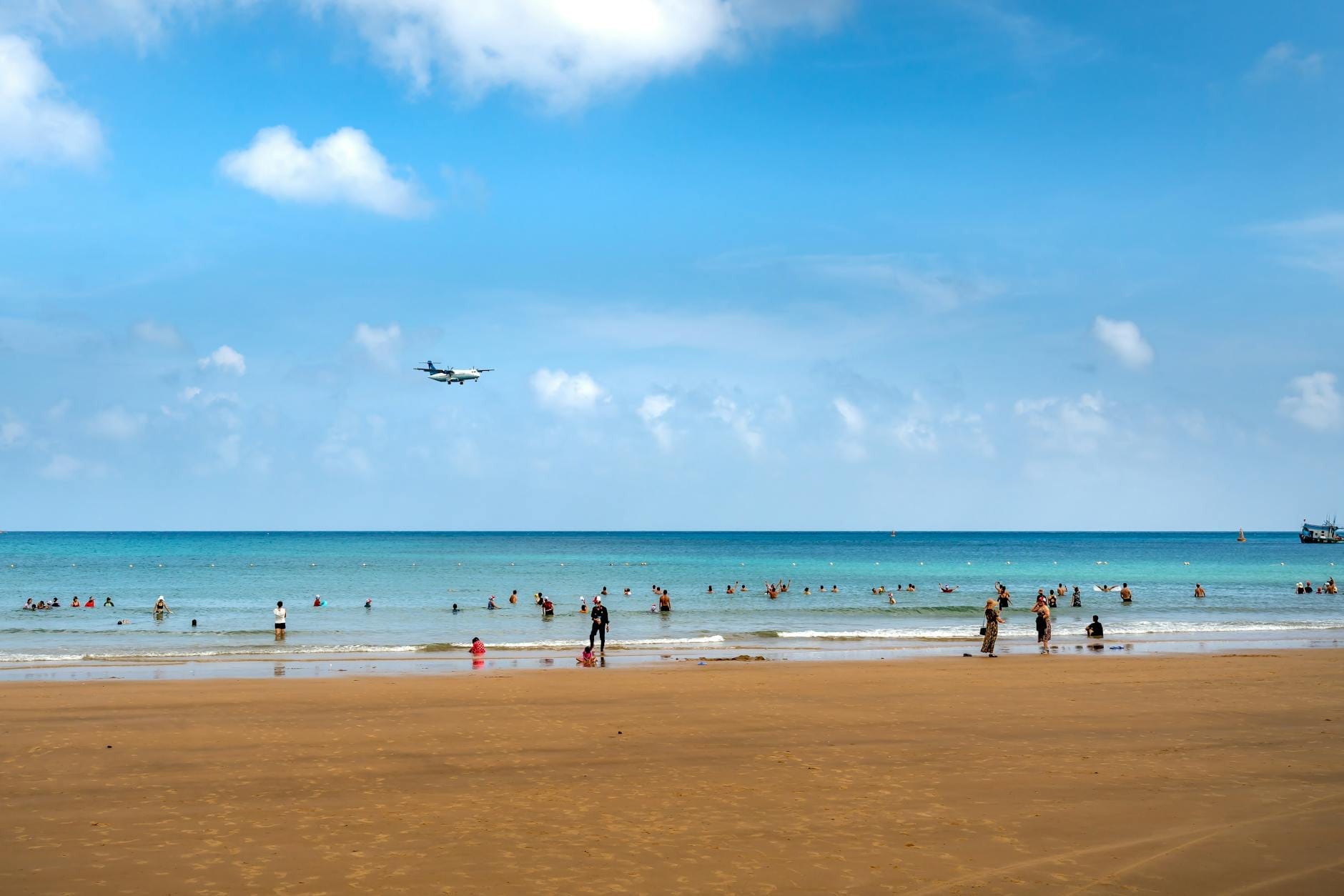
Mai Khao and the northern tip of Phuket offer a completely different experience from the resort-heavy south. The island's longest beach stretches through Sirinat National Park, where sea turtles nest, planes skim low overhead, and the pace of life slows to almost nothing.
Mai Khao is where Phuket runs out of road and the crowds fall away. Stretching 11 kilometers along the northwestern coast within Sirinat National Park, this is the island's longest beach and its least developed, a place where the main entertainment is watching wide-body jets descend toward the adjacent international airport and scanning the waterline for nesting sea turtles at dusk.
Orientation: Where North Phuket Begins
Mai Khao sits at the northern apex of Phuket island, roughly 35 kilometers from Phuket Town and around 41 kilometers from Patong. Geographically, it is the last significant area before the Sarasin Bridge connects the island to Phang Nga Province on the Thai mainland. Phuket International Airport (HKT) occupies the land just inland, making this the first and last patch of Phuket that most visitors fly over without realizing its beach lies directly below.
The beach itself is contained within Sirinat National Park, which also covers the nearby Nai Yang and Nai Thon beaches to the south. This protected status is the single biggest reason Mai Khao looks the way it does: no beachfront development, no row of sunbeds and umbrellas, no jet ski operations. The park boundary runs parallel to the coast, and the forest behind the beach remains intact.
To the south, the northern beach zone transitions gradually through Bang Tao and Surin toward the more developed mid-island stretch. If you want to understand how the whole northern coast fits together, the guide to Kamala, Surin, and Bang Tao covers the areas immediately south of Mai Khao. Taken together, this entire northern corridor is the quieter, greener alternative to the southern resort belt.
Character & Atmosphere
Early morning in Mai Khao feels almost disorienting if you've arrived from Patong the night before. By 6:30 a.m., the beach is already warm and the light hits the sand at a low angle, turning it golden. You'll share the shoreline with a handful of resort guests doing yoga or jogging, a few local fishermen checking lines, and almost no one else. The sound is mostly wind and surf, punctuated every ten to fifteen minutes by the low roar of a descending aircraft.
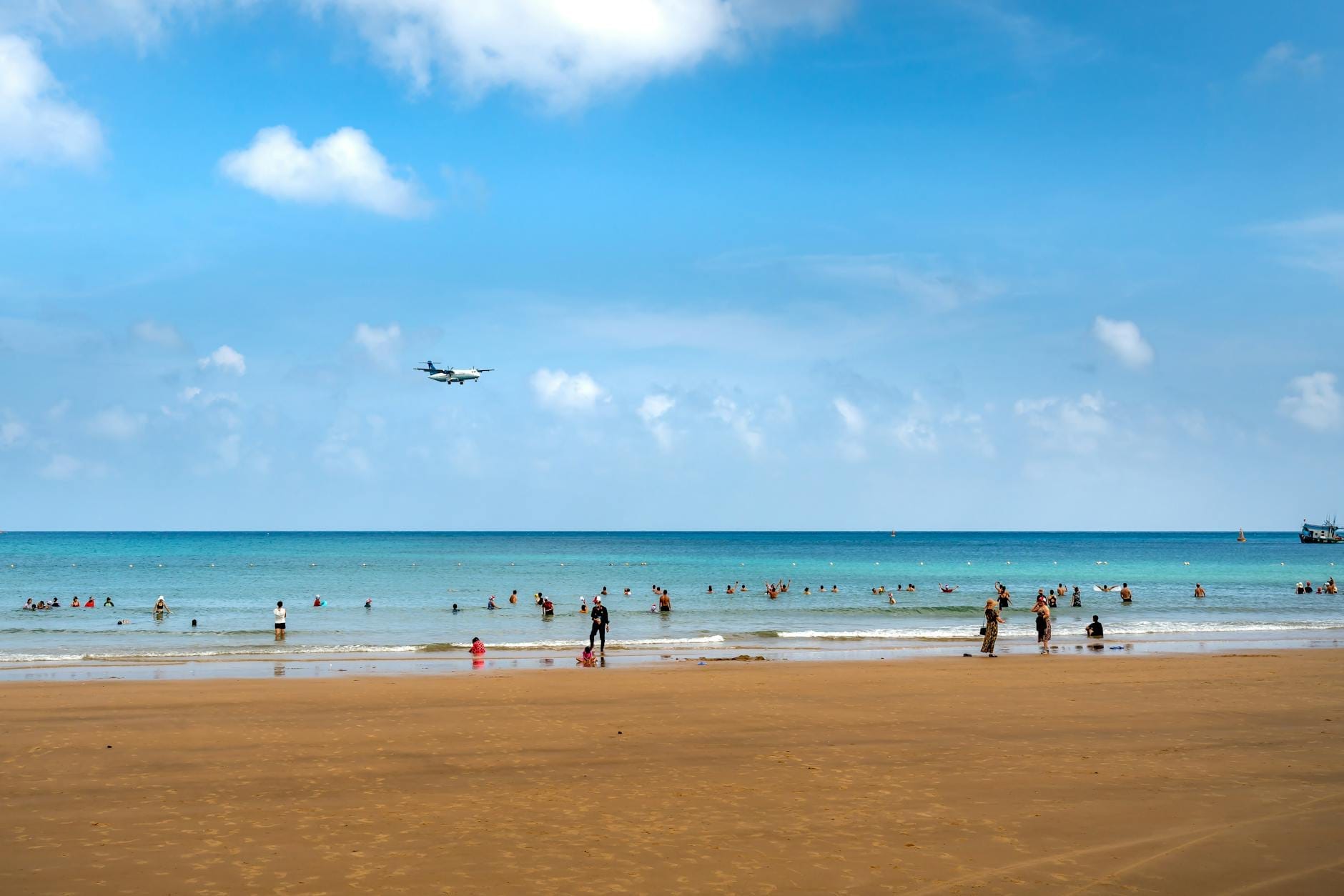
That plane-spotting detail is not incidental. Phuket Airport's runway orientation sends incoming flights directly over the northern beach, and they come in low enough to make out airline livery clearly. The 'flight viewing area' near the beach road has become a quiet local ritual, especially in the late afternoon when inbound traffic peaks. Families set up plastic chairs and watch the aircraft like others might watch a sunset.
By midday, the beach is warm and largely empty. The shoreline looks more wild here than anywhere else on Phuket: coarser sand, fewer facilities, casuarina trees lining the back of the beach rather than hotel pools. There are basic restroom facilities and a few spots selling cold drinks and simple Thai snacks, but you should not expect a restaurant strip. Afternoons carry a heavy, still heat in the dry season, and the park forest behind the beach offers shade if you know where to walk.
After dark, Mai Khao is quiet in a way that surprises visitors expecting Phuket-standard nightlife. The luxury resorts along this stretch have their own bars and restaurants, and beyond those gates, the roads are dark and largely empty. That is not a drawback for the traveler who came here specifically to decompress. It is, however, a genuine mismatch if you want evening entertainment options within walking distance.
ℹ️ Good to know
Between November and February, Olive Ridley and Leatherback sea turtles nest on Mai Khao beach. The Sirinat National Park authorities monitor the nests, and there are sometimes guided evening walks during peak nesting season. Check at your hotel or with the park office for current schedules.
What to See & Do
The beach itself is the primary draw. Mai Khao Beach runs for 11 kilometers with almost no interruption. Walking the full length and back is a legitimate half-day activity, and the empty stretches in the middle of the beach, away from the resort entry points, are where you feel most clearly that this is protected land. Bring water, sunscreen, and footwear you don't mind getting sandy.
Sirinat National Park is the framework around the beach, and its inland trails and mangrove boardwalk near Nai Yang offer a change from the open shoreline. The park entry fee is modest and goes directly toward conservation. The mangrove area near the southern end of the park is particularly good in the early morning when wading birds are feeding.
The flight viewing area near the northern end of the beach road draws a consistent crowd of aviation enthusiasts and curious visitors. There's no formal infrastructure: people simply pull over, set up along the fence line or on the beach itself, and watch. The best hours for volume of aircraft are roughly 9 to 11 a.m. and 3 to 6 p.m., which align with the busiest arrival banks at HKT.
North Phuket is also a practical base for day trips off the island. The Sarasin Bridge, just minutes north of Mai Khao, connects to Phang Nga Province, and from there you can reach James Bond Island and the wider Phang Nga Bay circuit more quickly than from central Phuket. If you're staying in Mai Khao and want to do a bay tour, you'll likely save 30 to 40 minutes each way compared to departing from Patong.
Walk the full stretch of Mai Khao Beach at low tide, ideally in the early morning
Visit the Sirinat National Park mangrove boardwalk near Nai Yang Beach
Watch aircraft land from the beach road flight viewing area
Look for sea turtle nesting activity between November and February
Use the location as a departure point for Phang Nga Bay day trips
⚠️ What to skip
Do not swim at Mai Khao Beach. Strong longshore currents and undertows make it genuinely dangerous year-round, not just during the monsoon. The beach is beautiful for walking and observing, not for entering the water. Red flags are posted, but the absence of lifeguards means you're on your own if you ignore them.
Eating & Drinking
Eating in Mai Khao is not the same experience as eating in Phuket Town or even Bang Tao. The neighborhood's food scene divides neatly into two worlds: the resort dining rooms, which are polished, priced in line with international hotel standards, and often excellent; and the handful of roadside spots and small local restaurants along Route 4030 and the approach roads, which are casual, cheap, and unremarkable but reliable.
For independent travelers on a mid-range budget, the most practical approach is to stock up before arriving, either at one of the large supermarkets near Thalang town on Route 402, or at the convenience stores near the airport. The cluster of local eateries along the main road into the area does decent pad thai, fried rice, and grilled seafood, but do not expect the kind of concentrated street food scene you'd find closer to Phuket Town.
If you want a proper meal out in the evenings, the Bang Tao and Laguna area to the south has a far more developed restaurant scene. See the broader Phuket dining guide for context on what each part of the island offers. Driving south 15 to 20 minutes opens up considerably more choice.
Drinking in the evening means the resort bars unless you drive south. The bars at the major properties along Mai Khao are genuinely pleasant, often positioned around pools facing west for sunset views, but they charge resort prices. Budget travelers who want a cold Chang beer on a plastic stool will find slim pickings in this corner of the island.
Getting There & Around
Mai Khao is the most directly accessible part of Phuket for arriving international travelers, given that Phuket International Airport sits within the same northern zone. If you're flying in, a taxi to a Mai Khao resort can take as little as 10 to 15 minutes and costs significantly less than a taxi to Patong or Kata. That convenience is one of the less obvious arguments for basing yourself here.
From central Phuket, the main route is north along Route 402 (Thepkasattri Road) to Route 4030, which branches northwest toward the coast. The drive from Phuket Town takes approximately 40 to 55 minutes in normal traffic, longer during the morning and late afternoon peaks. From Patong, add another 15 to 20 minutes.
Public songthaews (shared pickup trucks operating fixed routes) do run along Route 402, but they are infrequent and do not serve the beach road directly. For most visitors, renting a scooter or booking a private taxi is the only realistic way to get around. Grab operates in Phuket and can get you a ride from the airport or major points, but driver availability in the far north is less reliable than in central areas. Read more practical logistics in the guide to getting around Phuket.
Within Mai Khao itself, distances between the beach access points, the resort entrances, and the flight viewing area are spread over several kilometers. Without your own transport, you are largely confined to your immediate surroundings. This is one area where renting a scooter for even a single day makes an outsized difference to what you can see and do.
💡 Local tip
If you're arriving at Phuket Airport with a rented scooter or car booked through a local operator, ask them to deliver the vehicle directly to the airport arrival hall. Several operators offer this service, and it means you're mobile from the moment you land, without needing to pay for a taxi transfer first.
Where to Stay
Accommodation in Mai Khao skews heavily toward the upper end of the market. The area's protected status and limited commercial zoning means that large-scale budget hotel development never happened here. What did develop instead were a series of high-end villa resorts, set back from the beach or directly on it, targeting the kind of traveler who wants maximum seclusion and is willing to pay for it. Properties in this area tend to be larger in footprint and more architecturally considered than their equivalents in Patong or Kata.
For families or couples on honeymoon, this combination of beach access, privacy, pool-villa layouts, and proximity to the airport makes genuine practical sense. You can fly in, clear customs, and be at your villa within 20 minutes. At the end of the trip, you're not fighting across the island to catch an early flight.
Budget and mid-range travelers are better served by staying in the Bang Tao and Laguna strip to the south, where there is more variety in accommodation type and price, plus easier access to restaurants and activities. Check the full Phuket accommodation guide for a structured breakdown of which area suits which traveler.
If you do stay in Mai Khao, book a property that includes its own restaurant or has a good meal plan option. Self-catering is awkward without a car, and the local food options within walking distance of most resorts are sparse. Being stranded at your resort for dinner every night gets old quickly, regardless of how good the in-house kitchen is.
Honest Assessment: Who Mai Khao Is For
Mai Khao is a specific kind of Phuket experience, and it is worth being direct about the gap between expectation and reality. The beach photographs beautifully and the national park setting is genuinely impressive. But this is not a base for island exploration, nightlife, or even varied dining without a vehicle and the willingness to drive. Travelers who arrive expecting a self-contained beach resort zone with restaurants, shops, and activities within walking distance will feel isolated.
Travelers who arrive wanting exactly the opposite of Patong, space, quiet, protected natural environment, proximity to the airport, and a beach that does not feel overrun, will find it delivers completely. The two profiles are equally valid. The mistake is confusing which one applies to you before you book.
For context on how the full island's geography affects where you should base yourself, the Phuket itinerary guide breaks down how to allocate time across different areas depending on your priorities.
TL;DR
Mai Khao is Phuket's northernmost and longest beach, protected within Sirinat National Park and almost entirely free of commercial development along the shoreline.
Best suited to travelers staying in luxury villa resorts who prioritize seclusion, natural scenery, and easy airport access over nightlife, restaurants, or beach activities.
Do not swim here: strong currents make the water dangerous year-round despite the beach's attractive appearance.
A rental scooter or private car is essential; public transport connections are minimal, and distances between points of interest are too spread out to navigate on foot.
The combination of sea turtle nesting (November to February), plane spotting, and Phang Nga Bay day trip access gives the area a distinct identity that works well for the right traveler.
Phuket has three distinct seasons, and each suits a different type of traveler. This guide breaks down the dry season, hot season, and monsoon period with practical advice on crowds, prices, sea conditions, and what you can actually do each month.
Phuket has no metro, no train network, and taxi meters that drivers routinely ignore. This guide cuts through the confusion with honest pricing, route logistics, and the best transport option for every type of trip across the island.
Phuket has over 30 beaches ranging from lively resort strips to near-deserted coves. This guide covers every beach worth knowing, organized by character and location, with honest advice on swimming conditions, crowds, and how to make the most of each one.
Phuket sits at the center of one of Southeast Asia's most spectacular seascapes. These are the best day trips from the island, from the legendary Phi Phi archipelago to the limestone karsts of Phang Nga Bay, plus ethical wildlife encounters and nearby island escapes.
Planning a trip to Phuket but not sure how to structure your time? This guide breaks down realistic day-by-day itineraries for 5, 7, and 10-day trips, covering beaches, island day trips, cultural sites, and practical logistics so you spend less time figuring out and more time actually there.
From Bangla Road's neon-lit clubs to low-key beach bars in Kamala and jazz spots in Phuket Old Town, Phuket's nightlife spans every budget and mood. This guide breaks down real costs, the best venues by area, seasonal crowd patterns, and what to skip.
Phuket is far more than beaches and Patong nightlife. This guide covers the best things to do across the entire island — temples, islands, food markets, viewpoints, water parks, and cultural attractions — with honest advice on what to skip and what to prioritize based on your travel style.
Phuket's food scene runs the full spectrum, from smoky roadside stalls serving Hokkien noodles for 60 THB to PRU at Trisara, the island's only Michelin-starred restaurant with tasting menus above 3,500 THB. This guide breaks down where to eat in Phuket by neighborhood, budget, and cuisine style, with honest picks and traps to avoid.
Picking the right area to stay in Phuket shapes your entire trip. This guide breaks down every major neighborhood, from lively Patong to peaceful Mai Khao, with honest assessments of who each area suits, what to budget, and what to avoid.