Phang Nga Bay: Limestone Giants, Sea Caves, and the Bay Beyond the Postcard
Phang Nga Bay is a 400 km² national park of vertical limestone karsts, mangrove tunnels, and tidal caves set in jade-green water between Phuket and the Thai mainland. It rewards early risers and kayak enthusiasts far more than the midday tour-boat crowd.
Quick Facts
- Location
- Phang Nga Province, between Phuket and the mainland of the Kra Isthmus, southern Thailand
- Getting There
- Organized day tours depart from Phuket piers (approx. 1.5–2 hrs by road and boat); private minivan to Phang Nga Town also an option
- Time Needed
- Full day (7–8 hrs including travel); half-day tours exist but feel rushed
- Cost
- National park entry approx. ฿300 adults / ฿100 children at major sites (e.g., James Bond Island); tour packages vary widely — verify current pricing before booking
- Best for
- Nature photography, sea kayaking, geology enthusiasts, families with older children
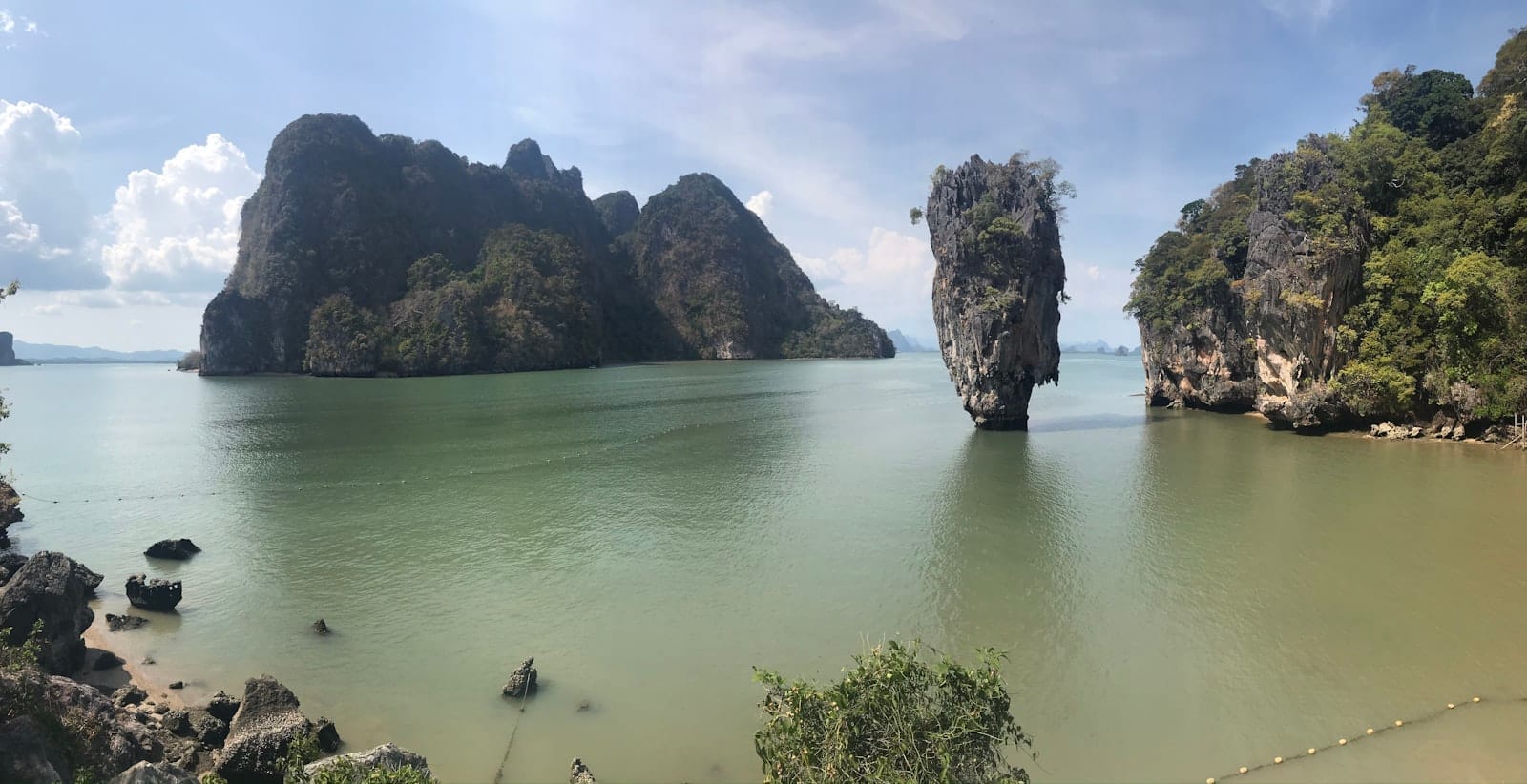
What Phang Nga Bay Actually Is
Phang Nga Bay (อ่าวพังงา) is a shallow, enclosed bay covering roughly 400 km² that sits between Phuket island and the Thai mainland. The Department of National Parks designated it as Ao Phang Nga National Park on 29 April 1981. It holds Ramsar wetland status (Site #1185, designated August 2002), recognizing the ecological importance of its mangrove forests, which rank among the largest remaining stands in Thailand.
The defining feature is the karst topography: 42 islands built from ancient limestone that was folded and pushed upward over millions of years, then sculpted by rain and tidal erosion into sheer vertical columns, arched sea caves, and hollow hongs (Thai for 'rooms') — enclosed lagoons only accessible at low tide through submerged tunnels. The tallest and most photographed pillar, Koh Ta Pu, rises roughly 20 meters from the waterline. Around 10,000 years ago, much of this seabed was exposed land; the karsts were once inland hills.
The bay is not just scenery. Chao Leh ('sea gypsy') communities have lived on several islands here for generations, fishing these waters and maintaining cultural traditions distinct from mainland Thai society. Koh Panyi, a Muslim fishing village built almost entirely on stilts above the water, is the most accessible of these communities and a regular stop on organized tours.
The Experience Hour by Hour
Early morning on the bay is categorically different from midday. Before 9 am, mist often clings to the base of the karsts, the water reflects the limestone walls with near-perfect clarity, and the longtail engine noise that defines midday tours is largely absent. Birds move through the mangrove canopy. The light is soft and directional, ideal for photography.
💡 Local tip
Book the earliest available departure from Phuket — typically 7–8 am. James Bond Island sees peak congestion between 10 am and 2 pm when multiple large tour groups arrive simultaneously. An early start puts you there before the first wave.
By late morning, the scene changes sharply. Large speedboats from Phuket begin arriving in clusters. Koh Khao Phing Kan (the James Bond Island location) becomes genuinely crowded — narrow paths fill with tour groups, souvenir sellers set up along the approach, and the famous rock pillar view gets busy with people waiting for unobstructed photos. This is not a peaceful experience at peak hours.
Afternoon tours, particularly those combining kayaking through the hongs, tend to thin out as day-trippers return to Phuket. If your tour includes a hong paddle, the late afternoon light entering the enclosed lagoons creates a warm, amber-toned atmosphere that midday simply does not offer.
Tickets & tours
Hand-picked options from our booking partner. Prices are indicative; availability and final rates are confirmed when you complete your booking.
Phuket and Phang Nga eco nature discovery tour
From 154 €Instant confirmationFree cancellationGuided elephant nature walk tour with transfer
From 50 €Instant confirmationFree cancellationMorning guided tour at hidden forest elephant reserve in Chalong
From 72 €Instant confirmationFree cancellationAfternoon guided tour at hidden forest elephant reserve in Chalong
From 72 €Instant confirmationFree cancellation
James Bond Island: Worth It, With Caveats
Koh Khao Phing Kan gained international recognition after appearing in the 1974 film 'The Man with the Golden Gun.' The official name is rarely used; locals and tour operators universally call it James Bond Island. The site itself is legitimately dramatic: two large limestone formations lean against each other above a small beach, and Koh Ta Pu stands isolated just offshore. The geology alone would justify a visit.
The honest caveat: the island is heavily commercialized. The path from the boat landing to the main viewpoint is lined with souvenir stalls selling shells, sarongs, and trinkets. The beach area is small and becomes crowded quickly. Visitors who expect a pristine natural encounter are routinely disappointed. Those who go knowing what it is — a spectacular geological feature wrapped in a brisk tourist operation — tend to enjoy it.
The national park entrance fee applies here. Bring exact change or expect queues at the payment point. National park staff are present and the site is well maintained despite the foot traffic.
Sea Kayaking the Hongs: The Real Draw
For many repeat visitors to Phang Nga Bay, the hongs (enclosed tidal lagoons) are the reason to return. These formations exist because the core of certain karst islands dissolved more quickly than the outer walls, leaving hollow chambers open to the sky but sealed at water level by the surrounding rock. At the right tide, a kayak can pass through a low, dark tunnel — sometimes just centimeters of clearance above your head — and emerge into a completely enclosed world: mangrove roots dipping into still water, hornbills overhead, the karst walls rising 30 or 40 meters on all sides.
Timing is everything. The tunnels are only passable within a narrow tidal window. Reputable tour operators calculate entry times based on the day's tide tables. If you book a budget tour that does not specifically include hong kayaking, you will see the bay from the outside only. Confirm with your operator before paying.
⚠️ What to skip
Not all tours that mention 'kayaking' include the hongs. Some use 'kayaking' to describe paddling around open water near the islands. Ask specifically whether the route passes through enclosed lagoon tunnels, and at what tidal state.
Most hong kayak tours use two-person inflatable kayaks with a guide at the rear doing most of the paddling. Solo kayak options exist through specialist operators but require advance booking and some paddling confidence. Neither requires prior kayaking experience for the standard route.
Koh Panyi and the Mangrove Channels
Koh Panyi is a Muslim fishing village of roughly 1,700 residents built on stilts above the shallows. It has existed in this location for over 200 years, founded by Indonesian fishermen from the island of Java. The village has a mosque, a school, a floating football pitch, and dozens of small restaurants catering to tour groups. At lunchtime, the waterfront fills with tour visitors eating fresh seafood — the food is decent, the portions generous, and the setting genuinely unusual. The village is the most lived-in, functioning place you will see on a standard Phang Nga Bay tour.
Between the islands, the boat route often passes through narrow mangrove channels where the vegetation closes overhead and the water shifts from green to dark brown. The smell changes — brackish and earthy rather than the open-sea salinity of the outer bay. Monitor lizards are commonly spotted on exposed roots. Egrets and kingfishers are regular sightings. These channels are brief but worth paying attention to.
Practical Logistics: Getting There and Getting It Right
Phang Nga Bay sits in Phang Nga Province, not on Phuket island itself. Most visitors access it via organized day tours departing from piers near Phuket — the journey involves both road travel and a boat transfer. The bay is linked to Phuket by the Sarasin Bridge, which connects the island to the mainland. For those staying in areas like Kamala, Surin, or Bang Tao, most operators offer hotel pickup. Check whether yours is included before assuming.
Tour types break into three broad categories: large speedboat group tours (fastest, loudest, cheapest), longtail boat tours departing from Phang Nga Town pier (slower, quieter, more authentic atmosphere), and private chartered tours (most flexible, significantly more expensive). The longtail option from Phang Nga Town is the choice of travelers who want to linger without being herded.
The dry season runs November through April, when seas are calm and visibility is excellent. May through October brings the southwest monsoon — conditions can be rough, some smaller operators cancel departures, and the light is frequently overcast. The bay does not shut down entirely in wet season, but the experience is less reliable. If you are planning a Phuket trip around Phang Nga Bay, check our guide to the best time to visit Phuket for month-by-month sea condition details.
ℹ️ Good to know
Accessibility: Phang Nga Bay is almost entirely boat-based. Limestone landings, low kayak tunnels, and wooden village walkways are not wheelchair accessible. Travelers with limited mobility can still join standard speedboat tours and experience the bay visually from the water, but direct participation in kayaking and land exploration is not feasible.
What to bring: reef-safe sunscreen (conventional sunscreen is damaging to the bay's ecosystem and increasingly restricted), a dry bag for your phone and camera, a light layer for the speedboat wind chill, and water shoes if your tour includes any beach or rock landings. Sandals tend to slip on wet limestone. Motion sickness medication is worth considering if you are sensitive — speedboats cross open stretches at pace.
Photography note: a wide-angle lens or phone camera works well for the karsts. In the hongs, light enters from above in a narrow beam — exposure can be tricky, and camera movement in a kayak adds difficulty. A waterproof housing or dry bag rated for submersion is sensible insurance. For context on other scenic spots in the region that reward similar effort, the Phi Phi Islands and Maya Bay are covered separately.
Who Will Not Enjoy This
Travelers who are sensitive to crowds, prefer unmediated natural experiences, or dislike organized group tours will find peak-hour visits to James Bond Island frustrating. The souvenir corridor, the group photo queues, and the speedboat noise at busy landings are all part of the package at most price points. If that matters to you, either commit to an early private charter or adjust expectations.
Young children under five may find the full-day format exhausting, and the kayak tunnels are not suitable for toddlers. Families with older children (8+) generally manage well. Those with no interest in geology or natural scenery, and who are primarily looking for beach time, will get more satisfaction from Phuket's beaches than a full day on the bay.
Insider Tips
- Book directly with an operator based in Phang Nga Town rather than through a Phuket beach-road agency. The longtail boat tours from Phang Nga Harbour Pier are slower but far less crowded than the Phuket speedboat packages, and they typically cost less.
- Ask your operator for the tidal schedule on your tour date before committing. Hong access depends on a narrow tidal window, and some operators run fixed itineraries regardless of conditions — a sign that the hongs may be an afterthought rather than a feature.
- Koh Panyi's floating football pitch is on the south side of the village and visible only if your boat circles the island. Ask specifically to see it if it interests you — most drivers will oblige.
- The Phang Nga Bay view from the road between Phang Nga Town and the pier — before you reach the water — can produce excellent early-morning karst photographs as the mist sits low across the hills. A phone camera is sufficient.
- If you hire a private longtail for the day, Khao Ping Kan (the cave near Koh Khao Phing Kan) is often skipped by large tours due to tide timing but is one of the most atmospheric sites in the bay. It has prehistoric cave paintings and requires wading. Worth negotiating into your private route.
Who Is Phang Nga Bay For?
- Nature and geology enthusiasts who want to understand the karst landscape rather than just photograph it
- Photographers seeking early morning mist and reflection conditions on limestone-studded water
- Sea kayakers interested in passing through enclosed tidal hongs inaccessible by larger craft
- Families with older children (8+) who can handle a full-day boat itinerary
- Travelers combining Phuket and Phang Nga Province in a single trip who want maximum scenic contrast
Nearby Attractions
Other things to see while in Phang Nga Bay:
- Wat Suwan Kuha (Cave Temple)
Carved into a limestone karst hill 13 km south of Phang Nga town, Wat Suwan Kuha shelters a 15-meter golden reclining Buddha inside a cathedral-sized cave chamber. Built roughly 150 years ago and once visited by King Rama V, this working temple offers an experience that combines genuine spiritual atmosphere with remarkable geology. Entry is free, the crowds are manageable, and it pairs naturally with a Phang Nga Bay day trip.
- James Bond Island (Khao Phing Kan)
James Bond Island, officially Khao Phing Kan, is one of Thailand's most photographed natural landmarks. Rising from Phang Nga Bay inside Ao Phang Nga National Park, this limestone island earned global fame as a filming location for the 1974 Bond film 'The Man with the Golden Gun.' Here is what the reality of a visit actually looks like.