Zurich Polybahn: The 100-Second Ride That Connects the Old Town to ETH Zurich
The Polybahn is Zurich's compact funicular railway, linking the Central tram hub to the Polyterrasse at ETH Zurich since 1889. A member of the ZVV network (Zone 110), it is covered by any valid Zone 110 ticket or pass; without one, single tickets cost around CHF 1.20 at the station machine. Either way, it is one of the city's best-value experiences, delivering a sweeping view over the Limmat valley in under two minutes.
Quick Facts
- Location
- Limmatquai 144, 8001 Zürich (lower station: Central)
- Getting There
- Central tram stop (trams 4, 15) — lower station is steps from the platform
- Time Needed
- 10–30 minutes including the terrace view; about 2 minutes if you are just riding up
- Cost
- Free with valid ZVV Zone 110 ticket/pass; ~CHF 1.20 single ticket without one (CHF 7.20 for 6-ride card)
- Best for
- City views, history lovers, students, photography, quick itinerary connections
- Official website
- www.polybahn.ch/en
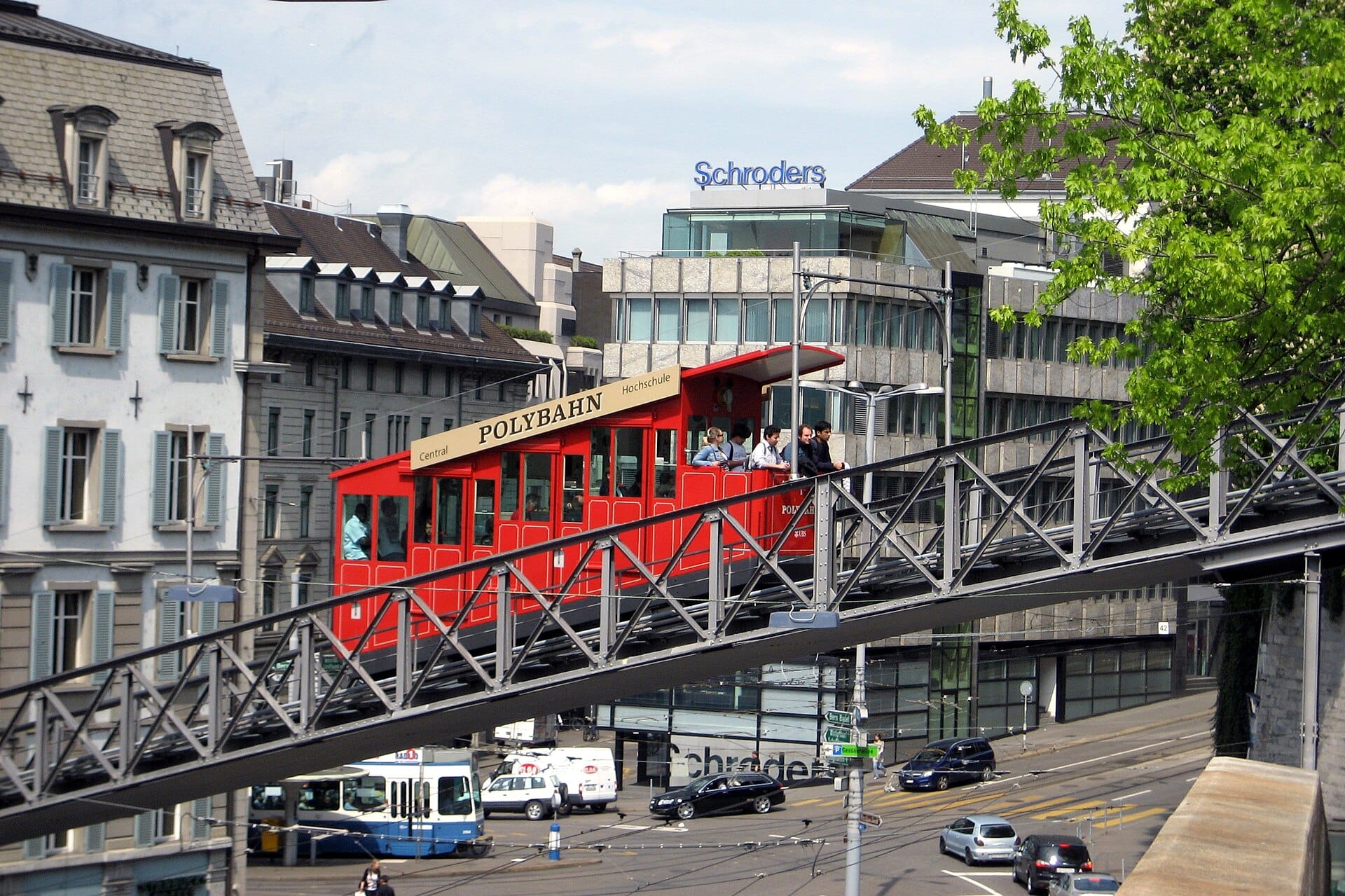
What the Polybahn Actually Is
The Polybahn, also known as the UBS Polybahn, is a short funicular railway in central Zurich that has been carrying passengers between the riverside district of Central and the Polyterrasse terrace beside ETH Zurich since 1889. It was built to give access to what was then a relatively new federal polytechnic institute perched on the hillside above the old town. Today it remains a working piece of urban infrastructure, used daily by ETH students, university staff, and a steady stream of visitors who want a fast route up the hill and a view of the city for less than the price of a coffee.
The ride takes approximately 100 seconds. You board a small car at the lower station on Limmatquai, the car ascends on a short inclined track through a stone arch, and you arrive at a terrace with a panoramic outlook over the Limmat river, the rooftops of the old town, and the lake in the distance. It is a genuinely efficient piece of engineering and, at 135 years old, a historic piece of urban transport still operating in the city.
💡 Local tip
The Polybahn is part of ZVV Zone 110: any valid Zone 110 ticket or pass covers the ride. Without a pass, single tickets cost around CHF 1.20 at the machine (a 6-ride card is CHF 7.20). The service runs every 5 minutes — keep small coins or a card ready if you need to buy a ticket.
The Ride: What to Expect Step by Step
The lower station sits right on Limmatquai 144, a short walk from the Central tram hub just north of the old town. The entrance is easy to miss if you are not looking for it: a small stone building with a glass facade and a ticket machine at street level. Trams rattle past on the road outside, and the noise of the junction gives way to the quieter mechanical hum of the cable system once you step inside.
The cars are compact and painted in a red and white scheme. The actual ascent lasts around 100 seconds. You arrive at the Polyterrasse, the open terrace directly in front of the main ETH Zurich building.
The upper station drops you directly onto the Polyterrasse, which is a wide stone terrace with an unobstructed view to the south and west. On a clear day you can see Lake Zurich and the city skyline. It is not a dramatic mountain panorama, but it is a particularly good urban viewpoint: the scale is human, the foreground is filled with Zurich's distinctive church towers and tiled rooftops, and the lake shimmers in the middle distance.
ℹ️ Good to know
Operating hours: Monday to Friday 6:30 a.m. to 9:00 p.m.; Saturday 7:30 a.m. to 9:00 p.m.; Sunday and public holidays 9:00 a.m. to 9:00 p.m. Service runs every 5 minutes. Verify current hours at polybahn.ch before your visit.
Tickets & tours
Live prices and dates from our booking partner. If you book, we may earn a commission at no extra cost to you.
Mount Titlis snow fun for first-time skiers from Zurich
From 212 €Instant confirmationFree cancellationSwiss ski experience from Zurich
From 321 €Instant confirmationFree cancellationBest intro tour of Zurich with a local
From 116 €Instant confirmationFree cancellationZurich Old Town guided walking tour
From 27 €Instant confirmationFree cancellation
How the Experience Changes by Time of Day
Early morning on a weekday is the most functional version of this ride. The 6:30 a.m. start means the first cars fill with ETH staff and early-rising students. The city below is still quiet, the light is cool and directional, and the Polyterrasse is almost empty when you arrive. If you want the terrace to yourself for photographs, this is the window. The stone surface is often wet from overnight condensation, and the smell of fresh bread drifts up from bakeries on the streets below.
Midday brings the heaviest use. Students moving between lectures, visitors ticking off the view, and the occasional tour group make the cars feel crowded. The wait at the lower station rarely exceeds one cycle given the 5-minute frequency, but the terrace itself becomes noticeably busier between 11:30 a.m. and 1:30 p.m.
Late afternoon, particularly from around 4:30 p.m. onward, is arguably the most rewarding time for leisure visitors. The light shifts to a warmer angle, the lecture schedule at ETH winds down, and the Polyterrasse clears out enough to sit on the stone benches without crowding. In summer, this is when the view across the lake toward the Alps is at its most photogenic, and in winter the low sun cuts across the old town roofline in a way that is worth the CHF 1.20 purely for the composition.
Historical and Architectural Context
The Polybahn opened in 1889, making it over 135 years old. It was built primarily to serve ETH Zurich (Eidgenössische Technische Hochschule), the federal polytechnic university founded in 1855 and whose main building occupies the hillside directly above Central. Walking the steep slope on foot was time-consuming, and the funicular provided a practical alternative from day one.
Architecturally, the lower station is a compact stone structure that sits flush with the Limmatquai streetfront without drawing excessive attention to itself. The track itself runs through an arched tunnel cut into the hillside before emerging onto the terrace, a piece of civil engineering that required careful integration with the existing urban fabric. The cars have been updated over the decades, but the basic infrastructure of the funicular follows the original 19th-century layout.
The Polybahn sits at the northern edge of Zurich's historic core. For a fuller sense of the surrounding area, the Altstadt stretches along both banks of the Limmat just to the south, with medieval streets, guild buildings, and the city's most significant churches within easy walking distance.
The Polyterrasse: What to Do Once You Arrive
The upper station delivers you directly to the Polyterrasse, the broad terrace of ETH Zurich's main building. This is not a manicured tourist attraction with roped-off sections. It is a working university campus terrace that happens to have one of the better views in the city. Stone benches run along the balustrade. The ETH main building itself, designed by Gottfried Semper and completed in 1864, rises behind you as you look out over the city.
From the Polyterrasse you are also well-positioned to continue exploring on foot. The ETH campus extends further up the hill, and the University of Zurich buildings are nearby. Walking back down through the old town rather than taking the Polybahn again gives you access to several of Zurich's key historic sites within a short radius.
The view from the terrace makes it one of the more understated viewpoints in Zurich, particularly because most visitors overlook it in favor of the Uetliberg or the Lindenhof. For a more formal hilltop viewpoint in the old town itself, the Lindenhof is a five-minute walk to the south and requires no funicular or fee.
Photography Tips and Practical Notes
The view from the Polyterrasse is best captured from the western end of the balustrade, where the Grossmünster's twin towers appear center-frame above the rooftops. A standard wide-angle lens or a smartphone with a slightly wide setting works well. Avoid the middle of the day in summer when haze sits over the lake and flattens the Alpine backdrop. Late afternoon light in autumn and winter produces the most defined shadows on the old town architecture.
For the ride itself, the right side of the car as you ascend (facing uphill) gives the best view out over the city during the brief moments the car is not inside the tunnel section. The windows are clean but the ride is short, so have your phone or camera ready before you board rather than fumbling during the ascent.
⚠️ What to skip
Accessibility information is not clearly listed on the official Polybahn website. If step-free access is a requirement, contact polybahn.ch directly before visiting to confirm whether the current configuration is suitable.
Getting There and Fitting It Into Your Itinerary
The lower station at Central is one of the most accessible points in Zurich. Trams 4 and 15 stop at Central, and Zurich Main Station (Zurich HB) is a short walk along the Limmatquai. If you are arriving from the old town, simply walk north along the river and the station entrance appears on your left before you reach the bridge.
The Polybahn fits naturally into a walking itinerary of the old town. Start at Grossmünster or Fraumünster, walk north along the Limmat, ride the Polybahn up, take in the terrace view, then descend on foot through the university district back into the old town. The full loop including stops takes two to three hours at a relaxed pace.
If you are building a broader day in the city, the Zurich walking tour guide covers a logical route that connects the Polybahn with the main historic sites on both sides of the river without excessive backtracking.
The Polybahn is a member of the ZVV transit network (Zone 110). If you hold a valid Zone 110 ticket, day pass, or transit pass, the ride is included at no extra charge. Without a valid Zone 110 ticket, single tickets are available at the machine at the lower station for around CHF 1.20 per ride.
Insider Tips
- Ride down, not just up. Most visitors take the Polybahn up and then walk back down through the old town. Taking it in both directions at different times of day gives you two entirely different views of the Limmat valley and costs only CHF 2.40 total.
- The Polyterrasse gets significantly quieter after 6:00 p.m., even in summer. If you want the view without the ETH student lunch crowd, the early evening slot is noticeably more peaceful and the light is better for photography.
- On weekday mornings before 8:00 a.m., the ride is almost entirely local commuters and researchers. It is one of the few moments in Zurich's tourist core where you are genuinely sharing infrastructure with the city's everyday life rather than being channeled through a visitor experience.
- The ETH main building's interior is generally accessible to the public during university hours. Once on the Polyterrasse, stepping inside to see the main hall and Gottfried Semper's architecture adds depth to the visit without any additional cost.
- If the weather is clear, check the Alpine visibility before you go. On high-clarity days in late autumn and winter, the view from the Polyterrasse toward the south includes a clear mountain horizon. On hazy summer afternoons, the Alpine backdrop disappears entirely.
Who Is Polybahn Funicular For?
- First-time visitors wanting a quick, low-cost orientation view of Zurich's old town and lake
- Architecture and urban history enthusiasts interested in 19th-century Swiss infrastructure
- Photographers working in the late afternoon or early morning golden hours
- Travelers building a self-guided walking itinerary through the Altstadt who need a practical hill connection
- Families with older children looking for a short, genuinely historical transport experience at minimal cost
Nearby Attractions
Other things to see while in Altstadt (Old Town):
- Augustinergasse
Augustinergasse is a short, narrow pedestrian lane threading through Zurich's Altstadt between Bahnhofstrasse and St. Peterhofstatt. Free to walk, open at all hours, and steeped in history dating to a 13th-century Augustinian monastery, it rewards those who look up, slow down, and pay attention to what surrounds them.
- ETH Zurich Main Building
The ETH Zurich Main Building (Hauptgebäude) is one of the most architecturally significant public buildings in Switzerland, designed by Gottfried Semper in 1864 and freely open to visitors. Standing above the Altstadt on Rämistrasse, it offers a rare chance to walk through a world-class university's historic core without paying a cent.
- Fraumünster
Founded in 853 and home to five monumental stained glass windows designed by Marc Chagall, Fraumünster is one of the most visually striking churches in Switzerland. Small in footprint but overwhelming in atmosphere, it earns its place on any serious itinerary of Zurich's Old Town.
- Grossmünster
The Grossmünster has defined Zurich's skyline for nearly 900 years. This Romanesque church is where Ulrich Zwingli launched the Swiss Reformation in 1519, and today its twin towers remain the most recognizable silhouette on the Limmat. Entry to the church is free; the tower climb costs CHF 5 and rewards you with one of the clearest views over the Old Town.
Planning a trip? Discover personalized activities with the Nomado app.