Xingtian Temple: Taipei's Living Temple of Commerce and Faith
Xingtian Temple (行天宮) in Zhongshan District is one of northern Taiwan's most visited religious sites, drawing tens of thousands of worshippers daily to honor Guan Di, the deity of war and commerce. Free to enter, open daily from 4am to 10pm, and a three-minute walk from the MRT, it offers an unfiltered look at Taiwanese folk religion in full, uninterrupted practice.
Quick Facts
- Location
- No. 109, Section 2, Minquan East Road, Zhongshan District, Taipei
- Getting There
- Xingtian Temple Station (Orange Line / Zhonghe–Xinlu Line), Exit 2 or 3, approx. 3–5 min walk
- Time Needed
- 30–60 minutes for a visit; longer if you observe ceremonies
- Cost
- Free admission
- Best for
- Cultural immersion, religious observation, photography of ritual practice
- Official website
- www.ht.org.tw
What Xingtian Temple Actually Is
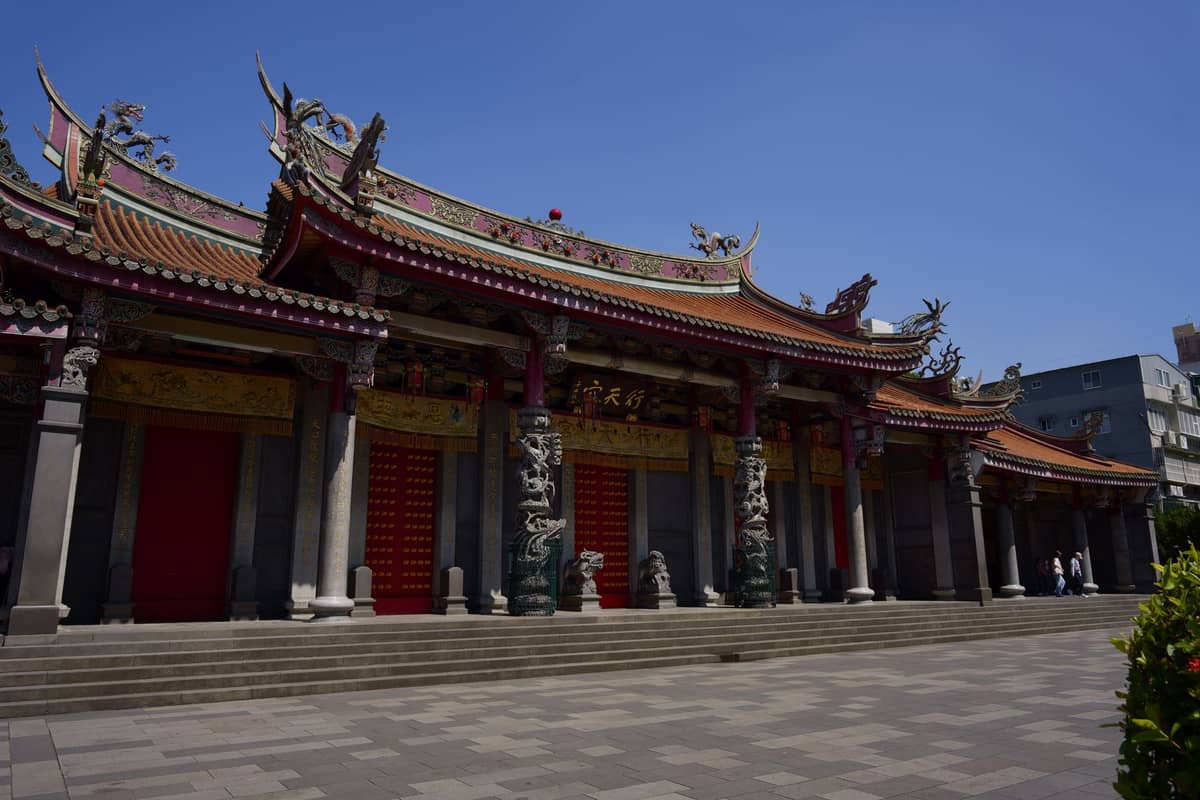
Xingtian Temple (行天宮) is a Taoist temple in Taipei's Zhongshan District dedicated to Guan Di, a historical general of the Three Kingdoms period who was deified over centuries and is now worshipped across Chinese-speaking cultures as the god of both war and commerce. In Taiwan, he is particularly revered by business owners, merchants, and anyone seeking protection or ethical guidance in their professional life.
Unlike many temples in Taipei that function primarily as heritage sites or tourist attractions, Xingtian Temple operates as an intensely active place of worship. Figures cited by the official Taipei travel authority suggest many thousands of visitors and worshippers per day. On weekday mornings, the forecourt fills with office workers stopping in before their commutes. On weekends, families arrive together to pray with clasped hands rather than incense — the temple banned incense and food offerings in 2014. This is not a museum piece. It is a working temple with rituals happening around you at most hours of the day.
ℹ️ Good to know
Admission is free and no booking is required. The temple is open daily from approximately 4:00am to 10:00pm, though most official sources list 10:00pm as the standard closing time. Arrive during daylight for the fullest experience — active ceremonies, blue-robed volunteers, and natural light on the roof tiles combine to striking effect.
The Temple Grounds: What You Will See
The main hall is dominated by the statue of Guan Di seated in ceremonial armor, his face painted red in the classical iconographic tradition. Flanking altars honor additional deities. The interior is unusually clear of incense smoke: the temple banned burning incense in 2014, so the air stays clean and the painted details are easier to see. Overhead, the roof structure features layered eaves in the southern Fujianese architectural tradition, with glazed ceramic ridge ornaments in deep greens and yellows.
The forecourt is where most of the visible ritual activity takes place. Since 2014 the temple has banned incense and food offerings, so worshippers pray with clasped hands rather than lighting sticks at burners. Blue-robed volunteers help direct the flow and perform blessing ceremonies. The organized, unhurried quality of the worship is itself instructive: this is a community that knows exactly what it is doing.
Near the entrance and along the perimeter, volunteers in distinctive yellow vests offer a service unique to Xingtian Temple: they perform blessing rituals using bundles of dried grass to symbolically sweep away bad luck from a person's body. This practice, known locally as a kind of spiritual cleansing, draws long lines particularly on auspicious calendar days. If you are visiting purely as an observer, step aside from the queues and watch from a respectful distance.
💡 Local tip
Photography is generally tolerated inside the temple, but always yield to worshippers rather than positioning yourself in their path for a shot. Avoid photographing people in close-up without awareness of context — many are here in genuine private devotion.
How the Atmosphere Changes Through the Day
The temple opens around 4:00am, and the early morning hours are when Taipei's working population visits before the day begins. By 7:00am, the forecourt is already active with a steady stream of worshippers. Without incense smoke, the atmosphere is purposeful and quieter than many Taipei temples — people are focused, not socializing.
Midday and early afternoon on weekends bring the largest crowds. The noise level rises, the smoke density increases, and the surrounding streets fill with food vendors and the general energy of Zhongshan on a busy Saturday. This is the richest period visually, but the least comfortable for anyone hoping to linger and absorb the place without feeling pressed.
Weekday late afternoons, particularly between 3:00pm and 5:00pm, offer a balance: the temple is active but not overwhelming, the light comes in at a lower angle that turns the main hall's interior golden, and the blue-robed volunteers conducting blessing ceremonies are often easier to observe. Evening visits, before the 10:00pm close, take on a different mood — the exterior is lit, the crowds have thinned, and the sound of chanting from inside the main hall carries more clearly.
Historical and Cultural Context
Guan Di — sometimes romanized as Kuan Ti or Guan Yu — was a military commander who died in 220 CE and was progressively elevated in Chinese religious tradition. By the Ming dynasty he had been officially canonized, and his worship spread through the Chinese diaspora across Southeast Asia and beyond. In Taiwan, this veneration found particularly strong expression through Fujianese immigrant communities who brought their religious customs with them during the Qing dynasty period of settlement.
Xingtian Temple in its current form is a relatively modern institution, but it taps into a lineage of Guan Di worship that is centuries old in Taiwan. The temple's rapid growth in the 20th century tracks closely with Taipei's economic expansion: as the city became a commercial center, Guan Di's dual identity as protector of both martial integrity and honest commerce made this temple a natural gathering point for Taiwan's merchant class. Many of Taipei's business owners visit at least once a year, and the temple's importance in professional and commercial life remains very much current.
For a broader look at Taipei's temple culture, the Taipei temples guide covers the major religious sites across the city, including how Xingtian fits into the wider landscape of Taoist and Buddhist practice here.
Getting There and Getting Around
The most practical route is the Taipei Metro. Take the Orange Line (Zhonghe–Xinlu Line) to Xingtian Temple Station, which is named directly for the temple. Exit 2 or Exit 3 both lead toward the temple entrance on Minquan East Road within a three-to-five minute flat walk. The MRT runs frequently and the station is straightforward to navigate even for first-time visitors.
Multiple city bus lines serve the Xingtian Temple area on Songjiang Road and Minquan East Road if you prefer surface transport. Uber and local taxis are also widely available throughout Zhongshan District. The surrounding streets are flat and the walk from the station has no significant barriers, though specific accessibility infrastructure within the temple itself — ramps, accessible restrooms — is not thoroughly documented in official sources, so visitors with mobility requirements should confirm directly.
Xingtian Temple sits in the broader Zhongshan District, which is dense with hotels, restaurants, and commercial streets. If you are planning a full day in this part of the city, the Zhongshan neighborhood guide covers the surrounding area in detail.
What to Wear and Bring
Modest, casual clothing is appropriate. There is no strict dress code at the entrance, but bare shoulders or very short shorts are out of place in a space this actively used for worship. Covered shoulders and knees are the sensible baseline. In Taiwan's humid subtropical climate, lightweight breathable fabrics work better than denim or thick layers — the body heat of crowds will quickly make you warm regardless of season.
Bring a reusable bag if you intend to pick up anything at the stalls outside, and carry water since the temple interior offers no refreshments. If you visit during summer (May through September), expect real heat and humidity both inside and out. The shoulder seasons of October through April are considerably more comfortable for extended outdoor and temple visits.
For a broader look at how Taipei's seasons affect temple visits and outdoor sightseeing in general, see the guide to the best time to visit Taipei.
Who Should Skip It
If you have already visited Longshan Temple in Wanhua and Dalongdong Baoan Temple in Datong, and your interest in Taiwanese temple architecture and religious practice is largely satisfied, Xingtian Temple adds less in terms of visual novelty. The architectural style is not its primary draw compared to those two older sites.
Travelers whose schedule is tight and who are prioritizing landmark sightseeing over cultural immersion might find that the time is better spent at heritage sites like Longshan Temple or Dalongdong Baoan Temple, both of which have stronger architectural and historical profiles as heritage destinations. Xingtian Temple earns its place specifically for those who want to witness active contemporary religious practice rather than examine historical temple aesthetics.
Unlike most Taipei temples, Xingtian Temple is a good choice for visitors who are sensitive to incense smoke: incense and food offerings have been banned here since 2014, so the halls stay comparatively clear.
Insider Tips
- The blessing ceremony conducted by the yellow-vested volunteers is free, open to anyone regardless of religion, and requires no Mandarin. Simply join the queue near the entrance and follow the lead of those in front of you. It takes only a few minutes.
- Weekday mornings between 7:00am and 9:00am offer the most concentrated observation of genuine daily worship without heavy tourist traffic. The early-morning light also makes this the best window for photography.
- The streets immediately outside the temple — particularly on Songjiang Road — are lined with vendors selling offering goods, religious items, and snacks. The stalls are part of the temple economy and browsing them gives context to what is happening inside.
- Avoid visiting on major Taiwanese folk religion calendar days without doing prior research: on these dates crowds become very dense and the experience shifts from contemplative to logistically overwhelming for first-time visitors.
- If you have an EasyCard for the MRT, reload it at the station before arriving — the area's cafes and street stalls often accept it, making cashless movement through the neighborhood convenient.
Who Is Xingtian Temple For?
- Travelers who want unscripted, unmediated contact with active Taiwanese religious culture
- Photographers seeking documentary-style subject matter: smoke, ceremony, crowd behavior, architectural detail
- Anyone with a specific interest in Chinese folk religion, Taoism, or the cult of Guan Di
- Visitors staying in Zhongshan who want a meaningful cultural stop within easy walking distance of their hotel
- Early risers looking for a purposeful 7:00am start before the rest of the city is fully awake
Nearby Attractions
Other things to see while in Zhongshan District:
- Lin An Tai Historical House
Lin An Tai Historical House is a meticulously preserved Minnan-style courtyard residence dating back roughly 200 years, relocated to Binjiang Park beside the Keelung River in Zhongshan District. Admission is free, the setting is calm, and the architecture offers a rare window into the domestic life of a prosperous Qing-era Taiwanese family.
- Miniatures Museum of Taiwan
Tucked one floor below street level in Taipei's Zhongshan District, the Miniatures Museum of Taiwan houses an extraordinary collection of hand-crafted scale models, from Victorian manor houses to ornate European theaters, each built with obsessive precision. It is a quiet, unhurried attraction that rewards careful looking and suits travelers who want something genuinely different from the usual temple-and-night-market circuit.
- Museum of Contemporary Art Taipei (MOCA)
The Museum of Contemporary Art Taipei (MoCA Taipei) is Taiwan's first museum dedicated solely to contemporary art, set inside a beautifully repurposed Japanese colonial-era building in central Zhongshan. With a remarkably low entry fee and a program that rotates frequently, it rewards both a quick afternoon stop and a deliberate deep dive.
- National Revolutionary Martyrs' Shrine
Modeled on Beijing's Hall of Supreme Harmony and completed in 1969, the National Revolutionary Martyrs' Shrine in Zhongshan District honors approximately 390,000 individuals recognized as national martyrs. Entry is free, the changing of the guard happens on the hour, and the ceremonial scale of the complex makes it one of Taipei's most architecturally striking institutions.