Wellcome Collection: London's Most Thought-Provoking Free Museum
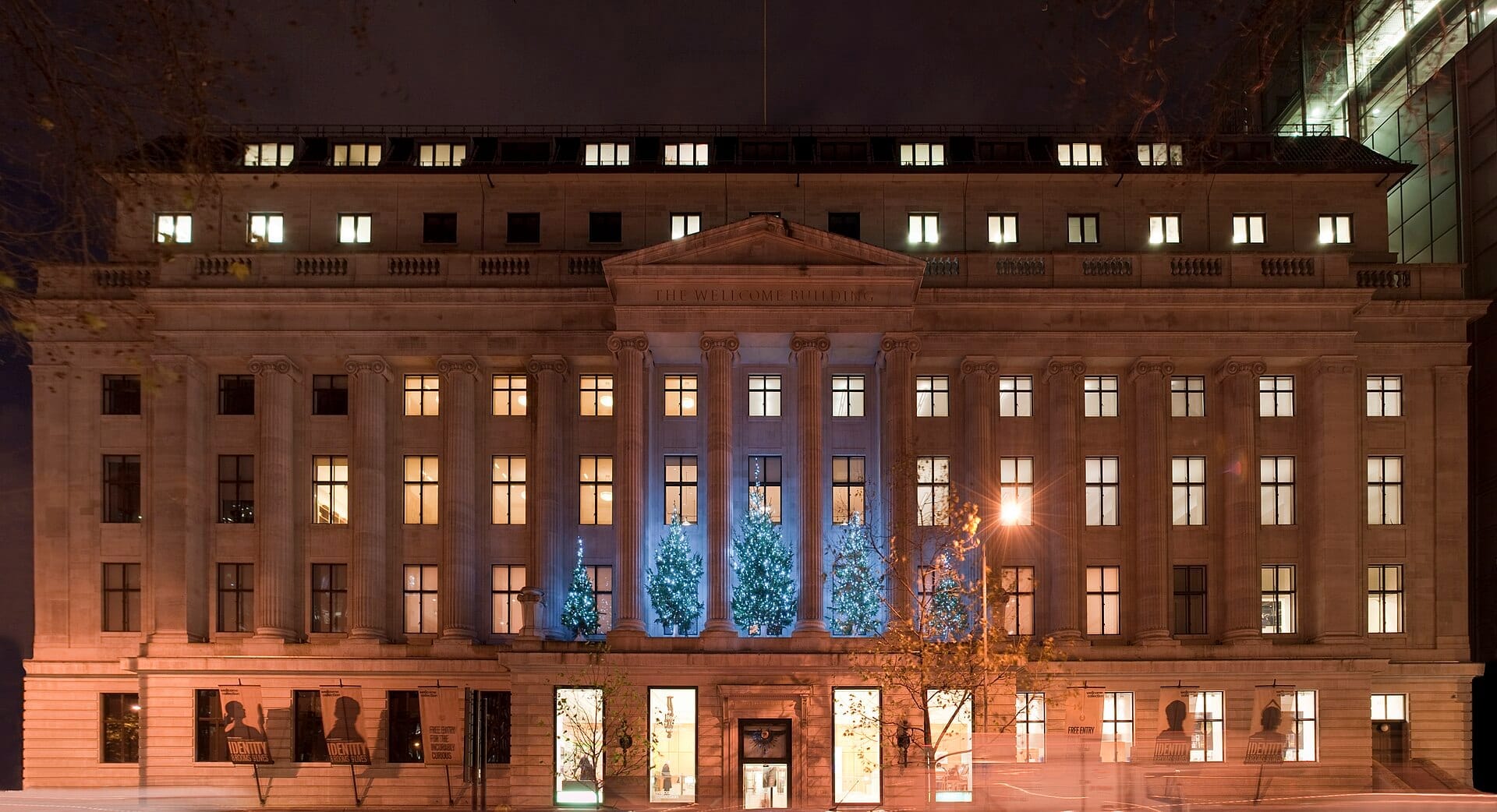
Wellcome Collection on Euston Road occupies a neoclassical building that was purpose-built to house Sir Henry Wellcome's extensive collections on medicine, the human body, and what it means to be alive. Entry to the permanent galleries is free, the exhibitions are challenging, and the café alone is worth the detour.
Quick Facts
- Location
- 183 Euston Road, London NW1 2BE (Euston / King's Cross area)
- Getting There
- Euston Square (Circle, Hammersmith & City, Metropolitan lines) – directly opposite. Euston station (Victoria & Northern lines, National Rail) – 3 min walk
- Time Needed
- 1.5–3 hours for permanent galleries; longer if attending a temporary exhibition
- Cost
- Free (permanent galleries). Some temporary exhibitions and events may require timed tickets – check wellcomecollection.org
- Best for
- Intellectually curious adults, medical history enthusiasts, art lovers who want context alongside beauty
- Official website
- wellcomecollection.org
What Is Wellcome Collection, Exactly?
Wellcome Collection describes itself as 'a free museum and library exploring health and human experience'. That description is accurate but undersells the place considerably. What you actually encounter is a museum that asks uncomfortable questions about the body, disease, identity, and mortality, and then surrounds those questions with some of the most arresting objects in London. It sits on Euston Road in a neoclassical building that opened in 1932 (originally as the Wellcome Building), constructed to house the non-commercial ambitions of Sir Henry Wellcome, an American-born pharmacist who built one of the world's great pharmaceutical fortunes and used the proceeds to collect obsessively.
Wellcome (1853–1936) amassed more than one million objects in his lifetime, spanning surgical instruments from ancient Egypt, Napoleon's toothbrush, Peruvian mummies, and Charles Darwin's walking stick. He wanted to document the full story of human attempts to understand and heal the body. After his death, the Wellcome Trust – now one of the world's largest biomedical research charities – transformed his collecting legacy into a permanent public resource. The result is unlike any other museum in London.
💡 Local tip
The permanent galleries are free and, at present, do not normally require advance booking. For temporary exhibitions that do require tickets (sometimes free, occasionally paid), book online in advance – popular shows sell out weeks ahead.
The Permanent Galleries: What You'll Actually See
The ground floor opens into a wide, light-filled atrium with a café on one side and the shop and information desk on the other. The building is well-maintained, and the signage is clear, which matters because the content itself demands full attention. Pick up a map if you want to be systematic, though wandering works equally well here.
The permanent collection is displayed across two main gallery spaces. 'Being Human' occupies the first floor and examines what distinguishes humans from other animals: our minds, our social lives, our fear of death, our drive to make sense of suffering. Objects here range from ancient votive offerings left at Roman temples to modern brain scans. The curation deliberately places archaeological artefacts alongside contemporary artworks and medical specimens, creating unexpected conversations between centuries.
A second gallery space focuses on the lived experience of the body: birth, ageing, illness, and recovery. (The long-running Medicine Man exhibition closed in 2022; current displays rotate.) It tends to be quieter than 'Being Human', and some visitors find it more affecting. Cases of anatomical teaching aids from the 18th and 19th centuries sit close to personal testimonies from people navigating chronic illness today. The museum treats the historical and the contemporary as equally worthy of examination.
ℹ️ Good to know
Both permanent galleries contain material about death, surgery, and human anatomy that some visitors find confronting. The museum uses content warnings on specific cases and provides a quiet room if needed. Children can visit, but parental judgment on age-appropriateness is sensible.
Tickets & tours
Hand-picked options from our booking partner. Prices are indicative; availability and final rates are confirmed when you complete your booking.
Soho Instagram a self-guided walking tour to top photo spots
From 6 €Instant confirmationFree cancellationTootbus London by Night: Bus tour
From 32 €Instant confirmationFree cancellationIFS Cloud Cable Car Ride and Uber Boat Hop-on Hop-off 1 Day Ticket
From 38 €Instant confirmationFree cancellationThe Making of Harry Potter Guided Tour of London Warner Bros. Studio
From 201 €Instant confirmationFree cancellation
Temporary Exhibitions: The Real Draw for Repeat Visitors
Wellcome Collection's temporary programme is where the institution earns its reputation as a serious cultural venue. Past exhibitions have explored the science of sleep, the history of genetics, the cultural dimensions of HIV and AIDS, and the relationship between mental health and creativity. These shows are typically more ambitious in scale than the permanent galleries, drawing on loans from institutions worldwide and commissioning new artworks alongside archival material.
The exhibition spaces on the upper floors are large enough to support immersive installations. If you plan your visit around a specific show, arrive on a Tuesday or Wednesday morning when the building is at its quietest. The museum closes at 18:00 daily (closed Mondays); occasional evening events are listed on the website rather than being a regular late-opening night.
Check the programme well before your visit at wellcomecollection.org. Wellcome also runs a substantial events schedule – talks, screenings, workshops – that connects directly to current exhibitions. If you're planning a cultural week in London, it pairs naturally with a visit to the British Library, which is a short walk east along Euston Road.
The Reading Room and Library
One of the least-visited and most underrated spaces in the building is the Reading Room on the first floor. Open to anyone, it functions as a free public library focused on health and human experience, stocked with books that sit between mainstream science writing, academic research, and cultural criticism. The room is quiet, thoughtfully lit, and staffed by librarians who can guide you to relevant material.
For researchers, the Wellcome Collection Library holds an extraordinary archive of rare books, manuscripts, and visual material relating to medicine and science. Access to specialist library and study rooms may require advance booking and registration – confirm on the official site before making a special trip.
How the Visit Feels at Different Times of Day
Midweek mornings are the quietest time to visit. By 10:30 on a Tuesday or Wednesday, you can move through the permanent galleries almost alone, which matters here – some of the cases reward extended looking, and crowding disrupts the reflective atmosphere the curators have worked hard to create. The light in the first-floor gallery shifts noticeably as the morning progresses, with natural light from the upper windows catching the glass cases differently after about 11:00.
Weekend afternoons are significantly busier, particularly during popular temporary shows. The café fills up, the atrium echoes with conversation, and the narrower display corridors can feel congested. The content doesn't change, but the experience of engaging with it does. That said, the café on a busy Saturday has its own appeal: it's a good place to overhear London, and the food is well above average for a museum offering.
Check the events calendar before your visit if you want a social atmosphere — occasional evening talks and screenings draw a more local crowd than the daytime tourist mix. The café is a good stop for coffee or lunch during standard opening hours.
⚠️ What to skip
Wellcome Collection’s galleries are closed on Mondays, though the library café and shop are open during the day. This catches visitors out more often than you'd expect, particularly those combining it with a visit to nearby Euston or King's Cross attractions. Double-check the opening hours at wellcomecollection.org before travelling.
Getting There and Practical Details
The location on Euston Road is straightforward to reach. Euston Square station, served by the Circle, Hammersmith and City, and Metropolitan lines, is directly opposite the building on the south side of Euston Road. Euston mainline station – one of London's major intercity rail terminals, also served by the Victoria and Northern lines – is about a three-minute walk away. King's Cross St Pancras, one of the best-connected interchanges in the city, is about 10–12 minutes on foot heading further east.
Several bus routes serve Euston Road, and the street itself is wide and well-signposted. If arriving by car, note that Euston Road lies on the edge of central London’s Congestion Charge zone and is affected by related traffic and charging schemes and parking is extremely limited. Tube or bus is the practical choice for almost every visitor.
Accessibility is handled well. Step-free access from street level is available through an automatic entrance on Euston Road, and all public floors are reachable by lift. Manual wheelchairs can be borrowed, accessible toilets are available, and the building includes a Changing Places facility. Induction loops are fitted at the information desk and in event spaces. Staff are generally well-informed about access provisions.
Wellcome Collection sits in the northern part of the West End, a few streets above the main tourist corridor. If you're constructing a day's itinerary in this part of London, see our 3-day London itinerary for suggested combinations, or check the broader guide to London's best museums to understand how Wellcome fits into the city's wider cultural landscape.
An Worth Knowing: Is It Worth Your Time?
Wellcome Collection is not for everyone. If you want spectacle – vast halls, famous paintings, iconic artefacts you can photograph and recognise – this is not your museum. The objects here are often obscure, the themes are demanding, and the experience requires intellectual engagement rather than passive admiration. Visitors who arrive expecting something like the Natural History Museum or the British Museum will find the scale modest and the content unsettling.
But for visitors who find medicine, the history of science, ethics, and the human body interesting, Wellcome Collection is one of the most rewarding free attractions in London. The curation is rigorous without being dry, the temporary exhibitions are consistently ambitious, and the building itself is pleasant to spend time in. It rewards return visits in a way that many larger institutions do not.
If you're drawn to London's deeper cultural offer and want to move beyond the most-visited sights, Wellcome Collection belongs on your list alongside places like the Sir John Soane's Museum and the Courtauld Gallery – institutions that prioritise genuine curiosity over crowd volume.
Insider Tips
- The café on the ground floor is good – it's run with the same care applied to the rest of the building, and it's a popular lunchtime spot for people working in the area. Arrive before 12:30 or after 14:00 to avoid queues on busy days.
- The shop is one of the better museum shops in London, stocking books that sit between academic and accessible on topics spanning medicine, art, and science. It's worth browsing even if you spend nothing – the curation reflects the museum's intellectual seriousness.
- Tuesday and Wednesday mornings are the quietest times to visit. The museum opens at 10:00 and closes at 18:00 (closed Mondays). Evening talks and screenings are sometimes scheduled — check wellcomecollection.org for the current programme.
- If you want to experience the permanent collection without interpretation fatigue, do the galleries first and the temporary exhibition after – not the other way around. The permanent galleries reward slower looking, and energy levels matter here.
- The Reading Room on the first floor is a calm space to sit and think after time in the galleries. It's open to the public without booking during library hours and often overlooked by visitors focused on the exhibition spaces.
Who Is Wellcome Collection For?
- Adults with a serious interest in medical history, science, or the philosophy of the body
- Art lovers who want conceptual depth alongside visual experience
- Repeat London visitors who have exhausted the main tourist circuit and want something different
- Solo travellers who enjoy unhurried, contemplative museum visits
- Anyone seeking a free, high-quality cultural experience in a central, accessible location
Nearby Attractions
Other things to see while in West End:
- British Library
The British Library holds over 170 million items spanning thousands of years of human thought, from the Magna Carta to Beatles lyrics. Entry to the building and permanent collection galleries is free, making it one of the most rewarding stops in central London for curious travellers.
- British Museum
The British Museum holds one of the world's great collections of human history and culture, spanning two million years across more than 60 free galleries. Entry to the permanent collection is free, but knowing how to navigate the scale of it makes the difference between a rewarding visit and an overwhelming one.
- Carnaby Street
Carnaby Street is the pedestrianised shopping district in Soho that defined the look of 1960s London and continues to draw fashion lovers, food hunters, and curious walkers today. Free to explore and five minutes from Oxford Circus, it rewards those who slow down and wander its connecting lanes.
- Coal Drops Yard
Coal Drops Yard is a redeveloped Victorian industrial estate in King's Cross, now home to independent retailers, restaurants, and bars set beneath strikingly restored brick vaults. The public outdoor spaces are free to enter and a short walk from King's Cross St Pancras station.