Walden Pond: Thoreau's Shoreline and One of New England's Most Storied Swimming Holes
Walden Pond State Reservation in Concord, Massachusetts preserves the glacial kettle pond where Henry David Thoreau lived and wrote between 1845 and 1847. Today it draws literary pilgrims, swimmers, hikers, and anyone looking for genuine quiet within an hour of Boston.
Quick Facts
- Location
- 915 Walden St., Concord, MA 01742 — approximately 20 miles northwest of downtown Boston
- Getting There
- Concord Station (MBTA Fitchburg Commuter Rail Line), about 1.4 miles (2.3 km) from the reservation entrance
- Time Needed
- 2–4 hours for the full pond loop plus Thoreau site; a half-day if you plan to swim
- Cost
- No walk-in fee. Daily parking: $8 for MA-registered vehicles, $30 for out-of-state vehicles. Cash not accepted; pay via DCR YODEL portal or credit card on-site. Verify current rates at Mass.gov before visiting.
- Best for
- Literary history, open-water swimming, woodland hiking, reflective walks, family day trips
- Official website
- www.mass.gov/locations/walden-pond-state-reservation
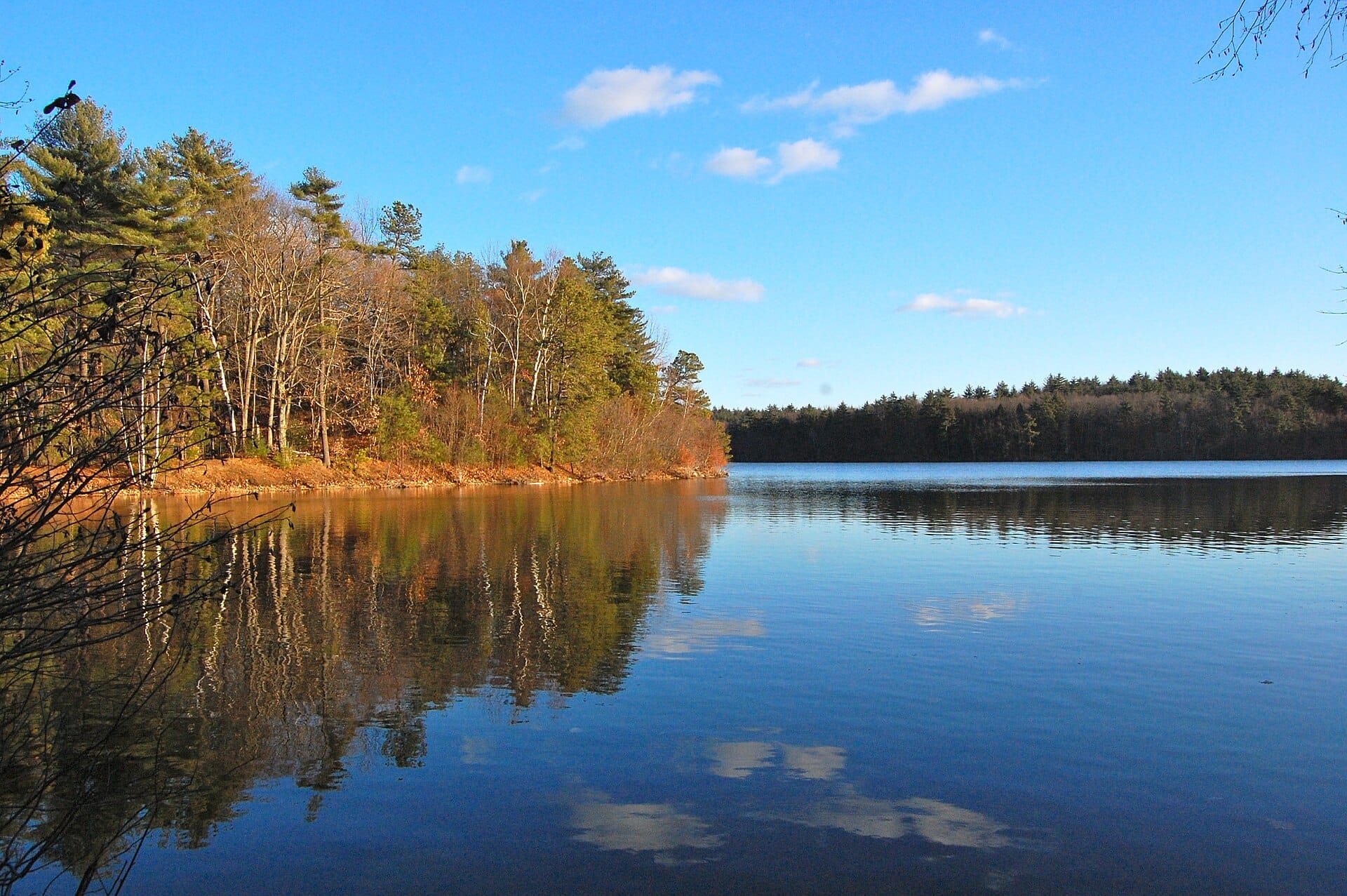
What Walden Pond Actually Is
Walden Pond State Reservation protects approximately 250 acres (101 ha) of land within the reservation and a 61-acre (25 ha) glacial kettle pond in Concord, Massachusetts. The pond itself formed roughly 10,000 to 12,000 years ago when a retreating glacier left a massive block of buried ice; as that ice melted, it created the round, steep-sided basin you see today. The water is exceptionally clear by Massachusetts standards, fed almost entirely by rain and groundwater rather than streams, and its maximum depth reaches about 102 feet.
Most visitors come because of one man. Henry David Thoreau built a small cabin on the pond's north shore in the spring of 1845 and lived there for two years, two months, and two days. His account of that period, published as Walden; or, Life in the Woods in 1854, became one of the foundational texts of American literature and environmentalism. Walden Pond was designated a National Historic Landmark in 1962, a recognition of its cultural weight rather than ecological rarity, though the ecology is well worth noting.
Walden Pond is one leg of a longer literary and natural history geography in the area. If you're building a full day, the surrounding Concord landscape connects to Minute Man National Historical Park, just a few miles east. For context on how this fits into Massachusetts' broader heritage, the Boston history guide covers the wider region's timeline.
The Pond at Different Times of Day
Arrive early and Walden Pond belongs almost entirely to you. The park opens at 5:00 am, and in the hour or two before 8 am, the Main Beach is quiet enough that you can hear the frog chorus on the far shore. The light is low and horizontal, cutting through the oak and pine canopy and laying gold strips across the water. Mist rises off the surface on cool mornings. This is when the place feels closest to what Thoreau described: an intimate, almost private relationship between a person and a body of water.
By late morning on a summer weekend, the dynamic shifts completely. The parking lot fills fast, sometimes before 10 am on hot July and August days. Families stake out positions on the sand, and the Main Beach becomes quite crowded. The swim area is roped off and lifeguarded during the main season. The pond water itself is cold even in summer, a product of its depth and groundwater supply, which surprises many first-time visitors expecting a tepid swimming hole.
⚠️ What to skip
The parking lot closes when the reservation reaches capacity, which can happen before noon on summer weekends. Check the DCR website or call the reservation's recorded message before driving out. If you're coming by MBTA, this issue disappears entirely.
Weekday afternoons in late spring and early fall offer perhaps the best overall balance: the crowds thin, the water temperature peaks after weeks of sun, and the slanted afternoon light makes the colors of the surrounding forest pop. The Visitor Center is open daily from 10:00 am to 4:00 pm, so arriving mid-afternoon still gives you access to the exhibits and restrooms there.
Tickets & tours
Hand-picked options from our booking partner. Prices are indicative; availability and final rates are confirmed when you complete your booking.
Boston Summer Night Trolley Tour and River Cruise
From 27 €Instant confirmationFree cancellationLEGOLAND Discovery Center Boston tickets
From 26 €Instant confirmationFree cancellationGhosts and Gravestones tour of Boston
From 39 €Instant confirmationFree cancellationBest of Boston tour
From 182 €Instant confirmationFree cancellation
The Thoreau Connection: What to See and Where
The cabin Thoreau built no longer stands, but its location is marked clearly on the north shore of the pond, about a ten-minute walk from the Main Beach parking area along the yellow-blazed Pond Path. A cairn of stones — started by admirers in the 19th century and grown ever since — marks the approximate site. Visitors continue to add stones, and the pile is substantial now, a spontaneous monument that Thoreau himself would probably have found both gratifying and ironic.
Near the Visitor Center, a full-scale reconstruction of the cabin's exterior gives you an accurate sense of scale: it was small, roughly 10 by 15 feet, with a single room, a fireplace, and a loft. Inside the Visitor Center, exhibits cover Thoreau's two-year experiment, the ecological significance of the kettle pond, and the 20th-century conservation battles that prevented the land from being developed. That history is worth knowing. By the 1950s, the pond faced serious degradation from overuse, and a public campaign eventually led to formal state protection.
Hiking the Pond Path and Surrounding Trails
The main trail around the pond is the Pond Path, a roughly 1.7-mile loop that stays close to the water's edge for most of its route. The footing is sandy and rooted in spots, and the trail crosses a few rocky outcroppings where you can sit directly over the water. Most fit adults complete the loop in 45 to 60 minutes at a relaxed pace. There are no significant elevation changes, though the path undulates over drumlin ridges in a few spots.
Beyond the pond loop, the reservation connects to Heywood Meadow and the Ridge Trail system in the surrounding woods. These secondary trails give you more solitude and a broader sense of the glacial landscape: rounded ridges, kettle depressions, and sandy soil that tells the whole story of the glacier without a single interpretive sign. Wear shoes with some grip; sandals are fine for the Main Beach but poor choices for the ridge trails, which can be slippery when wet.
If you're combining Walden with a longer outdoor day around Boston, the Boston outdoor activities guide has suggestions for pairing it with other green spaces in the region. For a closer-in option, Arnold Arboretum offers a very different but equally rewarding experience.
Swimming: What to Know Before You Get In
Swimming is the main draw for a large share of summer visitors. The Main Beach, on the northeast shore near the parking area, is the designated swim zone. A second smaller beach, Red Cross Beach, sits on the south shore and is accessible from the Pond Path. Both have sandy entries. The water clarity is remarkable, particularly in early summer before algae growth peaks: on a calm day, you can see the sandy bottom through 20 feet of water.
The pond runs cold. Surface temperatures in early June typically hover around 60 to 65°F (15 to 18°C), even after warm spring weather. By late July, the upper layer warms considerably, but jump in from one of the rocky ledges and you'll hit cold water fast. Lifeguards are on duty at the Main Beach during the summer season, but swimmers at Red Cross Beach are unsupervised. Children and weak swimmers should stay in the supervised area.
ℹ️ Good to know
There is no food concession inside the reservation. Bring water and snacks. The nearest stores are in Concord Center, about 1.5 miles north. Alcohol, fires, grilling, camping, and pets are not permitted anywhere in the reservation.
Getting There: The Car-Free Option Is Real
Walden Pond is roughly 20 miles northwest of downtown Boston, and driving is the default for most visitors. The reservation is located at 915 Walden Street in Concord, just off MA Route 126 south of Route 2. Parking costs $8 per day for Massachusetts-registered vehicles and $30 for vehicles with out-of-state plates. Fees are paid by credit card or through the DCR YODEL portal; the reservation does not accept cash.
The car-free approach is more practical than most visitors realize. The MBTA Fitchburg Commuter Rail Line runs from North Station in Boston to Concord Station, and trains run throughout the day, with the journey taking roughly 40 to 50 minutes. Concord Station sits about 1.4 miles northwest of the reservation entrance, a walk of 25 to 30 minutes through a quiet residential area on a mostly flat route. This option eliminates the parking fee and the capacity stress entirely, and arriving by train means you're also walking through part of Concord's historic center.
For more on navigating the MBTA commuter rail and other ways to move around the Greater Boston area, the guide to getting around Boston covers commuter rail logistics alongside subway and bus options.
When to Visit and What Weather Does to the Experience
Late May through early June is arguably the strongest window. The trees are fully leafed but summer crowds have not yet arrived, the water is cold but swimmable for determined swimmers, and the light in the late afternoon is warm without the August haze. Weekday visits in this period can feel uncrowded.
Fall is the other peak window for quality. September and October bring fewer people and spectacular foliage reflected in the pond's clear water. The swim season is effectively over, but the hiking and contemplative aspects of the visit improve: the air is sharp, the forest floor turns red and gold, and the reflection of the tree line in the still water on a calm October morning is something worth making a specific trip for.
For a detailed look at the fall season around Boston, including specific timing for foliage, the Boston in fall guide is worth reading before you plan your trip.
Winter visits are possible and sometimes atmospheric, but the park's reduced hours, cold temperatures, and absence of amenities make it a specialist interest. Spring, before the trees fill in, offers good birdwatching and a clear view of the pond's shape that summer obscures.
Is It Worth the Trip?
Walden Pond is not a spectacular natural landscape in the way Acadia or the White Mountains are. The pond is relatively small, the surrounding forest is second growth, and on a peak summer weekend the Main Beach can feel more like a suburban recreational facility than a place of philosophical significance. Visitors expecting an overwhelming scenic experience may find it modest.
What it offers instead is something harder to find: a place where a specific set of ideas about simplicity, nature, and deliberate living took actual physical form, and where that landscape is still largely recognizable 175 years later. The walk to the cabin site, the sound of the water through the pines, and the scale of the pond, small enough to swim across but large enough to feel open, all have a quiet cumulative effect that most visitors describe as different from what they expected. It repays attention. Visitors who arrive in a rush, photograph the cabin replica, and leave in 45 minutes will miss most of what the place has to offer.
Travelers who are not interested in Thoreau and are looking purely for a great swimming destination in the Boston area will find perfectly good alternatives closer to the city. But for those willing to make the commuter rail journey and spend a proper half-day, Walden Pond delivers something distinct in the regional landscape.
Insider Tips
- Arrive before 8:00 am on summer weekends if you're driving. The lot fills well before noon and the DCR posts real-time capacity alerts online. The walk from Concord Station sidesteps this problem entirely.
- The Pond Path runs counterclockwise from the Main Beach to the cabin site and back. Most visitors go clockwise, following the first visible trailhead. Go the opposite direction and you'll pass the cabin site before the crowds arrive.
- The Visitor Center exhibits on the conservation history of the pond, particularly the fight against development in the mid-20th century, are undervisited and interesting. Budget 20 minutes there even if you're primarily there to hike.
- Cell coverage is inconsistent in parts of the reservation, particularly on the south and west shore trails. Download an offline map before you arrive if you plan to go beyond the Pond Path loop.
- The commuter rail schedule thins out on weekends. Check the MBTA Fitchburg Line timetable in advance and identify your return train before you leave, especially if you're visiting in fall when sunset comes early.
Who Is Walden Pond For?
- Readers and literary travelers tracing Thoreau's writing in its original setting
- Families with children looking for a supervised freshwater swimming beach with nearby hiking
- Day-trippers pairing Walden Pond with Concord's historic center and Minute Man National Historical Park
- Fall foliage seekers wanting quiet reflection rather than crowded viewpoints
- Hikers who prefer a meditative, flat-to-gentle woodland walk over strenuous terrain
Nearby Attractions
Combine your visit with:
- Arnold Arboretum
Founded in 1872, the Arnold Arboretum is the oldest public arboretum in North America — a free, 281-acre landscape in Jamaica Plain managed by Harvard University. With over 15,000 accessioned plants and sweeping hillside views, it draws botanists, dog walkers, and curious visitors in equal measure across all four seasons.
- Blue Hills Reservation
Ten miles south of downtown Boston, Blue Hills Reservation spreads across more than 7,000 acres of forested hills, rocky ridgelines, and glacial wetlands. Free to enter and open year-round from dawn to dusk, it offers 125 miles of trails ranging from easy pond-side loops to a genuine summit climb at 635-foot Great Blue Hill.
- Boston Duck Tours
Boston Duck Tours puts you aboard a replica World War II DUKW amphibious vehicle for an 80-minute circuit of the city's most historic landmarks, finishing with a splash into the Charles River. Running seasonally from late March through late November, it's one of the few tours in Boston that covers both street-level sights and a Charles River perspective in a single trip.
- Boston Harbor Islands
Boston Harbor Islands National and State Park puts 34 islands and peninsulas within easy ferry reach of downtown Boston. From Civil War earthworks on Georges Island to the oldest lighthouse station in the United States on Little Brewster, the park rewards visitors who are willing to trade the city's brick sidewalks for salt air and open water.