Minute Man National Historical Park: Where the Revolution Began
Minute Man National Historical Park preserves the 970-acre corridor where the first shots of the American Revolution were fired on April 19, 1775. Spread across Lexington, Lincoln, and Concord, the park offers free admission, a five-mile Battle Road Trail, and one of the most consequential landscapes in American history.
Quick Facts
- Location
- Lexington, Lincoln & Concord, MA (approx. 16 miles northwest of Boston)
- Getting There
- By car via I-95/Rte 128 to Rte 2A; no direct MBTA rail to the park — MBTA Commuter Rail (Fitchburg Line) reaches Concord Center, about 1.5 miles from North Bridge
- Time Needed
- 2–5 hours (full Battle Road Trail takes 3–4 hours on foot; North Bridge alone is 1–1.5 hours)
- Cost
- Free — no entrance fee
- Best for
- History enthusiasts, walkers, families, fall foliage seekers, photographers
- Official website
- www.nps.gov/mima/index.htm
What Minute Man National Historical Park Actually Is
Minute Man National Historical Park is a federally protected landscape covering roughly 970 acres across three Massachusetts towns: Lexington, Lincoln, and Concord. Established on September 21, 1959, as a unit of the National Park System, the park preserves the ground over which British Regulars and colonial Minute Men fought on April 19, 1775 — the opening engagements of the American Revolutionary War. This is not a single monument or building. It is a corridor: fields, forest, stone walls, farm foundations, and a five-mile trail threading through terrain that looks, in places, remarkably close to how it appeared 250 years ago.
The park divides roughly into two sections. The eastern portion follows the Battle Road — the route British troops marched from Lexington toward Concord and then retreated along under fire. The western section centers on North Bridge in Concord, where colonial forces fired what Ralph Waldo Emerson later called 'the shot heard round the world.' Most visitors choose one or the other on a half-day visit, though the full experience rewards those who see both.
💡 Local tip
Start at the Minute Man Visitor Center on Route 2A in Lincoln (near the eastern entrance off I-95/Route 128) before hitting the trail. The 25-minute film shown there provides context that makes the landscape far more legible once you're walking it.
The Battle Road Trail: Walking the Fight
The Battle Road Trail runs approximately five miles along the original road the British column used on April 19, 1775. The surface shifts between packed gravel, dirt path, and original paved road sections. For much of its length it passes through second-growth forest and open meadow, with interpretive wayside markers at significant positions: Hartwell Tavern, the Bloody Angle, Meriam's Corner, and the site of the Ephraim Hartwell House.
Hartwell Tavern, a restored 18th-century farmhouse staffed seasonally by living-history interpreters in period dress, is worth a slow stop. On weekends in summer and early fall, you may find a musket demonstration in the yard, the smell of woodsmoke drifting from the kitchen hearth, and a ranger explaining the social structure of a colonial farming household. The detail is granular and credible — not the sanitized version you get at theme parks.
The Bloody Angle is the spot where the trail makes a sharp bend and where colonial militia inflicted particularly heavy casualties on the retreating British column from behind stone walls and tree cover. Standing there, the tactical logic is immediately apparent: the walls that farmers built to clear fields for planting became perfect cover for ambush. The park does not over-dramatize this. A simple marker explains what happened. The silence does the rest.
ℹ️ Good to know
The Battle Road Trail is relatively flat and well-maintained, but some sections are unpaved. Sturdy walking shoes are sufficient for most of it. The trail is open sunrise to sunset year-round, though visitor center hours are seasonal (generally April through October, roughly 9:00–17:00 when open — confirm current hours at nps.gov/mima before visiting).
Tickets & tours
Hand-picked options from our booking partner. Prices are indicative; availability and final rates are confirmed when you complete your booking.
Day trip to Newport Mansions from Boston
From 120 €Instant confirmationFree cancellationComprehensive Historical Tour of Boston's Iconic Landmarks
From 76 €Instant confirmationFree cancellationHistorical Cambridge and Harvard Square doughnut tour
From 60 €Instant confirmationFree cancellationBoston Summer Night Trolley Tour and River Cruise
From 27 €Instant confirmationFree cancellation
North Bridge and Concord: The Western Section
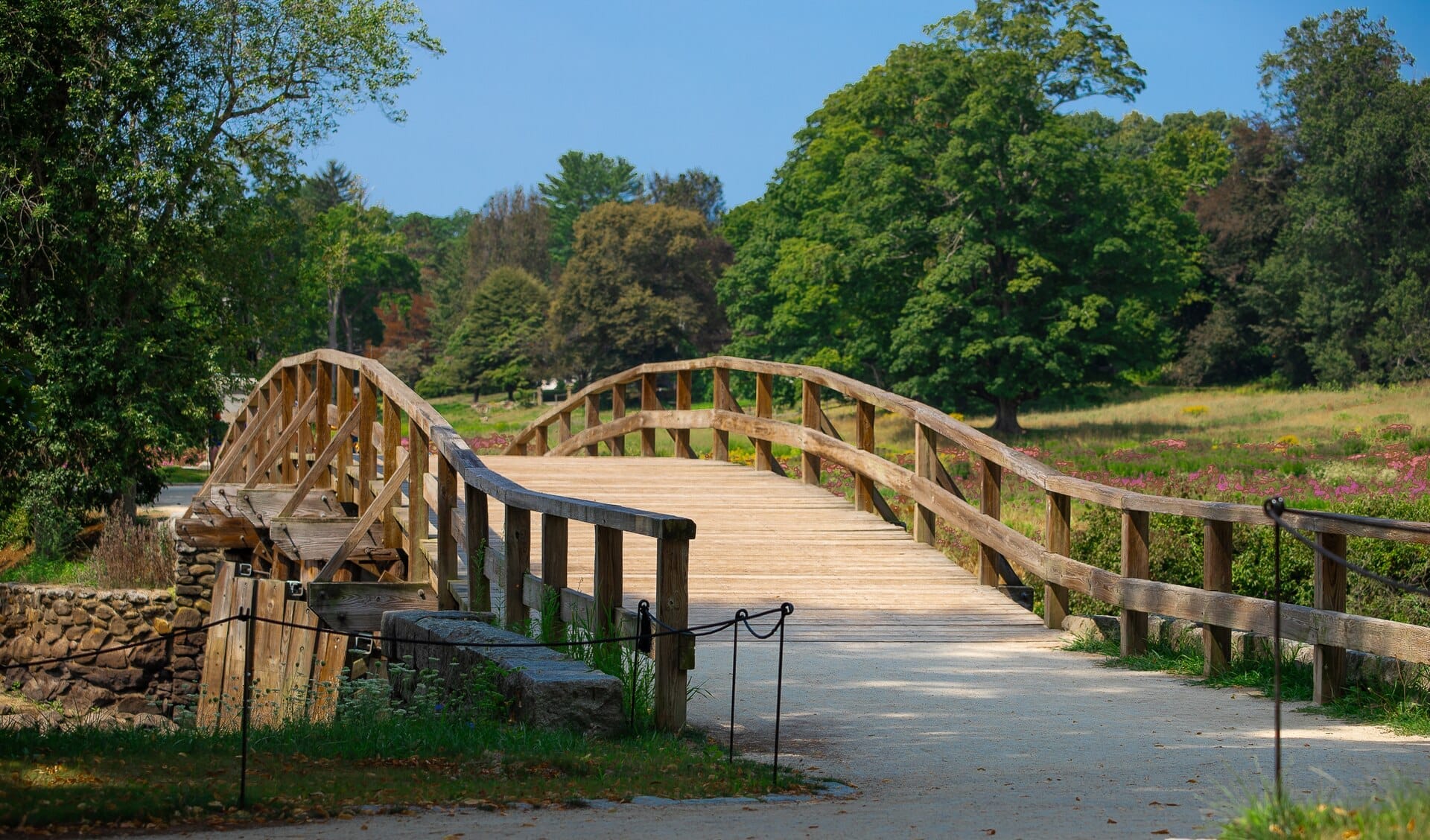
North Bridge, a wooden footbridge over the Concord River, is the park's most iconic single site. The replica bridge — the original structure is long gone — sits in a quiet meadow framed by the Concord River and a line of willows. Daniel Chester French's Minute Man statue, unveiled in 1875 for the centennial, stands at the Concord side of the bridge. This is the same sculptor who later made the Lincoln Memorial seated figure. The statue is bronze, slightly larger than life, and depicting a farmer-soldier with a plow at his feet and a musket in his hands.
The North Bridge area is quieter and more pastoral than the Battle Road section. On a weekday morning, especially in spring or fall, the meadow is often nearly empty. The river moves slowly past the bridge, red-winged blackbirds call from the reeds, and the whole scene has a stillness that makes the violence of April 19, 1775 feel both distant and suddenly comprehensible. The North Bridge Visitor Center, located in the Buttrick Mansion nearby, provides additional historical exhibits.
If you are spending a full day in the area, Concord Center — a short walk or drive from North Bridge — adds literary depth to the historical context. The town was home to Emerson, Thoreau, Hawthorne, and Louisa May Alcott. The combination of revolutionary history and 19th-century literary culture makes this one of the more intellectually layered day trips in the Boston region. For more on planning a full day out here, the day trips from Boston guide covers logistics and timing in detail.
How the Park Changes by Time of Day and Season
Early morning, particularly on weekdays, is the best time to experience the Battle Road Trail without interruption. By 8:00 AM, the light comes low through the tree canopy, the trail is cool, and the only sounds are birds and your own footsteps on the gravel. Weekend middays in summer bring school groups, tour buses, and organized reenactments — valuable if you want the living-history experience, but crowded around the visitor center and Hartwell Tavern.
Fall is arguably the park's best season. Late September through mid-October, the forest along the Battle Road turns amber and copper, the meadows at North Bridge go golden, and the crowds thin noticeably after the school-group peak. The light in October afternoon is particularly good for photography along the bridge and the open sections of the trail. Bring layers — temperatures can drop quickly once you're in the shade of the tree corridor.
Winter visits are possible and atmospheric: snow on the stone walls, frost on the meadow grass, the park almost entirely empty. The visitor centers are closed or operating reduced hours from November through March, so come prepared with a trail map downloaded in advance. For the full picture of what Boston-area attractions look like in the cold months, the Boston in fall guide and the Boston in winter guide offer seasonal context.
Historical Context: Why April 19, 1775 Matters
The events commemorated at Minute Man National Historical Park were not the result of a single political decision but the culmination of years of escalating tension between the British Crown and the Massachusetts colonists. On the night of April 18, 1775, British General Thomas Gage ordered roughly 700 Regulars to march from Boston to Concord to seize colonial military stores. Paul Revere, William Dawes, and Samuel Prescott rode ahead to warn the colonial militias.
At Lexington Green early on the morning of April 19, approximately 77 militia from Captain John Parker’s company faced the British column. Shots were exchanged — eight colonists died. The British continued to Concord, where they found most of the military stores already moved. At North Bridge, colonial forces who had been gathering on the high ground above the river advanced toward the British unit guarding the bridge. Shots were fired; two colonists and three British soldiers were killed. The British column began its retreat toward Boston, and by the time they reached Charlestown, 73 British soldiers were dead and 174 wounded, with 26 missing. Colonial casualties were 49 killed, 41 wounded, and 5 missing. For deeper historical background on the events leading to that morning, the Boston history guide traces the full arc from colonial settlement to independence.
The significance is not merely military. The Battle Road was the first sustained guerrilla engagement against a professional European army in the New World, and its outcome demonstrated that colonial resistance was viable. The landscape you walk today was the proving ground for that argument.
Practical Walkthrough: How to Plan Your Visit
By car, the park is reached via I-95/Route 128 to Route 2 or Route 2A, with signed exits to both the eastern visitor center (Lincoln) and the North Bridge area (Concord). Parking is free at major sites including the Minute Man Visitor Center, Hartwell Tavern, and the North Bridge trailhead. On busy summer weekends, the North Bridge parking area fills by mid-morning — arrive before 9:00 AM or plan to park at Buttrick Mansion and walk.
Without a car, the MBTA Commuter Rail Fitchburg Line reaches Concord Center, from which North Bridge is approximately 1.5 miles on foot along Monument Street — a manageable walk with good views. The Battle Road section near the eastern visitor center is not realistically walkable from any rail station. Check current MBTA schedules at mbta.com before traveling.
The park is free to enter, with no per-person or per-vehicle charge. This makes it one of the most substantive free historical experiences in Greater Boston — on par with walking the Freedom Trail in terms of historical density, but considerably less crowded. For other no-cost options in the city, the free things to do in Boston guide covers the full range.
⚠️ What to skip
There is no food or water available inside the park. Bring water and snacks, particularly if you plan to walk the full Battle Road Trail. The nearest services are in Lexington Center or Concord Center, each about a 5-10 minute drive from the main park access points.
Photography and Accessibility
For photography, the two best locations are the North Bridge meadow in morning light (the east-facing orientation means the bridge and statue are front-lit early in the day) and the canopy sections of the Battle Road Trail in fall, where the tree tunnel effect is pronounced. The Minute Man statue photographs best in overcast conditions — direct midday sun creates harsh shadows on the bronze.
Accessibility varies across the park. The Minute Man Visitor Center, North Bridge Visitor Center, and key trailhead areas have accessible parking and restrooms. Portions of the Battle Road Trail are graded and paved, suitable for wheelchairs and mobility devices, though unpaved sections and some historic structures present barriers. The North Bridge itself and the meadow approach are relatively flat and accessible. The NPS accessibility page at nps.gov/mima provides specific details by site.
Who Should Skip This
If you have a single half-day in Boston and want maximum visual drama per hour, there are denser in-city options. The park requires a car for the full experience, demands walking (the most meaningful sections are not driveable), and rewards visitors who come with at least a baseline interest in American Revolutionary history. Travelers who find 18th-century military and political history dry, or who are primarily interested in urban neighborhoods, dining, or contemporary culture, will likely find this pilgrimage unsatisfying.
Similarly, visitors expecting a polished theme-park presentation may be surprised by the park's restraint. The NPS approach here is deliberate understatement: modest signage, preserved landscape, and ranger interpretation rather than immersive technology. That restraint is precisely what makes it powerful for the right visitor — but it is not for everyone.
Insider Tips
- The April 19 Patriots Day reenactment draws large crowds and can make parking nearly impossible — if you want to see the living-history event, arrive before 7:00 AM or take the MBTA to Concord. If you want a quieter visit, avoid the park entirely in the week surrounding Patriots Day (the third Monday in April in Massachusetts).
- Rangers lead free guided walks from the Minute Man Visitor Center when the visitor center is open. These fill up on weekends. The ranger walks cover ground and interpretation that the wayside markers alone cannot replicate — worth timing your arrival to catch one.
- The Wayside, a historic house in Concord associated with Nathaniel Hawthorne, Louisa May Alcott, and the Alcott family, is technically part of the park but operates on a separate schedule and may charge a small tour fee. Check the NPS site for current tour availability; it adds a compelling literary layer to the history.
- Cell service is inconsistent along the Battle Road Trail, particularly in the forested central section. Download the NPS Minute Man app or a PDF trail map before you leave the visitor center parking lot.
- The stone walls along the Battle Road are original — many date to the 18th century. Running your hand along them connects the abstraction of 'colonial farmland' to something tactile and specific. The farmers who built them were the same men who used them as cover on April 19.
Who Is Minute Man National Historical Park For?
- American history enthusiasts who want landscape context, not just museum exhibits
- Walkers and hikers looking for a half-day trail with genuine historical content
- Families with older children (roughly 8+) who can engage with interpretive signage and ranger talks
- Fall foliage seekers wanting a less-crowded alternative to peak-season destinations
- Visitors combining a Concord day trip with literary and natural history stops
Nearby Attractions
Combine your visit with:
- Arnold Arboretum
Founded in 1872, the Arnold Arboretum is the oldest public arboretum in North America — a free, 281-acre landscape in Jamaica Plain managed by Harvard University. With over 15,000 accessioned plants and sweeping hillside views, it draws botanists, dog walkers, and curious visitors in equal measure across all four seasons.
- Blue Hills Reservation
Ten miles south of downtown Boston, Blue Hills Reservation spreads across more than 7,000 acres of forested hills, rocky ridgelines, and glacial wetlands. Free to enter and open year-round from dawn to dusk, it offers 125 miles of trails ranging from easy pond-side loops to a genuine summit climb at 635-foot Great Blue Hill.
- Boston Duck Tours
Boston Duck Tours puts you aboard a replica World War II DUKW amphibious vehicle for an 80-minute circuit of the city's most historic landmarks, finishing with a splash into the Charles River. Running seasonally from late March through late November, it's one of the few tours in Boston that covers both street-level sights and a Charles River perspective in a single trip.
- Boston Harbor Islands
Boston Harbor Islands National and State Park puts 34 islands and peninsulas within easy ferry reach of downtown Boston. From Civil War earthworks on Georges Island to the oldest lighthouse station in the United States on Little Brewster, the park rewards visitors who are willing to trade the city's brick sidewalks for salt air and open water.