Vulcano Island: Craters, Mud Baths, and Raw Volcanic Scenery in the Aeolian Islands
Vulcano is the southernmost of Sicily's Aeolian Islands and the one that delivers the archipelago's volcanic drama most directly. From the rim of the Gran Cratere to the sulphurous mud baths at Porto di Levante, this compact island packs an intense sensory experience into a small footprint. It rewards a full day, and for those who stay overnight, it reveals a quieter, more elemental side after the day-trippers leave.
Quick Facts
- Location
- Vulcano, Aeolian Islands, Province of Messina, Sicily, Italy
- Getting There
- Ferry or hydrofoil from Milazzo (approx. 45–60 min by hydrofoil); no airport on the island
- Time Needed
- Full day minimum; overnight stay recommended to experience the island after day-trippers depart
- Cost
- Island access is free; ferry fares vary by operator and season; mud baths and crater trail charge small fees (reported around €3–7, verify on site)
- Best for
- Volcano enthusiasts, hikers, geology lovers, travellers seeking raw Mediterranean landscapes
- Official website
- www.visitsicily.info/en/vulcano
What Vulcano Actually Is
Vulcano Island is not a postcard. It smells of sulphur, its beaches are dark grey or rust-red depending on the mineral content underfoot, and the landscape is stripped back to something geological and unornamented. That is precisely its appeal. Of the seven inhabited Aeolian Islands, Vulcano is the one that confronts you with the fact that you are standing on a volcano, rather than simply around one.
Covering roughly 21 square kilometres in the Tyrrhenian Sea, Vulcano is the southernmost of the Aeolian Islands and the closest to the Sicilian coast. Volcanic activity has shaped this terrain for approximately 120,000 years. The last major eruptive phase of the main cone, the Gran Cratere, occurred between 1888 and 1890. The volcano is currently in a state of fumarolic activity, meaning gases and steam vent continuously from the crater rim and from underwater vents near the port. The island is monitored by Italian geological authorities, and while eruptions are not currently ongoing, this is classified as an active volcanic system.
The Aeolian Islands, including Vulcano, hold UNESCO World Heritage status for their geological significance as a textbook example of volcanic island-building processes. If you want to understand the broader archipelago before you arrive, the Aeolian Islands travel guide covers all seven islands and how they compare.
⚠️ What to skip
Visitors with respiratory conditions, asthma, or cardiovascular issues should exercise caution. Sulphurous gas concentrations near the mud baths and crater fumaroles can be intense, particularly on still days when there is no wind to disperse them. Children and pregnant women should also approach these areas carefully.
The Gran Cratere: Hiking to the Rim
The defining experience on Vulcano is the climb to the rim of the Gran Cratere. The trail begins near Porto di Levante and ascends approximately 390 metres to the crater rim. The path is steep, loose underfoot in places, and sandy for much of the upper section. It is not a technical climb, but it demands a reasonable level of fitness. Allow between one and two hours for the ascent depending on your pace, and roughly the same for the descent.
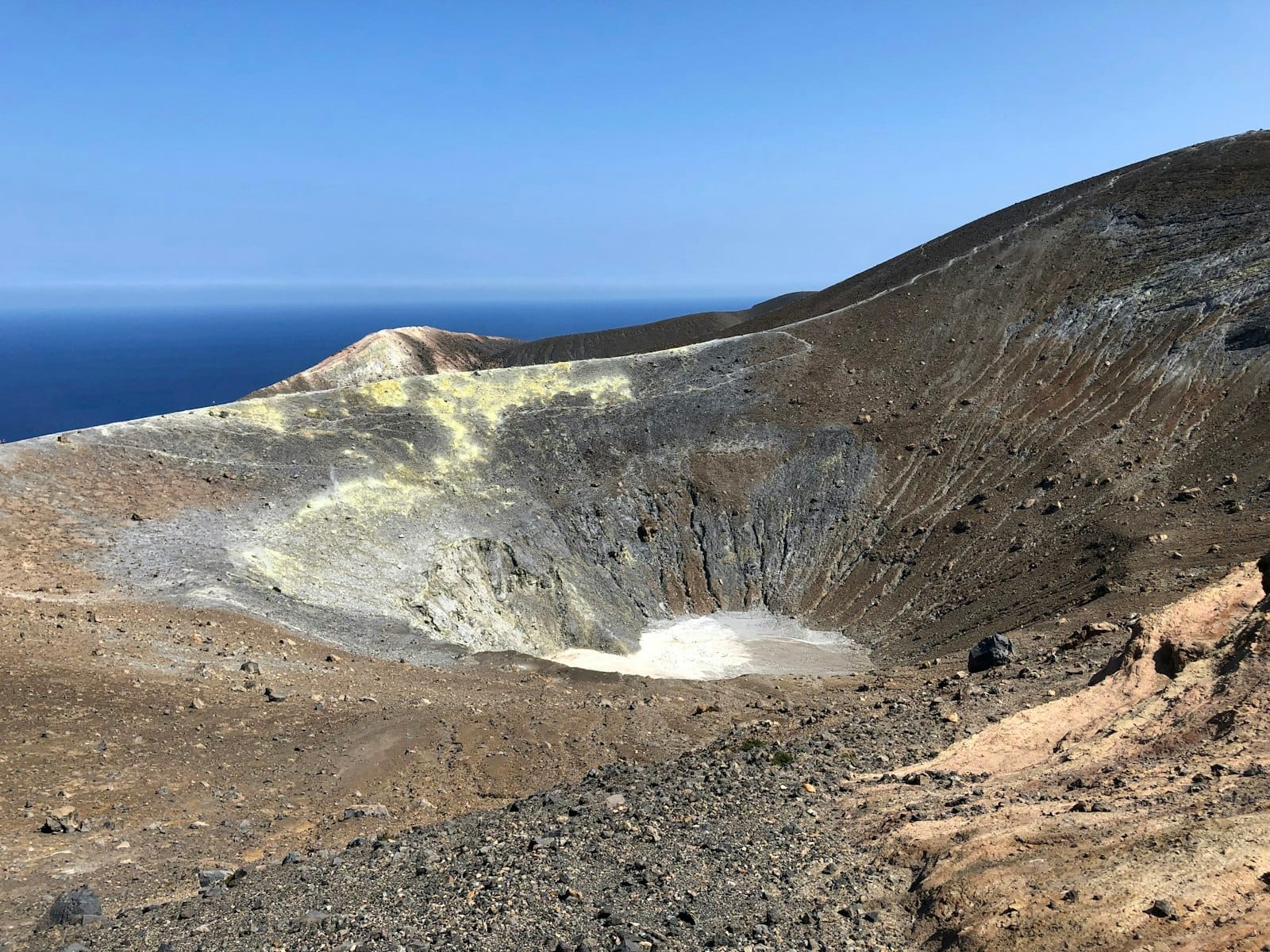
What you encounter at the top is difficult to prepare for. The crater rim is wide enough to walk sections of it, and the views in every direction are extraordinary. To the north, on a clear day, you can see Lipari, Salina, Stromboli, and the full spread of the Aeolian chain. Below, the crater floor is a shifting palette of yellows, oranges, and whites left by mineral deposits. The fumaroles along the rim vent with a hiss you can hear before you see them, and the smell is sharp and unmistakable.
Start the hike no later than 7:30 or 8:00 in the morning during summer. The trail has no shade whatsoever, and by mid-morning the heat reflecting off the pale volcanic rock becomes punishing. Bring at least one and a half litres of water per person, sun protection, and closed shoes with grip. Sandals are a poor choice on the loose upper sections. A small entrance fee for the crater trail is charged at the base; fees are reported in the range of approximately €3–7 but should be verified on site as they vary by season and operator.
💡 Local tip
Photography tip: the crater rim is at its most dramatic in the early morning, when low-angle light catches the sulphur deposits and mist still clings to the lower flanks. By midday the scene is bleached out and less photogenic. A polarising filter helps cut haze across the inter-island views.
Tickets & tours
Hand-picked options from our booking partner. Prices are indicative; availability and final rates are confirmed when you complete your booking.
Lipari and Vulcano mini-cruise from Taormina
From 80 €Instant confirmationFree cancellationIslands of Lipari and Vulcano from Cefalu
From 75 €Instant confirmationFree cancellationFull Day Islands of Lipari and Vulcano Tour from Taormina
From 82 €Instant confirmationFree cancellation4x4 off-road tour of Vulcano's hidden scenic spots
From 55 €Instant confirmationFree cancellation
The Mud Baths and Thermal Waters
At Porto di Levante, a short walk from the ferry dock, the Fanghi di Vulcano were shallow thermal pools fed by volcanic gases bubbling up through the seabed. The mud that accumulated in these pools was mineral-rich and warm, reportedly reaching temperatures around 40 degrees Celsius in the pools themselves, and considerably hotter close to active vents, but the site has been closed to the public in recent years for safety reasons. Visitors coat themselves in grey mud, wait for it to dry and crust, then rinse in the adjacent sea.
Be clear-eyed about what this is. The mud baths are not a luxury spa experience. The smell is overwhelming, the pools are shared with strangers in varying states of grey-coated undress, and the area around the pools is often crowded between late morning and early afternoon in high season. Go early, before 9:00, if you want a calmer experience. Leave any jewellery, especially silver, in your accommodation: sulphur compounds will blacken silver permanently within minutes of contact.
The nearby stretch of coast, sometimes called Acque Calde, has naturally heated seawater where volcanic vents warm the shallows. Snorkelling in these areas gives you an unusual view of the seabed geology. When the formal mud bath area is open, a small fee is charged for access; however, the site has been closed to the public in recent years, so current access and pricing should be checked locally. Bring an old swimsuit you do not mind staining, and rinse thoroughly in fresh water afterwards.
Beaches and Coastline
Vulcano's most photographed beach is the Spiaggia Nera, a stretch of dark volcanic sand at Porto di Levante. The sand is fine and blackened by basaltic minerals, which absorbs heat quickly, so beach shoes are useful here in summer. The water is clear and shifts through deep greens and blues in a way that reads differently against the dark shore than it would against pale limestone. It is not a large beach, and it fills up fast in July and August.
On the western side of the island, Spiaggia di Gelso sits at the foot of cliffs and is considerably less visited. Getting there requires a scooter, taxi, or a long walk. The reward is calm, clean water and far fewer people. The restaurant at Gelso operates seasonally and is worth checking before you make the trip. Spiaggia dell'Asino, also known as Spiaggia di Ponente, is the longest beach on the island and more sheltered; it sits near the thermal zone and tends to attract a mixed crowd of day-trippers and longer-stay visitors.
Getting to Vulcano and Moving Around the Island
Vulcano has no airport. The only way to reach the island is by sea. The main departure point from Sicily is Milazzo, a port town on the northeastern Sicilian coast, from which hydrofoils take approximately 45 to 60 minutes to reach Porto di Levante. Ferries also connect Vulcano with Messina and offer seasonal connections to Naples and ports on the Calabrian coast. Timetables and operators vary considerably by season; check current schedules before planning your trip, as winter services are significantly reduced.
If you are travelling from Palermo or Catania, you will need to reach Milazzo first, either by train or by bus. The guide to getting around Sicily explains intercity transport options in detail.
Once on the island, the flat area around Porto di Levante is walkable. For the crater trail and for reaching remote beaches, most visitors hire scooters, quad bikes, or bicycles from rental shops near the port. Taxis are available but limited. There is no public bus network in the conventional sense; a minibus service operates on some routes, but schedules should be confirmed locally. The island is compact enough that a scooter gives you full access in half a day.
ℹ️ Good to know
The island of Vulcano is administered as part of the Comune di Lipari, which includes several of the Aeolian Islands. If you are visiting multiple islands, ferries between them are generally efficient in high season, with Lipari being the most connected hub.
When to Visit and What to Expect by Season
The Aeolian Islands have a strongly seasonal tourist economy. From late June through August, Vulcano is crowded, accommodation prices are at their peak, and the ferry crossings from Milazzo require advance booking. The crater hike in August heat is genuinely demanding and should not be underestimated. If your goal is the volcanic landscape rather than the beach scene, late May, early June, or September offer significantly better conditions: fewer visitors, cooler temperatures on the hike, and a more composed atmosphere around the port.
Spring visits, particularly April and May, come with the caveat that some seasonal businesses may not yet be open, and boat schedules are leaner. The island is quieter, the light is softer, and the vegetation on the lower flanks shows more green than it does in the bleached summer months. October can be a good shoulder-season option, though services begin to contract again and weather becomes less predictable.
For a broader picture of how the seasons affect travel across the region, the best time to visit Sicily guide covers climate patterns, crowds, and costs across the island.
Practical Considerations Before You Go
Accommodation on Vulcano ranges from simple rooms above small restaurants to better-appointed hotels near the port. Most of the island's overnight options are in or near Porto di Levante and Porto di Ponente. Booking well in advance is essential for summer. There are no major supermarkets in the conventional sense; stock up on any specific supplies in Milazzo before boarding.
The terrain around the crater is genuinely inaccessible for visitors with significant mobility impairments. Sandy and steep, the trail has no infrastructure for assisted access. The port area and the beaches closer to it are more manageable on relatively flat ground. If you are travelling with someone who cannot hike, the island still offers the mud baths, the beach, and views across the channel to Lipari, which is satisfying on its own terms.
If you are planning a multi-island itinerary, Lipari Island is the largest of the Aeolian Islands and makes a natural base, with more accommodation options and onward ferry connections to Stromboli and Panarea.
Who Might Want to Skip Vulcano
Vulcano is not a conventional beach holiday. If you are looking for a soft, polished Mediterranean island experience with clear turquoise water over white sand, this is not the right destination. The beaches are dark, the smell near the mud baths is persistent and strong, and the landscape is austere rather than lush. Visitors who found Stromboli or Etna too intense from an environmental sensory standpoint may find Vulcano similarly uncomfortable.
Day-trippers who arrive late morning and plan to see the crater, the mud baths, and the beach in a single short visit often end up rushed and frustrated by the crowds. If you cannot commit to an early start and a full day, the experience is diminished. One hour at the mud baths between noon and two in August is genuinely unpleasant. Give the island proper time, or reconsider the itinerary.
Insider Tips
- Leave any silver jewellery, including rings and chains, locked in your accommodation before going near the mud baths. Sulphur compounds will blacken silver within minutes of exposure and the discolouration is very difficult to reverse.
- The ferry dock at Porto di Levante has a bar directly adjacent to it. Arrive early, get a coffee, and watch the island wake up before the hydrofoils from Milazzo begin delivering day-trippers around mid-morning. The difference in atmosphere between 8:00 and 11:00 is substantial.
- If you plan to hike the Gran Cratere and visit the mud baths in the same day, do the hike first. You will be less fatigued, the light is better, and you can cool off in the thermal waters afterwards rather than arriving at the trailhead already spent.
- The western beach at Gelso, reached by scooter or taxi, is significantly quieter than the port-side beaches even in August. The drive across the island also gives you a view of the interior landscape that most day-trippers never see.
- Book your return hydrofoil ticket when you buy your outbound one. In peak season, departures fill up quickly and being stranded on an extra unplanned night, while not catastrophic, is an inconvenience that is easy to avoid.
Who Is Vulcano For?
- Hikers and volcano enthusiasts who want to stand on an active crater rim without a multi-day expedition
- Geology and natural history travellers drawn by the UNESCO volcanic landscape
- Photographers working in early morning light, looking for stark, unusual Mediterranean compositions
- Travellers doing a multi-island Aeolian circuit who want to anchor one night on the island closest to Sicily
- Anyone who finds conventional beach islands too predictable and wants landscape with some geological tension
Nearby Attractions
Other things to see while in Aeolian Islands:
- Lipari
Lipari is the largest and most accessible of Sicily's Aeolian Islands, a UNESCO World Heritage volcanic archipelago in the Tyrrhenian Sea. From its towering citadel and world-class archaeological museum to obsidian-streaked cliffs and crystalline coves, Lipari rewards travelers who want more than a beach stopover.
- Panarea
Panarea is the smallest of the seven inhabited Aeolian Islands, a car-free volcanic outcrop in the Tyrrhenian Sea with a surface area of just 3.4 km². part of a UNESCO World Heritage Site for its geological significance, it draws travelers who want crystalline water, dramatic terrain, and an atmosphere that feels genuinely removed from the mainland. It is also, by Aeolian standards, one of the priciest places to stay in Sicily.
- Salina
Salina is the second-largest of the Aeolian Islands, shaped by twin extinct volcanoes and unusually lush vegetation compared to its neighbours. It produces the archipelago's finest Malvasia dessert wine, grows some of Sicily's best capers, and attracts visitors who want genuine island life over day-trip crowds.
- Stromboli
Stromboli is one of the world's most persistently active volcanoes, erupting small bursts of lava and ash typically every 20–30 minutes around the clock. Part of the Aeolian Islands UNESCO World Heritage Site, it draws travelers willing to reach a genuinely remote place in exchange for an experience that is difficult to match anywhere in Europe.