Vatican Museums: The Complete Visitor Guide
The Vatican Museums are one of the largest and most visited art collections on earth, spanning papal apartments, ancient sculptures, Renaissance galleries, and the Sistine Chapel. Understanding the scale before you arrive makes all the difference between a meaningful visit and an exhausting march.
Quick Facts
- Location
- Viale Vaticano, Vatican City (within Rome)
- Getting There
- Metro Line A – Ottaviano-S. Pietro, then a 10-min walk
- Time Needed
- 3–5 hours minimum; a full day for serious visitors
- Cost
- From €10 (reduced); €17–20+ for skip-the-line online booking. Verify current rates at museivaticani.va
- Best for
- Art history lovers, first-time Rome visitors, and anyone who wants to see the Sistine Chapel in context
- Official website
- www.museivaticani.va
What the Vatican Museums Actually Are
The Vatican Museums, known officially as the Musei Vaticani, are not a single museum in the conventional sense. They are a sprawling complex of interconnected galleries, courtyards, and decorated halls spread across more than 42,000 square meters inside Vatican City, the world's smallest sovereign state. Over 70,000 pieces are on permanent display, drawn from two millennia of papal collecting. Another 50,000 works are preserved in storage, unseen by the public. The sheer density is disorienting at first, but that is part of the experience.
The collection ranges from ancient Egyptian artifacts and Etruscan bronzes to Raphael's frescoed apartments and the ceiling that Michelangelo spent four years painting while lying on scaffolding. Practically speaking, the Sistine Chapel draws almost everyone, but many visitors leave without fully appreciating what surrounds it. The museums reward curiosity and punish rushing.
💡 Local tip
Book tickets online in advance through the official website (museivaticani.va). The queue for walk-up visitors can stretch for hours, especially between April and October. The skip-the-line option adds a modest fee but is consistently worth it.
A Brief History of the Collection
The museum's origin story is surprisingly precise. In 1506, a farmer digging in his vineyard on the Esquiline Hill unearthed a marble sculpture of a Trojan priest and his sons being crushed by sea serpents. Pope Julius II, an aggressive patron of the arts, immediately recognised it as the Laocoön group, a sculpture described by the Roman author Pliny the Elder. Julius had it transported to his Belvedere Courtyard, where it became the nucleus of what would eventually become one of the world's great public collections.
The museum structure as we know it was formally established in 1771 under Pope Clement XIV and expanded in a neoclassical direction by Pope Pius VI. Over the centuries, popes commissioned, inherited, and occasionally looted art on a scale no private collector could match. The result is a collection that cuts across geography and time in ways that feel almost accidental, because much of it was.
In 2024, the Vatican Museums attracted 6.8 million visitors, ranking them among the top museum destinations in the world. That number shapes every aspect of the experience, from the noise level in the galleries to the temperature inside the Sistine Chapel on a July afternoon.
Tickets & tours
Live prices and dates from our booking partner. If you book, we may earn a commission at no extra cost to you.
Navigating the Galleries: Where to Focus
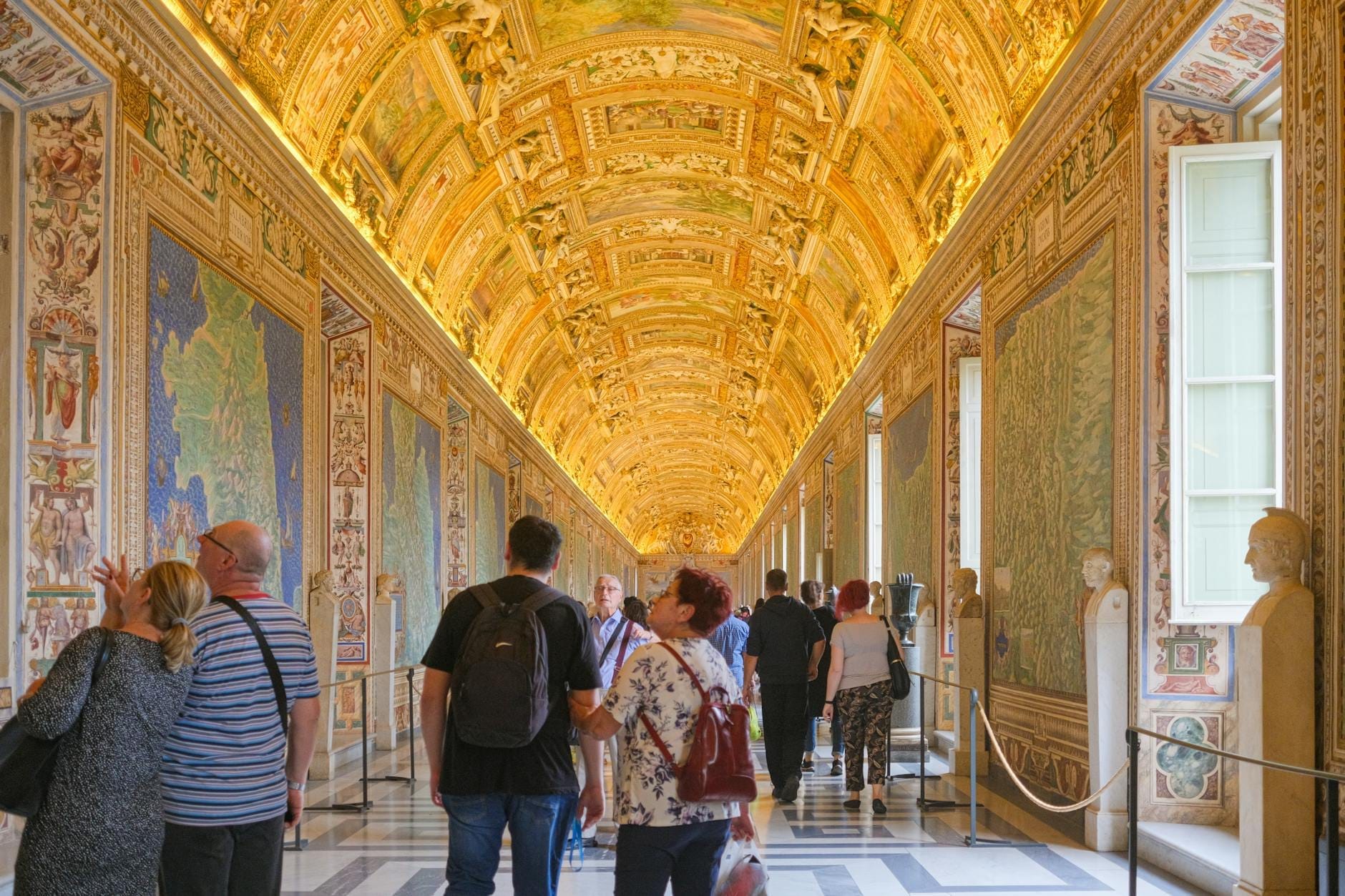
The standard route funnels visitors through a long sequence of galleries before arriving at the Sistine Chapel. This is not accidental. The path takes you past the Pio-Clementino Museum, which houses the Laocoön and the Apollo Belvedere, two of the most influential sculptures in Western art history. It then passes through the Gallery of Maps, a 120-meter corridor lined with detailed topographic frescoes of the Italian peninsula painted between 1580 and 1585. The corridor is visually overwhelming, and most visitors move through it quickly without fully processing what they are looking at.
The Raphael Rooms come just before the Sistine Chapel. These four interconnected chambers were painted largely by Raphael and his workshop between 1508 and 1524, and they represent some of the most sophisticated fresco cycles of the Italian Renaissance. The School of Athens, in the Stanza della Segnatura, is often singled out: a scene of ancient philosophers arranged around Plato and Aristotle, with portraits of Leonardo da Vinci, Michelangelo, and Raphael himself embedded in the crowd. Take time here. It is easy to rush past because the Sistine Chapel feels like the destination.
For those interested in Roman antiquities, the museums also connect conceptually to other major sites in Rome. The Capitoline Museums and the National Roman Museum hold comparable ancient collections and are worth comparing for a fuller picture of how Rome has preserved its past.
The Sistine Chapel: Managing Expectations
The Sistine Chapel is smaller than most people expect. At roughly 40 meters long and 13 meters wide, it is about the size of a large church nave. The ceiling fresco, commissioned by Pope Julius II and completed by Michelangelo between 1508 and 1512, covers approximately 500 square meters and includes nine scenes from Genesis. The Last Judgment on the altar wall was painted by Michelangelo two decades later, between 1536 and 1541, at the request of Pope Paul III.
The challenge is absorbing it under real conditions. On a typical afternoon, the chapel holds several hundred people simultaneously. Guards periodically call for silence in multiple languages. Photography is prohibited, though enforcement is inconsistent. Bring binoculars if you have them: the ceiling is 20 meters overhead, and the details that matter most are not visible to the naked eye from floor level without optical help.
ℹ️ Good to know
The chapel also functions as an active place of worship and is used for the papal conclave. This gives it a dual identity that many visitors find affecting: a room that doubles as the world's most reproduced artwork and one of Catholicism's most sacred spaces.
Visitors who find the standard route too crowded sometimes prefer early-morning or evening openings when available. Check the official website for current extended-hours schedules, which vary seasonally. Arriving when the doors open is the most reliable way to reach the Sistine Chapel with a manageable crowd density.
How the Visit Changes by Time of Day
The Vatican Museums fill quickly and stay full for most of the day during peak season. In the morning, before organized tour groups arrive, the pace in the outer galleries is noticeably slower. The Pio-Clementino courtyard has a particular quality in the early hours: the stone sculptures in open-air niches catch the low morning light, and the pigeons and the quiet make it feel briefly like a private garden.
By midday, the corridors are densely packed and the noise level rises significantly. The Gallery of Maps, with its narrow width and constant foot traffic, becomes uncomfortable. The Sistine Chapel in the early afternoon is at its most crowded and warmest. If you arrive late in the day, around two hours before closing, the crowd density drops, but the energy is different: fatigue shows on faces, and staff begin ushering groups toward the exit. There is no universally perfect time, but early morning is the consensus choice for good reason.
Summer heat is a practical concern. The museums are largely indoors but not uniformly air-conditioned. Bring water, wear light clothing, and consider that the physical distance covered on the standard route exceeds several kilometers. Comfortable shoes are not optional.
Getting There, Dress Code, and Practical Details
The museums are located on Viale Vaticano inside Vatican City. The entrance is on the north side of Vatican City, a 10-minute walk from Metro Line A's Ottaviano-San Pietro station. Bus routes 23, 40, 49, and 492 also stop nearby. Taxis and ride-hailing services (Uber and Free Now operate in Rome) can drop you directly at the entrance.
Dress code is enforced: shoulders and knees must be covered to enter, the same standard applied at St. Peter's Basilica and most Roman churches. Scarves and cover-ups are sold by street vendors outside the entrance, but bringing your own is cheaper and less stressful.
Accessibility varies across the complex. Many areas are wheelchair accessible, but the age and architectural complexity of the buildings mean that some galleries involve stairs or uneven surfaces. The official website provides a detailed accessibility map; it is worth reviewing before your visit if mobility is a concern.
⚠️ What to skip
Ticket prices and opening hours change. Always verify current information at museivaticani.va before your visit. Third-party ticket resellers often charge significant markups for the same admission.
Combining the Vatican Museums with nearby sites makes logistical sense. St. Peter's Square and the basilica are a short walk from the museum exit, and Castel Sant'Angelo is roughly 15 minutes on foot. For a structured itinerary, see our three-day Rome itinerary which builds the Vatican into a full day.
Who Will Love This and Who Should Think Twice
The Vatican Museums are exceptional for anyone genuinely interested in Renaissance art, ancient sculpture, or the history of the Catholic Church as a cultural institution. First-time visitors to Rome who want to understand the city's role in Western civilization will find the collection essential rather than optional.
Young children often struggle with the length and the quiet that portions of the visit require. Families should plan a shorter route targeting specific highlights rather than attempting the full circuit. The gift shop and the cafeteria offer natural break points. For family-focused planning, our guide to Rome with kids includes practical notes on pacing a Vatican visit.
Travelers who are primarily interested in outdoor Rome, or who find enclosed, densely crowded spaces draining, may leave feeling more depleted than inspired. The experience rewards patience and preparation. Without either, it can feel like an expensive, airless crowd simulation.
Insider Tips
- The Pinacoteca, the Vatican's dedicated painting gallery, is often bypassed by visitors rushing to the Sistine Chapel. It contains works by Caravaggio, Leonardo da Vinci (an unfinished Saint Jerome), and Raphael's Transfiguration. Allow 30 extra minutes for it.
- The Cortile della Pigna, the large open courtyard with a giant bronze pine cone from the Roman era, is a good place to rest and recalibrate mid-visit. Few tour groups linger there.
- If you are booking online and see a timeslot early in the morning on a weekday, take it. Weekday mornings in the shoulder season (March, October) are significantly quieter than any weekend slot.
- The exit from the Sistine Chapel leads directly toward St. Peter's Basilica via an internal passage. This shortcut is available but not always clearly marked. Ask a staff member rather than backtracking through the full museum route.
- Audio guides and guided tours are available and worth considering for the Raphael Rooms specifically. Without context, the political and theological content of those frescoes is easy to miss, and that content is half of what makes them remarkable.
Who Is Vatican Museums For?
- Art history enthusiasts who want to trace Renaissance painting and ancient sculpture in a single visit
- First-time visitors to Rome treating the Vatican as a foundational experience
- History-minded travelers interested in the Catholic Church's role as a patron and collector
- Photographers focused on architecture and decorative ceilings (note: Sistine Chapel photography is prohibited)
- Travelers spending three or more days in Rome who can dedicate a full morning or afternoon without feeling rushed
Nearby Attractions
Other things to see while in Vatican & Prati:
- Castel Sant'Angelo
Built as a Roman emperor's mausoleum and transformed over centuries into a fortress, prison, and papal refuge, Castel Sant'Angelo is one of Rome's most historically dense landmarks. This guide covers what to expect inside, when to visit, and how to navigate it without wasting time.
- Ponte Sant'Angelo
Ponte Sant'Angelo is Rome's most photogenic river crossing, a nearly 1,900-year-old imperial bridge leading directly to Castel Sant'Angelo. Built by Emperor Hadrian and later adorned with ten Baroque angel sculptures designed by Bernini, it offers some of the finest views of the Tiber and the city's historic skyline. Entry is free, and the bridge never closes.
- St. Peter's Basilica
The largest church in the world and the spiritual center of Roman Catholicism, St. Peter's Basilica rewards every visitor who crosses its threshold — whether or not they share the faith. This guide covers what to expect, when to go, and how to make the most of your time inside one of Rome's most extraordinary buildings.
- St. Peter's Square
St. Peter's Square, known in Italian as Piazza San Pietro, is the grand elliptical forecourt of St. Peter's Basilica in Vatican City. Designed by Gian Lorenzo Bernini in the 17th century, it is one of the most architecturally ambitious public spaces ever built. Entry is free and the square is open around the clock, though the experience shifts dramatically depending on when you arrive.
Planning a trip? Discover personalized activities with the Nomado app.