St. Peter's Square (Piazza San Pietro): What to Expect Before You Go
St. Peter's Square, known in Italian as Piazza San Pietro, is the grand elliptical forecourt of St. Peter's Basilica in Vatican City. Designed by Gian Lorenzo Bernini in the 17th century, it is one of the most architecturally ambitious public spaces ever built. Entry is free and the square is open around the clock, though the experience shifts dramatically depending on when you arrive.
Quick Facts
- Location
- Piazza San Pietro, 00120, Vatican City
- Getting There
- Metro Line A: Ottaviano-S. Pietro or Cipro; Bus 40, 46, 64; Tram 19 (Piazza Risorgimento)
- Time Needed
- 30–60 minutes for the square alone; 2–4 hours if combining with the Basilica
- Cost
- Free entry to the square (St. Peter's Basilica interior is also free; separate tickets required for dome climb)
- Best for
- Architecture lovers, history enthusiasts, pilgrims, early-morning walkers
- Official website
- www.basilicasanpietro.va/en/san-pietro/the-square
What Is St. Peter's Square?
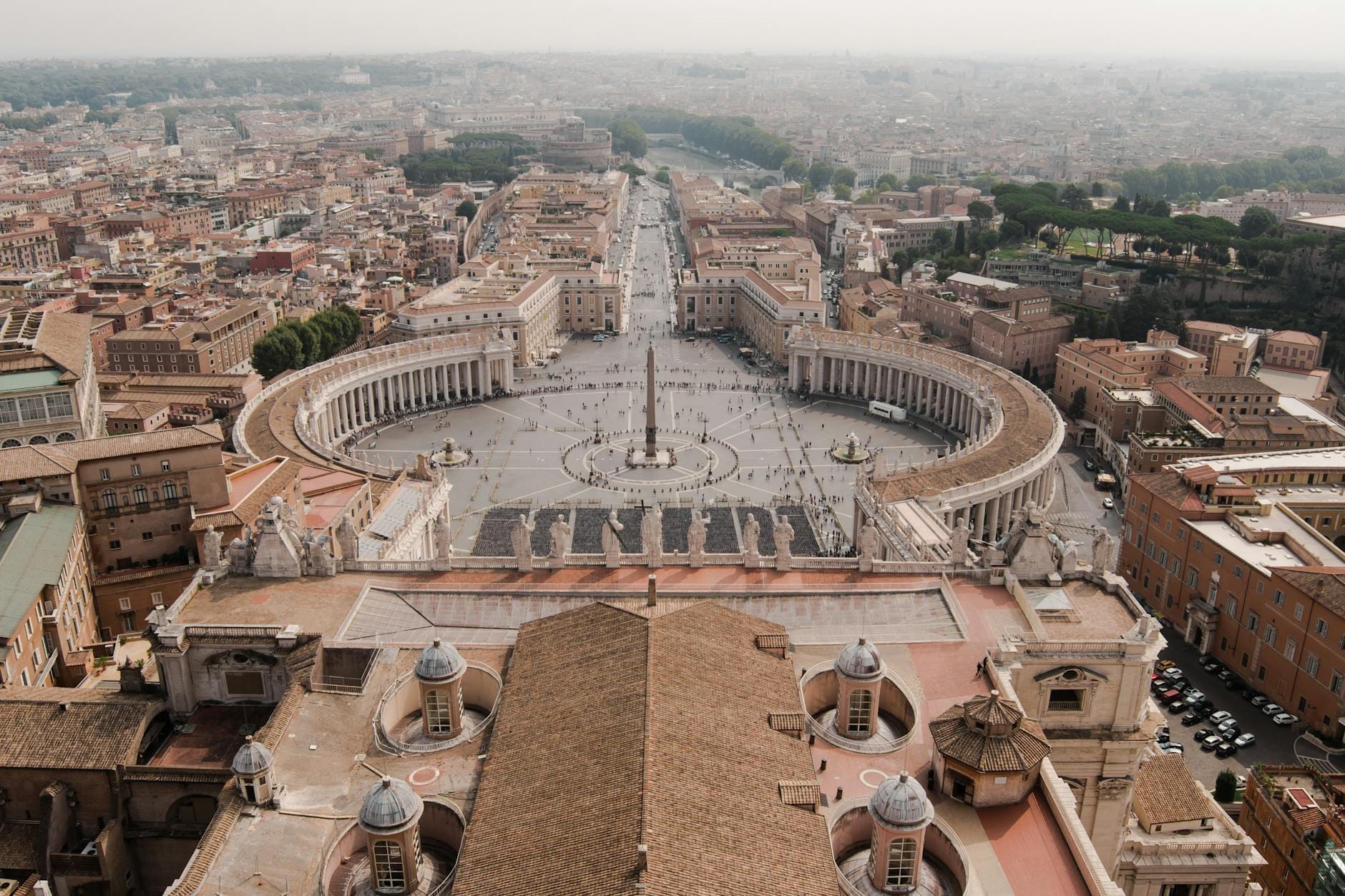
Piazza San Pietro is the enormous forecourt that precedes St. Peter's Basilica in Vatican City, an independent city-state enclosed within Rome. It is not a square in the geometric sense. Bernini's design is a vast horizontal ellipse, measuring roughly 196 meters across, framed by two sweeping curved colonnades that reach outward like open arms. The visual effect from the center is one of controlled grandeur: you are simultaneously enclosed and exposed, with the basilica's facade rising at one end and the city of Rome retreating behind you at the other.
The space can accommodate more than 300,000 people during major papal events, and on ordinary days it serves as a gathering point, a thoroughfare, and a monument all at once. Whether you approach it as a work of urban design, a religious site, or simply the most photographed foreground in Rome, the square rewards close attention.
💡 Local tip
The square is technically part of Vatican City, not Italy. You cross an international border (informally) when you step past the boundary marked by the white stones embedded in the paving. There are no passport checks.
Bernini's Colonnades: The Architecture Up Close
Construction of the colonnades ran from 1656 to 1667, commissioned by Pope Alexander VII and executed by Gian Lorenzo Bernini at the height of his career. The scale is hard to process until you walk alongside the columns themselves. There are 284 columns and 88 pilasters arranged in four rows, all in the Doric order, topped by a continuous entablature. Above the colonnade, 140 statues of saints stand in a line against the sky, each roughly 3.2 meters tall. They were installed in 1670, three years after the colonnades were completed.
Bernini intended the colonnades to represent the Church embracing the faithful, a metaphor he articulated explicitly. Whether or not you find that reading persuasive, the spatial effect is real. Standing at the center of the ellipse, the columns appear to compress and align, creating an almost theatrical sense of enclosure. Walk toward the fringes of the ellipse and the perspective opens again. The square is designed to be experienced in motion, not just observed.
Look for the two small stone discs set into the paving of the square, one on each side of the central obelisk. These mark the focal points of Bernini's ellipse. Stand on either disc and look toward the nearest colonnade: the four rows of columns collapse into a single visual plane, appearing as one solid wall. It is a precise geometric trick, and it still works.
Tickets & tours
Live prices and dates from our booking partner. If you book, we may earn a commission at no extra cost to you.
St Peters Basilica guided tour with optional dome access
From 12 €Instant confirmationFree cancellationSt. Peter's Basilica, Vatican Museums, Sistine Chapel reserved entry
From 81 €Instant confirmationFree cancellationVatican Museums, Sistine Chapel and St. Peter's Basilica guided tour
From 89 €Instant confirmationFree cancellationVatican Museums, St. Peter's Basilica and Sistine Chapel Guided Tour
From 139 €Instant confirmationFree cancellation
The Obelisk at the Center
The obelisk standing at the exact center of the square is not a Roman creation or a Christian symbol. It is an ancient Egyptian obelisk, approximately 25 meters tall, with no hieroglyphic inscriptions (which is unusual for an obelisk of its age and suggests it may have been made for export rather than ritual use). Emperor Caligula had it transported to Rome in 37 CE, where it stood in the Circus of Nero on the Vatican hill, the very site where early Christian martyrs, including Saint Peter, were reportedly killed.
In 1586, Pope Sixtus V ordered the obelisk moved to its current position in front of the basilica. The engineering operation, overseen by Domenico Fontana, required months of preparation, hundreds of workers, and a system of ropes and wooden cranes. The obelisk has stood in the square ever since, topped with a Christian cross and housing, according to tradition, a relic of the True Cross. It is one of the few Egyptian obelisks in Rome that has never been toppled.
How the Experience Changes by Time of Day
Arriving before 8:00 AM gives you the square nearly to yourself. The light at that hour is low and directional, cutting across the colonnade and catching the texture of the travertine. The fountains are running, the pigeons are active, and the whole space has a stillness that is almost impossible to find at midday. This is the time for photography without crowds and for walking the colonnade corridors without interruption.
By mid-morning, particularly from 10:00 AM onward, tour groups arrive in force. The square fills quickly on any day, and on Wednesdays it fills to capacity: the Pope holds his General Audience here (or in the adjacent Audience Hall) on Wednesday mornings when he is in Rome. If you want to attend the audience, tickets are free but must be requested in advance through the Prefecture of the Papal Household. If you simply want to visit the square, Wednesday mornings are the worst time to arrive without a ticket.
Late afternoon, after 4:00 PM, brings a second wave of calm. Tour groups have largely moved on. The light turns golden in spring and summer, illuminating the facade of the basilica from the west. The square at dusk, with the dome silhouetted and the colonnades glowing, is genuinely striking. At night, the square is lit, accessible, and very quiet. Rome's night energy does not extend here in the way it does in Trastevere or around the Pantheon.
⚠️ What to skip
Access to the square is restricted without notice during papal ceremonies, special liturgical events, and major Catholic holidays. Check the Vatican's official calendar before planning a visit, especially around Easter, Christmas, and major feast days.
Practical Walkthrough: Getting There and Moving Around
The most direct public transit option is Metro Line A to Ottaviano-S. Pietro. From the station it is a 10-minute walk west along Via della Conciliazione, the wide avenue that leads directly to the square. This approach, while functional, strips away some of the surprise. A more atmospheric entry is to arrive from the north via the Borgo district, through the narrow medieval streets, and then turn a corner to find the colonnade suddenly in front of you. Consider the Castel Sant'Angelo as a starting point, crossing via Ponte Sant'Angelo and walking south through Borgo Pio.
Bus lines 40, 46, and 64 connect the square to the historic center and Termini station. Tram 19 stops at Piazza del Risorgimento, a short walk away. Taxis are available and plentiful; there is a rank near the square's entrance on Via della Conciliazione. Driving to the Vatican is not recommended. Parking is extremely limited and the streets in the Borgo neighborhood are congested for much of the day.
Dress code applies not to the square itself, which is open public space, but to entry into St. Peter's Basilica. Shoulders and knees must be covered. If you arrive without appropriate clothing, vendors near the square sell scarves and shawls at inflated prices. Bring your own or plan ahead. The square's paving is uneven travertine and the distances are significant; comfortable flat shoes are practical.
ℹ️ Good to know
Photography in the square is unrestricted. The best angles of the full ellipse are from above, either from the dome of St. Peter's or from a high window in one of the surrounding buildings. At ground level, a wide-angle lens helps manage the scale.
Combining the Square with Nearby Attractions
The square is the logical starting point for the Vatican neighborhood, but it is not the only reason to spend time in this part of Rome. The Vatican Museums are accessed from a separate entrance on Viale Vaticano, about a 15-minute walk from the square. Booking in advance is essential: walk-up queues can stretch for several hours on peak days. If you are planning a full day, the museums in the morning and the square and basilica in the afternoon is a workable sequence.
Visitors with more time in the area should note that the Vatican neighborhood extends beyond the immediately obvious landmarks. The Prati district, just north of the square, is a residential and commercial area with good cafes and restaurants that cater more to locals than to tourists, which means better coffee and less marked-up menus. It is a useful place to eat before or after a long visit without the worst of the tourist-zone pricing.
For travelers thinking about how St. Peter's Square fits into a wider Rome itinerary, it pairs naturally with a morning at the Vatican Museums, an afternoon in the Borgo or Trastevere, and an evening walk across Ponte Sant'Angelo. For a broader picture of how to organize time across the city, the Rome in 3 days guide offers a workable framework.
Who This Attraction Is Not For
The square is not a good fit for travelers who are exhausted by crowds and want a contemplative experience during peak hours. Between 10:00 AM and 3:00 PM on any weekday in the spring or summer tourist season, the square is loud, crowded with tour groups, and frequently overwhelmed with selfie photographers and hawkers at the perimeter. The architecture does not become less impressive, but the experience is significantly degraded.
It is also not a destination for travelers who have limited mobility and have not planned ahead. The paving is uneven, the distances across the square are substantial, and there are no seats or shade in the main body of the plaza. The colonnades provide shade along their perimeter, but reaching them from the center requires a 10-minute walk across open stone. In summer, midday heat in the square can be intense.
Insider Tips
- Stand on the focal-point discs embedded in the paving (one on each side of the obelisk) and look toward the nearest colonnade. The four rows of columns align into a single plane. It is a Bernini optical trick that most visitors walk straight past.
- Wednesday General Audiences with the Pope are free but require advance tickets from the Prefecture of the Papal Household (request via the Vatican website). Arriving without a ticket on Wednesday morning means navigating a large crowd without access to the event.
- The narrow colonnade corridors are themselves worth walking through. They are shaded, cool in summer, and give you close access to the column bases and statuary at eye level, an entirely different experience from the open square.
- For an elevated view of the full ellipse, climb to the dome of St. Peter's Basilica. The view from the external gallery around the drum of the dome gives you a clear bird's-eye perspective on Bernini's design that no ground-level photograph can replicate.
- The square is at its quietest between 6:30 AM and 8:00 AM, and again after 7:00 PM. Both windows offer dramatically different light and a fraction of the daytime crowd.
Who Is St. Peter's Square For?
- Architecture enthusiasts who want to study Bernini's spatial composition at close range
- Pilgrims and Catholic travelers attending papal audiences or visiting on significant feast days
- Early-morning walkers who want Rome's most dramatic open space without the crowds
- Photographers working with wide-angle lenses in golden-hour light
- First-time visitors to Rome who want to orient themselves before entering the Vatican complex
Nearby Attractions
Other things to see while in Vatican & Prati:
- Castel Sant'Angelo
Built as a Roman emperor's mausoleum and transformed over centuries into a fortress, prison, and papal refuge, Castel Sant'Angelo is one of Rome's most historically dense landmarks. This guide covers what to expect inside, when to visit, and how to navigate it without wasting time.
- Ponte Sant'Angelo
Ponte Sant'Angelo is Rome's most photogenic river crossing, a nearly 1,900-year-old imperial bridge leading directly to Castel Sant'Angelo. Built by Emperor Hadrian and later adorned with ten Baroque angel sculptures designed by Bernini, it offers some of the finest views of the Tiber and the city's historic skyline. Entry is free, and the bridge never closes.
- St. Peter's Basilica
The largest church in the world and the spiritual center of Roman Catholicism, St. Peter's Basilica rewards every visitor who crosses its threshold — whether or not they share the faith. This guide covers what to expect, when to go, and how to make the most of your time inside one of Rome's most extraordinary buildings.
- Vatican Museums
The Vatican Museums are one of the largest and most visited art collections on earth, spanning papal apartments, ancient sculptures, Renaissance galleries, and the Sistine Chapel. Understanding the scale before you arrive makes all the difference between a meaningful visit and an exhausting march.
Planning a trip? Discover personalized activities with the Nomado app.