Ponte Sant'Angelo: Rome's Angel-Lined Bridge Across the Tiber
Ponte Sant'Angelo is Rome's most photogenic river crossing, a nearly 1,900-year-old imperial bridge leading directly to Castel Sant'Angelo. Built by Emperor Hadrian and later adorned with ten Baroque angel sculptures designed by Bernini, it offers some of the finest views of the Tiber and the city's historic skyline. Entry is free, and the bridge never closes.
Quick Facts
- Location
- Spans the Tiber River between Campo Marzio and Castel Sant'Angelo, Rome
- Getting There
- Metro Line A: Lepanto or Ottaviano; Bus lines 23, 40, 46, 62, 64, 87, 280
- Time Needed
- 15–30 minutes to cross and linger; longer if combined with Castel Sant'Angelo
- Cost
- Free. Open 24 hours, 7 days a week
- Best for
- Architecture lovers, photographers, evening strollers, history enthusiasts
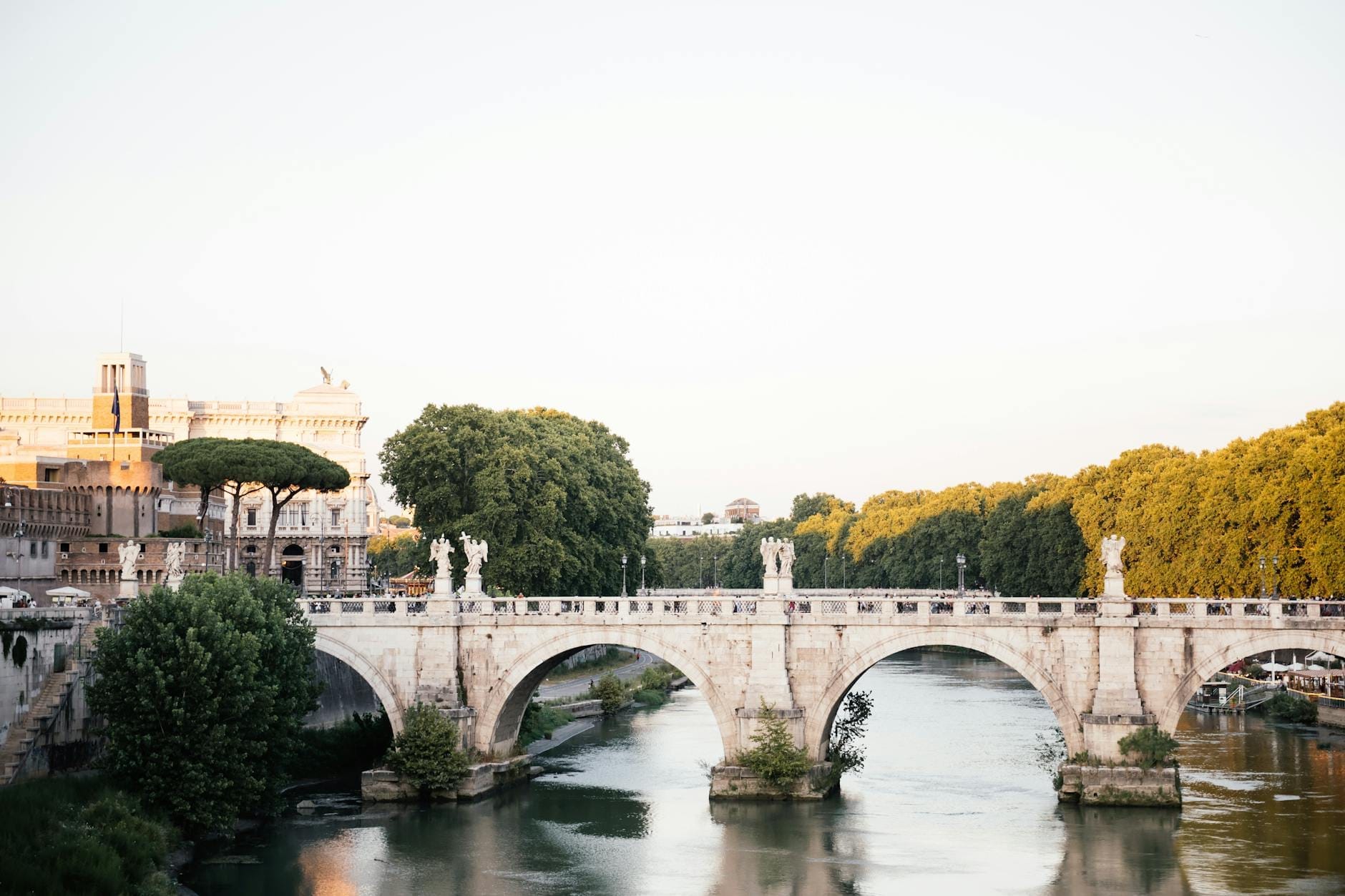
What Ponte Sant'Angelo Actually Is
Ponte Sant'Angelo is a pedestrian bridge in Rome that has been in continuous use for nearly 1,900 years. Emperor Hadrian commissioned it between 130 and 134 CE, originally calling it Pons Aelius after his family name. Its sole purpose at the time was functional: to give Romans a direct route from the city center to his grand mausoleum on the western bank of the Tiber, the circular structure now known as Castel Sant'Angelo. Of the original Roman construction, three central arches survive beneath centuries of restoration and embellishment.
The bridge was renamed Ponte Sant'Angelo following a legend from 590 CE, when Pope Gregory the Great reportedly saw a vision of the Archangel Michael sheathing his sword above the mausoleum during a plague, signaling its end. The name stuck. The angel sculpture atop Castel Sant'Angelo today commemorates that vision, and the bridge's own identity became inseparable from it.
ℹ️ Good to know
The bridge measures approximately 130 meters long and rests on piers roughly 7 meters high, with individual spans of around 18 meters. It is pedestrian-only, which keeps traffic noise off it and makes the crossing genuinely pleasant.
The Bernini Angels: What You're Actually Looking At
The ten marble angel statues lining the bridge's balustrades are what transform it from an old Roman crossing into one of the most theatrically beautiful streets in Europe. Pope Clement IX commissioned Gian Lorenzo Bernini to design them in 1669, and work continued until 1688 by his pupils. Each angel carries a symbol of Christ's Passion: a crown of thorns, a sponge soaked in vinegar, nails, a cross, a lance. The figures twist and gesticulate with full Baroque expressiveness, their stone drapery caught mid-billow as if the wind off the Tiber had frozen them in place.
Bernini himself carved two of the angels, the ones holding the crown of thorns and the INRI inscription tablet. Pope Clement liked them so much he kept the originals inside Sant'Andrea delle Fratte church to protect them from the elements; what stands on the bridge today are copies. If you want to see Bernini's actual hand in stone, you'll need to visit that church in the Trevi district.
The angels work as a procession. Walking from the Campo Marzio side toward Castel Sant'Angelo, you pass through what feels like a ceremonial corridor leading to the fortress gateway. It is deliberate stagecraft, and it functions exactly as intended. Baroque Rome understood urban theater. For context on how this fits into the city's wider artistic legacy, see our guide to the Castel Sant'Angelo, which sits at the far end of the bridge and rewards a longer visit.
Tickets & tours
Live prices and dates from our booking partner. If you book, we may earn a commission at no extra cost to you.
Tour of Pontifical Villa Gardens at Castel Gandolfo in Minibus
From 15 €Instant confirmationFree cancellationSt. Peter's Basilica, Vatican Museums, Sistine Chapel reserved entry
From 81 €Instant confirmationFree cancellationGuided tour of Galleria Borghese and of Villa Borghese gardens
From 69 €Instant confirmationFree cancellationVatican: Basilica, Dome and underground early bird tour
From 50 €Instant confirmationFree cancellation
How the Experience Changes Through the Day
Early morning, before 8am, is the version of Ponte Sant'Angelo that most visitors never see. The Tiber catches flat silver light, the bridge is nearly empty, and the angels stand out sharply against pale sky. Street cleaners work the surrounding piazzas, and the only sounds are pigeons and the distant rumble of delivery trucks on the lungotevere embankment road below. This is the best window for photography: no crowds obscuring the statues, soft directional light from the east, and the cylindrical mass of Castel Sant'Angelo in clean shadow.
Midday in summer is a different matter entirely. The bridge sits in full sun with almost no shade, and by 11am it fills steadily with tourists walking between the Vatican and the historic center. The pavement gets hot underfoot, and the statues lose their sculptural clarity in flat overhead light. If you have no choice but to visit mid-afternoon in July or August, cross quickly and linger at either end where there is some shelter.
The bridge earns its reputation most reliably at dusk. Around sunset, the fortress floodlights switch on gradually, the Tiber turns copper and then dark, and the angels glow warm against a deepening blue sky. Street musicians sometimes set up on the approaches. The atmosphere is genuinely striking, and the crowds, while still present, feel less intrusive because everyone has slowed down. Winter evenings around 5pm offer the same quality of light with far fewer people.
💡 Local tip
For the best photographs of the angels against the sky, shoot from the bridge level looking slightly upward, not from the embankment below. The low balustrade puts the statues against open sky rather than the city backdrop, giving each figure dramatic negative space.
Walking the Bridge: What to Expect
The crossing itself takes about five minutes at a relaxed pace, though most people slow considerably to look at the statues and the river views. On the east (Campo Marzio) side, the approach is a small piazza where street vendors sometimes sell prints and religious souvenirs. The bridge deck is broad, paved in large stones worn smooth, and slopes gently upward toward the center from both ends.
The views north and south along the Tiber from the middle of the bridge are among the best river views in Rome. Looking south, you can see other historic bridges in the distance. Looking north, the river curves away toward Piazza del Popolo. There are no benches on the bridge itself, so most visitors simply stop and lean against the balustrade. Be aware that the stone parapet is not especially high, and the bridge can get genuinely crowded during peak hours.
On the west end, the bridge gates open onto the base of Castel Sant'Angelo's grounds. From here you can enter the fortress directly (paid admission required), walk the embankment north toward Prati, or continue further west toward the Vatican. The Vatican district is about a 15-minute walk from the bridge, making this a logical stop on any route between St. Peter's and the historic center.
History Worth Knowing Before You Cross
Pons Aelius was not always a peaceful promenade. During the Middle Ages and into the Renaissance, it was one of Rome's main execution sites. The bodies of condemned men were sometimes displayed on the bridge or thrown from it into the Tiber. Giacomo Puccini set the dramatic final scene of his opera Tosca at Castel Sant'Angelo, a choice that reflects the fortress and bridge's long association with papal justice and political prisoners.
The bridge also has an unfortunate entry in the annals of crowd disasters. In 1450, during a Jubilee Year, a stampede of pilgrims on the overcrowded bridge killed an estimated 172 people. The incident prompted the removal of the balustrades to allow escape routes, and the event was significant enough to influence later crowd management practices at major Roman events.
For travelers interested in how Rome layers its ancient, medieval, and Baroque histories into single sites, Ponte Sant'Angelo is a particularly concentrated example. The same logic applies to the broader Roman Forum and the city's other ancient survivors, each carrying centuries of repurposing.
Getting There and Practical Notes
The bridge is a 10–12 minute walk from Ottaviano Metro station (Line A), following Via della Conciliazione past St. Peter's Square and then north along the river. From Lepanto Metro station (also Line A), the walk is slightly shorter, roughly 8 minutes heading south along the river embankment. Bus lines 23, 40, 46, 62, 64, 87, 280 all stop close to the bridge on the lungotevere roads running along both banks.
The bridge is pedestrian-only and free to cross at any hour. There is no entrance gate, no ticket booth, and no queue. Accessibility is limited: both approaches involve several steps with no ramp alternative visible at the bridge itself. Travelers with mobility limitations should verify current conditions locally, as the surrounding embankment areas have their own layout.
If you are planning a wider day around this area, the combination of Ponte Sant'Angelo, Castel Sant'Angelo, and a walk through Prati for coffee or lunch covers a logical geographic loop. For a more structured itinerary that includes this bridge, the Rome in 3 days guide includes it within a Vatican-area morning.
⚠️ What to skip
Pickpockets are active on and around Ponte Sant'Angelo, particularly when the bridge is crowded. Keep bags zipped and in front of you. The narrow crossing concentrates foot traffic, which creates cover for opportunistic theft.
Is It Worth Your Time? An Honest Assessment
Ponte Sant'Angelo is not a destination attraction in the sense that it demands an afternoon. It takes fifteen minutes to cross, observe the statues properly, and take in the river views. Its value lies in its position: it connects two major sites and is genuinely beautiful in a way that earns the short detour from either direction.
Travelers expecting a quiet, contemplative experience will find that harder to achieve here than at Rome's less prominent historic bridges. This is a high-traffic corridor for Vatican visitors, and it shows. The site is not overhyped exactly, but it is best understood as a transit experience that happens to be exceptional, not a place to sit and spend an hour. Those seeking a slower engagement with Roman bridges and river views might find the area around Tiber Island or the Aventine waterfront more rewarding for unhurried exploration.
Photographers committed to getting the best image of the bridge from the outside should note that the view from the embankment below offers a strong composition with all ten angels visible above the parapet, particularly effective at dusk. This angle also appears in most of the iconic photographs of the bridge. For other high-yield photography spots in the city, the best views in Rome guide covers additional vantage points worth planning around.
Insider Tips
- Arrive before 8am if photography is a priority. The bridge empties out significantly in early morning, the light from the east is directional and soft, and you can stand in the middle of the deck without anyone walking into your frame.
- The two angels Bernini carved himself are not on this bridge. They were replaced with copies to protect them from weathering. The originals are inside Sant'Andrea delle Fratte church, near the Trevi area, and are free to view during church opening hours.
- The embankment path running below the bridge on the east bank offers an underused alternative view. From there you can photograph the full arch sequence of the bridge with the Castel Sant'Angelo behind it, without the crowd congestion on the bridge deck itself.
- Winter visits, particularly weekday mornings in January or February, reveal the bridge at its least crowded. The fortress backdrop is moodier in low winter light and the lack of other pedestrians makes the angel statues feel more present.
- If you are visiting Castel Sant'Angelo afterward, buy your ticket online in advance. The fortress entrance is at the west end of the bridge, and queues at the door can add significant waiting time to what should be a fluid morning.
Who Is Ponte Sant'Angelo For?
- Architecture and Baroque art enthusiasts who want to see Bernini's sculptural language applied at urban scale
- Photographers working in early morning or at dusk when the light and crowd conditions align
- First-time Rome visitors following the Vatican-to-historic-center route on foot
- Travelers with limited time who want a high-quality visual experience that costs nothing and requires no advance planning
- History readers interested in the layered use of a single site across Roman, medieval, Renaissance, and Baroque periods
Nearby Attractions
Other things to see while in Vatican & Prati:
- Castel Sant'Angelo
Built as a Roman emperor's mausoleum and transformed over centuries into a fortress, prison, and papal refuge, Castel Sant'Angelo is one of Rome's most historically dense landmarks. This guide covers what to expect inside, when to visit, and how to navigate it without wasting time.
- St. Peter's Basilica
The largest church in the world and the spiritual center of Roman Catholicism, St. Peter's Basilica rewards every visitor who crosses its threshold — whether or not they share the faith. This guide covers what to expect, when to go, and how to make the most of your time inside one of Rome's most extraordinary buildings.
- St. Peter's Square
St. Peter's Square, known in Italian as Piazza San Pietro, is the grand elliptical forecourt of St. Peter's Basilica in Vatican City. Designed by Gian Lorenzo Bernini in the 17th century, it is one of the most architecturally ambitious public spaces ever built. Entry is free and the square is open around the clock, though the experience shifts dramatically depending on when you arrive.
- Vatican Museums
The Vatican Museums are one of the largest and most visited art collections on earth, spanning papal apartments, ancient sculptures, Renaissance galleries, and the Sistine Chapel. Understanding the scale before you arrive makes all the difference between a meaningful visit and an exhausting march.
Planning a trip? Discover personalized activities with the Nomado app.