University of Queensland (UQ): A Visitor's Guide to the St Lucia Campus
The University of Queensland's St Lucia campus is one of Brisbane's most architecturally striking public spaces, open to all visitors free of charge. Sandstone quadrangles, public art, lakeside walkways, and some of Brisbane's best campus greenery make it a genuine afternoon destination, not just a detour for students.
Quick Facts
- Location
- St Lucia, Brisbane, Queensland, Australia
- Getting There
- CityCat to UQ St Lucia ferry terminal; buses to Chancellor's Place and UQ Lakes
- Time Needed
- 1.5 to 3 hours depending on interests
- Cost
- Free general campus access; individual attractions may vary
- Best for
- Architecture lovers, walkers, history enthusiasts, families, and design-minded visitors
- Official website
- www.uq.edu.au
What Kind of Place Is This?
The University of Queensland, founded in 1909, occupies a river-bend peninsula at St Lucia, about 7 km southwest of the Brisbane CBD. The St Lucia campus is UQ's largest and most visitor-friendly, with public access to its grounds, several galleries, and a shoreline walk. Importantly, it is not a walled or restricted campus. Anyone can walk in, wander the Great Court, follow the lakeside paths, or sit under a sandstone colonnade without needing to enrol or book ahead.
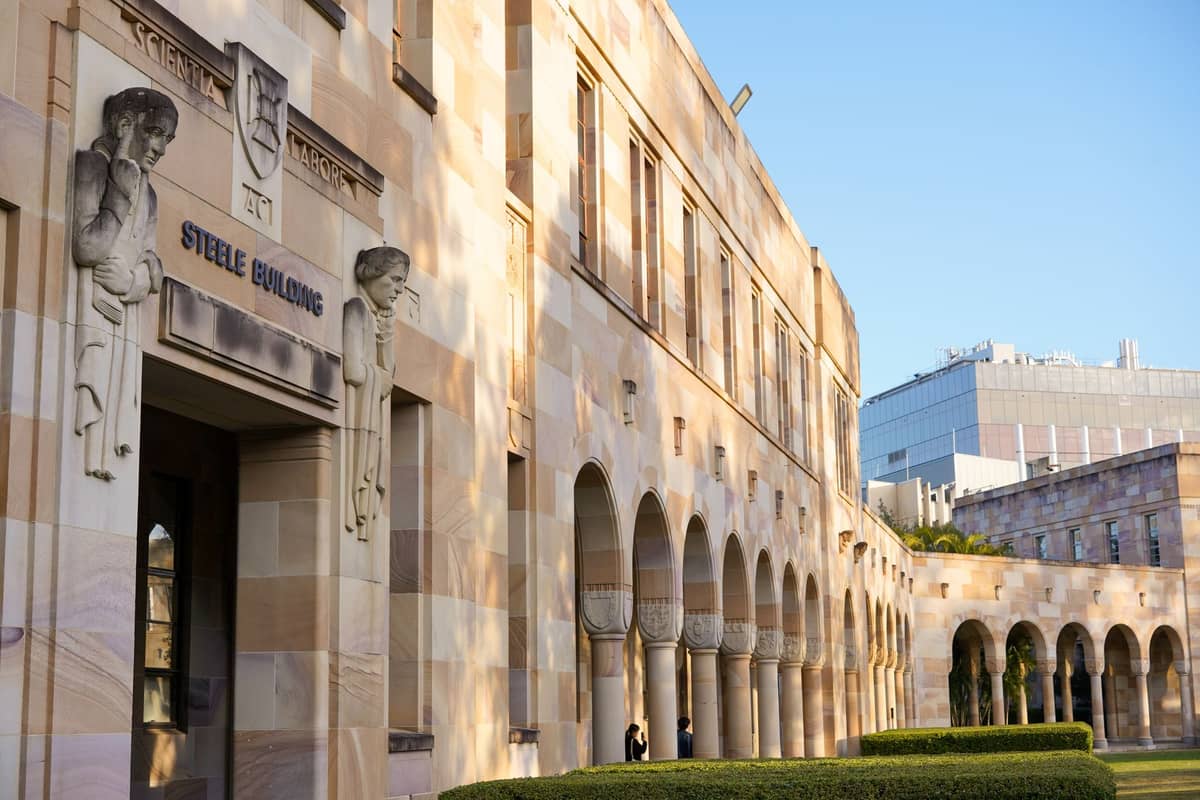
What surprises most first-time visitors is the architectural ambition of the place. Queensland is not typically associated with European-style stonework, yet UQ's central precinct was built from locally quarried Helidon sandstone, giving it a warm, amber tone that catches the afternoon sun in a way that feels almost Mediterranean. The Great Court, modelled loosely on Oxford's quadrangles, is the visual centrepiece and one of the most photographed spots in Brisbane.
💡 Local tip
The CityCat ferry to the UQ St Lucia terminal is the most scenic way to arrive and drops you close to the campus heart. From South Bank, the journey takes roughly 15 to 20 minutes on the water.
The Great Court and Sandstone Precincts
The Great Court is the architectural and social spine of the campus. Enclosed on three sides by sandstone cloisters, it is a large open lawn with a central fountain and mature fig trees providing deep shade. In the cooler months between April and September, students eat lunch here, events get staged on the grass, and the proportions of the space become genuinely impressive. In the summer heat, the shade under the arched walkways offers real relief, and the stone stays cool to the touch even in the afternoon.
The detail work on the sandstone buildings rewards close attention. The carvings include botanical motifs, and the blend of Romanesque revival and interwar academic styles gives the precinct a coherence that newer Australian universities struggle to replicate. The buildings were developed in stages across several decades of the 20th century, so the uniformity took time to achieve. Walking the full perimeter of the cloisters, which takes around 15 to 20 minutes at a slow pace, reveals changes in stonework quality and patina that tell the story of that construction timeline.
Photography here works best in the hour before sunset, when the low angle of light brings out the amber depth of the sandstone. Midday is harsher and produces flat, bleached images. Early morning is quiet and soft-lit but the campus is largely empty, which can work in your favour if you want the cloisters to yourself.
Tickets & tours
Live prices and dates from our booking partner. If you book, we may earn a commission at no extra cost to you.
Luggage Storage in Brisbane
From 5 €Instant confirmationFree cancellationBrisbane's dark stories true crime tour
From 21 €Instant confirmationFree cancellationFull-day Mount Tamborine winery tour from Brisbane with lunch
From 140 €Instant confirmationFree cancellationNorth Stradbroke Island small groups day tour
From 79 €Instant confirmationFree cancellation
Art Galleries and Cultural Spaces
UQ is home to the UQ Art Museum, a public gallery with a permanent collection and rotating temporary exhibitions. Entry is free when open, but the museum is currently closed while a new gallery is built in Forgan Smith Tower. The collection spans Australian and international work, with particular strengths in contemporary Australian art and Indigenous art. Visiting in conjunction with the campus walk is straightforward as the museum is centrally located. Check the UQ Art Museum's own schedule for current opening days before visiting, as university holidays can affect hours. The collection spans Australian and international work, with particular strengths in contemporary Australian art and Indigenous art. Visiting in conjunction with the campus walk is straightforward as the museum is centrally located. Check the UQ Art Museum's own schedule for current opening days before visiting, as university holidays can affect hours.
The campus also holds a notable public art collection spread across the grounds, including sculpture and large-scale works positioned near building entrances and open spaces. This is not a formally ticketed trail, but a UQ campus map makes it easy to navigate between key works. For visitors already interested in Brisbane's broader art scene, the Gallery of Modern Art and Queensland Art Gallery at South Bank are worthwhile pairings with a UQ visit.
The Lakes and Grounds: Where to Walk
The campus lakes are a different register entirely from the sandstone formality. A chain of artificial lakes runs through the lower part of the campus, edged with native vegetation and populated by water birds year-round. In the early morning, the lakes are uncrowded and you can watch herons and cormorants alongside students cycling to early lectures. Turtles are commonly spotted basking near the banks, particularly from September to November when the water warms.
The lakeside path circuits are flat, well-maintained, and accessible, covering roughly 2 to 3 km depending on which loops you take. There is no dedicated hiking infrastructure here, it is more of an extended amble than a hike, and the surface is sealed in most sections. Families with strollers can manage the main lakeside routes without difficulty.
If this kind of green, water-adjacent walking appeals, the City Botanic Gardens near the CBD offer a complementary experience with more formal planting and better river views.
Practical Walkthrough: How to Structure Your Visit
The CityCat ferry drops you at the UQ terminal, which is near UQ Lakes bus station and the Eleanor Schonell Bridge. From there, a 5 to 10 minute walk uphill leads into the campus proper. The gradient is gentle but noticeable in summer heat. Alternatively, buses stop at Chancellor's Place, which deposits you closer to the Great Court and the central library precinct. The nearest train stations are Toowong, Park Road, and Dutton Park, each requiring a connecting bus to reach the campus, so the CityCat or direct bus is the simpler option for most visitors.
For a first visit, a logical sequence is to arrive by ferry, walk up through the lower campus to the Great Court, spend time in the cloisters, visit the UQ Art Museum if it is open, then follow the lakeside path back toward the ferry or toward the UQ Lakes bus stops. This loop takes roughly 90 minutes at a comfortable pace and covers the campus highlights without backtracking.
Cafes and food outlets are distributed across the campus and range from chain options to independent spots. On weekdays during semester, services are fully operational. Outside semester or on weekends, some outlets reduce hours or close, so it is worth checking if you are planning to eat on campus. A water bottle is advisable in warmer months, as the campus is large and exposed in sections.
⚠️ What to skip
During university exam periods and semester breaks, the campus is noticeably quieter and some facilities close or reduce hours. If you are visiting for the atmosphere of a working university, semester time between February and June, or July and November, is best.
Historical and Cultural Context
UQ was established by an Act of the Queensland Parliament in 1909, making it Queensland's oldest university. For much of its early history it operated from the city centre before the St Lucia campus was developed from the 1930s onward. The sandstone building program was partly a statement of permanence and civic ambition at a time when Queensland was still asserting its cultural credentials relative to the southern states.
The campus sits on land that is part of the traditional Country of the Turrbal and Jagera peoples. Brisbane City Council acknowledges both nations in its own materials, and UQ has its own Reconciliation Action Plan and First Nations cultural programming. For visitors interested in Brisbane's deeper Indigenous and settler history, the Brisbane heritage and history guide provides broader context across the city.
Over its history, UQ has produced multiple Nobel laureates, including Peter Doherty and the team behind the human papillomavirus vaccine. These contributions are referenced in campus displays and in the UQ Gatton and Herston campuses' specialist facilities, though the St Lucia campus is the one most relevant to general visitors.
Accessibility and Honest Limitations
UQ provides a dedicated accessible-paths-and-buildings map for St Lucia, with accessible parking available subject to campus rules. The lakeside paths are generally flat and sealed, but some internal campus routes involve steps or uneven surfaces between older buildings. Anyone with mobility considerations should consult the accessibility map before planning a route.
It is also worth being direct about who might find the visit underwhelming. The campus is not a conventional tourist attraction with ticketed experiences or curated visitor programming. If you are looking for interactive exhibits, dramatic natural scenery, or a high-energy day out, this is not the right destination. It functions best as a slow, exploratory visit suited to people who enjoy architectural detail, public art, and the particular atmosphere of a large, working research university.
Visitors expecting the kind of immersive natural experience available at sites like Brisbane Botanic Gardens at Mount Coot-tha will find UQ's grounds pleasant but less spectacular. The campus is best understood as an add-on to a broader Brisbane itinerary rather than a standalone full-day destination.
Insider Tips
- The Forgan Smith Building tower offers an unusual internal architectural perspective from certain upper corridors, worth a look if you are already inside the building.
- The lakeside path is most active with wildlife in the early morning between 7 and 9 am. Turtles are easiest to spot near the wooden pontoon areas, particularly in spring.
- UQ's campus food outlets are substantially cheaper than CBD equivalents during semester. The options near the Union Complex are a practical lunch stop if you are watching your spending.
- The sandstone cloisters photograph best in the last 60 to 90 minutes of daylight. The amber tone of the stone deepens significantly and the long shadows add depth to architectural shots.
- If you want to extend the day, the Regatta Hotel at Toowong is a short bus or rideshare away and is one of Brisbane's most historically significant pubs, worth a stop before heading back to the city.
Who Is University of Queensland (UQ) For?
- Architecture and design enthusiasts drawn to interwar academic stonework
- Walkers and casual explorers looking for a green, low-key half-day
- Families with older children interested in university life or wildlife spotting at the lakes
- Photographers wanting interesting architectural light in a non-touristy setting
- Budget-conscious visitors seeking free cultural experiences with genuine substance
Nearby Attractions
Combine your visit with:
- Boondall Wetlands
Stretching across 1,150 hectares of tidal flats, mangroves, and melaleuca forest north of the CBD, Boondall Wetlands is Brisbane's largest urban nature reserve. Free to enter, it rewards early-morning visitors with dense birdlife, quiet boardwalks, and a genuine sense of distance from the city.
- D'Aguilar National Park
D'Aguilar National Park stretches across roughly 40,000 hectares of subtropical rainforest, eucalypt woodland, and rocky ridgelines just northwest of Brisbane. It offers serious hiking trails, abundant wildlife, and genuine quiet, all within an hour of the city centre.
- Daisy Hill Koala Centre
Daisy Hill Koala Centre offers one of the most low-key, genuine koala encounters near Brisbane, completely free of charge. Set inside Daisy Hill Conservation Park, this small but thoughtfully designed centre combines educational exhibits with resident koalas in an outdoor enclosure, alongside wild koalas living in the surrounding eucalypt forest. It rewards patient visitors who arrive without expectations of a zoo-style show.
- Lone Pine Koala Sanctuary
Opened in 1927, Lone Pine Koala Sanctuary in Fig Tree Pocket is the world's first and largest koala sanctuary, home to koalas alongside kangaroos, platypuses, and native birds. It's the most direct way to get close to Australian wildlife without leaving the Brisbane area, though knowing when and how to visit makes a real difference to the experience.
Planning a trip? Discover personalized activities with the Nomado app.