D'Aguilar National Park: Brisbane's Wild Backyard
D'Aguilar National Park stretches across roughly 40,000 hectares of subtropical rainforest, eucalypt woodland, and rocky ridgelines just northwest of Brisbane. It offers serious hiking trails, abundant wildlife, and genuine quiet, all within an hour of the city centre.
Quick Facts
- Location
- 12–35 km northwest of Brisbane CBD, accessed via Mount Nebo Road from The Gap or via Samford Road
- Getting There
- Private vehicle required for most areas; no direct public transit to the park interior
- Time Needed
- Half day for a single trail; full day for multiple areas; overnight for camping
- Cost
- No general park-entry fee; camping permits required (fees apply)
- Best for
- Hikers, wildlife spotters, families seeking nature close to the city
- Official website
- parks.qld.gov.au/parks/daguilar
What D'Aguilar National Park Actually Is
D'Aguilar National Park is not a manicured day-trip destination with gift shops and paved viewpoints. It is a working national park, covering approximately 40,000 hectares of the D'Aguilar Range, with trail conditions that change after rain, wildlife that appears and disappears on its own schedule, and sections that require a 4WD to reach at all. That honest description is also the point: this is the closest large wilderness to a major Australian city, and it rewards visitors who come prepared rather than expecting convenience.
The park has two main sections. The southern section, closest to Brisbane, is accessible via Mount Nebo Road from The Gap, and it contains the majority of maintained day-use areas including Walkabout Creek Discovery Centre, Jolly's Lookout, Maiala, and Bellbird Grove. The northern Mount Mee section, roughly a 90-minute drive from the city, is quieter and less visited, and a 4WD is recommended beyond The Gantry day-use area. Most visitors come to the southern section and leave having seen only a fraction of what the park contains.
ℹ️ Good to know
The park is open 24 hours a year-round, but Queensland Parks advises walking and riding during daylight hours only. Walkabout Creek Discovery Centre opens daily 9 am to 4 pm, closed Christmas Day and some public holidays. Verify hours with the official park website before visiting.
History and Cultural Significance
The D'Aguilar Range holds deep cultural significance for the Jinibara and Turrbal peoples, whose connections to this Country predate European settlement by tens of thousands of years. The Queensland Parks authority acknowledges this in its official nature, culture and history documentation, and visitors should approach the landscape with that context in mind.
In European historical terms, the first national park gazetted on the range was declared in 1930, covering just 261 hectares. D'Aguilar National Park as a formal entity was declared in 1994, and the northern Mount Mee State Forest was incorporated in 2000. The park as it exists today, at approximately 40,000 hectares, is the result of decades of incremental conservation decisions, and it sits within a broader network of bushland corridors that connect coastal areas to the ranges.
Tickets & tours
Live prices and dates from our booking partner. If you book, we may earn a commission at no extra cost to you.
Luggage Storage in Brisbane
From 5 €Instant confirmationFree cancellationBrisbane's dark stories true crime tour
From 21 €Instant confirmationFree cancellationFull-day Mount Tamborine winery tour from Brisbane with lunch
From 140 €Instant confirmationFree cancellationNorth Stradbroke Island small groups day tour
From 79 €Instant confirmationFree cancellation
What the Park Looks and Feels Like
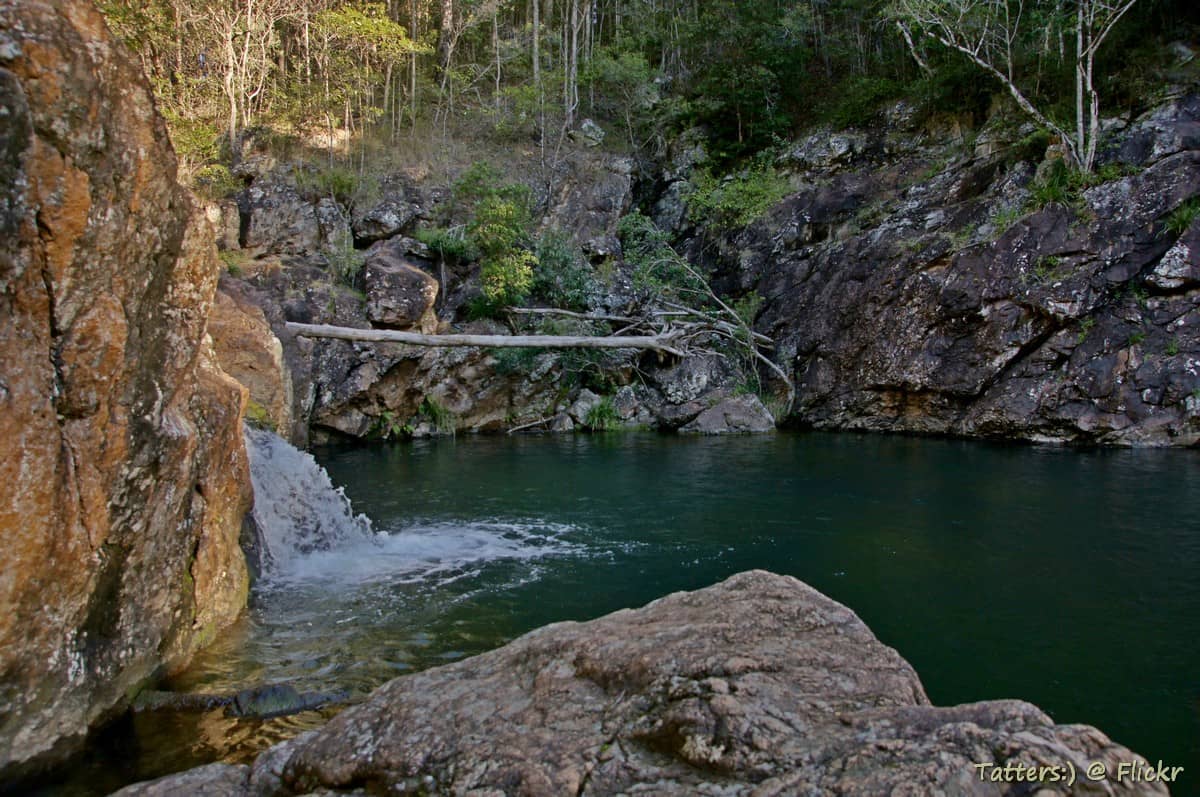
The southern section of the park shifts between open eucalypt forest and dense subtropical rainforest depending on aspect and elevation. On the eastern escarpment slopes, where moisture gathers, the canopy closes overhead and the light drops. The air is noticeably cooler, and the smell shifts from dry eucalyptus to something denser: wet bark, leaf litter, and the faint sweetness of strangler figs. The soundscape is significant. At dawn, it is almost entirely birdsong, with whipbirds and currawongs calling across the ridgelines.
In the drier eucalypt woodland sections, the light is harder and the ground is patterned with bark and grass. Wallabies are frequently seen in open clearings at dusk, particularly around Maiala and Jolly's Lookout picnic areas. Koalas exist in the park but are genuinely difficult to spot without patience and upward attention. Brisbane's suburban koala population is separate from the park population; the animals here are wild and not habituated to people.
Visitors who want a guided introduction to the local fauna before entering the park should consider Walkabout Creek Discovery Centre, which sits on the park boundary and houses native animals in a controlled environment. It is a useful primer, particularly for families with children, before attempting longer trails.
Key Areas and Trail Options
Jolly's Lookout is the most accessible viewpoint in the park and the most frequently visited. It sits at the top of Mount Nebo Road and offers a wide view across the northern suburbs of Brisbane and out toward Moreton Bay on clear days. The lookout itself takes about five minutes to reach from the car park. It is not a destination for experienced hikers looking for solitude; on weekend mornings it can draw a steady stream of visitors. Come early or on a weekday.
Maiala day-use area, a short drive further along Mount Nebo Road, is the starting point for several of the park's better rainforest walks. The circuit tracks here move through tall coachwood, grey myrtle, and hoop pine, and the paths are generally well-marked. After significant rain, sections become muddy and slippery. Closed-toe shoes are the minimum; trail runners or hiking boots are more appropriate.
Bellbird Grove, named for the bell miners that call through the canopy, is a quieter area suited to shorter walks and picnics. The ambient noise from those bell miners creates a continuous, high-pitched ringing that some people find remarkable and others find disorienting. It is one of the more atmospheric spots in the southern section.
For those who want to combine a park visit with a broader exploration of the D'Aguilar Range's trail network, the Brisbane hikes and walks guide covers trail grades, distances, and starting points in more detail.
Practical Access and Getting There
The park has no practical public transport access. The interior trail heads and day-use areas are only reachable by private vehicle. For the southern section, the main route is Mount Nebo Road, accessed from The Gap via Waterworks Road. The drive from central Brisbane to Jolly's Lookout takes roughly 30 to 45 minutes depending on traffic and the specific destination. Samford Road provides an alternative approach to several areas.
Fuel up before entering the park. There are no petrol stations inside, and the roads through the range have limited mobile phone coverage in places. Download offline maps before you go or pick up a printed trail map from Queensland Parks.
⚠️ What to skip
The northern Mount Mee section is approximately a 90-minute drive from Brisbane and requires a 4WD beyond The Gantry day-use area. Do not attempt unsealed roads in a standard vehicle after heavy rain.
There is no general park-entry fee. Camping permits are required for overnight stays and fees apply. Book camping through the Queensland Parks online reservation system before arriving, as sites can fill during school holidays and long weekends.
Wildlife, Weather, and When to Visit
Brisbane's humid subtropical climate means the park experiences hot, humid summers and mild, dry winters. From roughly May to September, conditions are significantly more comfortable for walking: temperatures are lower, humidity drops, and rain is less frequent. Summer visits (December to February) are possible but demand early starts; heat and humidity build quickly once the sun rises above the canopy, and the risk of afternoon thunderstorms is real.
If you are planning a trip around Brisbane's broader calendar, the best time to visit Brisbane guide explains seasonal patterns in more detail and factors beyond just the park.
Wildlife activity is highest at dawn and dusk. Brush turkeys are present throughout the year and have little fear of humans near picnic areas. Pademelons (small forest wallabies) emerge at the edges of clearings in low light. The park also supports a healthy population of lace monitors. Do not feed any wildlife, including the turkeys, regardless of how persistently they investigate your picnic.
Accessibility and Who This Park Suits
Wheelchair-accessible facilities are available at Walkabout Creek Discovery Centre and parts of Bellbird Grove, Jolly's Lookout, Maiala, The Cedars, and The Gantry day-use areas, though some assistance may be needed. The accessible areas allow people with limited mobility to experience the park's scenery and birdlife without requiring a full trail walk. The longer rainforest circuits, however, involve uneven surfaces, tree roots, and creek crossings that are not suitable for wheelchairs or prams.
Visitors who are primarily looking for a polished attraction with structured programming may find the park underwhelming. It does not have an interpretive centre in the main trail areas, the signage is functional rather than narrative, and large sections are genuinely remote. That is a feature for experienced bushwalkers and a disappointment for visitors expecting something closer to a themed nature experience. Be honest with yourself about which category you fall into before driving 40 minutes into the ranges.
Families with young children who want structured wildlife interaction close to Brisbane are better served by Lone Pine Koala Sanctuary or Walkabout Creek, both of which provide guaranteed wildlife encounters in a managed setting.
Insider Tips
- Jolly's Lookout is best visited before 8 am on weekends. After that, the car park fills and the atmosphere shifts from peaceful to crowded. The view does not change but the experience does significantly.
- The Rainforest Circuit at Maiala is consistently underrated relative to more publicised Brisbane hikes. It is short enough (around 3 km) to do in an afternoon but dense and atmospheric enough to feel like a genuine wilderness experience.
- Leeches are present in the rainforest sections after rain. Tuck socks over trouser cuffs or apply a repellent designed for leeches around boot openings. This is not mentioned in most visitor guides and catches first-timers off guard.
- Mobile reception is patchy throughout the park and disappears entirely in some valleys. Screenshot your trail maps, download offline maps via a mapping app before you leave home, and tell someone where you are going.
- The Mount Mee section sees a fraction of the visitor numbers of the southern park but offers some of the best walking on the range. The drive is longer but the payoff in terms of solitude and scenery is substantial for those willing to make the trip.
Who Is D'Aguilar National Park For?
- Hikers wanting serious trail options within an hour of Brisbane's CBD
- Wildlife enthusiasts prepared to walk quietly at dawn or dusk
- Families combining a Walkabout Creek visit with an introductory rainforest walk
- Campers looking for a genuine bush experience close to a major city
- Photographers working in low light conditions at the escarpment viewpoints
Nearby Attractions
Combine your visit with:
- Boondall Wetlands
Stretching across 1,150 hectares of tidal flats, mangroves, and melaleuca forest north of the CBD, Boondall Wetlands is Brisbane's largest urban nature reserve. Free to enter, it rewards early-morning visitors with dense birdlife, quiet boardwalks, and a genuine sense of distance from the city.
- Daisy Hill Koala Centre
Daisy Hill Koala Centre offers one of the most low-key, genuine koala encounters near Brisbane, completely free of charge. Set inside Daisy Hill Conservation Park, this small but thoughtfully designed centre combines educational exhibits with resident koalas in an outdoor enclosure, alongside wild koalas living in the surrounding eucalypt forest. It rewards patient visitors who arrive without expectations of a zoo-style show.
- Lone Pine Koala Sanctuary
Opened in 1927, Lone Pine Koala Sanctuary in Fig Tree Pocket is the world's first and largest koala sanctuary, home to koalas alongside kangaroos, platypuses, and native birds. It's the most direct way to get close to Australian wildlife without leaving the Brisbane area, though knowing when and how to visit makes a real difference to the experience.
- Shorncliffe Pier
Standing on Moreton Bay since 1882, Shorncliffe Pier is one of Brisbane's most evocative heritage structures. The 350-metre timber walkway stretches out over the water at the quiet suburb of Shorncliffe, rewarding visitors with open bay views, cooling sea breezes, and a peaceful escape from the city's centre.
Planning a trip? Discover personalized activities with the Nomado app.