Union Station Hotel Nashville: The Gothic Train Station Worth Stopping For
Built in 1900 as a Louisville and Nashville Railroad terminal, the Union Station Nashville Yards is now a 125-room boutique hotel with one of the most dramatic lobby interiors in Tennessee. The soaring stained-glass ceiling, limestone turrets, and barrel-vaulted great hall make it worth a visit whether you are a guest or simply passing through downtown.
Quick Facts
- Location
- 1001 Broadway, Downtown Nashville, TN 37203
- Getting There
- Walk from Lower Broadway (~10 min); Uber/Lyft from BNA airport is approx. 15 min. No subway in Nashville; WeGo bus routes serve downtown Broadway corridor.
- Time Needed
- 15–30 min to explore the lobby and exterior; longer for dining or drinks (note that lobby access policies may change and can occasionally be restricted to guests)
- Cost
- Free to enter the lobby; room rates vary by date — check the official site for current pricing
- Best for
- Architecture lovers, history enthusiasts, hotel guests, photographers
- Official website
- www.unionstationhotelnashville.com
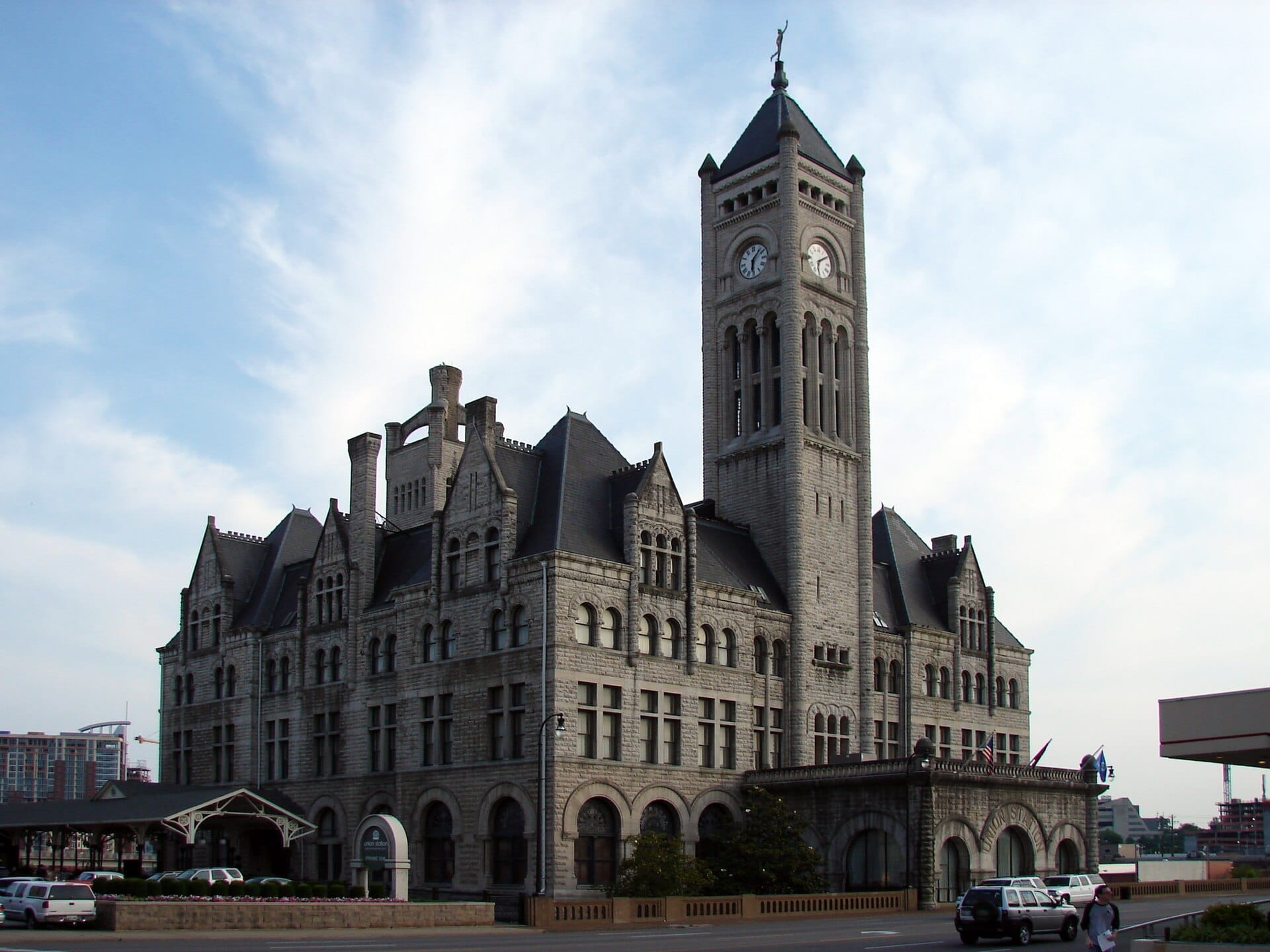
What You Are Actually Looking At
The Union Station Nashville Yards is a Romanesque Revival limestone building that was completed in 1900 to serve the Louisville and Nashville Railroad. Its silhouette, a cluster of turrets and towers rising above Broadway, signals something older and heavier than most of what surrounds it. From the sidewalk, the exterior reads almost ecclesiastical: deeply rusticated stonework, arched window openings, and a central clock tower that has marked the western edge of downtown for over a century.
Step through the entrance and the scale shift is immediate. The great hall, now the hotel lobby, is covered by a barrel-vaulted ceiling set with original stained-glass panels. Depending on the hour, filtered light moves across the stone floor in long amber and green bands. It is one of those interiors that genuinely stops people mid-step. Even travelers who have no intention of staying here will pause, pull out a phone, and tilt their heads back.
💡 Local tip
The lobby is typically open to the public at no charge, though access can occasionally be limited for private events or hotel guests; you generally do not need a reservation or specific reason to walk in, look around, and admire the ceiling when it is open. Staff are accustomed to curious visitors.
A Brief History Worth Knowing Before You Visit
Construction of the station began in 1898 and it opened officially in 1900, making it the primary rail gateway into Nashville for decades. The Louisville and Nashville Railroad ran passenger service through here at a time when train travel was the dominant form of long-distance transport in the American South. The building was designed with genuine civic ambition: the stone, the height, the decorative details all communicate that arriving in Nashville was meant to feel like arriving somewhere.
Passenger rail declined through the mid-twentieth century and the station eventually fell into disuse. After a period of abandonment, it was converted and reopened as the Union Station Hotel in 1986 as a luxury boutique hotel and special event destination, becoming one of the earlier examples in Nashville of adaptive reuse of a major historic structure. The building is listed on the National Register of Historic Places. A significant renovation completed in 2020–2021 updated the 125 rooms across seven floors while preserving the defining architectural features of the public spaces.
For travelers who want to place this building within a broader arc of Nashville history, the Tennessee State Museum covers the state's full historical timeline and provides useful context for understanding how the railroad era shaped the city's growth.
Tickets & tours
Live prices and dates from our booking partner. If you book, we may earn a commission at no extra cost to you.
Old Town trolley tour of Nashville
From 54 €Instant confirmationFree cancellationHatch Show Print guided tour
From 21 €Instant confirmationFree cancellationDowntown walking tour of Nashville
From 21 €Instant confirmationFree cancellationNashville Downtown Underground Donut Tour
From 46 €Instant confirmationFree cancellation
The Lobby at Different Times of Day
Morning is the quietest window. Before 9am, the lobby has almost no foot traffic beyond hotel guests heading to breakfast. The stained-glass ceiling catches early light from the east-facing windows and the hall takes on a cool, slightly churchlike quality. The stone floor, the wooden check-in desk, and the general absence of background noise make the space feel closer to its original era than at any other hour.
By late afternoon, especially on weekends, the mood changes. The bar draws a pre-dinner crowd and the lobby fills with both guests and locals. The stained glass picks up warmer tones as afternoon light shifts, and the ambient noise level rises to something between a hotel lounge and a cocktail party. This version of the space is less solemn but more alive, and it gives the hall a different kind of energy worth experiencing.
Evening, particularly Friday and Saturday nights, can be genuinely loud. The hotel sits close to the Broadway entertainment district and the bar becomes a destination in its own right. If quiet contemplation of the architecture is what you are after, a weekday morning visit serves that goal far better than a Saturday night.
ℹ️ Good to know
Photography of the lobby ceiling is best in the morning when natural light passes through the stained glass at a low angle. A wide-angle lens or your phone's ultra-wide setting handles the scale better than a standard focal length.
The Architecture in Detail
The building's style draws from Romanesque Revival and Gothic influence in a combination that was fashionable for American civic and institutional buildings at the turn of the twentieth century. The exterior limestone was quarried locally, which gives it a warm grey tone that reads differently from the harder white stone used in state government buildings further up Capitol Hill. The corner tower is the most photographed element of the exterior and serves as a useful landmark when navigating from Lower Broadway on foot.
Inside, the vaulted ceiling is the main event, but the secondary details reward attention: carved stone capitals on the pilasters, the proportions of the arched openings between spaces, and the original iron structural elements visible in the upper reaches of the hall. The 2021 renovation appears to have respected these features rather than smoothing them away. The result is a lobby that reads as genuinely historic rather than recreated.
Nashville has a richer collection of significant historic architecture than most visitors realize. The Tennessee State Capitol, designed by William Strickland and completed in 1859, is a short walk northeast and makes for a natural architectural pairing with Union Station if you are spending a morning exploring the built environment of downtown.
Staying Here vs. Visiting as a Day Guest
As a hotel, the Union Station Nashville Yards sits in a particular category: boutique, historic, and well-located, but not the largest or most comprehensively amenitized option in the city. The 125 rooms are spread across seven floors; upper-level rooms with views toward downtown offer a perspective on the city that standard downtown hotels do not replicate. Room rates are premium compared to chain hotels in the same area, reflecting both the location and the historic designation.
For non-guests, the bar and restaurant provide the most natural reason to spend time here beyond a quick lobby visit. The bar, positioned within the great hall, serves cocktails against the backdrop of the stained glass ceiling. It is a genuinely distinctive setting for a drink. If you are working through Nashville's food and drink landscape, this is worth adding as an early-evening stop before heading to Lower Broadway.
If you are planning a broader stay and weighing accommodation options across different neighborhoods, the guide to where to stay in Nashville breaks down the trade-offs between downtown, Midtown, East Nashville, and other areas.
Getting There and Getting Around Afterward
The hotel sits at 1001 Broadway, placing it at the western approach to the Broadway honky-tonk strip. Walking east from the front entrance puts you at the heart of Lower Broadway within ten minutes. The Gulch neighborhood, with its restaurants and murals, is a short walk south. Nashville International Airport (BNA) is approximately eight miles southeast; a ride-hail or taxi takes roughly 15 minutes outside peak traffic, though Broadway itself can slow things considerably on weekend evenings.
Nashville does not have a subway system. The WeGo Public Transit bus network covers downtown and surrounding neighborhoods, but most visitors to this part of the city navigate on foot or by ride-hail. Parking is available in nearby garages if you are driving; the hotel has its own valet service for guests.
For a fuller picture of how to move around the city without a car, the getting around Nashville guide covers ride-hail, bus, and walkability by neighborhood.
⚠️ What to skip
Broadway is heavily congested on Friday and Saturday evenings. If you are arriving by car or ride-hail after 7pm on a weekend, budget extra time and consider being dropped off a block away to avoid the entertainment district backup.
Honest Assessment: Who Gets the Most from This Visit
The Union Station Nashville Yards rewards anyone with an interest in American railroad history, adaptive reuse architecture, or pre-war civic building design. It is one of the few places in Nashville where you can stand inside a space that has looked essentially the same for over a century, and that carries genuine weight for a city that tears down and rebuilds at a rapid pace.
It is less compelling if you are looking for something quintessentially Nashville in the music-history sense. There are no recording studios, no live performance spaces, no Country Music Hall of Fame exhibits here. The building's significance is architectural and civic rather than musical. Travelers who want to focus entirely on Nashville's music heritage will find more directly relevant stops elsewhere on Broadway and along Music Row.
For the music-history angle, the Country Music Hall of Fame is a ten-minute walk east and is the city's most comprehensive music museum. The Ryman Auditorium is similarly close and offers a different kind of historic interior that pairs well with a Union Station visit on the same morning.
Insider Tips
- Weekday mornings before 9am offer near-solitude in the lobby. The stained glass ceiling reads best in low foot traffic when you can stand still and look without being navigated around.
- The bar seats directly beneath the vaulted ceiling. If you want to experience the architecture as a functioning space rather than a museum piece, an early-evening drink here does that more effectively than a quick lobby pass-through.
- The exterior clock tower is best photographed from the south side of Broadway, slightly to the west, where you can get the full tower against sky without other buildings crowding the frame.
- The 2021 renovation preserved original stone and ironwork details in the upper sections of the great hall that are easy to miss if you only look straight ahead. Take two minutes to look up into the structural bays above the stained glass.
- If you are visiting in summer, the thick limestone walls keep the lobby noticeably cooler than the street outside. It makes for a genuinely pleasant mid-afternoon stop when the Broadway heat is at its worst.
Who Is Union Station Hotel For?
- Architecture and design enthusiasts interested in American Romanesque Revival and adaptive reuse
- History travelers who want physical contact with pre-twentieth-century Nashville
- Photographers looking for dramatic interior light and a distinct exterior silhouette
- Couples seeking a special-occasion hotel with a unique historic setting
- Curious day visitors who want a free, no-obligation look at one of downtown Nashville's finest interiors
Nearby Attractions
Other things to see while in Downtown Nashville:
- 3rd & Lindsley
Since 1991, 3rd & Lindsley has been the venue where Nashville musicians play when they want to be heard, not just seen. Located half a mile south of Broadway in the SoBro district, it is an intimate, no-frills room that draws touring acts, local legends, and serious audiences in equal measure.
- Acme Feed & Seed
Housed in a landmark 1943 building at the corner of 1st Avenue and Broadway, Acme Feed & Seed is a multi-level bar, restaurant, and music venue with a rooftop overlooking the Cumberland River. It offers a more layered experience than the typical honky-tonk strip, with a rooftop that earns its reputation for views and a ground floor that still delivers the Broadway energy.
- Adventure Science Center
Adventure Science Center is Nashville's premier interactive science museum, offering 44,000 square feet of hands-on exhibits, a 75-foot adventure tower, and a 63-foot dome planetarium. It has served the city since 1945 and remains one of the most engaging family destinations near downtown Nashville.
- Bicentennial Capitol Mall State Park
Bicentennial Capitol Mall State Park is a free, 19-acre outdoor park in downtown Nashville built to commemorate Tennessee's 200th anniversary of statehood. Anchored by a 200-foot granite map of the state, a 95-bell carillon, and the Rivers of Tennessee Fountains, it doubles as one of the most informative and peaceful green spaces in the city center.
Planning a trip? Discover personalized activities with the Nomado app.