Trogir: Croatia's Stone-Built Medieval Island Town
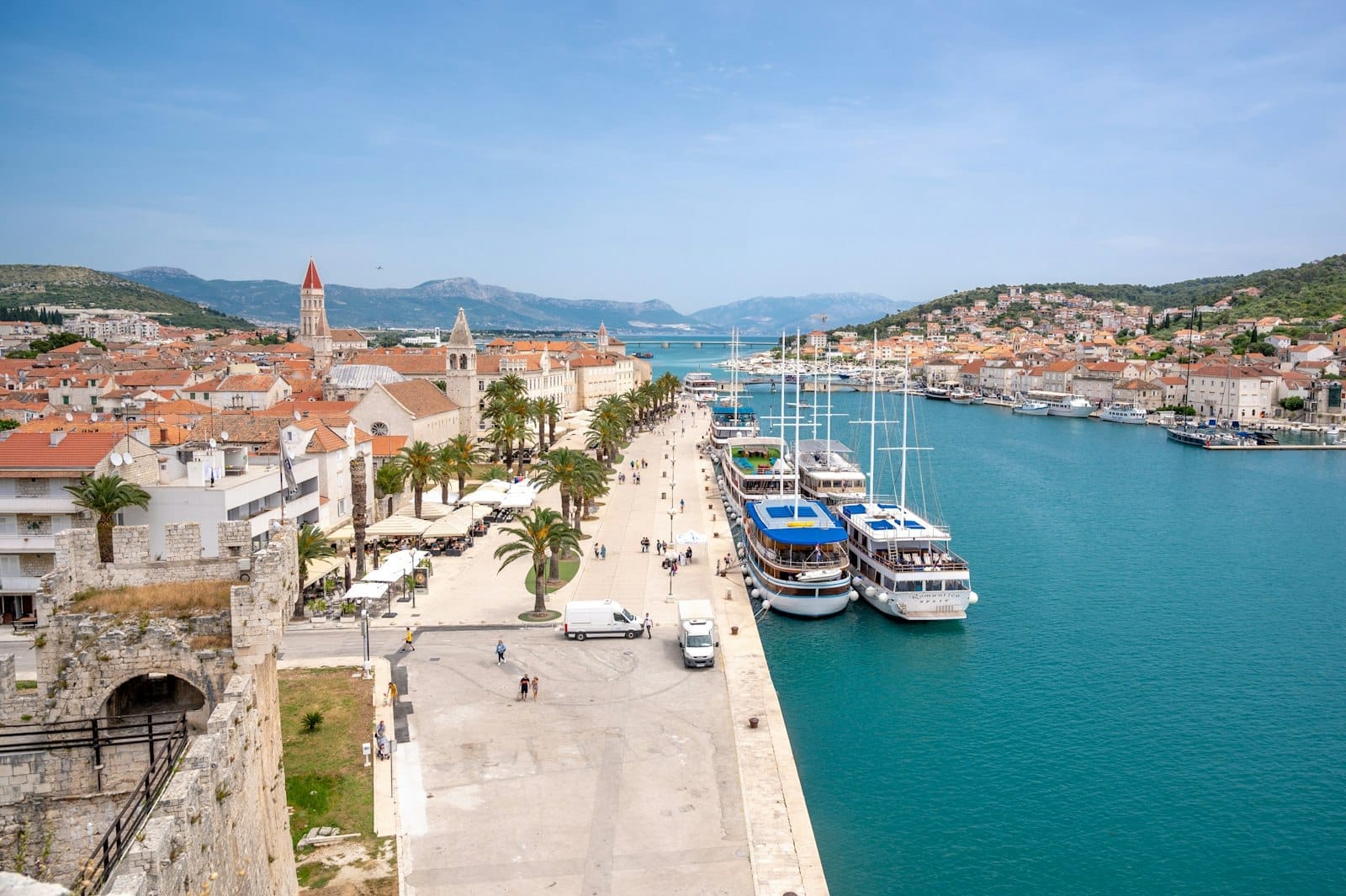
Founded by Greeks in the 3rd century BC and a UNESCO World Heritage Site since 1997, Trogir is a compact medieval town on a small island between the mainland and Čiovo. Its cathedral portal, Venetian fortress, and grid of limestone streets form the most complete Romanesque-Gothic ensemble in the region.
Quick Facts
- Location
- 27 km west of Split, 5 km from Split Airport, Split-Dalmatia County
- Getting There
- Direct bus from Split bus station (roughly 30-45 min depending on traffic); accessible by car via the coastal road or motorway
- Time Needed
- 3-5 hours for the old town; full day if including Čiovo island or a waterfront lunch
- Cost
- Free to enter the medieval core; individual site tickets apply (cathedral approx. €5-7 — verify on-site)
- Best for
- Medieval architecture, day trips from Split, history lovers, photography
- Official website
- whc.unesco.org/en/list/810
What Trogir Actually Is
Trogir is a medieval town built on a small island roughly 500 metres long and 250 metres wide, connected to the mainland by one bridge and to the larger Čiovo island by another. The entire historic core is a UNESCO World Heritage Site, listed in 1997 for having one of the most complete and unaltered sequences of Romanesque-Gothic architecture anywhere in Central Europe. The streets follow a Hellenistic grid laid down when Greek colonists established the settlement as Tragurion in the 3rd century BC — a plan that has remained essentially unchanged for over 2,300 years.
The town is not a reconstruction or an open-air museum. People live here. Laundry hangs between 13th-century stone facades, cats sleep on Roman-era foundations, and residents carry groceries past reliefs that predate the printing press. That quality of uninterrupted urban life, layered across Greek, Roman, Byzantine, Venetian, and Croatian periods, is what makes Trogir worth the 27-kilometre trip from Split.
ℹ️ Good to know
There is no gate or admission fee to enter the historic town. You walk in freely. Individual monuments — the cathedral, the Camerlengo fortress — charge separate entry fees. Verify current prices at each site, as they change seasonally.
The Cathedral of St. Lawrence: The Centrepiece
The Cathedral of St. Lawrence, which stands on the town's main square (Trg Ivana Pavla II), is the architectural reason most visitors make the trip. Construction began in the 13th century and continued across several centuries, so the building layers Romanesque structure with Gothic chapels and Renaissance additions. The bell tower alone spans three different stylistic periods visible as you look upward, reaching 47 metres at its highest point.
The cathedral's western portal, carved by the master sculptor Radovan in 1240, is the standout work. The portal is densely figurative: Adam and Eve flank the columns, apostles and prophets fill the archivolts, hunting and harvest scenes wrap the outer jambs, and a lunette depicts the Nativity above the door. The carving quality and depth of narrative detail are extraordinary for the period. Radovan signed his own name in the inscription — an early and rare act of artistic self-identification in medieval Europe. Even if you have no particular interest in Romanesque art, the portal is difficult to walk past without stopping.
The cathedral's interior holds the Chapel of St. John of Trogir (Ursini Chapel), a 15th-century Renaissance work by Nicola di Giovanni Fiorentino, considered one of the finest examples of early Renaissance sculpture in Dalmatia. The bell tower can be climbed for views across the island town, the Čiovo bridge, and the mainland hills. Entry to the cathedral and tower is ticketed — expect to pay in the range of €5-7 per person, though this should be confirmed at the entrance.
Tickets & tours
Hand-picked options from our booking partner. Prices are indicative; availability and final rates are confirmed when you complete your booking.
Split and Trogir half-day tour
From 40 €Instant confirmationFree cancellationBlue Lagoon and Trogir boat tour from Split
From 98 €Instant confirmationFree cancellationBlue Lagoon and Trogir private boat tour
From 1.850 €Instant confirmationFree cancellationHalf-day boat trip to Blue Lagoon and Solta Island from Trogir
From 65 €Instant confirmationFree cancellation
The Town's Layers: Streets, Squares, and Fortifications
The street grid is tight and largely car-free. From the Land Gate on the north side (the main historic entrance, topped with a relief of St. John of Trogir) to the sea-facing Riva promenade on the south, the entire island takes about ten minutes to cross on foot. But the density of the architecture slows you down: there are Venetian palaces with Gothic bifurcated windows, a 15th-century loggia, Baroque church facades, and small courtyards tucked behind unmarked doorways.
On the western tip of the island stands the Camerlengo Fortress, a 15th-century Venetian fortification with a distinctive round tower. The fortress hosts summer events and can be climbed for an elevated view of the surrounding water channels and Čiovo. Nearby, the smaller Kula Sv. Marka (St. Mark's Tower) completes what remains of the Venetian defensive ring. The southern Riva waterfront, lined with café chairs and moored boats, contrasts sharply with the dense interior streets — it's the place locals come in the evening and the place tourists tend to gravitate toward first.
The town has echoes of Split's own historic core, though Trogir is considerably smaller and more intact. If you've already explored Diocletian's Palace in Split, Trogir offers a useful contrast: less Roman, more medieval, less commercialised, and with fewer tourists competing for the same sight lines.
How the Town Changes Through the Day
Trogir behaves differently in the morning than it does at midday. Before 9am, the streets are almost empty. The smell of baked bread comes from the handful of small bakeries near the market area. The light on the limestone facades is warm and angled, which makes the cathedral portal read particularly well photographically. This is when the town feels most like itself.
By late morning, tour groups from Split and cruise ships arriving at the nearby Seget Donji terminal begin to fill the main square and the area around the cathedral. The Riva café terraces fill up, and the narrow lane between the Land Gate and the main square becomes genuinely congested. From roughly 11am to 3pm in summer, the town is at its most crowded and loudest.
The late afternoon is worth considering as an alternative arrival window. By 4-5pm, many day-trippers have left. The light turns gold, the square empties noticeably, and restaurants shift from tourist-menu mode to something closer to a local dinner service. If you're coming from Split by bus, an afternoon visit followed by dinner and an evening return works well logistically and gives you the town at its most relaxed.
💡 Local tip
Arrive before 9am or after 4pm to see the cathedral portal and main square without crowds. Midday in July and August is the least rewarding time to visit — hot, crowded, and photographically flat.
Getting There from Split
The most straightforward option is the public bus from Split's main bus station near the ferry terminal. Buses run frequently throughout the day and drop you a short walk from the Land Gate entrance to the old town. The journey takes approximately 30-45 minutes depending on traffic, and the route passes through several coastal settlements, which makes it more scenic than the motorway by car.
If you're renting a car, Trogir is a natural stop on the way to or from Split Airport, which sits only 5 kilometres from the town centre. This makes Trogir a realistic first or last stop on a Dalmatian itinerary — arrive into the airport, drop bags at the car hire desk, and spend three hours in Trogir before driving to Split. Parking is available near the bridge on the mainland side, as cars cannot enter the historic island core. For context on how Trogir fits into a broader trip, the day trips from Split guide covers logistics alongside other excursion options.
Some visitors combine Trogir with a visit to the Roman ruins at Salona (Solin), which lies on the road between the two towns. The ruins are extensive and significantly less visited than either Split or Trogir. Details on what to expect are covered in the Salona Roman ruins guide.
Practical Walkthrough and What to Bring
The island is entirely pedestrianised and almost entirely paved in polished limestone. In wet conditions, the stone becomes slippery, so flat-soled shoes with some grip are advisable. In summer, the surface reflects heat, and the narrow streets trap it — a hat and water bottle are not optional. There are no supermarkets inside the old town; the small konobas and café bars are priced for tourists.
Wheelchair and pushchair access is limited. The historic street surfaces are uneven, some lanes have steps at thresholds, and the cathedral interior requires navigating a narrow entrance. The town is accessible in general terms, but visitors with significant mobility limitations should expect to skip several interior sites.
Photography is unrestricted in the public streets and on the exterior of buildings. The cathedral interior may restrict tripods during services. For travellers combining Trogir with broader sightseeing across Split's coastline, the 3-day Split itinerary incorporates Trogir as a natural half-day excursion within a structured trip.
Honest Assessment: Who This Is and Isn't For
Trogir is a genuinely exceptional medieval site. The architecture is not merely old — it is coherent, dense, and in many cases world-class. The cathedral portal by Radovan is one of the great works of medieval European sculpture and deserves to be better known outside specialist circles. The town as a whole rewards slow, observant walking rather than checking sites off a list.
That said, it is a small town. You will have seen the essential sights within two to three hours. It does not have the energy or variety of Split, the island atmosphere of Hvar, or the natural drama of Krka National Park. Travellers who need continuous stimulation or don't find architecture inherently interesting may feel they've exhausted it quickly.
In peak summer, the combination of midday heat, cruise ship passengers, and the physical constraint of the island can feel oppressive rather than atmospheric. The town handles crowds less gracefully than Split, simply because there is less space to diffuse them. If your travel dates are fixed in July or August, time your visit carefully — it makes a significant difference.
⚠️ What to skip
Trogir is not a beach destination. Čiovo island, connected by bridge, has some beaches, but they are modest. If beaches are your priority, Trogir is a detour rather than a destination. Check the Split beaches guide if that's what you're planning around.
Insider Tips
- The best view of Radovan's portal comes from a standing position directly in front, slightly below the main door level — step back toward the centre of the square rather than standing close. Early morning light from the east hits the carvings at an angle that brings the relief depth into sharp contrast.
- The Camerlengo Fortress is consistently less crowded than the cathedral but offers better elevated views over the water channels and Čiovo. It also hosts open-air film screenings and concerts in summer — check locally for the schedule.
- The covered market just outside the Land Gate on the mainland side sells local olive oil, dried figs, and lavender products from Dalmatian farms. Better quality and lower prices than anything sold inside the old town.
- The lane running directly behind the cathedral (parallel to the main square) is almost always quiet, even when the Riva and main square are packed. It leads past several Gothic palace facades that most visitors completely miss.
- If you're combining Trogir with a drive to or from Split Airport, the parking area at the foot of the bridge is free or low-cost compared to central Split — some travellers park here and take the bus into Split for a day visit, using Trogir as a base.
Who Is Trogir For?
- Architecture and history travellers who want medieval Europe's most intact Romanesque-Gothic streetscape in a single afternoon
- Photographers seeking early-morning limestone-and-shadow compositions without competing with large crowds
- Travellers with a Split Airport connection who want to use a layover productively
- Families with older children interested in history — the fortress and tower climbs hold attention well
- Anyone doing a 3-day Split itinerary who wants one strong half-day excursion without full-day commitment
Nearby Attractions
Combine your visit with:
- Archaeological Museum Split
Founded in 1820, the Archaeological Museum Split (Arheološki muzej Split) is widely regarded as the oldest museum institution in Croatia. Its collection of some 150,000 artifacts, spanning prehistoric through medieval periods, makes it the most complete record of ancient Dalmatia in existence. The arcaded garden alone, lined with Roman sarcophagi and stone inscriptions, is worth the ticket price.
- Blue Cave (Biševo)
The Blue Cave, or Modra špilja, is a flooded sea cave on Biševo island whose interior glows an otherworldly blue when sunlight enters through a submerged opening. Reachable only by small boat, it sits about 50 km southwest of Split and draws visitors from across the Dalmatian coast. The light effect is real — but timing, weather, and crowds determine whether the experience feels magical or rushed.
- Brač Island
Brač is the largest island in Dalmatia, covering around 395–396 km² and rising to about 778 metres at Vidova Gora, the highest peak among all Adriatic islands. Reachable by ferry from Split in under an hour, it delivers a full day of beach, landscape, and stone-village atmosphere without the crowds that descend on Hvar.
- Cetina River Canyon
The Cetina River Canyon carves through limestone karst southeast of Split, delivering sheer cliff walls, the 49-metre Gubavica Falls, and one of Dalmatia's most rewarding rafting routes. Whether you kayak the emerald water, walk the gorge paths, or simply lunch beside the historic Radmanove Mlinice mills, it is a compelling contrast to Split's coastal crowds.