Train Street Hanoi: The Old Quarter Alley Where Trains Still Run
Train Street is a narrow residential alley in Hanoi's Old Quarter where an active railway line passes just centimetres from the doorsteps of local homes. It draws visitors for the spectacle of a train threading through tightly packed buildings, though the experience has changed significantly in recent years.
Quick Facts
- Location
- Phung Hung Street area, Old Quarter, Hoan Kiem District, Hanoi
- Getting There
- Walk from Hoan Kiem Lake (15 min); Grab taxi or xe om to Dien Bien Phu or Le Duan Street
- Time Needed
- 30–60 minutes, depending on train timing
- Cost
- Free to walk; cafes along the track charge for seating
- Best for
- Photography, urban curiosity, a glimpse of everyday Hanoi life
What Train Street Actually Is
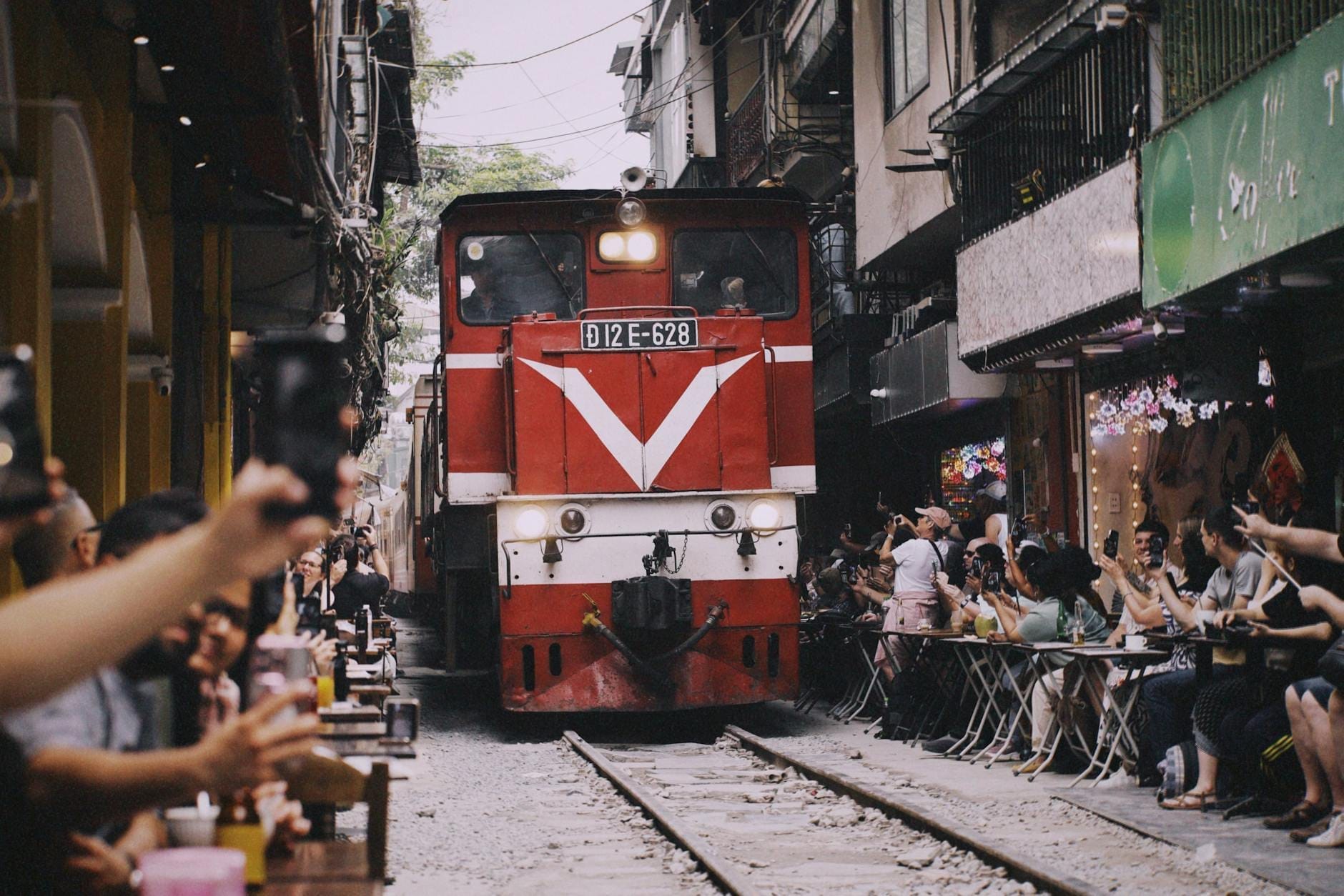
Train Street is not a street in any conventional sense. It is a stretch of residential alley in Hanoi's Old Quarter where the railway track running north out of Hanoi Railway Station passes at ground level, separated from the front doors of homes and small shops by no more than a metre of space on each side. The track runs through this corridor several times a day, and for a few minutes the alley transforms from a quiet backstreet into something genuinely startling: a full-size train moving slowly but emphatically through what feels like someone's living room.
The main section most visitors see runs along a stretch near Phung Hung Street, though the track continues for some distance in both directions. The alley itself is lined with narrow shophouses, potted plants on windowsills, laundry on lines overhead, and the kind of accumulated domestic detail that makes clear people have lived here for a very long time. Between train passes, children play on the tracks, residents set out chairs, and the scene feels entirely ordinary.
ℹ️ Good to know
Train schedules change seasonally and are not always published in real time. Ask your hotel or a local cafe near the track for the current day's approximate passing times before walking out.
The History Behind the Track
The railway line through Hanoi was built during the French colonial period in the late 19th and early 20th centuries, part of the broader Indochina rail network. The city grew around the tracks over the following decades, and in parts of the Old Quarter the gap between residential construction and the railway corridor narrowed to the point where the boundary between public infrastructure and private home became almost meaningless.
The Old Quarter itself dates its commercial street grid to at least the 14th century, with each lane historically associated with a particular trade. The railway arrived long after those patterns were established, threading through an already dense urban fabric rather than reshaping it. That compression is what gives Train Street its particular character. For more on how the Old Quarter's layout developed, the Hanoi Old Quarter guide covers the district's history and street-by-street logic in detail.
Tickets & tours
Live prices and dates from our booking partner. If you book, we may earn a commission at no extra cost to you.
Hanoi Walking Street Food Tour with Train-Street Visit
From 28 €Instant confirmationFree cancellationHa Noi train station to Ha Noi city centre private transfer
From 19 €Instant confirmationFree cancellationNoi Bai International Airport Fast Track Service with SIM Card Option
From 25 €Instant confirmationFree cancellationPrivate full-day trip from Hanoi to Halong Bay with boat cruise
From 59 €Instant confirmationFree cancellation
What the Visit Feels Like: Morning vs. Evening
In the morning, the alley is relatively quiet. Residents move through their routines, small food stalls set up near the ends of the track corridor, and the light is flat and even. It is a good time for photography if you want the texture of daily life without a crowd, though the morning train passes early and you will need to verify the schedule to catch it.
By late afternoon, the character shifts. Visitors begin gathering, cafe seating fills up along the alley edges, and the atmosphere becomes noticeably more performative. Photographers position themselves along the track, some standing closer than is advisable. When the train does come through, it sounds its horn repeatedly as it approaches and moves at low speed, but the clearance on both sides is genuinely narrow. The noise is considerable: a deep horn blast, then the mechanical clatter and weight of the carriages passing a few feet away. The smell is oil, hot metal, and brake dust.
The evening train pass, typically around dusk or after dark, draws the largest crowds. Cafe lights reflect off the rails, the horn cuts through the alley's noise, and people press back against walls and cafe railings as the train moves through. It is dramatic in a way that is real rather than staged, but the crowd density at this hour means the experience is more spectacle than contemplative.
⚠️ What to skip
Stay off the tracks and inside designated viewing areas or cafe seating when a train is approaching. The clearance is extremely tight. This is an active railway, not a tourist installation.
The Cafe Situation: What Changed and Why It Matters
For several years, a cluster of small cafes operated directly along the track, offering front-row seating inches from the rails. Hanoi authorities ordered these cafes closed in 2019 on safety grounds, and enforcement came in waves after that. The situation has fluctuated since: some businesses have reopened in modified form, others have remained closed, and the experience available to visitors changes depending on when you arrive and what the current enforcement posture is.
As of recent visits, some cafe-style access along the corridor exists, typically set slightly back from the track and operating with varying degrees of formality. Expect to pay a small cover charge or minimum order for seating. The coffee itself is standard Vietnamese café fare: strong ca phe sua da (iced coffee with condensed milk) for around 30,000 to 50,000 VND. Do not expect the train-adjacent seating of pre-2019 photographs. If you see images online of chairs placed directly on or beside the rails, those are almost certainly outdated.
💡 Local tip
If a cafe employee is actively guiding people to seating and collecting payment before the train arrives, that is generally a sign the spot is operating in at least semi-organized fashion. Impromptu gatherings on the open track are more likely to draw police attention.
Getting There and Navigating the Area
Train Street sits within the Old Quarter, roughly a 15-minute walk from the northern shore of Hoan Kiem Lake. The most straightforward approach is to walk north on Dinh Tien Hoang, cross into the old street grid, and ask locals or use a map app to navigate to the Phung Hung Street area. The alley entrance is not prominently signed and the alleys in this part of the Old Quarter look similar from the outside, so GPS is genuinely useful here.
If taking a Grab (the dominant ride-hailing app in Vietnam), ask to be dropped near Dien Bien Phu Street or at the intersection with Phung Hung. From there the track is a short walk. Motorbike taxis (xe om) are also available throughout the Old Quarter and can navigate the narrow lanes more efficiently than cars at busy times.
The surrounding streets reward some wandering. Dong Xuan Market is less than 10 minutes on foot to the northeast, and the Hanoi Old Quarter Night Market runs on weekend evenings on nearby Hang Dao Street.
Photography Tips and Practical Notes
The best photographic position varies by light. In the morning with east-facing light, the western end of the corridor gives better illumination on the train itself. In late afternoon, the light reverses. The narrow alley means a wide-angle lens compresses distance in a way that can make the train look closer to buildings than it actually is, though in truth the clearance is small enough that no distortion is needed to make the point.
For phone photographers: the train moves slowly enough to capture cleanly without burst mode, but the horn blast can startle and cause camera shake if you are not prepared for it. Position yourself well before the train is audible. Do not attempt to photograph from the track itself.
Accessibility along the corridor is limited. The surface is uneven, the alleys are narrow, and there are no formal pathways or ramps. Visitors with mobility considerations will find it difficult to navigate comfortably, particularly when crowds build before a scheduled pass.
Honest Assessment: Is It Worth Your Time?
Train Street delivers something genuinely unusual: the collision of domestic urban life and heavy rail infrastructure at arm's length. The two minutes when the train actually passes are striking in a way that photographs do not fully capture, because the sound and the physical presence of something that large moving that close has a visceral quality.
The honest qualification is that the experience is brief and the surrounding wait can feel thin if the crowd is large or the cafe situation is uncertain on a given day. Visitors who arrive expecting a photogenic, easily accessible spectacle may find the reality messier and more contingent than anticipated. Visitors who treat it as a window into how an old city absorbs infrastructure, and who are content to spend an hour in an interesting backstreet regardless of whether the train arrives on schedule, tend to find it worthwhile.
If you are planning a broader day in this part of the city, combining Train Street with Hoan Kiem Lake and a walk through the Old Quarter's street grid makes for a full and coherent half-day. For a complete picture of how to structure your time in Hanoi, the Hanoi itinerary guide offers day-by-day options that can accommodate this stop without making it the sole focus.
Visitors who will not enjoy this: anyone with a low tolerance for crowds at peak hours, anyone expecting a curated or heritage-managed experience, and anyone bothered by the ethics of tourism clustering around a working-class residential street. Those concerns are legitimate. The people who live along this track deal with regular foot traffic through what is their actual neighborhood, and the balance between visitor interest and resident comfort is not always well managed.
Insider Tips
- Check train schedules the morning of your visit by asking at your hotel or the nearest cafe to the track. Trains run roughly twice daily in each direction but times shift, and arriving without this information means potentially waiting an hour or more.
- The less-visited northern section of the track, beyond the main cafe cluster, has the same clearance and the same train but significantly fewer people. Walk a few minutes further along the corridor before the train arrives if you want a less crowded sightline.
- Arrive 20 minutes before the expected train time, not 5. The final few minutes before the pass are when crowd pressure builds and positions near the track edges get contested.
- The alley walls in the late afternoon pick up warm reflected light from the low sun. That light on the domestic details of the houses, the laundry, the plant pots, is often more interesting photographically than the train itself.
- Combine the visit with a walk along Phung Hung Street, which has a stretch of archway murals painted on the old railway viaduct walls. It adds context and visual interest to what is otherwise a fairly contained stop.
Who Is Train Street For?
- Urban photographers looking for something beyond standard temple and lake shots
- Architecture and infrastructure enthusiasts interested in how Hanoi's colonial-era railway integrates with its old street fabric
- Travelers on a half-day Old Quarter walk who want an unusual detour with a clear focal point
- Anyone who appreciates watching a city go about its life around something that would be fenced off and decommissioned in most other countries
- Visitors with children old enough to appreciate the drama of a full-size train passing at close range
Nearby Attractions
Other things to see while in Old Quarter:
- Đồng Xuân Market
Đồng Xuân Market is the largest and oldest covered market in Hanoi's Old Quarter, operating since 1889. A wholesale hub by day and a street food destination by night, it rewards visitors who know what they're looking for.
- Hanoi Ceramic Mosaic Mural
The Hanoi Ceramic Mosaic Mural runs for 3.85 kilometres along the embankment roads bordering the Old Quarter, recognised by Guinness World Records as the longest ceramic mosaic mural on earth. Created to mark Hanoi's 1,000th anniversary in 2010, it tells the city's history in fired clay and coloured tile — and it's completely free to experience on foot.
- Hanoi Old Quarter Night Market
Every Friday, Saturday, and Sunday evening, the streets around Hang Dao in Hanoi's Old Quarter close to traffic and fill with market stalls, street food vendors, and live folk performances. It's the most accessible snapshot of local weekend culture in the city center, though knowing what you're walking into makes the difference between an enjoyable evening and an overwhelming one.
- Long Bien Bridge
Long Bien Bridge is one of Hanoi's most historically loaded landmarks, a steel cantilever structure built by the French at the turn of the 20th century that has survived two wars, countless floods, and decades of daily use. Walking across it offers a perspective on Hanoi that few other spots can match: wide Red River views, the drone of motorbikes and bicycles, and a direct line into the city's layered past.
Planning a trip? Discover personalized activities with the Nomado app.