Tokyo Dome City: The Complete Guide to Tokyo's All-in-One Entertainment Complex
Tokyo Dome City packs an amusement park, professional baseball stadium, spa, hotels, shopping, and dining into a single compact campus in Bunkyo. Admission to the grounds is free, making it easy to drop in for a few hours or spend a full day.
Quick Facts
- Location
- 1-3-61 Koraku, Bunkyo-ku, Tokyo 112-0004
- Getting There
- Korakuen Station (Marunouchi/Namboku lines), Kasuga Station (Toei Mita/Oedo lines), or Suidobashi Station (JR Chuo-Sobu line)
- Time Needed
- 2–5 hours depending on activities; a full day if you include a game or spa
- Cost
- Free entry to grounds; ride tickets extra; Tokyo Dome Tour from ¥2,000 (adults) and ¥1,000 (children)
- Best for
- Families, baseball fans, rainy-day entertainment, and evening dining
- Official website
- www.tokyo-dome.co.jp/en
What Tokyo Dome City Actually Is
Tokyo Dome City is a large mixed-use entertainment complex in Bunkyo, a ward that most tourists overlook in favor of Shinjuku or Shibuya. That's arguably the complex's biggest advantage: it draws crowds primarily from within Japan, which gives it a different character from the heavily international-tourist-facing attractions elsewhere in the city.
The campus is anchored by Tokyo Dome, the roughly 45,000-seat domed stadium that serves as the home ground of the Yomiuri Giants, one of Japan's most storied professional baseball teams. Around it, the complex spreads across restaurants, a dedicated amusement park (Tokyo Dome City Attractions), a large spa facility (Spa LaQua), several hotels, and a shopping and entertainment building called LaQua. Walking from one end to the other takes under ten minutes.
The grounds themselves have no entrance fee. You pay only for what you choose to do: individual ride tickets, stadium tour passes, spa admission, or specific dining and shopping. This makes Tokyo Dome City genuinely flexible in a way that all-inclusive theme parks are not.
ℹ️ Good to know
Opening hours for the amusement park section vary by season and day. Third-party sources report roughly 11:00–21:00 on weekdays and 10:00–19:00 on weekends and holidays, but these change frequently. Always check the official website before visiting, especially around major events or holidays.
The Amusement Park: Thrills at Human Scale
Tokyo Dome City Attractions is a compact urban amusement park, and it's worth calibrating your expectations accordingly. This is not Disneyland. The ride count is modest, the footprint is small, and the overall experience feels more like a well-maintained fair than a full resort. What it does offer that few parks can match is sheer verticality: rides climb and twist across rooftops and around the stadium structure itself, creating unexpected views of the surrounding Bunkyo skyline.
The Thunder Dolphin roller coaster is the headline attraction, a steel coaster that threads through a gap in a building and circles the LaQua complex. It's a legitimately fast, disorienting ride that looks terrifying from ground level. On a clear afternoon, the open cars give you brief, vertiginous views toward the Tokyo Dome roof before the track dips back into the urban maze. Lines are usually manageable outside of weekend afternoons and school holidays.
Families with younger children will find a reasonable range of gentler options: carousels, a Ferris wheel that rises above the shopping zone, and smaller rides scaled for kids under 120 cm. The Ferris wheel, called Big-O, is reportedly the world's first centreless Ferris wheel, a structural curiosity if not a visual landmark. In the evening, its lights are visible from the approach roads near Suidobashi Station.
💡 Local tip
For photography, the best angles of the Thunder Dolphin are from the pedestrian paths between the stadium and the LaQua building, especially in the late afternoon when the light falls across the track from the west.
Tickets & tours
Hand-picked options from our booking partner. Prices are indicative; availability and final rates are confirmed when you complete your booking.
Tour to Mt. Fuji Area, Oshino Hakkai and Kawaguchi Lake from Tokyo
From 57 €Instant confirmationFree cancellationNikko UNESCO Shrine and Nature View 1-Day Tour from Tokyo
From 78 €Instant confirmationFree cancellationYanaka: historical walking tour in Tokyo's old town
From 40 €Instant confirmationFree cancellationMeiji Shrine, Imperial Palace, Asakusa and Tokyo Skytree Entry
From 34 €Instant confirmationFree cancellation
Tokyo Dome: Seeing the Stadium Up Close
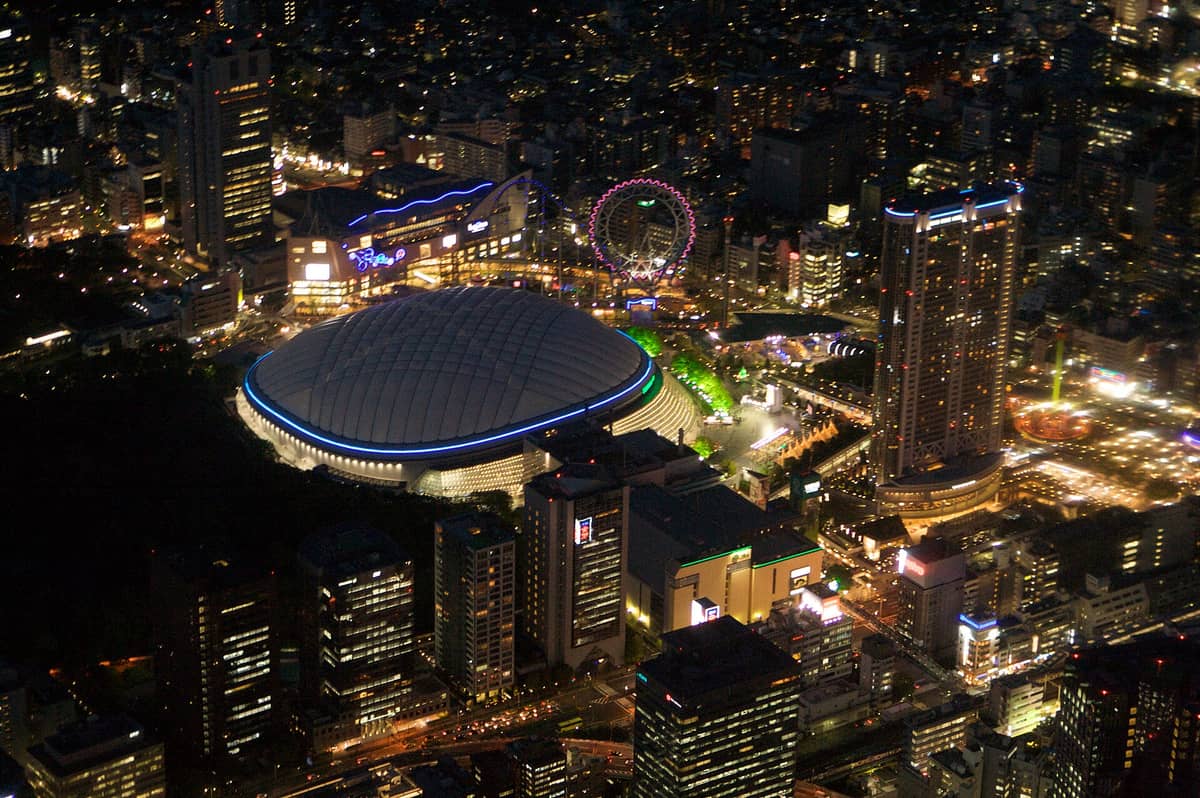
Even if you have no interest in baseball, the dome itself is hard to ignore. Opened in 1988, Tokyo Dome was Japan's first domed stadium and became an architectural milestone: a pressurized air-supported roof spanning roughly 45,000 square meters, kept inflated by continuous air pressure. The white fibreglass membrane glows at night and gives the structure the slightly surreal look of a spacecraft that's settled permanently into central Tokyo.
The official Tokyo Dome Tour allows visitors to walk through sections of the stadium normally closed to the public, including the dugout area, the field perimeter, and sections of the stands. Tickets are ¥2,000 for adults (high school age and above) and ¥1,000 for children. Note that the route includes stairs and is not fully accessible for wheelchair users. Tours are not available on game days, so check the Giants' schedule if this is a priority.
Attending an actual Yomiuri Giants game is a different experience altogether. Japanese baseball crowds are famously organized: each team has dedicated cheer sections with coordinated songs, percussion, and team-specific call-and-response chants. It's participatory in a way that European sports cultures rarely are. For context on other major spectator sports in Tokyo, see the guide to sumo in Tokyo, which offers a similar window into deeply ritualized Japanese sporting tradition.
How the Experience Shifts by Time of Day
Mornings at Tokyo Dome City are quiet in a way that surprises first-time visitors. The plaza between the stadium and LaQua fills with office workers cutting through on their way to nearby stations, delivery vehicles resupplying the restaurants, and the occasional early-opening coffee shop doing steady business. It doesn't feel like an entertainment district yet.
By early afternoon, families with children arrive and the amusement park section grows noticeably louder. Weekend afternoons between roughly 13:00 and 17:00 are the busiest period: ride queues lengthen, the plaza fills with strollers, and the food stalls start doing proper business. If your priority is shorter waits and more room to move, a weekday morning or the first hour after the park opens is noticeably calmer.
Evenings are the most atmospheric stretch. After 18:00, the illuminated Big-O Ferris wheel reflects off the polished floors of the LaQua shopping area, the restaurants fill with after-work crowds, and the scale of the dome becomes more apparent as the surrounding sky darkens. On game nights, the approach to the stadium takes on the specific low-frequency hum of a crowd settling into seats, and the surrounding streets fill with vendors and fans. If you're visiting without tickets to a game, the atmosphere is still worth experiencing from outside.
Spa LaQua and the Rest of the Complex
Spa LaQua occupies the upper floors of the LaQua building and draws on natural hot spring water sourced from approximately 1,700 meters underground. It's a sizeable urban onsen facility with indoor and outdoor baths, sauna zones, and a resting area where guests can spend several hours. The minimum age for the spa is generally primary school age (around 6 years old), and some bath areas are gender-separated. Admission pricing is on the higher end for Tokyo bathing facilities, and there's an additional charge for using the healing badia (sauna and rest) area.
For visitors who want to combine the spa with broader exploration, the surrounding Bunkyo ward offers some of Tokyo's more tranquil green spaces and gardens. The Koishikawa Korakuen Garden is a five-minute walk from Tokyo Dome City and represents one of the oldest surviving Edo-period stroll gardens in the city, a striking contrast to the commercial density of the complex next door.
The ground-level LaQua shopping zone is unremarkable by Tokyo standards: chain restaurants, a few retail shops, and some fast-casual food options. It's convenient but not a destination in itself. The dining options improve considerably on the upper floors, where a handful of full-service restaurants overlook the plaza.
Getting There and Getting Around
Tokyo Dome City sits within easy reach of three stations. Korakuen Station on the Tokyo Metro Marunouchi and Namboku lines is probably the most convenient for visitors staying in the central tourist belt, with direct connections from Ginza, Shinjuku, and Ikebukuro. Kasuga Station serves the Toei Mita and Toei Oedo lines. Suidobashi Station on the JR Chuo-Sobu line adds a third option and is particularly useful if you're coming from Akihabara or west-side JR stations.
The complex is roughly 15 minutes by metro from Shinjuku and about 25 minutes from Shibuya, making it a reasonable addition to a day that begins or ends in either of those areas. For a broader overview of navigating the city's rail network, the guide to getting around Tokyo covers the IC card system and line transfers in useful detail.
The complex is compact enough that no internal transport is needed. From any of the three stations, you'll be standing in the main plaza within a few minutes on foot. Signage is in Japanese and English throughout.
⚠️ What to skip
On Giants game days, the area around Suidobashi Station becomes very congested both before first pitch and immediately after the game ends. If you're not attending a game, avoid arriving or leaving in those windows. Check the Yomiuri Giants' official schedule at tokyo-dome.co.jp before planning your visit.
Is Tokyo Dome City Worth Your Time?
The honest answer depends on what you're looking for. As a standalone destination, Tokyo Dome City is more useful than it is spectacular. It lacks the historical layering of somewhere like Asakusa or the visual intensity of Shibuya, and the amusement park, while functional, won't satisfy theme-park enthusiasts who've visited major international parks.
Where it earns its place is as a practical option: on a rainy day, in the evening when other attractions are closed, with children who need kinetic activity, or as a companion to a visit to Koishikawa Korakuen Garden. The free entry model means there's no financial pressure to stay longer than you want to. If you're compiling a wider Tokyo itinerary, the things to do in Tokyo guide provides broader context for how this kind of entertainment complex fits into the city's larger offer.
Visitors who will be disappointed: those expecting a world-class theme park, anyone primarily motivated by traditional Japanese culture or history, and solo travelers with only one or two days in the city who have to make strict choices. For them, the time is almost certainly better spent elsewhere.
Families with children, baseball fans, and visitors looking for a relaxed evening option will likely find it worthwhile. If digital art and immersive experiences are more your interest, the teamLab Planets venue in nearby Toyosu offers a more singular experience, though it requires advance booking and charges full admission.
Insider Tips
- Free Wi-Fi is available throughout the complex, which is useful for checking real-time ride wait times and looking up the Giants' game schedule without burning mobile data.
- The pedestrian walkway on the north side of the dome, between the stadium wall and the garden boundary, is much quieter than the main plaza and gives you a cleaner view of the dome's scale without the foot traffic.
- Spa LaQua is significantly less crowded on weekday mornings before noon. If relaxation is your goal, that window gives you effectively a private experience at the same price.
- Ride tickets for Tokyo Dome City Attractions can be purchased individually or in bundles. If you're only interested in the Thunder Dolphin and the Ferris wheel, individual tickets usually work out cheaper than a full day pass, unless you plan to ride multiple attractions more than once.
- Koishikawa Korakuen Garden, about a 10-minute walk away, is one of the best low-cost garden experiences in central Tokyo (general admission around ¥300) and is almost always uncrowded compared to Shinjuku Gyoen. It's a natural pairing for the same half-day.
Who Is Tokyo Dome City For?
- Families with children aged 4–12 looking for a full afternoon of activities without planning complexity
- Baseball fans who want to see Tokyo Dome from the inside, whether or not a game is scheduled
- Visitors caught in rain looking for a covered entertainment option with low financial commitment
- Travelers staying in northern Tokyo (Bunkyo, Ueno, Akihabara area) who want a close evening destination
- Anyone combining a spa afternoon with a garden walk in a single, low-effort half-day
Nearby Attractions
Combine your visit with:
- Akasaka Palace (State Guest House)
The State Guest House, Akasaka Palace is Japan's principal diplomatic residence and one of the few Western-style palaces in Asia open to the public. Built in neo-baroque style for the Crown Prince in the early 20th century, it now receives heads of state and, on select days, ordinary visitors. The combination of ornate gilded interiors, formal French gardens, and a Japanese-style annex makes it one of the most architecturally unusual stops in Tokyo.
- Edo-Tokyo Open Air Architectural Museum
Spread across the grounds of Koganei Park, the Edo-Tokyo Open-Air Architectural Museum rescues and reassembles more than 30 historic structures spanning the Edo period through the early 20th century. From a dismantled farmhouse to a reconstruction of a Showa-era Tokyo streetscape, it is one of the most thoughtful and undervisited cultural sites in the metropolitan area.
- Enoshima
A small island off the Shonan coast of Kanagawa Prefecture, Enoshima packs a surprising amount into a short walk: a three-part Shinto shrine, ancient sea caves, a hilltop botanical garden, a lighthouse observation tower, and seafood stalls lining a stone-paved shopping street. It works as a half-day excursion or a full day if you combine it with nearby Kamakura.
- Gotokuji Temple
Gotokuji Temple in Setagaya is a working Soto Zen Buddhist temple that happens to be one of the claimed birthplaces of the maneki-neko, Japan's iconic beckoning cat. Hundreds of white ceramic cats line the shelves of a dedicated shrine, creating one of Tokyo's most quietly striking visual spectacles. Entry is free, crowds are manageable, and the surrounding grounds offer genuine calm.