Tivoli Gardens: Copenhagen's Iconic Amusement Park Explained
Tivoli Gardens is one of the world's oldest amusement parks, operating in the heart of Copenhagen since 1843. It blends rides, live music, gardens, and restaurants across distinct seasonal editions, from summer evenings lit by thousands of lanterns to a Christmas market that transforms the park entirely.
Quick Facts
- Location
- Vesterbrogade 3, 1630 København V, Copenhagen, Denmark
- Getting There
- Copenhagen Central Station (Hovedbanegården), 2-minute walk
- Time Needed
- 3–5 hours; a full evening is ideal in summer
- Cost
- Adults approx. 150–275 DKK entry; Ride Pass approx. 199–349 DKK (verify current prices at tivoli.dk)
- Best for
- Families, couples, first-time visitors to Copenhagen, Christmas season travelers
- Official website
- www.tivoli.dk/en
What Tivoli Gardens Actually Is
Tivoli Gardens is not quite like any other amusement park. Opened on 15 August 1843, it occupies a roughly eight-hectare site immediately beside Copenhagen Central Station, squeezed into the city's historic core rather than exiled to its outskirts. Most theme parks are destinations you drive to. Tivoli is a place you walk past on your way somewhere else and get pulled inside.
The combination it offers is unusual: a functioning fairground with roller coasters and a 1943 Ferris Wheel, sitting alongside manicured gardens, a Pantomime Theatre built in 1874, five or six serious restaurants, live concert stages, and a lake. It is loud in places and genuinely quiet in others. Children sprint between rides; couples eat at tables set with white linen a hundred metres away. That coexistence is the whole point.
Tivoli sits within Inner Vesterbro, immediately next to Copenhagen Central Station rather than inside the Indre By historic centre. For context on the wider neighbourhood around the park, see our guide to Indre By.
ℹ️ Good to know
Tivoli operates in distinct seasonal editions: Summer (typically April through September), Halloween (October into November), and Christmas (November into January). Hours vary significantly by date and season. Always check the current calendar at tivoli.dk before visiting — a Monday in April keeps different hours than a Saturday in July.
The History Behind the Spectacle
Georg Carstensen, a Danish event impresario, received royal permission from King Christian VIII to build an entertainment garden on former city fortification grounds just beyond the old Vesterport city gate. The park opened that summer to immediate public enthusiasm. Carstensen reportedly argued to the king that when people are being amused, they do not think about politics — a line that may be apocryphal but captures the spirit of the enterprise.
By the 1870s, permanent architecture began to accumulate. The Pantomime Theatre, a Chinese-style pavilion with a peacock curtain that fans open at the start of performances, dates from 1874 and remains the park's oldest standing building. It hosts the traditional Commedia dell'arte pantomime that has been performed at Tivoli for generations. The current Ferris Wheel, a replacement for the original 1884 version, was inaugurated in 1943 to mark the park's centenary.
The park was badly damaged by fire twice in the twentieth century, in 1944 and 1994, which is part of why its architectural mix now spans Victorian-era pavilions, mid-century reconstructions, and contemporary additions. What reads as eclectic planning is partly the result of rebuilding after disaster. The Danish Architecture Center has written extensively about how Tivoli's architecture reflects layers of national identity over 180 years.
Tickets & tours
Hand-picked options from our booking partner. Prices are indicative; availability and final rates are confirmed when you complete your booking.
Copenhagen Classic Pass 1-Day comprehensive ticket
From 89 €Instant confirmationCopenhagen card-HOP with 40+ attractions and hop-on hop-ff bus
From 78 €Instant confirmationFree cancellationEscape Tour self-guided, interactive city challenge in Copenhagen
From 30 €Instant confirmationEscape Tour self-guided, interactive city challenge in Copenhagen
From 30 €Instant confirmation
How the Experience Changes by Time of Day
Tivoli in the afternoon and Tivoli at 9 PM are genuinely different places. Daytime visits are practical and family-oriented. The rides operate, the gardens are clear to walk, queues are visible and manageable if you arrive early on a weekday. The park smells of freshly cut grass near the flower beds and fried food near the ride corridors. Children dominate the atmosphere entirely.
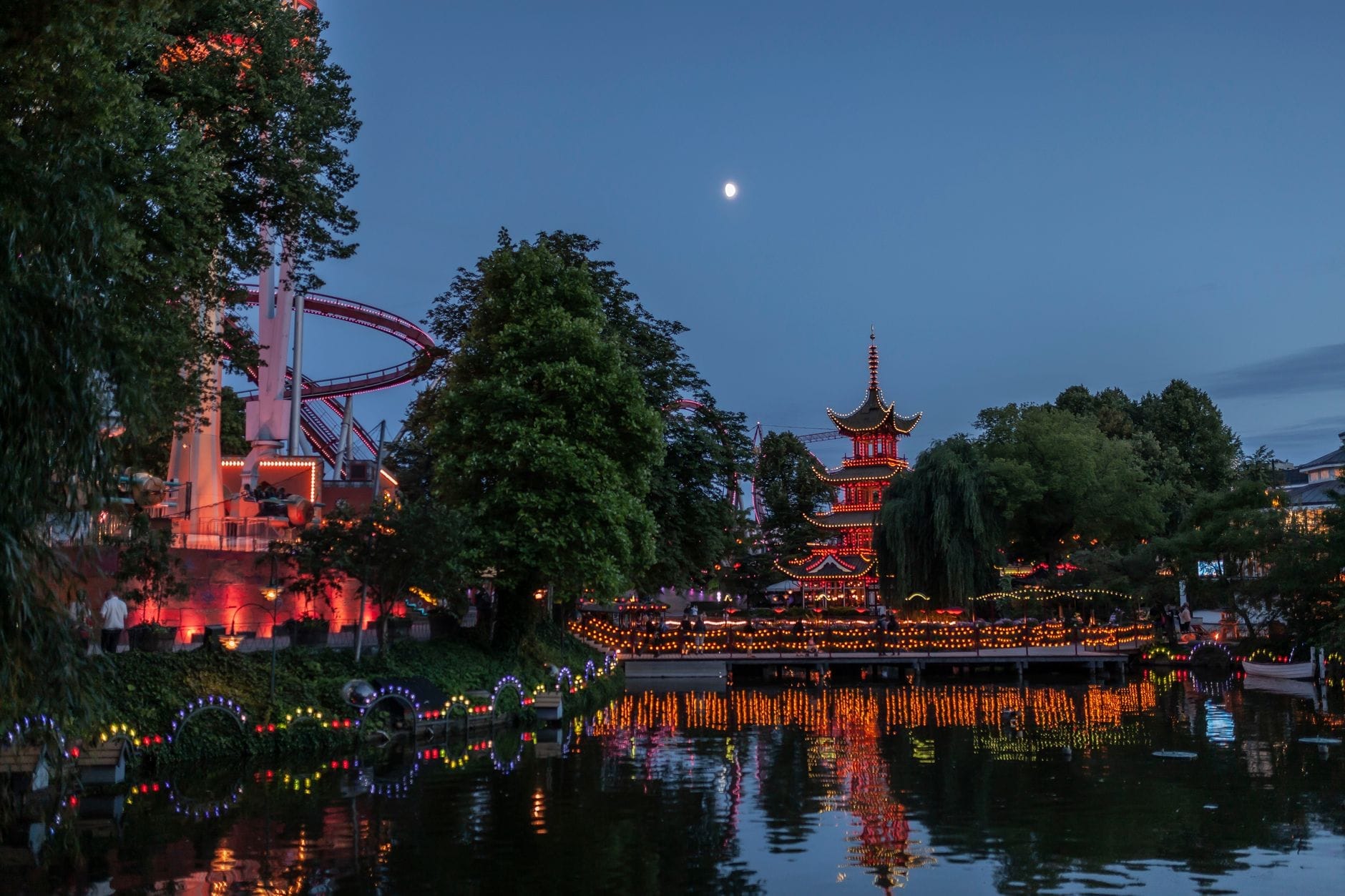
As evening arrives, the park shifts register. Tivoli uses tens of thousands of light bulbs across the grounds, and the effect when they come on at dusk is significant. The main lake reflects lantern light. The Chinese Tower, a pagoda-style structure over the water, glows amber. Music carries from the open-air stage. The crowd changes: couples and adults without children begin to outnumber the families, and the restaurants fill up.
Friday nights in summer bring the weekly fireworks display, launched from above the lake. They last about 15 minutes and draw a crowd around the waterfront. Arrive 20–30 minutes early if you want a clear sightline from the bank rather than looking over other people's shoulders.
💡 Local tip
For the best evening atmosphere with manageable crowds, aim for a weekday evening in June or early September rather than a Saturday in July. The summer weekend crowds can make the central pathways genuinely congested by 8 PM.
Getting There and Getting In
The logistics are about as straightforward as a major Copenhagen attraction gets. Copenhagen Central Station sits immediately adjacent to the park's main entrance on Vesterbrogade. Regional trains, the S-train network, and long-distance trains all stop at Hovedbanegården. From the station's main exit, you can see the Tivoli entrance in under two minutes of walking.
If you are coming from elsewhere in the city, the metro stops at Vesterport and Rådhuspladsen, both within a few minutes' walk. The airport (CPH) is connected directly to Central Station by train and takes about 15 minutes, making Tivoli a practical first or last stop on a Copenhagen visit. For full airport transfer options, see the Copenhagen airport transfer guide.
Entry tickets are sold at the gate and online. Buying online in advance is advisable on summer weekends and during the Christmas season, when queues at the ticket windows can be long. The entry ticket covers admission to the park and its gardens, the Pantomime Theatre performances, and most concerts. Rides require either individual tokens purchased inside the park or a separate Ride Pass. The Ride Pass makes sense if you plan to spend significant time on the attractions; otherwise, individual tokens work for a lighter visit focused on the atmosphere and gardens.
If cost is a concern, note that Tivoli admission is included in the Copenhagen Card. For details on whether the card makes financial sense for your itinerary, read the Copenhagen Card guide.
Seasons: Easter, Summer, Halloween, and Christmas
Summer Tivoli runs from approximately April through September and is the baseline warm-weather experience most people picture, alongside a shorter Easter season in spring. The gardens are in full bloom by May and June, the outdoor stages host jazz, classical, and popular music concerts several evenings a week, and the full ride roster operates. Temperature and light are the variables that most affect the visit: a warm June evening with the sky still light at 9 PM is as good as it gets.
The Halloween edition in early October and early November transforms the park with elaborate decorations, themed food stalls, and evening shows suited to older children and adults. It is less crowded than peak summer and often underrated. The Christmas season, running roughly from mid-November into early January, converts the gardens into one of Copenhagen's principal Christmas markets. If you are planning a winter trip, the Copenhagen Christmas guide covers how Tivoli fits into the broader seasonal picture.
Note that the park closes entirely between seasonal openings for maintenance and reset. A visit in late September or in February will usually find the gates shut, and the park is generally closed from early January until the Easter season each year. The official calendar on tivoli.dk is the only reliable source for exact open and closed dates each year.
⚠️ What to skip
Rides may be temporarily closed during high winds or heavy rain regardless of season. If you are visiting primarily for the roller coasters rather than the gardens and atmosphere, check the weather forecast and have a backup plan.
What to See Inside the Park
The park's layout is loosely organized around the central lake. Walking the perimeter of the lake takes about 10 minutes at a slow pace and gives you sightlines to most of the major structures. The Chinese Tower is the visual anchor from the water. The Pantomime Theatre sits to one side, and if a performance is scheduled, it is worth timing your walk to catch it — the peacock curtain opening is a theatrical moment that has been repeated at this location for 150 years.
The roller coasters are at the northern end of the park. The wooden coaster, known as Rutschebanen, dates from 1914 and is one of the oldest operating wooden roller coasters in the world. A brakeman rides each car and manually controls the speed on descents, which is an experience you will not find on modern steel coasters. The ride is not particularly intense by contemporary standards, but the mechanism is rare.
The Ferris Wheel offers a clear view over the park and the surrounding city rooftops. At 45 metres, it is not a panoramic tower experience, but the view across the gardens at night, looking down at the illuminated paths and lake, captures the park's scale in a way that is harder to appreciate at ground level.
Tivoli has a serious food offering for an amusement park. Several restaurants operate at a level that would hold their own outside the park gates. Reservations are advisable for dinner at the more formal establishments, particularly on weekends. The street-food stalls near the rides cover the expected fried and sweet options. The smørrebrød tradition is not specifically represented here, but the wider Copenhagen food landscape is worth exploring before or after your visit.
Photography and Practical Notes
The park photographs best at dusk, in the 30-minute window when the sky is still blue but the park lights have come on. Overcast evenings often produce better images than direct sunlight, which creates harsh shadows in the garden areas. The lake reflection of the Chinese Tower is the classic shot; position yourself on the south bank, roughly opposite the tower, for an unobstructed frame.
Smartphone cameras handle the evening light reasonably well. If you are carrying a dedicated camera, a fast prime lens (f/1.8 or wider) is more useful than a zoom, given the low-light conditions in the interior garden paths after dark.
Accessibility across the park is partially limited by the age of some structures. The gardens and main paths are largely manageable for wheelchairs and pushchairs, but some rides and older sections involve steps or ramps. Tivoli's official site provides current accessibility information, and contacting them directly before visiting is the most reliable approach for anyone with specific access requirements.
Tivoli connects naturally with the rest of the city centre. Stroget, Copenhagen's main pedestrian shopping street, starts a short walk from the entrance, and City Hall Square is immediately adjacent to the park's eastern boundary.
Insider Tips
- The park's free concert programme (included with entry) runs multiple times per week in summer. Check the schedule online before you arrive — acts range from jazz ensembles to international pop, and the open-air stage fills up quickly for popular names.
- The wooden coaster Rutschebanen runs a brakeman who physically controls speed during the ride. Sit in the front car for the clearest view of how this mechanism works, which is genuinely unusual among surviving historic coasters.
- If you are visiting during the Christmas season, arrive when the park opens rather than in the evening. The crowds at the Christmas market peak after dark; the decorations are equally impressive in the low-angle afternoon light of a Danish December day, and the queues at food stalls are far shorter.
- The park's eastern side, near the Pantomime Theatre and the smaller garden paths, is noticeably quieter than the central and northern sections throughout the day. If you want to walk the gardens in relative calm, start there.
- Lockers are available inside the park near the main entrance. If you are combining Tivoli with a day of city exploration, drop your bag before walking the rides rather than carrying it through the queues.
Who Is Tivoli Gardens For?
- Families with children of mixed ages, who can split rides and garden walks across a half day
- Couples visiting Copenhagen in summer who want an evening with atmosphere, food, and live music in one location
- First-time visitors to Copenhagen who want a concentrated sample of Danish design, history, and culture in a single afternoon
- Winter travellers arriving in November or December, for whom the Christmas market and illuminations are a primary draw
- Architecture and history enthusiasts interested in how a nineteenth-century pleasure garden has evolved across 180 years
Nearby Attractions
Other things to see while in Indre By (Old Town):
- Amalienborg Palace
Amalienborg is the official home of the Danish royal family and one of Copenhagen's most architecturally coherent ensembles. Four near-identical Rococo palaces frame a grand octagonal square, with the Amalienborg Museum open to visitors inside Christian VIII's Palace. The daily changing of the guard at noon is a punctual, unhurried ceremony worth timing your visit around.
- The Black Diamond
The Black Diamond is the modern extension of the Royal Danish Library, clad in polished black granite and angled toward the harbour on Slotsholmen. Entry is free, the atrium is genuinely impressive, and the building rewards visitors who take time to understand what they are looking at.
- Botanical Garden of the University of Copenhagen
Tucked behind Nørreport Station in the heart of the city, the Copenhagen University Botanical Garden is a 10-hectare green sanctuary with a Victorian glasshouse complex, a tranquil lake, and around 8,000 plant species. Entry to the grounds is free, making it one of the most rewarding stops in central Copenhagen for any pace of traveler.
- Christiansborg Palace
Christiansborg Palace sits on the Slotsholmen islet in central Copenhagen, serving simultaneously as the home of the Danish Parliament, the Supreme Court, the Prime Minister's Office, and the Royal Reception Rooms. It is widely described as uniquely housing all three branches of Denmark’s national government under one roof, and its 106-metre tower offers one of the best free panoramic views in the city.