Tiong Bahru: Singapore's Oldest Estate, Reimagined
Tiong Bahru is Singapore's first public housing estate, built in the 1930s by the Singapore Improvement Trust and now one of the city's most characterful neighborhoods. Pre-war Streamline Moderne blocks sit alongside indie bookshops, specialty coffee roasters, and a two-storey wet market that has been feeding the neighborhood since 1955. It rewards slow walking and early mornings.
Quick Facts
- Location
- Tiong Bahru, Central Singapore. Core streets: Seng Poh Road, Yong Siak Street, Tiong Poh Road, Moh Guan Terrace
- Getting There
- Tiong Bahru MRT (EW19, East-West Line); 5–10 min walk to the conservation estate
- Time Needed
- 2–4 hours for a relaxed morning; half a day if you linger at the market and cafés
- Cost
- Free to explore. Market meals from S$3–6. Café coffee from S$5–7
- Best for
- Architecture lovers, food seekers, slow-travel explorers, photographers
What Tiong Bahru Actually Is
Tiong Bahru is not a single attraction with a ticket booth and an exit gift shop. It is a living residential neighborhood that doubles as Singapore's most coherent surviving example of pre-war public housing. The name comes from Hokkien and Malay, loosely translating to 'new cemetery', a reference to the burial grounds that once occupied the land. Development began in the 1920s, and the first block, Block 55, was completed in December 1936. By 1941, the Singapore Improvement Trust (SIT) had completed 784 flats across the estate.
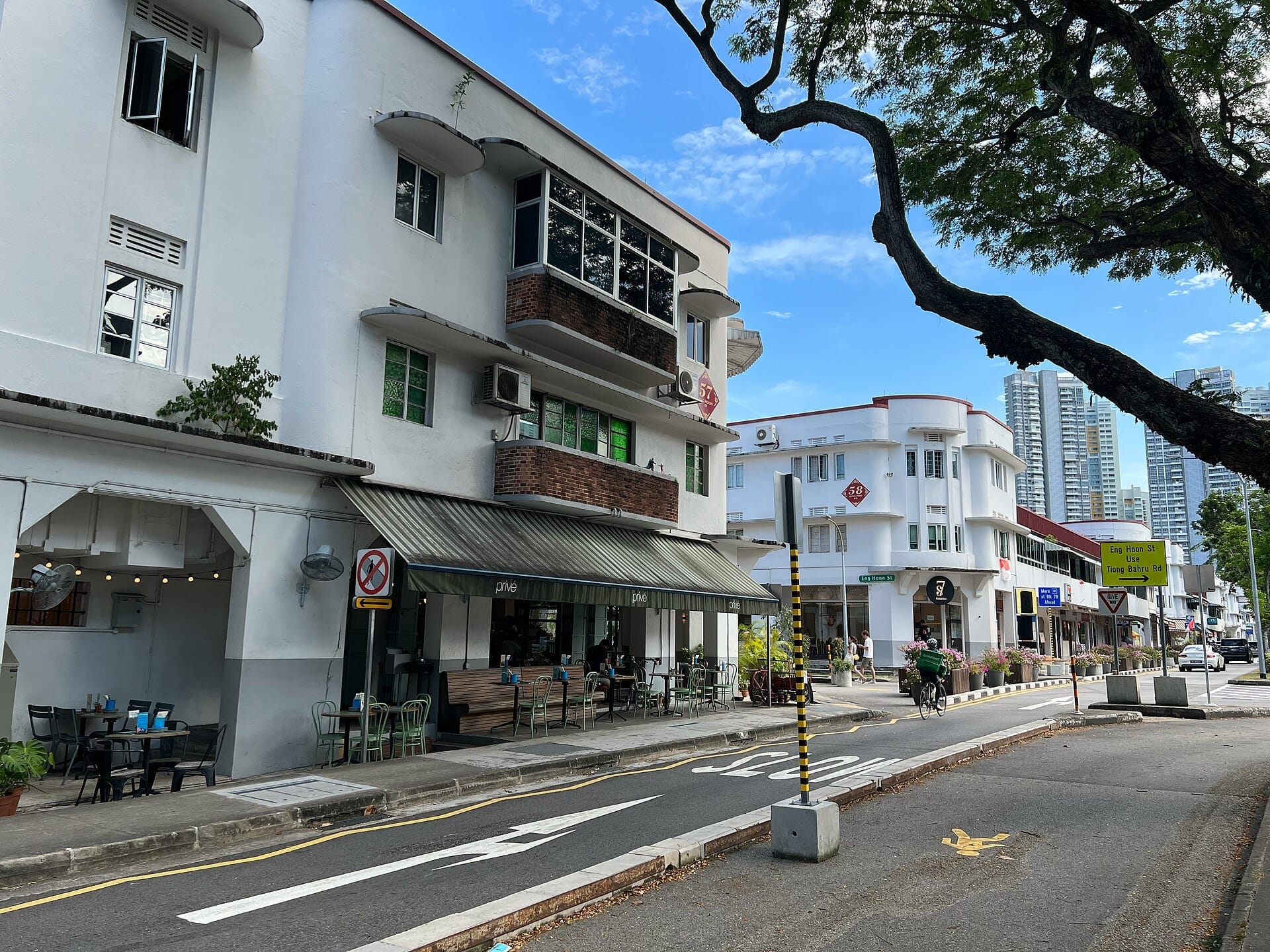
In 2003, the Urban Redevelopment Authority granted conservation status to 20 blocks within Tiong Bahru, protecting their architectural character. That decision is the reason the neighborhood looks the way it does today: curved stairwells, rounded balconies, flat rooftops, and spiral air vents that distinguish the Streamline Moderne style from the earlier colonial forms elsewhere in Singapore. These are not replicas or restored showpieces. People live in them. Laundry hangs from bamboo poles. Potted plants crowd corridor ledges. The conservation works precisely because daily life continues inside it.
💡 Local tip
Download the National Heritage Board's Tiong Bahru Heritage Trail PDF before you visit. It maps 20 key sites and provides architectural notes on each block, turning a casual stroll into a genuinely informed one.
The Architecture: Streamline Moderne in Tropical Form
The Streamline Moderne style reached Singapore via British planners trained in the European interwar aesthetic. It shares DNA with Art Deco but strips away the decorative excess, favoring horizontal lines, curved corners, and aerodynamic forms. In Tiong Bahru, this plays out in whitewashed concrete blocks with cantilevered balconies, open-air corridors on every floor, and internal courtyards that funnel wind through the buildings. The result is architecture designed for tropical ventilation, not just European style points.
Walk along Moh Guan Terrace and look up at the curved corners of blocks like Block 78. Run a hand along the render: it is smooth, slightly chalky, warm to the touch in the afternoon sun. The spiral staircases inside several blocks, visible through open ground-floor archways, are particularly striking. Each one is a continuous concrete helix with no central column. Photographers tend to point their cameras straight up through the center of these stairwells. The shot has become almost iconic, but it earns its reputation.
Yong Siak Street is where the ground-floor retail units have been taken over by independent businesses: a specialty bookshop, a florist, an artisanal bakery, a record store. The shopfronts are modest. Nothing is loud or over-branded. The commercial layer feels almost accidental, which is part of why it works.
Tickets & tours
Hand-picked options from our booking partner. Prices are indicative; availability and final rates are confirmed when you complete your booking.
Self-guided Singapore exploration tours with downloadable app
From 7 €Instant confirmationAsian Civilisations Museum entrance ticket
From 10 €Instant confirmationSingapore National Gallery ticket to all exhibitions
From 9 €Instant confirmationNational Orchid Garden Singapore tickets
From 10 €Instant confirmationFree cancellation
Tiong Bahru Market: Where the Neighborhood Actually Eats
The Tiong Bahru Market on Seng Poh Road occupies a two-storey circular building. Ground floor is a wet market: fish, vegetables, tofu, dried goods, live frogs in buckets. The smell is exactly what you would expect, sharp and fishy near the seafood section, sweeter toward the vegetable stalls. The upper floor is the hawker centre, and this is where you want to be.
The hawker level opens early and peaks between 7am and 10am, when the queue for char kway teow stretches past the neighboring stalls. Chwee kueh, steamed rice cakes topped with preserved radish, is a Tiong Bahru specialty that appears at a handful of stalls here and almost nowhere else at this quality. For the wider context of Singapore's hawker culture, the Singapore hawker centres guide explains what to order and how the system works before you sit down.
Come before 9am on a weekend if you want a seat without circling the floor twice. By 10am, every plastic chair is taken and the noise level, a combination of Mandarin, Hokkien, and the clatter of metal trays, reaches a comfortable roar. By noon, many stalls have sold out of their signature items and begin closing. Hawker culture here is not adjusted to tourist schedules.
ℹ️ Good to know
Tiong Bahru Market is open daily. Most hawker stalls operate morning to early afternoon; wet market stalls start earliest, often by 6am. Hours vary by individual stallholder and are not posted centrally. Arrive by 8am for the widest selection.
How the Neighborhood Shifts Through the Day
Early morning Tiong Bahru belongs to its residents. Between 6am and 9am, elderly residents do tai chi in the small parks between blocks, market-goers wheel trolleys along the five-foot ways, and the smell of freshly baked bread from the bakeries on Yong Siak Street drifts into the street. The light is soft, the pavements are cool, and the neighborhood operates entirely on its own logic, not yours.
From mid-morning onward, the café crowd arrives. The independent coffee shops along Yong Siak Street and the surrounding lanes fill up with laptop workers and weekend couples. This is not a problem, just a shift in atmosphere. The neighborhood handles both populations with minimal friction because they occupy different spaces: residents in the market and ground-floor provision shops, visitors in the cafés and bookshops.
Afternoons in Tiong Bahru are quiet in a way that is unusual for central Singapore. The heat between 1pm and 4pm pushes most foot traffic indoors. The streets empty. Shadows from the overhanging balconies create long stripes of shade on the pavement. This is actually a good time to photograph the architecture without pedestrians in frame. The covered five-foot ways (sheltered walkways along the shophouse fronts) keep you out of the direct sun as you move between blocks.
Walking the Estate: A Practical Route
Exit Tiong Bahru MRT and follow Tiong Bahru Road southwest toward the market. This takes roughly eight minutes on foot. Start at the market for breakfast, then walk south along Seng Poh Road and turn into Moh Guan Terrace to begin the conservation block circuit. The blocks are numbered and largely unfenced. You can walk into the ground-floor corridors, look up through the stairwells, and observe the details of the architecture without entering private residential areas.
From Moh Guan Terrace, loop through Tiong Poh Road and come out onto Yong Siak Street, where the independent shops are concentrated. If you are building a longer Singapore day, Tiong Bahru pairs naturally with a later afternoon visit to Chinatown Street Market, which is a 10-minute walk or one MRT stop away at Outram Park. The contrast between the two neighborhoods, one carefully preserved and residential, the other commercial and dense, is genuinely instructive about how Singapore manages heritage.
💡 Local tip
Wear flat, comfortable shoes. The five-foot ways and internal corridors have uneven surfaces, and several of the most architecturally interesting stairwells require stepping over a raised threshold. The streets are narrow and mostly shaded, so a hat is more useful than an umbrella during dry weather.
Who Might Not Enjoy This
Tiong Bahru is frequently described as charming, and it is, but the charm is low-key and requires some engagement to appreciate. Visitors looking for a major landmark, an audio-guided experience, or a clear start-and-end attraction will find the neighborhood underwhelming. There is no single building you have come to see. The interest is cumulative, built from dozens of small observations across an hour or two of walking.
Accessibility is also a genuine limitation. The conservation blocks were designed in the 1930s and have no elevators. Ground-floor corridors and streets are wheelchair-accessible, but the iconic spiral stairwells, the rooftop perspectives, and many café interiors involve steps. Visitors with significant mobility constraints should plan accordingly. For a more accessible architecture experience in Singapore, the National Gallery Singapore offers architectural heritage in a fully modernized, lift-accessible building.
Finally, those expecting Tiong Bahru to feel undiscovered will be mildly disappointed. It has been well-documented in travel media for over a decade. On weekend mornings, Yong Siak Street sees a steady stream of visitors. The neighborhood absorbs them without becoming a parody of itself, but it is not a quiet secret.
Photography Notes
The curved stairwells are the most-photographed element, and for good reason. The best light in them is between 9am and 11am on a clear day, when diffuse light enters from above without harsh shadows. A wide-angle lens or a phone camera in portrait mode both work well. For street-level exterior shots, shoot in the early morning before shutters rise on the shopfronts, when the blocks are cleanest against the sky.
The market level at the hawker centre photographs well under its own overhead lighting, which is warm and even. Be respectful of stallholders: ask before photographing individuals at work. Most will agree. Some will not. Both responses are reasonable.
Insider Tips
- The chwee kueh stalls at Tiong Bahru Market are a neighborhood specialty. Order a plate alongside a kopi (local coffee) and eat standing at the stall counter the way regulars do. The preserved radish topping should be generous; ask for extra if it looks sparse.
- Block 78 on Moh Guan Terrace has one of the clearest spiral stairwell views in the estate. The ground-floor archway is open to the public during daylight hours. Stand at the base and shoot directly upward for the classic perspective.
- Several of the flats in the conservation blocks are rented out as short-stay accommodations. If you want to experience the architecture from the inside overnight, search for listings in Tiong Bahru specifically and confirm the block number is within the conservation area.
- The National Heritage Board's Tiong Bahru Heritage Trail PDF is free to download and more detailed than any paid tour. Print it or download it offline before you arrive, as mobile signal inside some of the covered corridors is patchy.
- Weekday mornings between 7am and 9am offer the least crowded experience of both the market and the streets. If your schedule allows, a Tuesday or Wednesday morning visit is noticeably quieter than any weekend slot.
Who Is Tiong Bahru For?
- Architecture and design enthusiasts interested in Singapore's interwar Streamline Moderne heritage
- Food travelers who want to eat where residents actually eat, not at tourist-facing restaurants
- Photographers looking for strong geometric and light-play subjects in a compact area
- Slow travelers who prefer neighborhood exploration over ticketed attractions
- Visitors building a half-day itinerary that pairs morning market food with afternoon walking
Nearby Attractions
Combine your visit with:
- Boat Quay
Boat Quay stretches along the south bank of the Singapore River, its two- and three-storey shophouses packed with restaurants, bars, and cafes. Once the beating commercial heart of colonial Singapore, the strip today offers one of the city's most atmospheric settings for an evening meal or a morning walk with history underfoot.
- Clarke Quay
Clarke Quay lines the Singapore River with five blocks of conserved warehouses and shophouses, now packed with restaurants, rooftop bars, and clubs. Free to enter and active from dusk until well past midnight, it rewards visitors who arrive after dark when the neon reflects off the water and the crowds find their rhythm.
- Fort Canning Park
Standing 48 metres above the city centre, Fort Canning Park packs more history per square metre than almost anywhere else in Singapore. From ancient Malay royalty to British colonial command, the hill has shaped this island for over seven centuries — and today offers a genuinely peaceful escape just minutes from Orchard Road.
- Henderson Waves
Henderson Waves is Singapore's tallest pedestrian bridge at 36 metres above Henderson Road, connecting Mount Faber Park and Telok Blangah Hill Park along the Southern Ridges trail. Free to access at any hour, the 274-metre-long structure is equally rewarding at dawn, midday, and after dark.