Clarke Quay: Singapore's Riverside Nightlife and Dining Hub
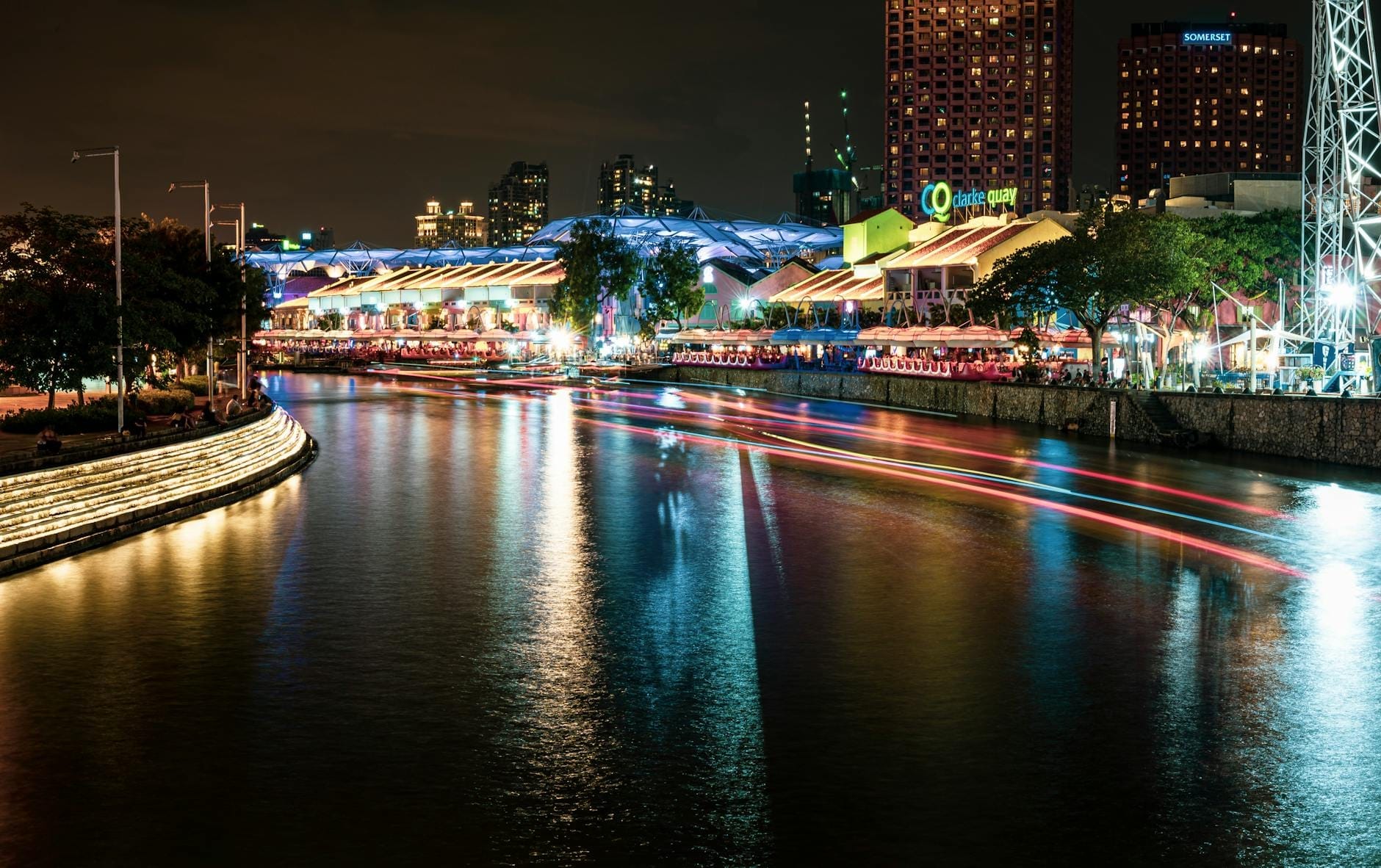
Clarke Quay lines the Singapore River with five blocks of conserved warehouses and shophouses, now packed with restaurants, rooftop bars, and clubs. Free to enter and active from dusk until well past midnight, it rewards visitors who arrive after dark when the neon reflects off the water and the crowds find their rhythm.
Quick Facts
- Location
- 3 River Valley Road, Singapore 179024
- Getting There
- Clarke Quay MRT (NE5, North East Line) or Fort Canning MRT (DT20, Downtown Line), both within 5 minutes on foot
- Time Needed
- 2–4 hours for dinner and drinks; 1 hour for a daytime walk
- Cost
- Free entry; drinks and meals at market rate (S$12–S$20 for cocktails, S$20–S$50+ per person for dinner)
- Best for
- Nightlife, riverside dining, colonial architecture, first-night arrivals
- Official website
- www.capitaland.com/sg/malls/clarkequay/en.html
What Clarke Quay Actually Is
Clarke Quay is a riverside precinct of five conserved warehouse-and-shophouse blocks sitting on a bend of the Singapore River, roughly ten minutes by MRT from the city centre. Entry is free, the precinct runs 24 hours, and the individual venues set their own hours. During the day it is quiet: a handful of brunch spots, a few tourists taking photos of the pastel-painted facades, and the occasional runner on the riverside path. After 6 pm, the dynamic shifts completely. By 8 pm, restaurant terraces are full. By 10 pm, the clubs along the waterfront have queues. By midnight, the whole strip is loud, lit up, and operating at full volume.
The precinct sits between Boat Quay to the east and Robertson Quay further upstream to the west. Together, the three quays form Singapore's riverside dining and nightlife corridor, but Clarke Quay is the most concentrated and the most commercially developed of the three.
💡 Local tip
If you arrive between 7 and 8 pm on a weekday, you can usually walk into most restaurants without a reservation and still snag a riverside terrace table. Weekends after 8 pm are a different story, especially for the popular outdoor bars.
History: From Trading Port to Entertainment District
The quay takes its name from Sir Andrew Clarke, who served as Governor of the Straits Settlements from 1873 to 1875. Under colonial administration, the Singapore River was the commercial spine of the settlement, and Clarke Quay was one of its busiest unloading points. Coolies (cargo labourers) transferred goods between bumboats on the river and the riverside godowns (warehouses) that lined this stretch. Rice, pepper, gambier, and rubber passed through the godowns here throughout the 19th and early 20th centuries.
Commercial activity on the river declined sharply in the second half of the 20th century as container ports replaced the traditional quay system. The Singapore government began conserving the riverside warehouse blocks in 1989, and the precinct was formally redeveloped as Festival Village, opening in December 1993. CapitaLand completed a major revamp in May 2006, adding the distinctive tent-like canopy structure that now covers much of the central promenade.
The tension between heritage and commerce is visible if you look closely. The shophouse facades have been restored and repainted in terracotta, ochre, and sage green, but the interiors are entirely modern. What looks like an old godown from the river is usually a fully air-conditioned bar or nightclub inside. Whether that trade-off counts as conservation or pastiche is a question Singapore visitors argue about regularly.
Tickets & tours
Hand-picked options from our booking partner. Prices are indicative; availability and final rates are confirmed when you complete your booking.
Adventure Cove Waterpark™ e-ticket
From 27 €Instant confirmationWild Wild Wet Waterpark Entrance Ticket
From 15 €Instant confirmationLion City bike tour in Singapore
From 55 €Instant confirmationFree cancellationLuggage Storage in Singapore
From 7 €Instant confirmationFree cancellation
What the Precinct Looks Like, Block by Block
Clarke Quay is divided into five blocks labelled A through E. Blocks A and B face the river directly, giving them the prime waterfront terraces and, consequently, the highest drink prices. Block C runs along the interior of the precinct and tends to house mid-range restaurants. Blocks D and E sit on the outer edges and include a mix of bars, clubs, and a few retail units that are rarely the reason anyone visits.
The central canopy, a large tensile roof structure, covers most of the main pedestrian spine. It keeps the rain off during Singapore's frequent afternoon downpours, but it also traps heat at ground level, which can make the interior of the precinct uncomfortable during the day. At night, with the canopy lit from above and the river to one side, the visual effect is considerably more impressive than it sounds on paper.
The riverside promenade is the best place to walk. Bumboats converted for tourist use depart from a small jetty here, offering river cruises that take in both the colonial quays and the modern Marina Bay skyline downstream. The contrast between the low-rise, colourful shophouse blocks at Clarke Quay and the glass towers visible from the water is genuinely striking at night.
For a broader view of how the Singapore River fits into the city's history, the Singapore River Cruise is a useful complement to a Clarke Quay visit, especially for first-time visitors.
Daytime vs Night: Two Very Different Experiences
During the day, particularly from 10 am to 5 pm, Clarke Quay is one of the calmer spots along the Singapore River. The architecture is easier to appreciate without crowds, the light hits the coloured facades well in the morning, and the few cafes that open early are quiet enough to sit and eat without rushing. This is also when the structural details of the conserved shophouses are most visible: the five-foot ways (covered pedestrian arcades), the shuttered windows, and the ironwork detailing on the upper floors.
The evening transformation is swift. From around 6 pm, the restaurant kitchens hit full capacity, and the smell of grilled seafood, Thai herbs, and charcoal wafts across the waterfront. The river reflects the coloured lighting from the venue facades, and weekend evenings bring a mix of groups that range from corporate after-work crowds in the early part of the night to a younger clubbing crowd that arrives later.
⚠️ What to skip
Clarke Quay on a Friday or Saturday night after 10 pm can be intensely crowded and noisy. If you are looking for a quiet dinner or a relaxed drink, a Tuesday or Wednesday evening is a noticeably different experience.
Getting There and Getting Around
The most direct public transport option is Clarke Quay MRT station on the North East Line (NE5), which exits onto River Valley Road immediately adjacent to the precinct. Fort Canning MRT on the Downtown Line (DT20) is a five-minute walk away and provides a useful alternative if you are coming from the Marina Bay or Bayfront direction. Both stations are well signed and accessible.
Taxis and ride-hailing apps (Grab is the dominant service in Singapore) drop off on River Valley Road or the side streets around the precinct. Driving in yourself is not recommended on weekend evenings given the parking demand in the area. The precinct is flat and entirely walkable, and the riverside promenade connects directly to Boat Quay to the east, making it easy to combine both on foot.
If you are staying near Marina Bay or Orchard Road, the MRT is straightforward and inexpensive for reaching Clarke Quay. A single journey from Orchard to Clarke Quay MRT costs well under S$2.
Photography and Practical Notes
The best photography window is the blue hour, roughly 30 to 45 minutes after sunset, when there is still enough ambient light to capture the shophouse colours and the river but the venue lighting has already come on. The riverside promenade directly opposite Blocks A and B gives the cleanest wide angle on the precinct, though the far bank is a public path and can get crowded with other photographers on weekends.
Clarke Quay is outdoors, so Singapore's heat and humidity apply. Lightweight clothing is suitable for the evening. During the November to January period, afternoon rain showers are more frequent, though the canopy provides partial cover. Most of the serious clubs enforce a smart-casual dress code at the door, which generally means no sandals or singlets for men after a certain hour.
The riverside paths are accessible on foot and reasonably even, though there are some steps between the promenade and the upper terrace levels of individual venues. No specific accessibility information is available from the operator for mobility devices, so it is worth contacting individual venues directly if this is a concern.
ℹ️ Good to know
Clarke Quay attracts a significant tourist crowd. Prices at waterfront venues reflect this: a beer on a riverside terrace can run S$15–S$18. If you want to compare, Boat Quay to the east has a similar mix of riverside bars at roughly similar prices, while Robertson Quay upstream is slightly quieter and more neighbourhood-oriented.
Is Clarke Quay Worth Your Time?
For a first visit to Singapore, Clarke Quay is a reasonable introduction to how the city uses its colonial-era riverfront, and the evening atmosphere is genuinely lively. The conserved architecture is attractive, even if the interiors are entirely modern. The food options are broad and the nightlife is well-established.
That said, Clarke Quay is not a place for authentically local food or for understanding how most Singaporeans eat out. The prices are pitched at tourists and after-work expense-account crowds. For an honest Singaporean food experience at a fraction of the cost, the hawker centres nearby are far more representative.
The nearby Lau Pa Sat hawker centre is a short walk or a one-stop MRT ride away and offers the kind of local cooking that Clarke Quay's restaurants largely do not. If you are comparing how to allocate a single evening, dinner at a hawker centre followed by a walk along Clarke Quay for drinks covers both experiences well.
Travellers who actively dislike loud nightlife, tourist-trap pricing, or crowded outdoor spaces on warm evenings will not find much to enjoy here, particularly on weekends. The daytime visit offers more peace but less atmosphere. There is no exhibit, performance, or singular attraction here: Clarke Quay is a place to eat, drink, and walk, and the quality of the experience depends almost entirely on who you are with and what hour you arrive.
For travellers interested in the broader Singapore River history, pairing Clarke Quay with a visit to the National Museum of Singapore provides useful context, as the museum covers the colonial commercial era in detail.
Insider Tips
- Arrive by 6:30 pm on a weeknight and you can almost always get a riverside table without booking. By 8 pm on weekends, most good terrace spots are gone.
- The far bank of the river, directly opposite the main precinct, offers the best unobstructed view of the whole Clarke Quay facade for photos, and almost nobody stands there because there are no bars on that side.
- The Crazy Elephant bar in Block C has been at Clarke Quay for decades and is one of the few venues with a genuine regular local crowd rather than purely a tourist mix, making it a noticeably different atmosphere from the waterfront bars.
- If it rains, the tensile canopy covers most of the central spine, so you can stay dry without going indoors. Heavy rain usually passes within 30–45 minutes in Singapore.
- Grab (ride-hailing) pickup can be slow at Clarke Quay after midnight on weekends due to demand. Walk five minutes to the quieter side streets on Merchant Road or River Valley Road for a faster pickup time.
Who Is Clarke Quay For?
- First-time visitors who want to experience Singapore's riverside nightlife in one evening
- Groups looking for a wide choice of restaurants and bars in a single walkable area
- Architecture and history enthusiasts who want to see conserved colonial godowns in context
- Photographers aiming for Singapore River reflections during the evening blue hour
- Travellers combining a river cruise with a riverside dinner
Nearby Attractions
Combine your visit with:
- Boat Quay
Boat Quay stretches along the south bank of the Singapore River, its two- and three-storey shophouses packed with restaurants, bars, and cafes. Once the beating commercial heart of colonial Singapore, the strip today offers one of the city's most atmospheric settings for an evening meal or a morning walk with history underfoot.
- Fort Canning Park
Standing 48 metres above the city centre, Fort Canning Park packs more history per square metre than almost anywhere else in Singapore. From ancient Malay royalty to British colonial command, the hill has shaped this island for over seven centuries — and today offers a genuinely peaceful escape just minutes from Orchard Road.
- Henderson Waves
Henderson Waves is Singapore's tallest pedestrian bridge at 36 metres above Henderson Road, connecting Mount Faber Park and Telok Blangah Hill Park along the Southern Ridges trail. Free to access at any hour, the 274-metre-long structure is equally rewarding at dawn, midday, and after dark.
- Jewel Changi Airport
Jewel Changi Airport is a 135,700 m² dome of forest, water, and commerce connecting Singapore's airport terminals. At its core stands the Rain Vortex, the tallest indoor waterfall on earth at 40 metres, surrounded by five floors of tropical greenery. Whether you have a layover or a full afternoon free, Jewel rewards the visit.