National Museum of Singapore: History, Architecture, and What to Expect Inside
The National Museum of Singapore is the island's oldest museum, housed in a striking 19th-century colonial building in the Civic District. It traces over 700 years of Singapore's story through immersive galleries, rare artifacts, and rotating exhibitions. Admission to permanent galleries is free for Singapore Citizens and Permanent Residents.
Quick Facts
- Location
- 93 Stamford Road, Civic District, Singapore 178897
- Getting There
- Bus 230 stops nearby; Bras Basah MRT (Circle Line) is a short walk
- Time Needed
- 2 to 3 hours for main galleries; 4+ hours if attending a special exhibition
- Cost
- Free for Singapore Citizens and Permanent Residents (permanent galleries); check official site for ticketed exhibition prices
- Best for
- History lovers, architecture admirers, families, first-time visitors to Singapore
- Official website
- www.nhb.gov.sg/nationalmuseum
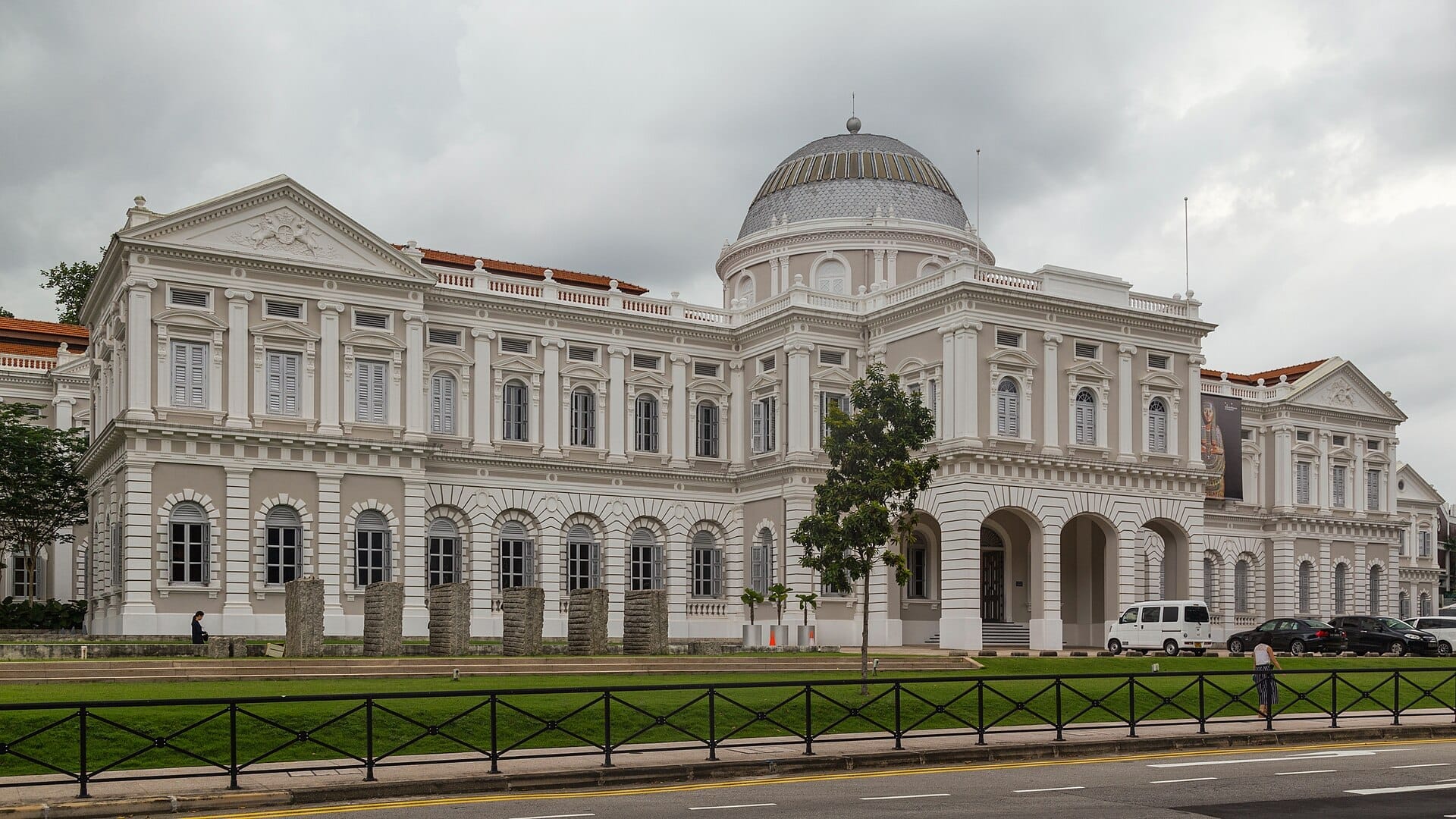
Why the National Museum of Singapore Deserves Your Attention
The National Museum of Singapore is not simply the country's oldest museum. It is the most authoritative single place in Singapore to understand how a small trading post became one of the world's most consequential city-states. Established in 1849 as the Raffles Library and Museum, the institution has been rehoused, renamed, and reinvented multiple times, but its core mission has remained constant: to preserve and interpret Singapore's layered identity for every generation.
The building itself commands attention from Stamford Road. The central dome, white colonnaded facade, and the sweeping glass-and-steel rotunda added during the 2006 renovation create an unusual architectural dialogue between colonial Victorian grandeur and contemporary design. It was designated a National Monument on 14 February 1992, which means the exterior is legally protected. For visitors arriving from Marina Bay or Fort Canning, the museum is an easy 15-minute walk through the Civic District, a precinct where Singapore's colonial, civic, and religious histories physically overlap.
ℹ️ Good to know
Note: The Singapore History Gallery is undergoing an upgrade and is now reopened. Check the official website before your visit, as gallery access and ticketing may be affected during this period.
The Building: What You Notice Before You Even Walk In
Arriving at the museum's main entrance on Stamford Road, the first thing most visitors register is the scale of the dome. Completed in 1887 and designed in the Renaissance Revival style, the original structure was built to house the growing collections of the colonial-era Raffles Library. The interior of the dome, visible from the ground floor atrium, is ringed with stained-glass panels depicting scenes of Singapore's pre-colonial and early colonial history. Natural light filters through these panels throughout the day, and the quality changes noticeably between morning and late afternoon.
The 2006 extension introduced a glass passage that connects the historic rotunda to a modern annex. This walkway functions as more than a corridor: it is an architectural seam between two eras. The contrast is deliberate and worth a few minutes of observation before proceeding into the galleries. The floors throughout the older section are polished terrazzo, and the acoustics in the high-ceilinged entrance hall amplify the ambient sound of visitors in a way that underscores the building's age.
Tickets & tours
Hand-picked options from our booking partner. Prices are indicative; availability and final rates are confirmed when you complete your booking.
Lion City bike tour in Singapore
From 55 €Instant confirmationFree cancellationLuggage Storage in Singapore
From 7 €Instant confirmationFree cancellationSingapore Little India self-guided walking audio tour
From 13 €Instant confirmationFree cancellationBig Bus panoramic night tour of Singapore
From 37 €Instant confirmationFree cancellation
Inside the Galleries: What You Will Actually See
The museum's permanent collection centers on Singapore's history from its earliest recorded settlements to independence and beyond. The Singapore History Gallery, when fully open, uses a combination of original artifacts, archival photographs, interactive media, and atmospheric environmental design to walk visitors through roughly 700 years of story. Key pieces include the Singapore Stone fragment, one of the earliest physical records of pre-colonial Singapore, and artifacts from the Japanese Occupation of 1942 to 1945, a period presented with unusual candor about civilian suffering and collaboration.
Beyond the flagship history galleries, the museum hosts a rotating program of special exhibitions covering topics as varied as fashion history, contemporary Southeast Asian art, and cultural memory. These ticketed exhibitions vary in quality and relevance for short-stay tourists, so it is worth checking the current program on the official website before you commit time to them. Some exhibitions genuinely reward attention; others are designed primarily for local school groups.
Families with children will find that the museum's interactive elements hold younger visitors' interest reasonably well, though the experience is more engaging for children aged 10 and up. For younger families, pairing the museum with a visit to the nearby Fort Canning Park provides a natural outdoor counterpoint after an hour or two indoors.
How the Experience Changes by Time of Day
Mornings from opening at 10am until around noon are the quietest period. School groups do visit, but they tend to arrive mid-morning and move through specific galleries in clusters. If you are visiting on a weekday and want unhurried access to the main galleries, arriving at 10am gives you at least 90 minutes before crowds build noticeably.
Weekend afternoons, particularly Saturday between 1pm and 4pm, are the museum's busiest window. The entrance hall fills with families, and some gallery sections require patience at interactive stations. If weekday visits are not possible, arriving at opening on a Saturday morning is the practical workaround.
Late afternoon, in the final hour before the 6:30pm last gallery admission, the museum quiets again. The light through the stained-glass dome panels is richest at this time on clear days. The gift shop near the main entrance is worth a few minutes: it stocks a better-than-average selection of books on Singapore's architecture, food history, and visual culture, with prices that are competitive with general bookshops.
💡 Local tip
The museum is fully air-conditioned throughout, making it one of the most practical midday stops during Singapore's hot season. If you are caught in an afternoon rainstorm, the Civic District location means the museum is an easy refuge from the weather.
Historical Context: Why This Institution Matters
The Raffles Library and Museum, from which the National Museum descends, was founded in 1849 during the tenure of the East India Company's administration of Singapore. Its original purpose was as much about legitimizing colonial authority through the apparatus of culture and knowledge as it was about scholarship. The collections were built from donations by colonial officials, naturalists, and traders, and they reflected the taxonomic enthusiasms of 19th-century European science: natural history specimens, ethnographic objects, and archaeological finds from the region.
After independence in 1965, the institution underwent a gradual transformation in both physical form and interpretive philosophy. The most significant shift came with the 2006 renovation, which not only added new physical infrastructure but also reoriented the museum's curatorial voice from colonial documentation toward a more self-determined national narrative. This is visible in how the contemporary galleries handle sensitive periods: the Japanese Occupation, the 1964 racial riots, and the turbulent path to merger with Malaysia and subsequent separation are presented with more nuance than Singapore's earlier institutions typically allowed.
Getting There, Getting In, and Practical Notes
The museum's address is 93 Stamford Road. Bus route 230 stops close to the entrance. The nearest MRT station is Bras Basah on the Circle Line, roughly a five-minute walk. The area is also walkable from Dhoby Ghaut (North South, Circle, and North East Lines) in around 10 minutes. Taxis and ride-hailing apps such as Grab drop off easily on Stamford Road. For context on navigating the city's transit network, the getting around Singapore guide covers MRT lines and bus options in detail.
Admission to permanent galleries is free for Singapore Citizens and Permanent Residents. For international visitors, ticket pricing for permanent and special exhibitions should be verified on the official website before your visit, as prices are subject to change and are not reproduced here to avoid outdating.
The museum opens daily from 10am to 7pm. Last ticket sales are at 6pm, and last gallery admission is at 6:30pm. There are no Sunday closures or public holiday closures noted, but verifying hours around major public holidays directly with the museum is advisable. The on-site cafe provides a reasonable midday break option, with seating inside the historic building.
⚠️ What to skip
The Singapore History Gallery is now reopened. If this gallery is a primary reason for your visit, confirm its current status via the official website before you go.
Photography and Accessibility
Photography is generally permitted in most galleries for personal use, though specific temporary exhibitions may restrict photography. The stained-glass dome interior is one of the most photogenic elements in the building, best captured from the ground floor atrium using a wide lens in the late afternoon when the light angles are most favorable. Flash use is discouraged near artifact displays.
The building has elevator access between floors and ramp access at the main entrance, making it usable for visitors with mobility considerations, though the heritage structure means some older corridor widths may be narrow. For visitors planning a broader Civic District day, the National Gallery Singapore is a 10-minute walk and provides a complementary experience focused on visual art from Southeast Asia and Singapore.
Who May Not Enjoy This
Visitors with very limited time in Singapore who are primarily interested in natural scenery, street food, or shopping will find the museum's investment of 2 to 3 hours difficult to justify against competing priorities. The museum is also unlikely to satisfy travelers who have already spent significant time across Southeast Asian history museums, as the coverage of pre-colonial history, while well-presented, covers ground that overlaps with institutions in the region.
Travelers seeking a quick, high-sensory urban experience will be better served by a morning in Chinatown or a walk through Kampong Glam. The museum rewards patience and genuine curiosity about Singapore's specific, often surprising story.
Insider Tips
- The museum's free audio guide app (downloadable before arrival) adds substantial depth to the permanent collection and is worth using even if you normally skip audio guides.
- The ground floor gift shop stocks a curated selection of books on Singapore's history and visual culture that are genuinely hard to find elsewhere in the city at comparable prices.
- Arrive within the first 30 minutes of opening on a weekday if you want the stained-glass dome atrium effectively to yourself. By 11am on weekdays and 10:30am on weekends, the entrance area becomes notably more crowded.
- The museum's outdoor lawn area between the main building and Stamford Road is used for occasional evening cultural events and light installations. Check the events calendar on the official website if your visit coincides with a weekend.
- Pair the museum with a short walk uphill to Fort Canning Park afterward. The park sits on a hill that was the seat of Malay royalty before colonial Singapore, and the two sites together make the city's layered history legible in a way that neither does alone.
Who Is National Museum of Singapore For?
- First-time visitors to Singapore who want historical context before exploring the city's neighborhoods
- History and architecture enthusiasts with at least half a day to invest
- Families with children aged 10 and older who respond to interactive museum formats
- Travelers caught in a midday rainstorm looking for a substantive, climate-controlled option
- Anyone interested in how a post-colonial nation constructs and presents its own national narrative
Nearby Attractions
Combine your visit with:
- Boat Quay
Boat Quay stretches along the south bank of the Singapore River, its two- and three-storey shophouses packed with restaurants, bars, and cafes. Once the beating commercial heart of colonial Singapore, the strip today offers one of the city's most atmospheric settings for an evening meal or a morning walk with history underfoot.
- Clarke Quay
Clarke Quay lines the Singapore River with five blocks of conserved warehouses and shophouses, now packed with restaurants, rooftop bars, and clubs. Free to enter and active from dusk until well past midnight, it rewards visitors who arrive after dark when the neon reflects off the water and the crowds find their rhythm.
- Fort Canning Park
Standing 48 metres above the city centre, Fort Canning Park packs more history per square metre than almost anywhere else in Singapore. From ancient Malay royalty to British colonial command, the hill has shaped this island for over seven centuries — and today offers a genuinely peaceful escape just minutes from Orchard Road.
- Henderson Waves
Henderson Waves is Singapore's tallest pedestrian bridge at 36 metres above Henderson Road, connecting Mount Faber Park and Telok Blangah Hill Park along the Southern Ridges trail. Free to access at any hour, the 274-metre-long structure is equally rewarding at dawn, midday, and after dark.