Henderson Waves: Singapore's Spectacular Elevated Walkway
Henderson Waves is Singapore's tallest pedestrian bridge at 36 metres above Henderson Road, connecting Mount Faber Park and Telok Blangah Hill Park along the Southern Ridges trail. Free to access at any hour, the 274-metre-long structure is equally rewarding at dawn, midday, and after dark.
Quick Facts
- Location
- 221 Henderson Road, Singapore 159557 — Southern Ridges, between Mount Faber Park and Telok Blangah Hill Park
- Getting There
- HarbourFront MRT (CC29/NE1) or Outram Park MRT (EW16/NE3), then bus or taxi to Henderson Road
- Time Needed
- 30–45 minutes on the bridge alone; 2–3 hours for the full Southern Ridges walk
- Cost
- Free — open 24 hours, no tickets required
- Best for
- Sunset views, architectural photography, evening walks, nature trail completionists
What Is Henderson Waves?
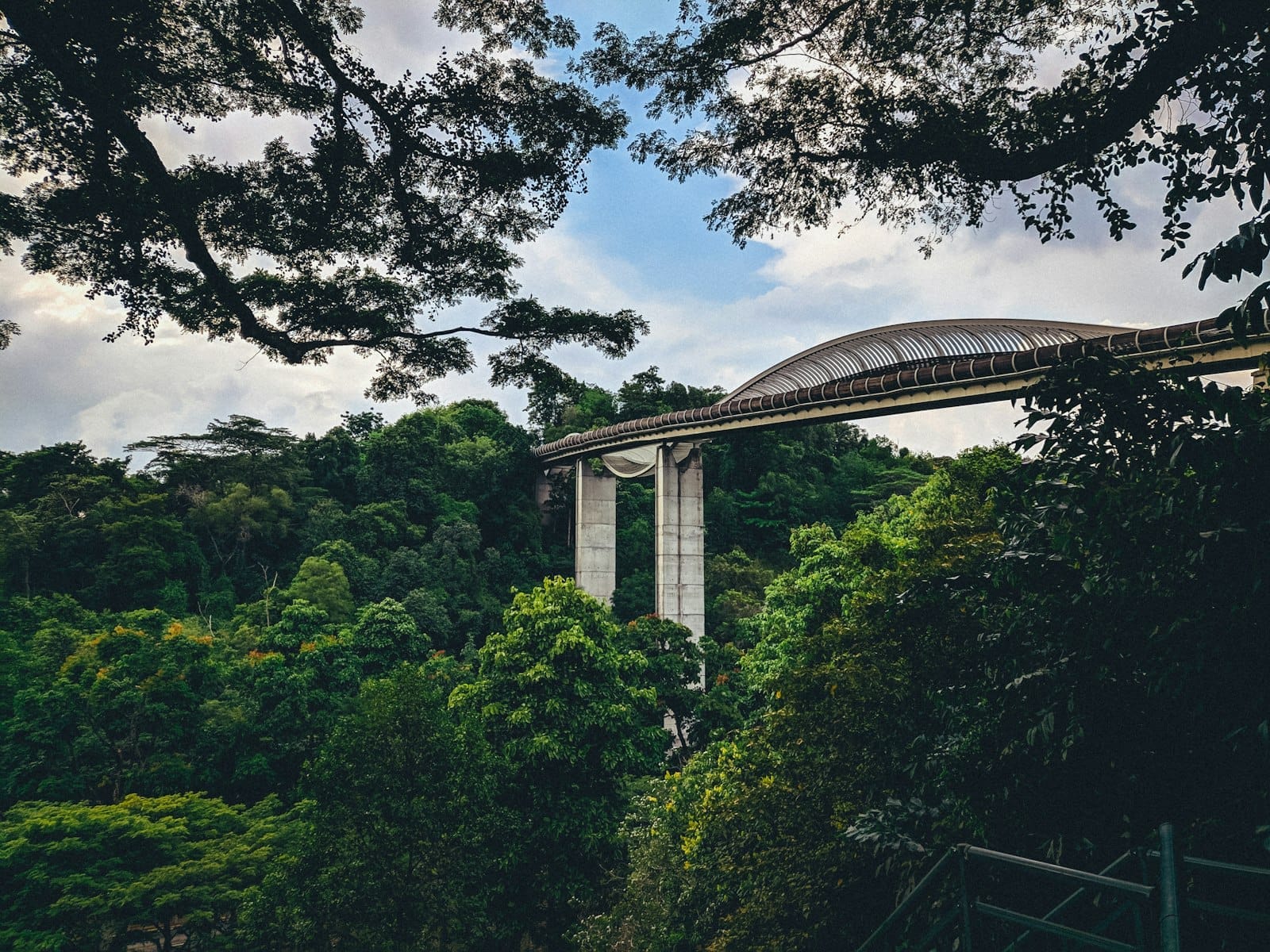
Henderson Waves is a pedestrian bridge in Singapore's Southern Ridges corridor that has become one of the most photographed pieces of urban infrastructure in Southeast Asia. Opened on 10 May 2008 by Prime Minister Lee Hsien Loong, it spans 274 metres, stands 36 metres above Henderson Road at its highest point, and earns its name from the wave-like steel ribs that ripple continuously along its length. It is, by height, Singapore's tallest pedestrian bridge.
The design comes from a collaboration between RSP Architects Planners & Engineers (Singapore) and IJP Architects (UK). Seven undulating steel waves form the bridge's spine, while yellow balau hardwood — a dense tropical timber — lines both the deck and the curved alcoves carved into the inner ribs. Those alcoves are not decorative: they are sheltered bench spaces where walkers rest, couples linger, and photographers set up tripods, all framed by sweeping views of the forest canopy and, on clear days, the southern waterfront.
💡 Local tip
The bridge sits at the midpoint of the Southern Ridges trail. If you only have time for one section, enter from Telok Blangah Hill Park, cross Henderson Waves, and descend toward Mount Faber Park for the most dramatic sequence of views.
The Experience by Time of Day
Time of day changes Henderson Waves more than almost any other attraction in Singapore. Early morning, roughly 6:30 to 8:00 am, is the most tranquil window. Joggers and dog walkers move briskly in both directions, the wood deck is cool underfoot, and thin mist sometimes hangs between the tree canopy and the ridge line below. Birdsong carries clearly at this hour because road traffic on Henderson Road beneath hasn't yet reached its peak. The light is soft and directional, ideal for photographing the bridge's curves without harsh shadows.
Midday between 11:00 am and 2:00 pm is the hardest stretch. Singapore sits roughly one degree north of the equator, and the tropical sun is relentless at this latitude. The yellow balau deck radiates heat, the steel frame absorbs it, and the shade from the wave ribs is partial at best. This window draws the fewest visitors and is worth skipping unless you have no choice.
Sunset and the hour after are the bridge's peak moment. From around 6:30 pm, the sky above the Telok Blangah ridge shifts through orange and deep red, and the bridge fills with photographers, couples, and small groups of friends. The atmosphere is lively without being crowded. Then, as full dark falls, the LED lighting embedded along the ribs activates. The bridge glows in shifting warm tones, the alcoves become intimate lit pockets, and the views down to the lit highway below take on a cinematic quality. This is when Henderson Waves delivers its most distinctive experience.
Tickets & tours
Hand-picked options from our booking partner. Prices are indicative; availability and final rates are confirmed when you complete your booking.
Adventure Cove Waterpark™ e-ticket
From 27 €Instant confirmationWild Wild Wet Waterpark Entrance Ticket
From 15 €Instant confirmationLion City bike tour in Singapore
From 55 €Instant confirmationFree cancellationLuggage Storage in Singapore
From 7 €Instant confirmationFree cancellation
Architectural and Cultural Context
Henderson Waves is part of a deliberate government investment in Singapore's green corridor infrastructure. The National Parks Board (NParks) developed the Southern Ridges as a 10-kilometre network of linked parks and elevated walkways running through the southern part of the main island. The project connected what had previously been isolated green spaces, Mount Faber Park, Telok Blangah Hill Park, HortPark, Kent Ridge Park, and Labrador Nature Reserve, into a continuous walking route. Henderson Waves is both the structural centrepiece and the visual anchor of that route.
The choice of yellow balau timber is significant beyond aesthetics. Balau is one of the hardest tropical hardwoods in the region, selected for its resistance to moisture, insects, and the intense UV exposure of Singapore's climate. The warm amber tones contrast deliberately with the industrial steel ribs, softening what could otherwise feel like a purely technical structure. The bridge received the President's Design Award in 2009, Singapore's highest design honour, and it continues to appear in architecture curricula as a case study in integrating natural materials with contemporary engineering. For more context on how Singapore's parks network fits together, the Southern Ridges walking trail page covers the full corridor in detail.
The Walk: What to Expect Step by Step
The bridge itself takes roughly ten minutes to cross at a comfortable pace, though most visitors take longer. The approach from the Telok Blangah Hill Park side begins with a ramp that rises gradually before delivering you onto the main span. The first undulation of the wave structure lifts the path upward, and the full panorama opens: a canopy of secondary rainforest on both sides, interrupted by glimpses of apartment blocks and, on the southern horizon, the faint grey outline of the waterfront and sea.
The alcoves are the physical feature that sets this bridge apart from any standard elevated walkway. Each one is formed by the inner curve of a wave rib, lined with the same timber as the deck, and fitted with a wide curved bench. They create the sensation of sitting inside a wooden shell suspended over the forest. In the evening especially, the alcoves trap ambient sound differently from the open deck — quieter, more enclosed, with a soft echo from the timber.
On the Mount Faber Park side, the bridge meets a path that continues up toward the cable car terminal and the hilltop restaurants. Most visitors turn around at the bridge's far end and retrace their steps, but continuing to Mount Faber is worth the extra twenty minutes if you have time. The hilltop offers a different class of view: the southern Singapore waterfront, Sentosa Island, and the container port visible to the west.
The full Southern Ridges trail to the east extends toward Kent Ridge Park and beyond, passing through HortPark. If you plan to walk the entire route, allow three to four hours and bring water. The Singapore Botanic Gardens are a separate attraction but offer a useful comparison point for understanding the range of green space Singapore has developed across the island.
Getting There and Practical Logistics
There is no MRT station within easy walking distance of Henderson Waves. The two practical options are to take a bus from HarbourFront MRT (Circle and North-East Lines) or Outram Park MRT (East-West, North-East, and Thomson-East Coast Lines), or to take a taxi or ride-hailing car directly to 221 Henderson Road. The bus journey from either station involves one transfer and some walking, so most visitors arriving specifically for the bridge find a direct taxi or Grab ride faster and not significantly more expensive given Singapore's taxi pricing.
Parking is limited in the immediate area, so driving is not recommended unless you are incorporating the bridge into a broader car-based Southern Ridges loop. Cycling is not permitted on the bridge itself; pedestrians only.
⚠️ What to skip
Wear proper walking shoes with grip. The timber deck is smooth and can become slippery after rain, which happens frequently in Singapore's year-round tropical climate. Bring water — there are no vending points on the bridge itself, though Telok Blangah Hill Park has some facilities nearby.
Smoking is prohibited on the bridge. There are no toilets on the bridge; the nearest facilities are in Telok Blangah Hill Park or at the Mount Faber cable car terminal. The bridge is fully paved and the ramps are gradual, but the undulating deck surface and absence of lifts or level alternatives mean it is not well-suited to wheelchair users or prams.
Photography Tips and Honest Limitations
For photography, the golden-hour window just before sunset is the clearest recommendation: warm light, moderate crowds, and the LED illumination beginning to activate as darkness falls. A wide-angle lens captures the full sweep of the wave structure from inside the span. The alcoves work well for portrait shots because the curved timber framing creates a natural vignette. Night shots of the full bridge from below, from Henderson Road itself, show the glowing structure against the dark ridge and are frequently seen in Singapore architecture publications.
One honest limitation: the views from the bridge, while pleasant, are primarily of forested slopes and middle-distance urban landscape. If you are expecting panoramic city skyline views of the type you would get from Marina Bay or the top of a hotel, you will be disappointed. Henderson Waves rewards visitors who value architectural design, green-corridor walking, and atmospheric evening light over pure destination-view spectacle. It pairs naturally with Mount Faber for anyone who wants a proper skyline photo, since the hilltop provides clearer sightlines to the waterfront.
Visitors doing a full evening in the area sometimes combine the bridge with the Singapore Cable Car at Mount Faber, which offers a different vantage point over Sentosa and the southern sea. The cable car runs its own operating hours and charges a separate fare, so check current times before planning that combination.
Who Might Not Enjoy This
Visitors with very limited time in Singapore should weigh this attraction carefully against city-centre options. The bridge requires dedicated travel time, and the experience, while genuinely impressive, is primarily architectural and nature-oriented. If your priorities are condensed sightseeing, famous landmarks, or food culture, the effort-to-reward ratio may not suit your itinerary.
Those with mobility limitations will find the undulating deck difficult, as noted above. And travellers who have already walked comparable elevated greenway structures elsewhere in Asia may find Henderson Waves covers familiar ground. For a denser concentration of things to do within a smaller area, Marina Bay or Chinatown offer more variety per hour spent.
Insider Tips
- The best unobstructed photograph of the full bridge from the outside is taken from Henderson Road below, not from the bridge itself. Walk down to road level on the Telok Blangah side just after the LED lighting activates at dusk.
- The alcove benches fill up quickly during the post-sunset golden hour. If you want one to yourself, arrive around 6:00 pm, slightly before the main crowd, and claim an alcove mid-span facing southwest for the last direct sun.
- The Telok Blangah Hill Park side of the bridge has a small nature trail through secondary forest that most bridge visitors skip. It takes about 15 minutes and gives you a view back toward the bridge through the tree canopy — a less-photographed angle.
- On weekday evenings, the bridge is noticeably quieter than weekends. If the social-media crowd feeling bothers you, Tuesday through Thursday evenings offer the same light conditions with around half the people.
- Bring insect repellent for the forested approaches on both sides of the bridge, especially in the early morning and after rain. The bridge deck itself is open and wind-exposed, but the park paths feeding it are not.
Who Is Henderson Waves For?
- Architecture and design enthusiasts who want to see Singapore's engineering ambition at pedestrian scale
- Photographers targeting golden-hour and night-time shots of a landmark structure
- Hikers and walkers completing the full Southern Ridges trail from end to end
- Evening strollers looking for a scenic, free, and unhurried alternative to the city-centre waterfront
- Families with older children or teenagers who can handle a moderate ridge walk
Nearby Attractions
Combine your visit with:
- Boat Quay
Boat Quay stretches along the south bank of the Singapore River, its two- and three-storey shophouses packed with restaurants, bars, and cafes. Once the beating commercial heart of colonial Singapore, the strip today offers one of the city's most atmospheric settings for an evening meal or a morning walk with history underfoot.
- Clarke Quay
Clarke Quay lines the Singapore River with five blocks of conserved warehouses and shophouses, now packed with restaurants, rooftop bars, and clubs. Free to enter and active from dusk until well past midnight, it rewards visitors who arrive after dark when the neon reflects off the water and the crowds find their rhythm.
- Fort Canning Park
Standing 48 metres above the city centre, Fort Canning Park packs more history per square metre than almost anywhere else in Singapore. From ancient Malay royalty to British colonial command, the hill has shaped this island for over seven centuries — and today offers a genuinely peaceful escape just minutes from Orchard Road.
- Jewel Changi Airport
Jewel Changi Airport is a 135,700 m² dome of forest, water, and commerce connecting Singapore's airport terminals. At its core stands the Rain Vortex, the tallest indoor waterfall on earth at 40 metres, surrounded by five floors of tropical greenery. Whether you have a layover or a full afternoon free, Jewel rewards the visit.