Fort Canning Park: Singapore's Most Historically Layered Green Space
Standing 48 metres above the city centre, Fort Canning Park packs more history per square metre than almost anywhere else in Singapore. From ancient Malay royalty to British colonial command, the hill has shaped this island for over seven centuries — and today offers a genuinely peaceful escape just minutes from Orchard Road.
Quick Facts
- Location
- Central Area, Civic and Cultural District, Singapore
- Getting There
- Fort Canning MRT (Downtown Line) or Dhoby Ghaut MRT (multiple lines)
- Time Needed
- 1.5 to 3 hours depending on how many gardens you explore
- Cost
- Free entry to the park; individual attractions within may charge separately
- Best for
- History lovers, morning walkers, photography, escaping the city heat
What Fort Canning Park Actually Is
Fort Canning Park is an 18-hectare heritage park sitting atop Fort Canning Hill, the highest point within comfortable walking distance of Singapore's city centre at approximately 48 metres (157 feet). That elevation might sound modest, but in a flat, densely built island-state, it translates into genuine separation from the noise below. The air shifts as you climb. Traffic fades. Birdsong takes over.
The park is managed by the National Parks Board (NParks) and entrance to the grounds themselves is free. What visitors find inside is not a single attraction but a layered landscape: recreated historical gardens, colonial-era architecture, massive rain trees, and archaeological sites that point to a history most visitors know nothing about when they first arrive.
💡 Local tip
Fort Canning MRT station on the Downtown Line opens directly onto the park's lower slopes, making this one of the most accessible green spaces in central Singapore. From Dhoby Ghaut MRT, it's an 8-12 minute walk.
Seven Centuries of History in One Hill
This hill was called Bukit Larangan in Malay, meaning 'Forbidden Hill'. The name was not casual. For centuries it served as the sacred seat of the ancient Malay kingdom of Singapura, and commoners were prohibited from setting foot on it. Excavations on the hill have uncovered artefacts suggesting royal occupation dating back to the 14th century, long before Stamford Raffles arrived in 1819.
Raffles himself recognised the hill's strategic value immediately. He built his bungalow here and designated the summit as Government Hill. The British then constructed a fort in 1860, naming it after Viscount Charles John Canning, Governor-General and First Viceroy of India. The fort served as military command headquarters and, critically, was the location where British commanders made the decision to surrender Singapore to Japanese forces in February 1942, one of the defining moments of World War II in Asia.
The park received its current name on 1 November 1981, when Prime Minister Lee Kuan Yew officially renamed it Fort Canning Park, transitioning it from what had been called Central Park since 1972. Today that deep stratification of Malay royalty, British colonialism, wartime trauma, and postcolonial reinvention is visible in physical form across the hillside if you know what you're looking at.
Tickets & tours
Hand-picked options from our booking partner. Prices are indicative; availability and final rates are confirmed when you complete your booking.
Adventure Cove Waterpark™ e-ticket
From 27 €Instant confirmationWild Wild Wet Waterpark Entrance Ticket
From 15 €Instant confirmationLion City bike tour in Singapore
From 55 €Instant confirmationFree cancellationLuggage Storage in Singapore
From 7 €Instant confirmationFree cancellation
What You'll Actually See: The Gardens and Landmarks
The park is divided into distinct garden zones, each referencing a different chapter of the hill's history. The Spice Garden recreates the experimental botanical garden that Raffles established here in 1822, one of the earliest such gardens in Singapore before the collection was relocated to what is now the Singapore Botanic Gardens. You'll find nutmeg, clove, pepper, and other plants that once drove the region's entire colonial economy.
The Royal Garden interprets the period of the ancient Malay sultanate, using plantings and design cues drawn from historical records. The First Botanical Garden zone marks where Raffles' original experimental collection stood. Jubilee Park adds open lawns that are heavily used for concerts and outdoor events. The Singapore Botanic Gardens, the direct descendant of Raffles' garden here, is worth pairing with a Fort Canning visit if you have a full day.
The Fort Canning Centre, the dominant building on the upper slopes, was originally built as British Army barracks. It now functions as a performing arts venue and event space. A replica of the 1903 Fort Canning Lighthouse stands nearby. The park also contains 15 heritage trees, with a particularly impressive heritage-listed rain tree (Samanea saman) whose canopy spreads wide enough to shelter dozens of people underneath. These trees are old enough that they change the microclimate beneath them noticeably.
How the Park Changes Through the Day
Early morning, roughly 6:30am to 8:30am, is when Fort Canning belongs to residents. Older Singaporeans do tai chi on the upper terraces. Joggers work the perimeter paths at a steady pace. The light is soft and directional, cutting through the forest canopy at low angles. The smell of damp soil and leaf litter is strongest at this hour, before the heat sets in. If you're after photographs without people in frame, this window is hard to beat.
By mid-morning, school groups and tourists begin arriving. The temperature rises quickly in Singapore's equatorial climate, and the hill offers significantly more shade than the streets below, but expect to sweat regardless. Carrying water is not optional. Midday is genuinely uncomfortable for extended walking, and most visitors sensibly limit themselves to shorter loops during this window.
Late afternoon from around 4:30pm brings relief. The heat breaks incrementally, families arrive with children, and the open lawns fill with people reading or lying on the grass. The golden hour light through the old rain trees is legitimately beautiful. On event nights, the park transforms entirely — concert setups appear on the lawns, and what was peaceful parkland becomes an outdoor amphitheatre for thousands.
⚠️ What to skip
Singapore receives significant rainfall year-round. The hill's paths can become slippery when wet. Wear closed shoes with grip if you plan to explore the slopes rather than just the flat terrace areas.
Navigating the Park Without Getting Lost
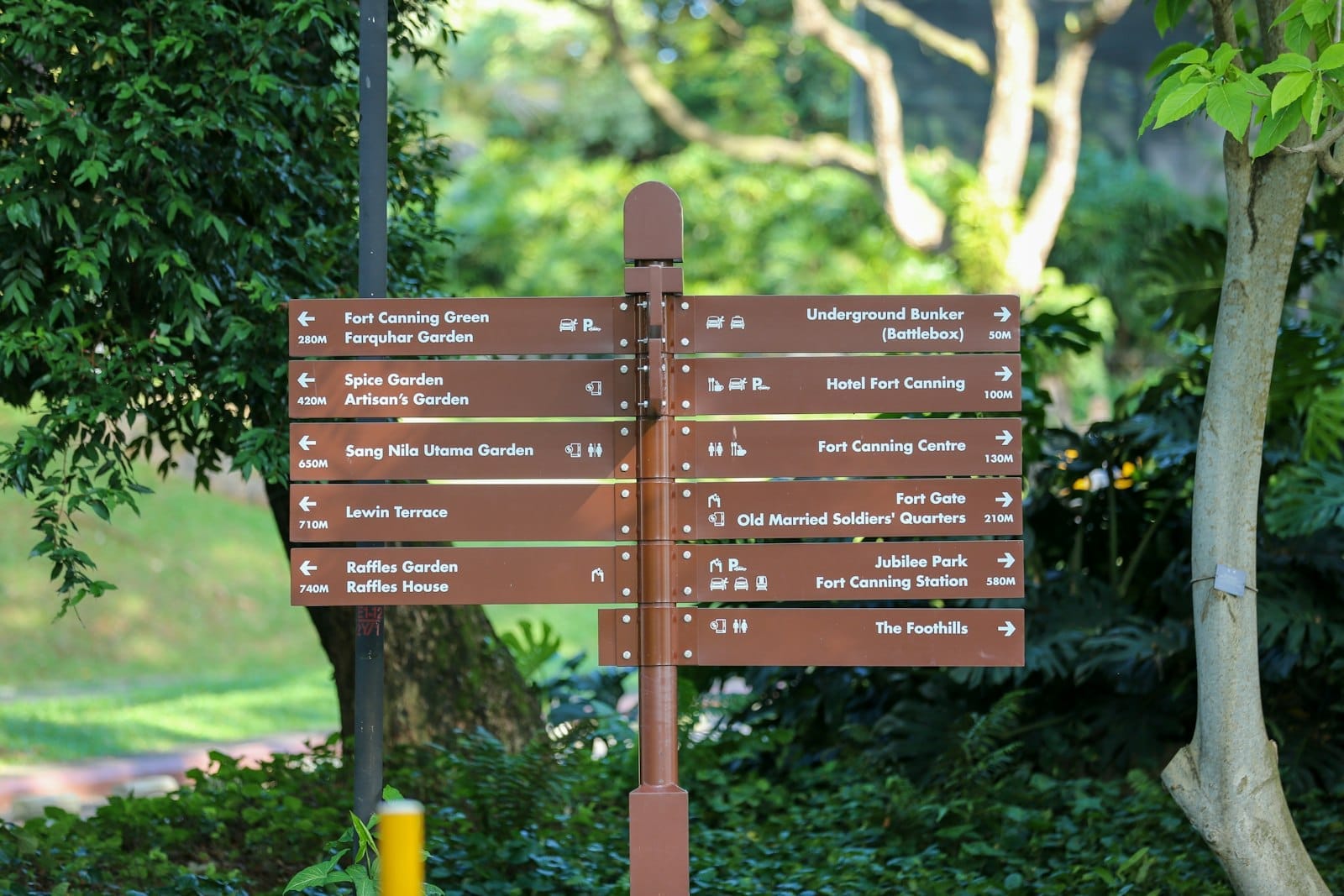
Fort Canning Hill has multiple entry points and a network of paths that can disorient first-time visitors. The most logical approach from Fort Canning MRT is to take the underpass directly into the lower park, then follow the main path uphill toward the Fort Canning Centre. From Dhoby Ghaut, you can enter via the Clemenceau Avenue gate or climb the stairs near the National Museum.
The park sits in the broader Civic and Cultural District, placing it within easy walking distance of the National Museum of Singapore and the Peranakan Museum. Combining Fort Canning with one or both of these makes for a coherent half-day focused on Singapore's layered past.
The park has no single fixed walking route. A complete circuit of the main paths, including the heritage gardens and the upper Fort Canning Centre terrace, takes roughly 60 to 90 minutes at a relaxed pace. If you add time to read the interpretive signage, which is genuinely informative rather than perfunctory, budget at least two hours. The signage is in English throughout.
Photography, Accessibility, and Practical Details
Photographically, the park rewards patience more than position. The heritage trees are the standout subjects, particularly the large rain tree whose scale only registers once someone stands beneath it. The Gothic Gate, a remnant of an old Christian cemetery on the hill, photographs well at any time of day. The lighthouse replica is photogenic but clearly modern.
Accessibility is mixed. The main upper terrace and Fort Canning Centre area are accessible via a gentler slope route, but several garden paths involve stairs and uneven stone surfaces. Visitors with mobility limitations should check the NParks website for the most current accessibility routing before arriving. The park is stroller-accessible on its main paths but not throughout.
For those building a broader Singapore itinerary, Fort Canning pairs naturally with a late afternoon walk down toward Clarke Quay along the river, which is roughly a 10-minute walk downhill from the park's southern exit. The contrast between the quiet hill and the river's energy below is stark and interesting. You can also read our broader guide to things to do in Singapore if you're still mapping out your time.
Who This Park Is Not For
Fort Canning is not a spectacle. There is no single defining view, no landmark photograph that everyone leaves with, and no single attraction that justifies the visit on its own. Visitors seeking a compact, high-impact experience, the kind delivered by, say, Gardens by the Bay's Supertree Grove after dark, will find Fort Canning underwhelming if they approach it the same way.
It also functions very differently from Singapore's coastal green spaces. There is no water, no beach, and no wide horizon. If outdoor recreation in a more expansive setting is the goal, East Coast Park or the Southern Ridges walk will suit better. Fort Canning rewards curiosity and patience. It does not reward a quick 20-minute pass-through.
Insider Tips
- The Gothic Gate on the lower slopes is a remnant of an early 19th-century Christian cemetery and is one of the most atmospheric spots in the park. Most visitors walk past it without stopping — pause and read the worn inscriptions on the surrounding tombstones.
- NParks runs guided heritage tours of Fort Canning periodically. These are worth booking in advance if you want structured historical context rather than reading the signage independently. Check the NParks website for the current schedule.
- The park's open lawns host a rotating calendar of major outdoor concerts and film screenings. If you're visiting Singapore during a large event like Shakespeare in the Park or ZoukOut (historically held in various Singapore locations), check whether Fort Canning is on the schedule — experiencing it during a concert night is a completely different kind of visit.
- The Spice Garden is small but genuinely interesting if you read the plant labels. Understanding that nutmeg and cloves from this region once drove European colonial expansion gives the modest garden an outsized historical weight.
- Exit via the stairs near the National Museum side if you want an immediate transition to air-conditioned museums. The National Museum of Singapore is essentially at the base of the hill on that side, and the juxtaposition of open-air history above and curated exhibits below works well as a paired half-day.
Who Is Fort Canning Park For?
- History-focused travellers who want to understand Singapore's origins before the British colonial period
- Morning walkers and joggers looking for green space within the city centre
- Photographers seeking canopy light and heritage architecture without the crowds of more famous parks
- Families with children who can handle moderate uphill walking and benefit from open lawn space
- Travellers building a Civic District half-day combining green space with nearby museums
Nearby Attractions
Combine your visit with:
- Boat Quay
Boat Quay stretches along the south bank of the Singapore River, its two- and three-storey shophouses packed with restaurants, bars, and cafes. Once the beating commercial heart of colonial Singapore, the strip today offers one of the city's most atmospheric settings for an evening meal or a morning walk with history underfoot.
- Clarke Quay
Clarke Quay lines the Singapore River with five blocks of conserved warehouses and shophouses, now packed with restaurants, rooftop bars, and clubs. Free to enter and active from dusk until well past midnight, it rewards visitors who arrive after dark when the neon reflects off the water and the crowds find their rhythm.
- Henderson Waves
Henderson Waves is Singapore's tallest pedestrian bridge at 36 metres above Henderson Road, connecting Mount Faber Park and Telok Blangah Hill Park along the Southern Ridges trail. Free to access at any hour, the 274-metre-long structure is equally rewarding at dawn, midday, and after dark.
- Jewel Changi Airport
Jewel Changi Airport is a 135,700 m² dome of forest, water, and commerce connecting Singapore's airport terminals. At its core stands the Rain Vortex, the tallest indoor waterfall on earth at 40 metres, surrounded by five floors of tropical greenery. Whether you have a layover or a full afternoon free, Jewel rewards the visit.