Peranakan Museum Singapore: Culture, Craft, and a Community's Story
Housed in a beautifully restored 1912 colonial schoolhouse on Armenian Street, the Peranakan Museum is Singapore's most focused exploration of Straits Chinese heritage. Ten permanent galleries take visitors through the rituals, crafts, and daily lives of the Peranakan communities across Southeast Asia, from wedding ceremonies to beadwork so fine it requires a magnifying glass.
Quick Facts
- Location
- 39 Armenian Street, Singapore 179941 (Civic District)
- Getting There
- City Hall MRT (East-West/North-South lines) or Clarke Quay MRT (Circle Line), then a short walk
- Time Needed
- 1.5 to 2.5 hours for a thorough visit
- Cost
- Check the National Heritage Board website for current admission prices; concessions available
- Best for
- History lovers, design enthusiasts, families with older children, and first-time visitors seeking cultural depth
- Official website
- www.nhb.gov.sg/peranakanmuseum
What the Peranakan Museum Is (and Why It Matters)
The Peranakan Museum is Singapore's only institution dedicated entirely to Peranakan cultures, those of the descendants of early Chinese, Indian, and other migrants who settled across the Malay Archipelago and adopted local customs, languages, and aesthetics over generations. The term 'Peranakan' means 'locally born' in Malay, and the communities it describes produced one of Southeast Asia's most visually distinctive and historically layered cultural traditions.
The museum reopened on 17 February 2023 after a major renovation, and the upgrade shows. Ten permanent galleries now cover everything from birth and marriage rituals to the material culture of Peranakan homes, the role of religion, and the distinct traditions of Peranakan communities beyond Singapore, including those in Malacca, Penang, Java, and the Coromandel Coast. This is not a niche collection aimed only at specialists. It is a well-curated, accessible introduction to a culture that shaped modern Singapore in ways most visitors only partially understand.
💡 Local tip
Friday evenings are the quietest and most atmospheric time to visit. The museum stays open until 9pm, the crowd thins noticeably after 6pm, and the interior lighting feels more like a private viewing than a public gallery.
The Building: A 1912 Schoolhouse Repurposed With Purpose
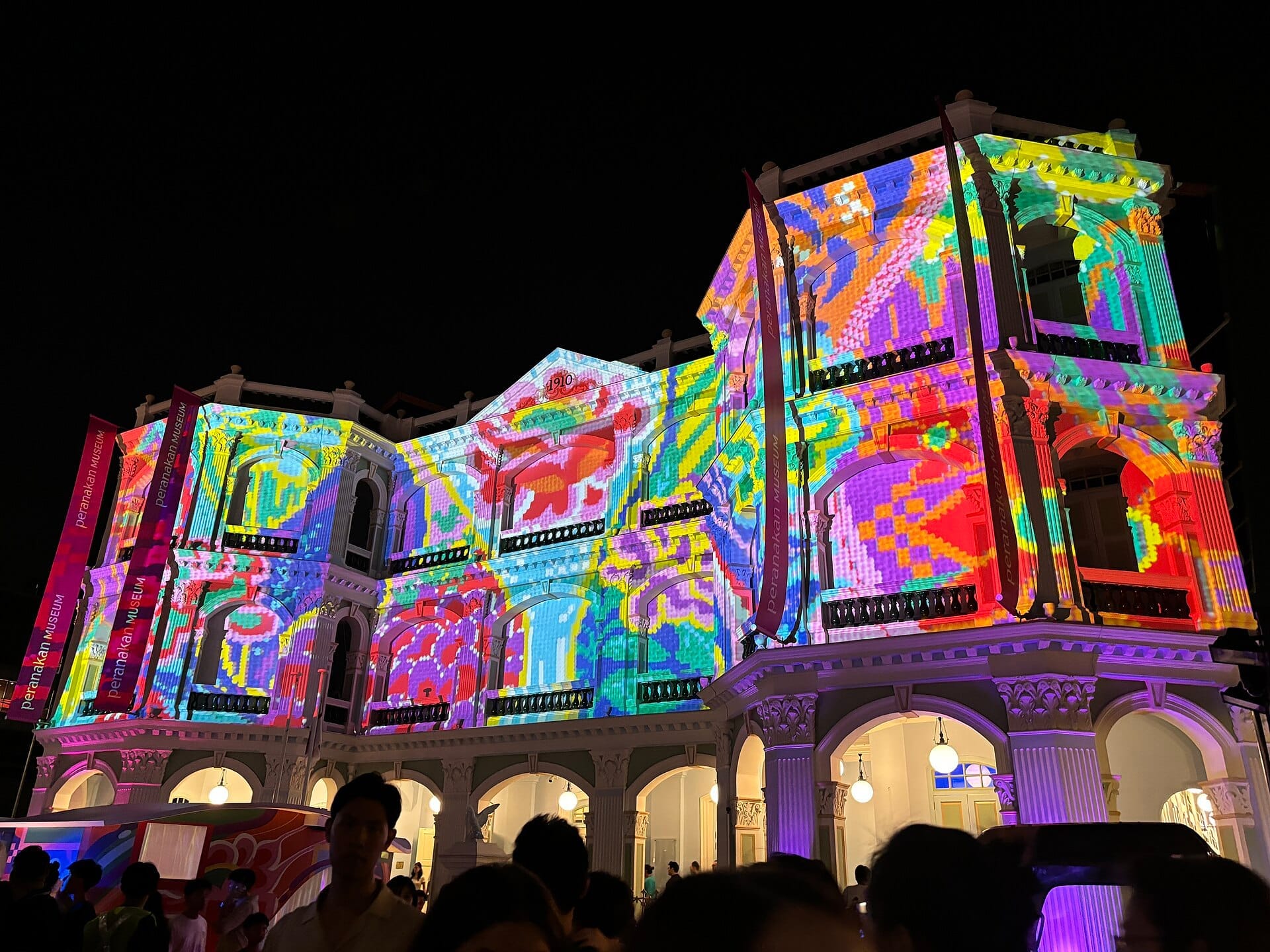
Before a single exhibit is encountered, the building itself rewards attention. The structure was constructed in 1912 as the Tao Nan School, a Chinese community school the first modern Hokkien school in the Straits Settlements to the children of early migrants. The architecture is Eclectic Classical in style, a common approach for civic and institutional buildings in Singapore during the late colonial period, combining European neoclassical proportions with decorative details that acknowledged the building's Chinese institutional identity.
The facade on Armenian Street features a symmetrical two-storey frontage with arched windows, pilasters, and a central entrance bay that reads as suitably ceremonial without being overwhelming. From the street, the building sits comfortably alongside nearby colonial-era neighbours, including the Armenian Church (Singapore's oldest Christian church, built in 1835) and the former Convent of the Holy Infant Jesus complex. This stretch of Armenian Street is one of the most historically compact blocks in the city, and arriving on foot along it is worth the extra few minutes.
The building served as the Asian Civilisations Museum's first home from 1997 before being repurposed exclusively as the Peranakan Museum in 2008. The 2023 renovation retained the heritage shell while updating the gallery interiors significantly. The transition from the colonial exterior to the richly coloured, object-dense galleries inside produces a pleasing contrast.
Tickets & tours
Hand-picked options from our booking partner. Prices are indicative; availability and final rates are confirmed when you complete your booking.
Adventure Cove Waterpark™ e-ticket
From 27 €Instant confirmationWild Wild Wet Waterpark Entrance Ticket
From 15 €Instant confirmationLion City bike tour in Singapore
From 55 €Instant confirmationFree cancellationLuggage Storage in Singapore
From 7 €Instant confirmationFree cancellation
Inside the Galleries: What You Will Actually See
The ten permanent galleries are organised thematically rather than strictly chronologically, which makes the experience feel exploratory rather than instructional. The opening galleries establish context, explaining who the Peranakans were, where they settled, and how distinct regional identities developed across different port cities. From there, the collection moves into the life-cycle rituals that defined Peranakan society: birth, coming-of-age, courtship, marriage, and death.
The marriage galleries consistently attract the most sustained visitor attention, and the reason is the objects themselves. A traditional Peranakan wedding could last twelve days and involved an extraordinary volume of ceremonial textiles, jewellery, ceramics, and furniture. The museum holds significant examples of all of these, including kasut manek (beaded slippers) with needlework so fine that individual stitches are nearly invisible to the naked eye, and heavily embroidered wedding garments in silk and gold thread that were intended to be worn once and preserved for generations.
Equally compelling is the section devoted to nyonya cuisine, the cooking tradition developed by Peranakan women that fused Chinese ingredients and techniques with Malay spice profiles. The displays here go beyond recipe cards and reproduced kitchens. They examine the social role of cooking within the Peranakan household and explain why certain dishes became markers of identity and status. Visitors who have already eaten their way through Singapore will find this section adds meaningful context to what they have tasted.
The museum also has strong holdings in Peranakan ceramics, particularly the distinctive nyonyaware porcelain ordered from Chinese kilns in bold pinks, greens, and yellows for Straits Chinese households. If the visual language of those ceramics is already familiar from shophouse interiors or Chinatown Heritage Centre displays, the Peranakan Museum provides a much deeper account of how they were produced, traded, and used.
How the Visit Changes by Time of Day
Morning visits, particularly on weekdays, offer the best conditions for slow looking. The galleries are rarely crowded before noon, and the ambient quiet allows the scale of individual objects to register properly. Schoolgroups do visit, but they tend to move quickly through specific galleries rather than saturating the whole space.
Weekend afternoons bring more visitors, especially families and tourists moving in clusters between the Civic District's other attractions. The galleries remain manageable, but popular display cases in the marriage and ceramics sections can become congested around cases that invite close inspection. If visiting on a weekend, arriving at opening time (10am) provides roughly ninety minutes of relatively uninterrupted access before foot traffic builds.
The Friday late opening is genuinely underused. Arriving at 7pm means roughly two hours of near-private access, and the lower-lit gallery conditions in the evening suit the material well. The embroidered textiles and lacquered furniture read differently under controlled artificial light than in the harsher midday atmosphere.
Practical Walkthrough: Getting There, Getting Around
The museum sits at 39 Armenian Street in the Civic District, a five to eight minute walk from City Hall MRT station (East-West and North-South lines). From Clarke Quay MRT (Circle Line), the walk is slightly longer at around ten to twelve minutes but passes through a pleasant sequence of conservation shophouses. Taxis and ride-hailing services can drop directly in front. There is no dedicated car park attached to the museum.
The Civic District location makes the Peranakan Museum an easy addition to a route that also includes the National Museum of Singapore (a five-minute walk away) or the National Gallery Singapore (about ten minutes on foot). Planning two museums in the same half-day is realistic if visits are focused.
The museum is air-conditioned throughout, which matters in Singapore's equatorial climate. Comfortable walking shoes are appropriate. There are no significant physical barriers within the galleries, though visitors with mobility considerations should check the museum's own accessibility information before arrival, as the building is a heritage structure.
ℹ️ Good to know
Opening hours: Daily 10am to 7pm. Fridays 10am to 9pm. Always confirm current hours and admission prices on the official National Heritage Board website before visiting, as these can change.
Photography, Context, and a Note on Honest Expectations
Photography is generally permitted in the permanent galleries without flash. The nyonyaware ceramics and embroidered textiles are among the most photogenic displays. The marriage-bed installation, with its layered canopy, carved furniture, and ritual objects arranged in a domestic tableau, is widely reproduced on social media and holds up well in person.
An honest note on scale: this is not a large museum. Visitors expecting the scope of the National Museum or the National Gallery will find the Peranakan Museum focused and contained rather than encyclopedic. That is not a shortcoming. The concentration of the collection is one of its strengths. But those who prefer broad survey experiences over deep dives into a specific culture may find two hours sufficient rather than feel they need more time.
Visitors who want to extend their engagement with Peranakan culture beyond the museum have good options nearby. The Katong and Joo Chiat neighbourhood in the east of the island is the historic residential heart of Singapore's Peranakan community, where the shophouse architecture, food culture, and family businesses provide a living complement to what the museum documents in glass cases.
Who Should Visit (and Who Might Not Connect)
The Peranakan Museum rewards visitors who bring some patience for material culture, meaning those willing to spend time in front of a beaded slipper or a porcelain bowl reading what it tells about the people who made and used it. Visitors primarily interested in sweeping historical narratives or interactive multimedia experiences may find the collection more static than they prefer.
Families with children under ten may find the gallery format difficult to sustain over a full visit, though the decorative objects are often visually striking enough to hold young attention for the first thirty minutes. The museum is genuinely excellent for design-literate visitors, textile enthusiasts, food historians, and anyone trying to understand what makes Singapore's cultural identity distinct from mainland Chinese or Malay traditions.
Insider Tips
- The museum shop stocks a considered selection of Peranakan-inspired homeware, ceramics, and books that are not widely available elsewhere in Singapore. Budget time at the end of your visit rather than trying to browse on the way in.
- Pick up the printed floor guide at the entrance rather than relying solely on wall text. It maps the gallery sequence more clearly than the signage inside, which can make the thematic organisation feel non-linear on a first visit.
- The gallery devoted to Jawi Peranakan culture (Peranakans of Indian-Muslim heritage) is one of the least-visited sections but contains some of the most unusual objects in the museum. It is easy to miss if you follow the crowd flow without checking the floor plan.
- If you are visiting with someone who has personal or family connections to Peranakan culture, allow extra time. The displays regularly provoke recognition and conversation that slow the pace considerably, and that is worth planning for.
- Combining this visit with a meal in the area provides cultural continuity. Several restaurants within a fifteen-minute walk serve nyonya cuisine. Eating something rooted in the same tradition you have just studied in the galleries adds a dimension no exhibit can fully replicate.
Who Is Peranakan Museum For?
- History and cultural heritage enthusiasts wanting depth over breadth
- Design, textile, and decorative arts lovers
- First-time visitors to Singapore seeking context beyond the skyline
- Travellers pairing the visit with a Katong or Joo Chiat neighbourhood exploration
- Anyone curious about how distinct hybrid cultures develop across generations of migration and settlement
Nearby Attractions
Combine your visit with:
- Boat Quay
Boat Quay stretches along the south bank of the Singapore River, its two- and three-storey shophouses packed with restaurants, bars, and cafes. Once the beating commercial heart of colonial Singapore, the strip today offers one of the city's most atmospheric settings for an evening meal or a morning walk with history underfoot.
- Clarke Quay
Clarke Quay lines the Singapore River with five blocks of conserved warehouses and shophouses, now packed with restaurants, rooftop bars, and clubs. Free to enter and active from dusk until well past midnight, it rewards visitors who arrive after dark when the neon reflects off the water and the crowds find their rhythm.
- Fort Canning Park
Standing 48 metres above the city centre, Fort Canning Park packs more history per square metre than almost anywhere else in Singapore. From ancient Malay royalty to British colonial command, the hill has shaped this island for over seven centuries — and today offers a genuinely peaceful escape just minutes from Orchard Road.
- Henderson Waves
Henderson Waves is Singapore's tallest pedestrian bridge at 36 metres above Henderson Road, connecting Mount Faber Park and Telok Blangah Hill Park along the Southern Ridges trail. Free to access at any hour, the 274-metre-long structure is equally rewarding at dawn, midday, and after dark.