Katong & Joo Chiat: Inside Singapore's Peranakan Heritage Quarter
Katong and Joo Chiat form Singapore's most intact Peranakan enclave, a stretch of District 15 where 1920s–1930s pastel shophouses line streets named after the community's own merchants and landlords. It is part heritage walk, part food trail, and entirely unlike the city's more polished tourist corridors.
Quick Facts
- Location
- District 15 (Marine Parade), eastern Singapore
- Getting There
- Dakota MRT (Circle Line) or Eunos MRT (East West Line); Marine Terrace MRT (Thomson-East Coast Line, opening 2026); buses along East Coast Road
- Time Needed
- 2–4 hours for a thorough walk; half-day with meals
- Cost
- Free to explore streets and murals; individual venues vary
- Best for
- Heritage architecture, Peranakan culture, street food, photography
What Katong and Joo Chiat Actually Are
Katong and Joo Chiat together describe a low-rise residential and commercial neighbourhood in Singapore's eastern District 15, roughly bounded by Joo Chiat Road, East Coast Road, and Marine Parade Road. The area is the country's most concentrated showcase of Peranakan (Straits Chinese) culture: the food, architecture, material heritage, and living street life of the community that emerged from intermarriage between Chinese settlers and local Malay populations, primarily from the 18th and 19th centuries onward.
The neighbourhood takes its two names from distinct but intertwined sources. Katong derives from the Malay 'Tanjong Katong', meaning turtle point, a reference to the green sea turtles that once nested along a coastline now buried under land reclaimed between 1966 and 1985. Joo Chiat Road was named after Peranakan businessman Chew Joo Chiat, who donated land around 1917 for road construction and died in 1926, leaving behind a street that still carries his name through hundreds of conserved shophouse facades.
The area was designated a national heritage conservation area in 1993 and named Singapore's first Heritage Town in 2011. Those official recognitions matter not just as accolades but as legal protections: the facades and rooflines of the 1920s–1930s shophouses cannot be altered, which is why walking here feels fundamentally different from the renovated entertainment precincts closer to the city centre.
The Shophouse Architecture Up Close
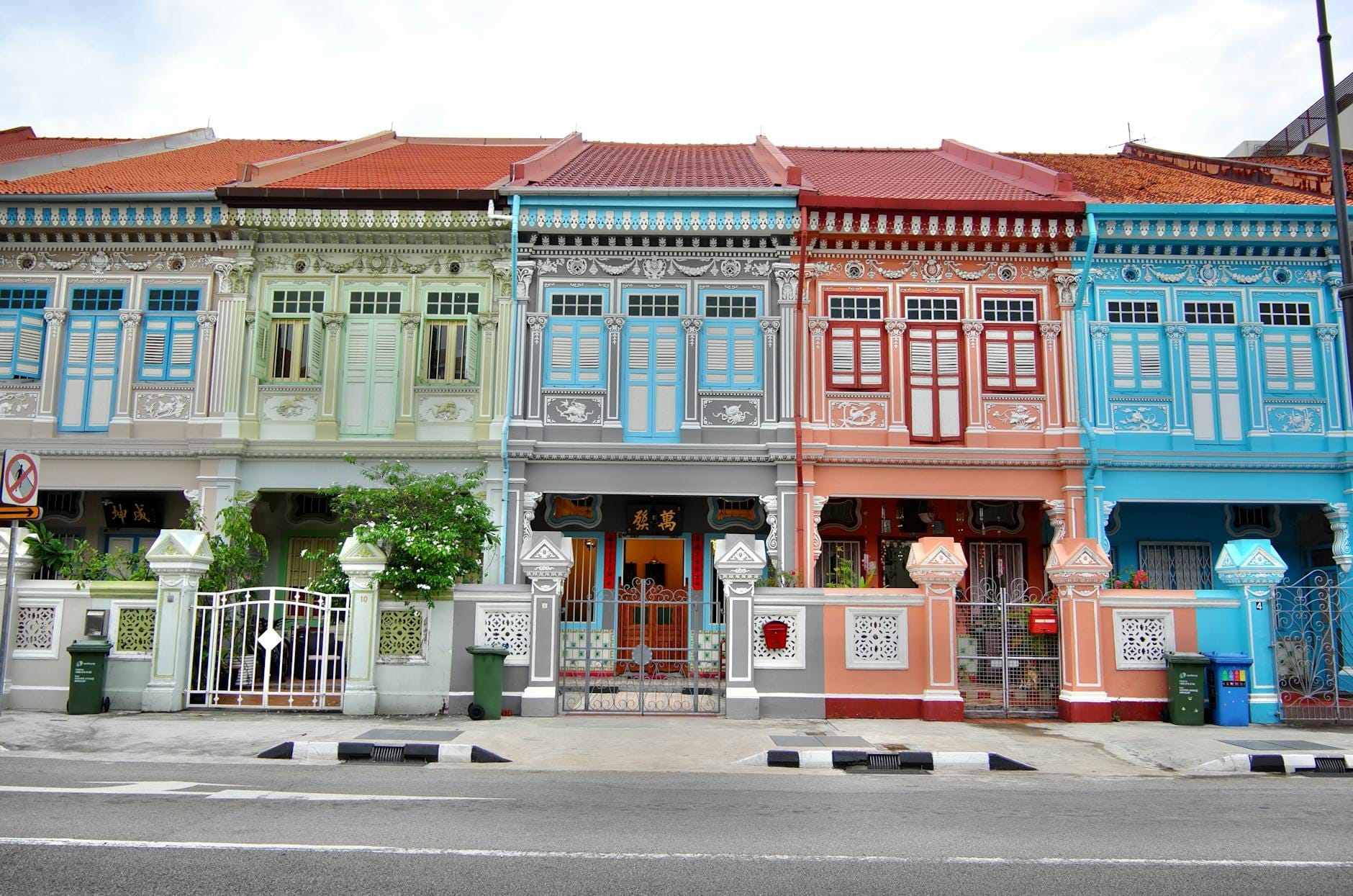
The defining visual element of Katong and Joo Chiat is the terraced shophouse, a building typology imported from southern China and adapted to Singapore's tropical climate. The standard form places a commercial or workshop space at street level, with a covered five-foot way (the sheltered pedestrian corridor set back from the facade) and residential floors above. What makes this district exceptional is the density of intact Art Deco and Late Shophouse Style examples from the 1920s and 1930s, finished in mint green, terracotta, mustard yellow, and pale blue, with ceramic tile panels, shuttered windows, and stucco relief detailing.
The row at 125 Joo Chiat Road is particularly well-regarded and has received a UNESCO Asia-Pacific Award for Cultural Heritage Conservation. The shophouses along Koon Seng Road are frequently photographed for their near-perfect state of preservation and symmetrical facades. Unlike some conservation areas elsewhere in Singapore, many of these buildings remain occupied as residences and small businesses rather than having been converted wholesale into bars or boutiques, which preserves the grain of daily life.
💡 Local tip
For the best light on shophouse facades, visit Koon Seng Road in the morning when the sun is low and the pastel colours read most clearly. By midday the light is harsh and flat.
Street-level details reward slow walkers. Look for the hand-painted ceramic tiles still set into the lower sections of some facades, the ornate ventilation tiles above doorways, and the occasional Peranakan threshold tile panel at the entrance to private terraces. These elements were not decorative afterthoughts; they were status signals in a community where material craft carried significant social weight.
Tickets & tours
Hand-picked options from our booking partner. Prices are indicative; availability and final rates are confirmed when you complete your booking.
Adventure Cove Waterpark™ e-ticket
From 27 €Instant confirmationWild Wild Wet Waterpark Entrance Ticket
From 15 €Instant confirmationLion City bike tour in Singapore
From 55 €Instant confirmationFree cancellationLuggage Storage in Singapore
From 7 €Instant confirmationFree cancellation
How the Neighbourhood Changes by Time of Day
Early mornings, before 9am, belong to residents. The coffee shops along East Coast Road fill with older regulars ordering kaya toast and soft-boiled eggs. The five-foot ways are still cool and shaded. Delivery motorcycles thread between parked cars. This is when the neighbourhood feels least performative and most like the working-class and middle-class Peranakan residential district it has been for a century.
By mid-morning, the area shifts. Cafes and heritage restaurants open. Weekend foot traffic builds noticeably by 10am, with visitors arriving to photograph shophouse rows and queue for laksa. On weekday mornings the streets are significantly quieter, making it a better time for unhurried photography and easier entry into popular food stalls.
Evenings bring a different character. The restaurants fill up and the neon from newer bars and the older coffee shops bleeds colour onto wet pavement after rain. Joo Chiat Road has a concentration of late-night businesses that cater to a local crowd rather than tourists, and the mix of elderly residents, young families, and weekend visitors produces a genuinely layered street scene. If rain is a concern, note that Singapore's afternoon thunderstorms are frequent and heavy: a light rain jacket or compact umbrella is practical throughout the year.
The Food: More Than Just Laksa
Katong laksa is the dish most associated with this neighbourhood: a coconut-milk-based noodle soup with cut noodles (traditionally eaten with a spoon alone, without chopsticks), cockles, fish cake, and a vivid red sambal. Several shops along East Coast Road compete for the title of the original, and the rivalry has produced both genuine quality and a certain amount of theatre. The Peranakan Kitchen, 328 Katong Laksa, and Janggut Laksa are among the long-running names, though hours and locations shift periodically.
The food trail extends well beyond laksa. Peranakan cuisine more broadly, also called Nyonya cooking, draws from Chinese and Malay techniques and produces dishes like ayam buah keluak (chicken braised with black nut), beef rendang, and kueh (layered steamed sweets in colours that mirror the shophouse facades outside). For a broader introduction to Singapore's food culture beyond this neighbourhood, the Singapore food guide covers the full range of the city's hawker and restaurant scene.
It is worth being honest about the food landscape here: not every stall is exceptional, and a few of the most-photographed spots have coasted on reputation for some years. Ask locally, check recent reviews, and be willing to walk a street or two past the obvious tourist clusters.
The Intan and Other Cultural Stops
The Intan, located at 69 Joo Chiat Terrace, is a private Peranakan museum housed in a conserved shophouse and operated by collector Alvin Yapp. It holds one of the most detailed collections of Peranakan artefacts in Singapore: porcelain, silverware, beadwork, furniture, and ceremonial items from the traditional 12-day Peranakan wedding. Visits are by appointment only and take place daily between 7am and 10pm. Admission fees apply, and numbers are kept small, which means the experience is genuinely intimate rather than institutional. It is not a drop-in attraction, but for visitors with a specific interest in Peranakan material culture, booking ahead is worthwhile.
For those who want a broader and more formally curated introduction to Peranakan history and identity, the Peranakan Museum in the civic district offers a larger permanent collection with restored interiors and bilingual interpretation. The two venues complement rather than duplicate each other.
Beyond the Intan, the neighbourhood rewards walkers who take side streets. Joo Chiat Place, Ceylon Road, and Everitt Road all contain conservation terraces with murals, independent art spaces, and the occasional antique dealer. The murals are not official installations but community-commissioned works that have accumulated over several years, depicting scenes from Peranakan domestic life and neighbourhood history.
Getting There and Getting Around
The most direct public transit access is via Marine Parade MRT station on the Thomson-East Coast Line, which places visitors near the southern end of Joo Chiat Road and within walking distance of East Coast Road. Several bus routes along East Coast Road also serve the area from both the city centre and Changi direction. Taxis and ride-hailing apps (Grab and Gojek are widely used in Singapore) are practical for reaching specific streets within the neighbourhood, though parking for private vehicles can be tight on weekends.
The neighbourhood is best explored on foot. Joo Chiat Road runs roughly north to south and makes a logical spine for a walking route: start near the MRT end and work northward, making detours onto Koon Seng Road, Joo Chiat Place, and the smaller side streets. The full length of Joo Chiat Road is walkable in under 30 minutes at a steady pace, but allowing two to three hours gives time to stop, eat, and photograph properly. For a fuller picture of how to structure time in eastern Singapore, the East Coast neighbourhood guide covers the wider area including the park and beach strip to the south.
ℹ️ Good to know
The neighbourhood is mostly flat and pedestrian-friendly, but some of the conserved terrace entrances have steps, and the five-foot ways vary in surface condition. Comfortable walking shoes are more practical than sandals if you plan to cover multiple streets.
Who Should Reconsider This Visit
Katong and Joo Chiat is not for visitors who need a clear ticketed attraction with a defined start and end point. There is no single monument, no admission-gated experience, and no cable car or observation deck. The value is diffuse and cumulative: it builds through an hour of walking, eating, and noticing details on building facades. Visitors who are short on time and already have Gardens by the Bay, Sentosa, or Orchard Road on a packed itinerary may find this neighbourhood difficult to justify over those more self-contained experiences.
It is also worth noting that the area is not undiscovered. On weekend mornings, the photogenic shophouse rows at Koon Seng Road attract a steady flow of photographers and social media visitors. The neighbourhood absorbs this traffic well enough, but anyone expecting a quiet, private discovery will need to arrive early or on a weekday.
Insider Tips
- Koon Seng Road is the most-photographed shophouse row but gets crowded by 10am on weekends. Arrive before 8:30am for empty frames and soft morning light.
- The Intan requires advance booking and keeps visitor numbers small. Email or call at least a few days ahead, especially on weekends. Their website lists current fees and available slots.
- Joo Chiat Road has a number of Peranakan kueh shops selling layered steamed cakes by weight. These make better edible souvenirs than the packaged goods sold in city-centre tourist shops, and they are made fresh daily.
- If you are combining this neighbourhood with East Coast Park, walk or take a short ride south along Marine Parade Road rather than backtracking to the MRT. The park entrance is close enough to make a logical half-day pairing.
- Many of the murals are on interior side streets rather than on Joo Chiat Road itself. Ceylon Road and Joo Chiat Place both have works worth seeking out that most visitors walking the main road miss entirely.
Who Is Katong & Joo Chiat For?
- Architecture and heritage photography enthusiasts
- Peranakan culture and history researchers or enthusiasts
- Food travellers focused on Nyonya cuisine and Katong laksa
- Slow-travel itineraries with at least half a day for one neighbourhood
- Repeat Singapore visitors who have already covered the major city-centre attractions
Nearby Attractions
Other things to see while in East Coast:
- East Coast Park
East Coast Park is Singapore's largest urban park, stretching 15 kilometres along the southeastern coastline on land reclaimed from the sea. Free to enter and open around the clock, it draws families, cyclists, and food lovers equally. The experience shifts dramatically by time of day, from quiet sunrise walks to packed weekend barbecue sessions under the casuarina trees.