East Coast Park: Singapore's Favourite Seaside Escape
East Coast Park is Singapore's largest urban park, stretching 15 kilometres along the southeastern coastline on land reclaimed from the sea. Free to enter and open around the clock, it draws families, cyclists, and food lovers equally. The experience shifts dramatically by time of day, from quiet sunrise walks to packed weekend barbecue sessions under the casuarina trees.
Quick Facts
- Location
- East Coast Park Service Road, Singapore 455486 — stretching from Marina East to near Tanah Merah, covering Marine Parade, Bedok, and Tampines
- Getting There
- No MRT directly at the park. Take bus services along Marine Parade Road or Bedok Road, then use pedestrian underpasses to reach the park. Taxis and ride-hailing apps drop off at carpark entrances along East Coast Parkway.
- Time Needed
- 2 to 5 hours depending on activity — a casual beach walk takes 1.5 hours; a full cycling circuit with a meal can fill half a day
- Cost
- Free entry. Bicycle rental from approximately S$8–15/hour at various kiosks in the park. Carpark fees apply if driving.
- Best for
- Cyclists, families with young children, seafood dinners, morning joggers, and anyone needing open space away from the city grid
- Official website
- http://www.nparks.gov.sg/visit/parks/park-detail/east-coast-park
What East Coast Park Actually Is
East Coast Park is Singapore's largest park at 185 hectares, running 15 kilometres along the island's southeastern shoreline. Every metre of it sits on reclaimed land, developed in the 1970s. Before reclamation, the sea came right up to the edge of what is now the East Coast Parkway expressway. That origin story matters practically: the beach here is engineered, the sand imported, and the lagoon calm by design rather than geography.
The park is divided into lettered areas (Area A through G and beyond) which function as informal landmarks. Most visitor facilities, bicycle rental kiosks, and food clusters sit between Area C and Area F. The western end near the Marina Bay area is quieter and less developed; the eastern stretch towards Bedok and Changi tends to attract more locals for barbecues and weekend gatherings.
ℹ️ Good to know
East Coast Park is open 24 hours daily, every day of the year, with free admission. The park is best navigated on bicycle or on foot — driving is possible but carparks fill fast on weekend mornings.
How the Park Changes Through the Day
Arrive before 7:30am on a weekday and East Coast Park feels like a different city. The air carries salt and the faint sweetness of casuarina needles warming in the morning heat. Joggers and dog walkers outnumber everyone else. The beach itself, with its soft, pale sand, is almost entirely empty — the water a flat grey-green, container ships visible on the horizon anchored in the Strait of Singapore. This is the version of the park that most tourists miss completely.
By 10am on a weekend the character shifts. Cycling families take over the 15-kilometre park connector. The scent of sunscreen mixes with charcoal smoke from early barbecue pits. Inline skaters weave past toddlers on balance bikes. The noise level rises noticeably around the playground areas and the McDonald's near Area C, which becomes an unlikely social hub.
Midday in Singapore's equatorial climate is genuinely punishing. Temperatures frequently exceed 32°C with high humidity, and there is limited shade on the beach strip itself. Most experienced park visitors disappear indoors or under the casuarina tree canopy between noon and 3pm. If you are visiting in this window, the seafood restaurants along the park road are the logical refuge.
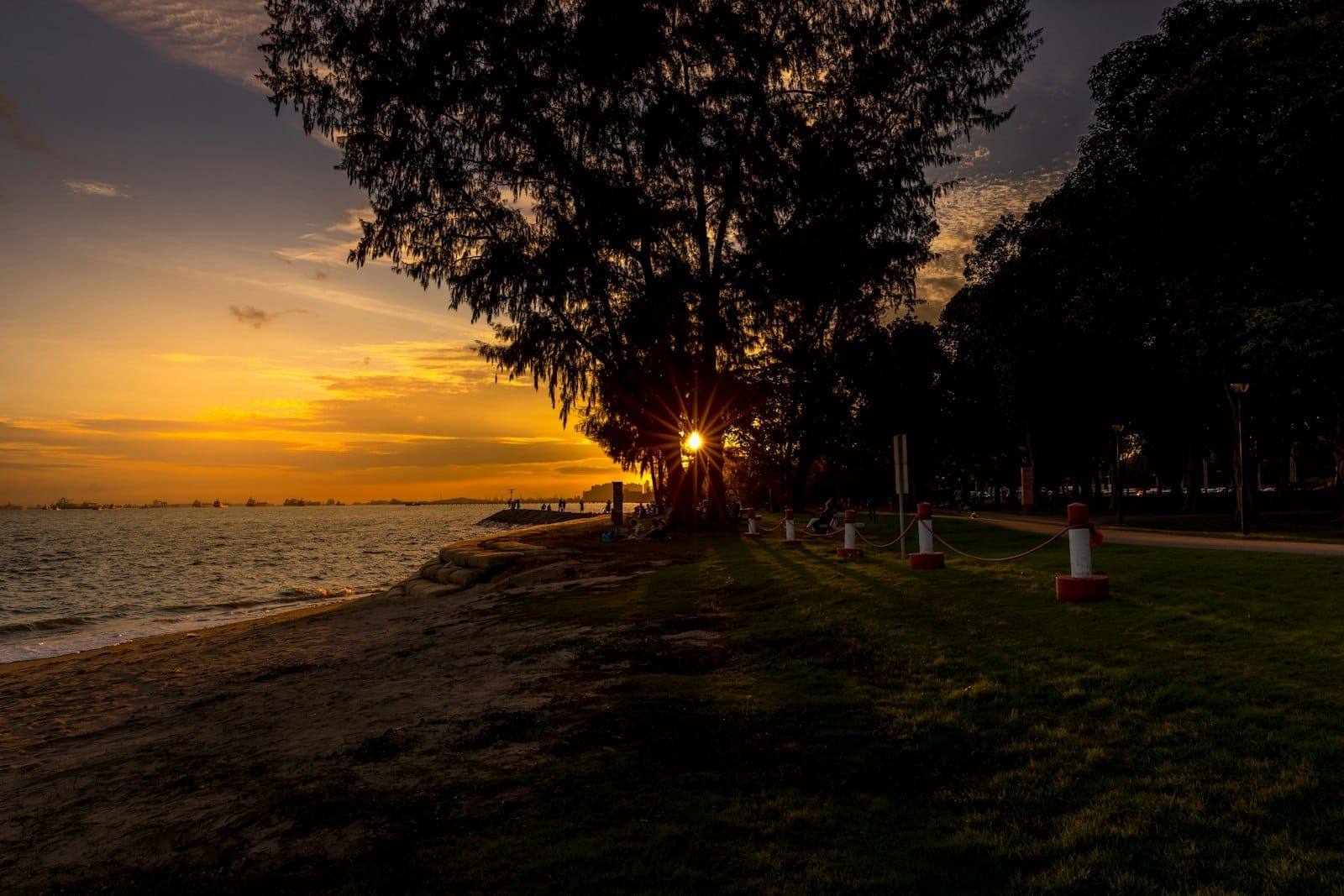
Late afternoon into evening is arguably the most atmospheric time. The sky shifts from white glare to gold and the temperature drops to something tolerable. Barbecue pits across the park come alive, especially on Friday and Saturday nights. The smell of satay and grilled seafood carries across the park road. The beach promenade fills with couples and extended families eating from takeaway boxes, and the lights of passing cargo vessels create an unexpectedly industrial backdrop over the water.
Tickets & tours
Hand-picked options from our booking partner. Prices are indicative; availability and final rates are confirmed when you complete your booking.
Adventure Cove Waterpark™ e-ticket
From 27 €Instant confirmationWild Wild Wet Waterpark Entrance Ticket
From 15 €Instant confirmationLion City bike tour in Singapore
From 55 €Instant confirmationFree cancellationLuggage Storage in Singapore
From 7 €Instant confirmationFree cancellation
The Beach and Waterfront
The beach at East Coast Park is Singapore's most accessible stretch of sand. It is not a tropical postcard beach: the water is murky with shipping traffic, swimming is technically possible in designated areas but not widely practiced by locals. The appeal is in the setting, not the sea. The soft sand, the breadth of the shoreline, and the view of the strait, lined with anchored tankers waiting to enter the port, give the park a working-port-meets-leisure-space quality that is uniquely Singaporean.
The East Coast Lagoon is a sheltered water area where kayaking and dragon boating take place. Several water sports operators run equipment rental from the lagoon area, and it is calmer and more suited to beginners than the open beach. Check with individual operators for current rental rates and availability, as these change seasonally.
⚠️ What to skip
Swimming in the open sea at East Coast Park is not recommended. The strait carries heavy shipping traffic and water quality is inconsistent. Use the designated swimming lagoon areas if you want to get in the water.
Cycling, Skating, and Active Recreation
The park connector path running the full length of East Coast Park is one of the smoothest and best-maintained cycling routes in Singapore. It links into the broader Park Connector Network, meaning a cyclist can ride from here all the way into the city or east towards Changi without touching a main road. Bicycle rental kiosks operate at several points in the park, mainly between Area C and Area F. Tandems, children's bikes, and baby seats are generally available alongside standard adult cycles. Expect to pay roughly S$8–15 per hour depending on the bicycle type and rental operator.
The Xtreme Skatepark in Area F is one of the largest skateparks in Southeast Asia. It draws a genuine skate community on evenings and weekends, and even if you are not skating, watching the level of riding here is worth a detour. Note that wheelchair access is limited in parts of this area. The park also has a dedicated inline skating circuit near Area C.
For families, the multigenerational garden includes playground equipment designed for different ages and abilities, making it one of the more inclusive outdoor spaces in Singapore. If you are planning a day with children, consider pairing East Coast Park with a visit to Singapore Zoo or the Gardens by the Bay for a fuller family day out.
Food at East Coast Park: The Real Reason Many Locals Come
East Coast Park has a genuine food culture attached to it, not as an afterthought but as a core part of its identity. The East Coast Seafood Centre, a cluster of open-air seafood restaurants near Area C/D, is where Singaporeans have been eating chilli crab and black pepper crab for decades. These are sit-down restaurants, not hawker stalls, and prices reflect that. A shared seafood dinner for two with crab, a vegetable dish, and drinks typically runs S$60–100 or more depending on the crab weight. Book in advance on weekends, particularly Friday and Saturday evenings.
If you want the park experience without restaurant prices, the East Coast Lagoon Food Village nearby is a proper hawker centre with laksa, satay, and barbecue seafood at significantly lower prices. For broader context on Singapore's hawker food culture, the Singapore hawker centres guide covers what to order, how to order it, and what to pay.
The barbecue pit culture here is also worth noting for self-catering visitors. Pits can be booked in advance through NParks and are enormously popular on public holidays and long weekends. Supermarkets in the nearby Marine Parade area stock marinated meats and skewers specifically marketed for ECP barbecues. This is a deeply local ritual that most tourists overlook.
Practical Navigation and Getting Around
The absence of an MRT station is the park's main practical inconvenience. The closest stations are Bedok (East-West Line) and Marine Parade (Thomson–East Coast Line), both requiring either a bus connection or a 15–20 minute walk through underpasses. Several bus routes run along Marine Parade Road and Bedok Road with pedestrian underpasses leading directly into the park — check the Singapore Land Transport Authority's journey planner for current routes and stops, as bus service details change. Grab and Gojek drop-offs at carpark entrances are generally the most convenient option for first-time visitors.
If you are driving, note that carparks at the popular sections (Area C through F) fill by 9am on weekend mornings. Arriving after 10am on a Saturday or Sunday often means parking well outside your intended area and walking or cycling in. The park road itself is one-way in sections, so navigation by car takes some planning.
For visitors unfamiliar with Singapore's transit network, the getting around Singapore guide explains the MRT, bus, and ride-hailing systems clearly, including how to use the EZ-Link card for public transport.
💡 Local tip
Photography tip: the best light for beach shots is the 30 minutes after sunrise and the hour before sunset. At these times, the container ships on the horizon catch the low light and the beach is practically empty of people. Bring a wide-angle lens if you want to capture the full scale of the strait.
Honest Assessment: Who Should Come, Who Should Skip
East Coast Park is an extremely good park for what it is: a well-maintained, free, large-scale outdoor recreation space with genuine food culture attached. It is not a pristine tropical beach, and if that is what you are looking for, you will be disappointed. The water is not clear, the sand is imported, and the backdrop includes an industrial port. Visitors hoping for a white-sand, turquoise-water experience should head to Sentosa instead, or consider a day trip to the Southern Islands.
Travellers on short itineraries of two to three days in Singapore may find East Coast Park a lower priority than the city-centre attractions. However, if you have four or more days and want to understand how Singaporeans actually spend their leisure time, a morning here is more revealing than another museum. Combine it with the Katong and Joo Chiat neighbourhood nearby for a full half-day that takes in both outdoor space and one of Singapore's most culturally layered residential districts.
Visitors with limited mobility will find the main park connector path and beach promenade fully accessible. The wheelchair accessibility note on the NParks website flags only certain sections of the Xtreme Skatepark as restricted. Restrooms and water points are positioned throughout the park at regular intervals.
Insider Tips
- Arrive by 7am on a weekday morning for the full quiet-beach experience. By 9am, even on weekdays, the cycling path near the seafood centre gets congested.
- The barbecue pit areas are free to use on a first-come basis if not pre-booked, but they disappear fast on Friday evenings. Show up by 5pm if you want to claim one without a reservation.
- For cycling, the rental kiosks near Area C tend to have shorter queues than the kiosk nearest the car park entrances. Walk 200 metres past the main cluster to the secondary kiosks and you will often walk straight up.
- The East Coast Lagoon Food Village is noticeably cheaper than the seafood restaurants and serves some of the same dishes — the barbecue stingray and satay here are well-regarded by regulars and cost a fraction of the sit-down restaurant prices.
- On public holidays and the eve of major festivals, the park fills from late afternoon to well past midnight. The atmosphere is genuinely festive, but if you need a parking space, plan to arrive before 4pm or use public transport entirely.
Who Is East Coast Park For?
- Cyclists and inline skaters wanting a long, uninterrupted path in a car-free environment
- Families with young children who need open space, shade, and playground facilities
- Foodies interested in eating chilli crab or black pepper crab at the iconic East Coast Seafood Centre
- Early-morning joggers and walkers who want seaside air without the tourist crowds
- Travellers on extended Singapore stays who want to experience how locals actually spend their weekends
Nearby Attractions
Other things to see while in East Coast:
- Katong & Joo Chiat
Katong and Joo Chiat form Singapore's most intact Peranakan enclave, a stretch of District 15 where 1920s–1930s pastel shophouses line streets named after the community's own merchants and landlords. It is part heritage walk, part food trail, and entirely unlike the city's more polished tourist corridors.