Chinatown Street Market: What to Expect Before You Go
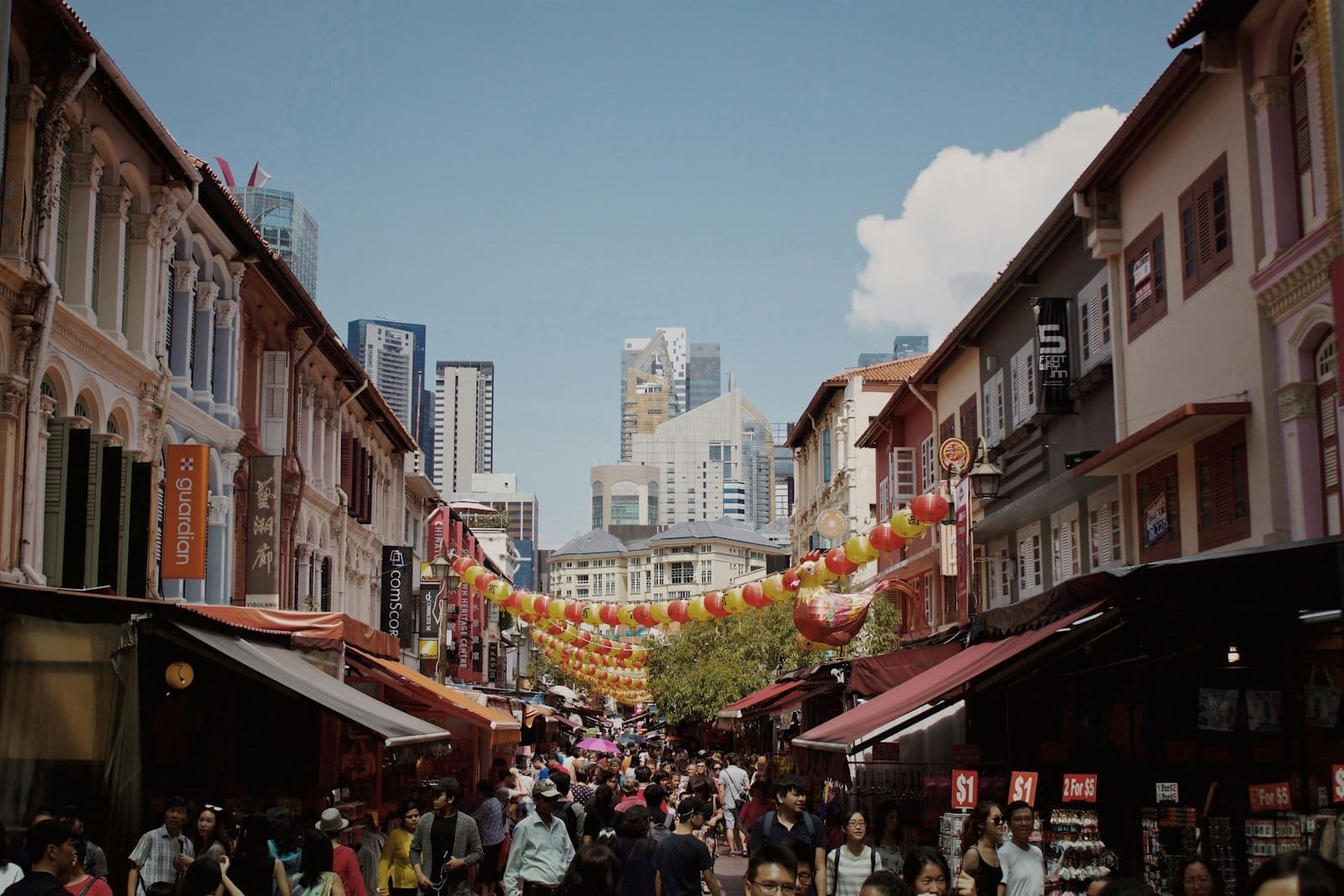
Chinatown Street Market sprawls across Pagoda, Trengganu, Sago, Temple, and Smith Streets in Singapore's historic Chinatown district. Free to enter and open daily, it offers souvenirs, snacks, and colonial streetscapes framed by red lanterns — at its best around dusk when the lights come on.
Quick Facts
- Location
- Pagoda Street, Trengganu Street, Sago Street, Temple Street, and Smith Street, Chinatown, Singapore
- Getting There
- Chinatown MRT (NE4 / DT19), 5-min walk
- Time Needed
- 1–2 hours
- Cost
- Free entry; budget S$10–30 for shopping or snacks
- Best for
- Souvenir hunters, first-time visitors, evening walkers
What Is Chinatown Street Market?
The Chinatown Street Market is an open-air street bazaar spread across several pedestrian lanes in Singapore's Chinatown district, with its heart at 29 Smith Street. It is free to enter, open daily from 9:30 AM to 10:00 PM, and sits within one of the oldest and most historically layered neighborhoods in Singapore. The market is bookended by two national monuments: the Sri Mariamman Temple to the north and the Jamae Mosque to the south, a pairing that quietly reflects Chinatown's multicultural past.
The market spans Pagoda Street, Trengganu Street, Sago Street, Temple Street, and Smith Street, each with its own slightly different character. Pagoda Street is the most photograph-heavy stretch, where red lanterns hang above rows of souvenir stalls. Sago Street, once home to death houses where elderly Chinese came to spend their final days, now sells trinkets and T-shirts, though the weight of its history lingers if you know to look for it. For deeper context on the neighborhood's layered past, the Chinatown Heritage Centre on Pagoda Street is worth a separate visit.
ℹ️ Good to know
Smith Street was officially converted into Chinatown Food Street, a covered hawker centre, on 13 November 2001. The broader Chinatown district was first allocated to Chinese immigrants in Stamford Raffles' 1822 Town Plan, making it one of the earliest planned ethnic quarters in the region.
How the Market Changes Throughout the Day
Visit at 10:00 AM and the market feels workmanlike. Vendors are arranging merchandise, a few tourists drift between stalls, and the air carries a faint scent of joss sticks drifting from the direction of Sri Mariamman Temple. The colonial shophouse facades are visible in the morning light, their pastel plaster and decorative timber shutters easier to appreciate before the foot traffic picks up.
By early afternoon, the market reaches its most crowded state. Stalls selling fridge magnets, lacquerware, silk pouches, jade-effect jewelry, and Chinese zodiac figurines line both sides of the street. The narrow lanes concentrate the heat, and the recorded music from competing stalls merges into a dense wall of noise. It is not unpleasant, but it is not the serene cultural experience some visitors expect.
Dusk is when the market earns its best moments. From around 6:30 PM, the strings of red lanterns and decorative lights switch on, and the colonial architecture takes on a warmer, more dramatic quality. The crowd thins slightly as day-trippers leave, and the remaining visitors tend to move more slowly. Photographers will find the best conditions here: the lantern glow is consistent, and the shophouse proportions frame well in a standard wide-angle shot. Most stalls begin winding down between 8:00 PM and 9:00 PM, though some remain open closer to the 10:00 PM closing time.
💡 Local tip
Arrive between 6:00 PM and 7:30 PM for the best combination of light, atmosphere, and active stalls. The lanterns are on, the worst of the midday heat has passed, and you can browse without feeling rushed by closing time.
Tickets & tours
Hand-picked options from our booking partner. Prices are indicative; availability and final rates are confirmed when you complete your booking.
Adventure Cove Waterpark™ e-ticket
From 27 €Instant confirmationWild Wild Wet Waterpark Entrance Ticket
From 15 €Instant confirmationLion City bike tour in Singapore
From 55 €Instant confirmationFree cancellationLuggage Storage in Singapore
From 7 €Instant confirmationFree cancellation
What You Can Buy (and What to Expect from Quality)
The honest answer is that most merchandise at Chinatown Street Market is mass-produced, sourced from the same wholesale suppliers you will find across Southeast Asian tourist markets. That is not a condemnation; it is useful context for setting expectations. You will find keychains, fridge magnets, miniature Merlion figurines, silk pouches, chopstick sets, printed tote bags, and dried food products such as bak kwa (barbecued pork slices) and dried mango.
Bargaining is acceptable, though not as aggressive a tradition here as in some regional markets. Vendors generally have a floor price, and politely asking for a discount on multiple items is more effective than negotiating on a single piece. Prices on items like keychains and small figurines are already low, so significant haggling rarely produces meaningful savings. Where bargaining makes more sense is on larger purchases: silk scarves, wooden carvings, or sets of decorative items.
For more considered purchases, the shophouses along the lanes house a small number of independent retailers selling higher-quality goods: traditional Chinese tea, handmade paper fans, and authentic calligraphy supplies. These are not always easy to spot among the louder souvenir stalls, but they are there. If tea is your interest, several dedicated tea houses along the surrounding streets offer tastings.
Getting There and Moving Around
The Chinatown MRT Station (NE4 / DT19, served by the North East Line and Downtown Line) is about a five-minute walk from the market entrance on Pagoda Street. Exit A brings you out near the Chinatown Complex, and from there the souvenir lanes are immediately visible.
The market streets are pedestrianized, which makes navigation straightforward. The area connects naturally to several nearby points of interest: the Buddha Tooth Relic Temple is a short walk along South Bridge Road, and the Sri Mariamman Temple is visible from the market's northern edge on Temple Street. Both are worth combining into the same visit.
If you are extending the afternoon into the evening, Lau Pa Sat is roughly 15 minutes by foot east toward the Central Business District and offers a good range of hawker food in a historic cast-iron building. For something closer, the Chinatown Complex Food Centre on New Bridge Road is one of Singapore's largest hawker centres and a better bet for local food than the tourist-facing Smith Street stalls.
💡 Local tip
Wear comfortable shoes with grip. The street surfaces can become slippery after rain, particularly on the older stone sections near Temple Street.
Historical and Cultural Context
Chinatown's origin as a planned ethnic enclave dates to 1822, when Stamford Raffles' Town Plan directed different ethnic communities to settle in designated zones. The Chinese community was assigned the area southwest of the Singapore River, and what is now the street market zone developed as one of the most densely populated parts of early colonial Singapore.
Sago Street, in particular, carried a reputation through the early to mid-20th century as the street of death houses, establishments that provided a place for elderly Chinese to live out their final days in the company of others from their dialect group. The practice ended decades ago, but the street's name still appears in Singapore's social history literature as a document of how early immigrant communities organized around shared cultural practice.
The architecture visible above the stall awnings, two and three-storey Straits Eclectic shophouses with ornate plaster facades, dates primarily from the late 19th and early 20th centuries. Many have been conserved under Singapore's Urban Redevelopment Authority guidelines. The Chinatown Heritage Centre occupies three restored shophouses on Pagoda Street and gives the clearest picture of what daily life in these buildings once looked like.
Who This Market Is and Is Not For
Chinatown Street Market works well as an orientation point for first-time visitors to Singapore who want a concentrated dose of visual atmosphere, accessible souvenir shopping, and proximity to several temples and cultural sites within easy walking distance. The free entry and flexible opening hours make it easy to fit into an itinerary without planning pressure.
Travelers who have spent time in similar markets elsewhere in Asia, such as Bangkok's Chinatown on Yaowarat Road or Kuala Lumpur's Petaling Street, may find the scale and variety here modest by comparison. Singapore's Chinatown Street Market is tidy, well-lit, and safe, but it lacks the layered street-food complexity and rough-edged energy of those counterparts. It is more polished than it is raw. If you are looking for a more local-feeling food experience, the nearby Maxwell Food Centre on Maxwell Road is a far better option than the tourist-oriented Smith Street stalls.
Visitors with limited mobility should note that while the streets are pedestrianized, the lanes can become congested at peak hours and some surface textures are uneven. There is no specific accessibility infrastructure documented for the market area itself.
Insider Tips
- The best lantern photographs are taken from the middle of Pagoda Street looking south, around 7:00 PM, when the overhead strings are fully lit and the shophouse facades still hold some residual daylight color.
- If you want to buy dried food products like bak kwa as gifts, the shops on New Bridge Road and Eu Tong Sen Street just outside the market zone often offer better quality and more transparent pricing than the street stalls.
- During major Chinese festivals, particularly Chinese New Year, the market transforms significantly with extra decorations, higher footfall, and temporary additional stalls. Prices for some goods increase during this period. Visit in the weeks before the festival rather than during the peak days if you want atmosphere without extreme crowds.
- The Chinatown Complex Food Centre, a five-minute walk away on New Bridge Road, is where locals actually eat. It houses one of the most diverse selections of hawker food in the area, including the original Hawker Chan stall, which earned a Michelin star.
- Some shophouses along Temple Street contain antique and curiosity shops that open later in the morning and are easy to miss if you walk quickly. The items range from vintage Singaporean ephemera to Southeast Asian ceramics and are worth a browse if you have time.
Who Is Chinatown Street Market For?
- First-time visitors to Singapore wanting a concentrated cultural and shopping introduction to Chinatown
- Souvenir shoppers looking for a wide selection of gifts at accessible price points
- Evening walkers and photographers drawn to the lantern-lit colonial streetscape after dark
- Families with children who can handle short walks between temples and market stalls
- Travelers pairing the market with nearby cultural sites like the Buddha Tooth Relic Temple or Sri Mariamman Temple
Nearby Attractions
Other things to see while in Chinatown:
- Buddha Tooth Relic Temple
The Buddha Tooth Relic Temple and Museum on South Bridge Road is one of Singapore's most architecturally striking religious sites. Built in 2007 in Tang Dynasty style, it houses what is believed to be the left canine tooth of the Gautama Buddha, displayed in a 3,500-kilogram gold stupa. Admission is free, and six floors of museum galleries, ceremonial halls, and a rooftop garden make it worth more than a passing glance.
- Chinatown Complex Food Centre
With over 260 stalls spread across a single floor, Chinatown Complex Food Centre is the biggest hawker centre in Singapore. Built in 1983 to rehouse the city's street vendors, it remains one of the most authentic and affordable places to eat in the country. No tourist markup, no reservations, just real food at real prices.
- Chinatown Heritage Centre
Housed in three restored pre-war shophouses on Pagoda Street, the Chinatown Heritage Centre reconstructs life in 1950s Chinatown with meticulous detail. Cramped sleeping cubicles, preserved opium dens, and the recorded voices of real migrants make this one of Singapore's most affecting indoor cultural experiences.
- Liao Fan Hawker Chan
Liao Fan Hawker Chan is the stall-turned-restaurant behind what the Michelin Guide called the world's most affordable starred meal. Located in Chinatown, it draws long queues for its glossy soya sauce chicken rice and noodles, served at prices that make fine dining comparisons almost absurd.