Buddha Tooth Relic Temple: What to Know Before You Visit
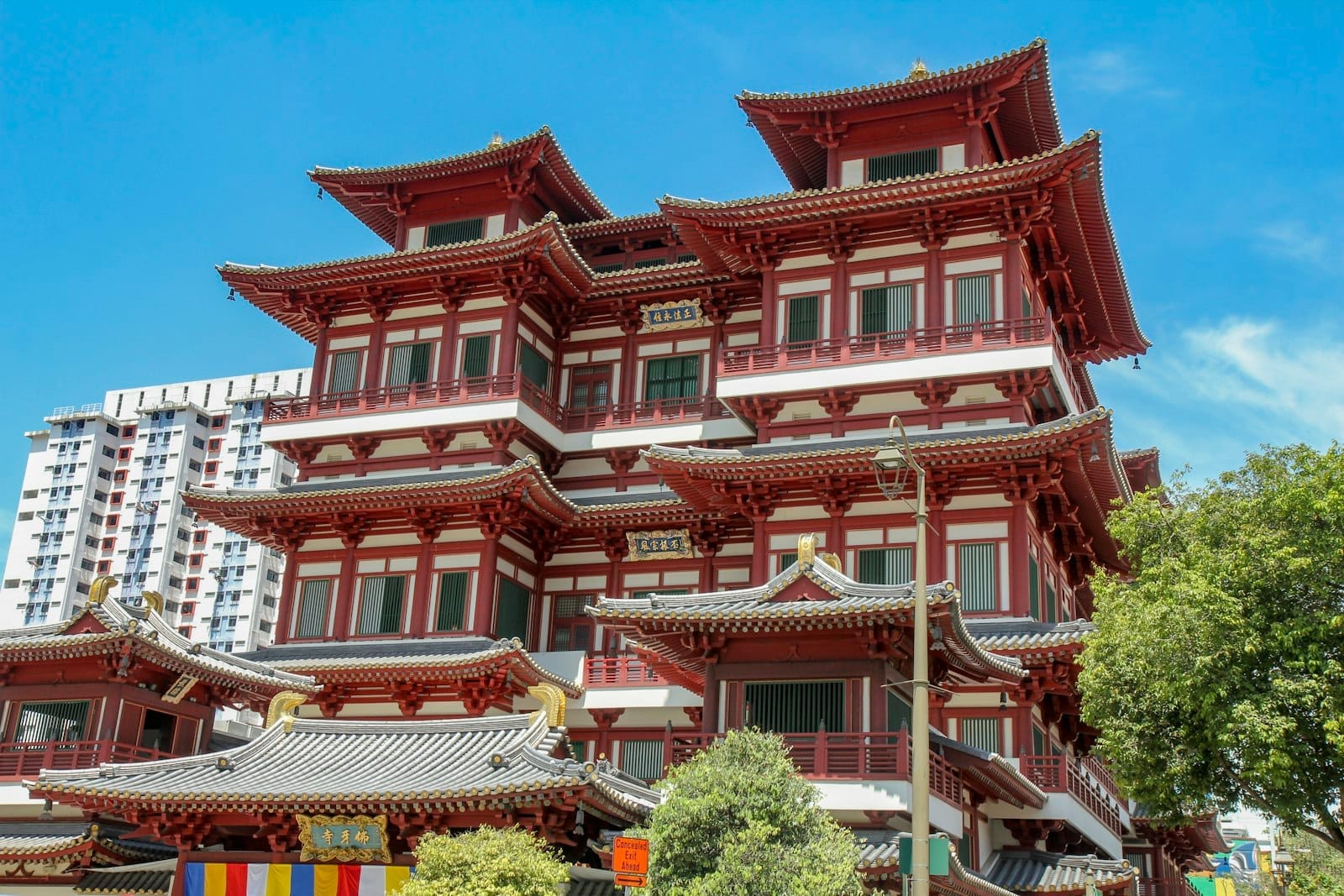
The Buddha Tooth Relic Temple and Museum on South Bridge Road is one of Singapore's most architecturally striking religious sites. Built in 2007 in Tang Dynasty style, it houses what is believed to be the left canine tooth of the Gautama Buddha, displayed in a 3,500-kilogram gold stupa. Admission is free, and six floors of museum galleries, ceremonial halls, and a rooftop garden make it worth more than a passing glance.
Quick Facts
- Location
- 288 South Bridge Road, Chinatown, Singapore 058840
- Getting There
- Chinatown MRT (NE4/DT19), exit A or D; also accessible by bus along South Bridge Road
- Time Needed
- 1 to 2 hours for a thorough visit; 30 minutes if just viewing the main hall
- Cost
- Free entry
- Best for
- Religious and architectural interest, photography, cultural immersion, family visits
- Official website
- www.btrts.org.sg
What the Buddha Tooth Relic Temple Actually Is
The Buddha Tooth Relic Temple and Museum, known in Mandarin as 佛牙寺 (Fó Yá Sì), sits on the southern end of South Bridge Road at the heart of Chinatown. Completed in 2007, it was built to house a relic believed to be the left canine tooth of Gautama Buddha, discovered in 1980 at a collapsed pagoda stupa in Myanmar. The relic is kept in the Sacred Light Hall on the fourth floor, encased inside a 3,500-kilogram stupa that incorporates approximately 320 kilograms of gold, 234 kilograms of which were donated by devotees.
The building is constructed in Tang Dynasty architectural style, with the design drawing from Buddhist Mandala cosmology. The main hall rises high and holds a commanding statue of Maitreya, the future Buddha, surrounded by the Four Heavenly Kings. Every surface rewards close attention: carved wooden details, lacquered columns, incense holders worn smooth by decades of use, and gilt accents that shift in color depending on how much natural light enters the hall. This is not a reconstruction of something ancient. It is a deliberately contemporary building designed to read as timeless.
ℹ️ Good to know
Opening hours are 7:00 AM to 5:00 PM daily. Arrive before 4:30 PM if you want to explore upper floors at a relaxed pace.
The Experience, Floor by Floor
Ground level sets the tone immediately. The courtyard outside is often occupied by older residents performing morning tai chi or sitting in quiet conversation, while tourists photograph the facade. Step through the main entrance and the temperature drops noticeably. The air carries a persistent layer of sandalwood incense, which intensifies on days when more worshippers attend. Shoes must be removed before entering the main worship hall, so there is a shoe rack area at the entrance.
The second and third floors hold the museum galleries, which cover Buddhist art, ritual objects, and the history of Buddhism across Asia. The collection includes Thangka paintings, religious manuscripts, and ceremonial implements from various Buddhist traditions. The labeling is clear and detailed in English, making this section genuinely informative rather than decorative. Many visitors skip these floors entirely, which means they are often calm even when the ground level is crowded.
The fourth floor is where the central relic is kept. Access to view the relic from the public gallery is available during set hours; only ordained monks may enter the inner chamber. The stupa itself is arresting in scale. The amount of gold used is not a rumor or exaggeration: the stupa visually dominates the room, and small plaques around the chamber record the names of donors who contributed gold. Photography is typically not permitted inside this room.
The rooftop garden on the sixth floor is frequently overlooked and rewards those who make the climb. It contains a 10,000 Buddha Pavilion with a large prayer wheel and individual Buddha figures arranged in circular rows. The garden is quiet, open to the sky, and offers a partial view over the surrounding Chinatown shophouses. Early mornings, before tour groups arrive, this space has an unusual stillness for a central Singapore location.
Tickets & tours
Hand-picked options from our booking partner. Prices are indicative; availability and final rates are confirmed when you complete your booking.
Adventure Cove Waterpark™ e-ticket
From 27 €Instant confirmationWild Wild Wet Waterpark Entrance Ticket
From 15 €Instant confirmationLion City bike tour in Singapore
From 55 €Instant confirmationFree cancellationLuggage Storage in Singapore
From 7 €Instant confirmationFree cancellation
How the Temple Changes Through the Day
The character of a visit shifts significantly depending on when you arrive. From around 9:00 to 10:30, the temple is predominantly used by local Buddhist devotees. Incense sticks are lit at the courtyard altars, monks may be conducting morning prayers in the main hall, and the ambient noise is mostly chanting and the soft percussion of prayer bells. This is the most atmospheric time to visit if you want to observe the temple functioning as a place of worship rather than as a tourist attraction.
By late morning and through the early afternoon, tour groups begin to arrive in earnest, particularly on weekends. The main hall becomes noticeably noisier and more congested between roughly 11:00 and 14:00. If you are coming specifically for photography or quiet contemplation, avoid this window. Weekday mornings are the most reliable option for avoiding crowds.
Late afternoon, from around 15:30 onward, sees a gradual thinning of visitors. The light entering the hall from the south-facing entrance changes angle, and the gold surfaces in the main hall catch it differently than in the morning. The temple closes at 17:00, so this window is short but often pleasant.
💡 Local tip
Weekday mornings between 9:00 and 10:30 offer the clearest view of the temple as a working religious site. Weekends before noon can be heavily crowded, particularly on public holidays or during Buddhist festivals like Vesak Day.
Historical and Cultural Context
Chinatown in Singapore developed from the early 19th century as successive waves of Chinese migrants, primarily Hokkien, Teochew, and Cantonese, settled around the area designated by Stamford Raffles. The southern end of South Bridge Road, where the temple now stands, was historically dense with clan associations, opera theaters, and small temples. The site the Buddha Tooth Relic Temple occupies was previously home to a building called the Majestic Theatre, which operated from the 1920s before being demolished.
The founding abbot, Venerable Shi Fa Zhao, led the project to build a temple specifically designed to house the relic and to serve Singapore's Buddhist community. Ground was broken in 2005, and the temple opened on 30 May 2007. It is operated as a charitable institution and receives no government funding for its operations. It sits within a broader Chinatown precinct that includes the Chinatown Heritage Centre and the Sri Mariamman Temple, Singapore's oldest Hindu temple, just two blocks north on South Bridge Road.
The Tang Dynasty architectural style is not arbitrary. Tang Dynasty China (618 to 907 CE) is widely regarded as a golden age for Buddhism in China, and the stylistic reference positions the temple within a specific lineage of Chinese Buddhist expression rather than the Theravada traditions dominant in Southeast Asia. This distinction is visible in the iconography: the main hall statues, the decorative motifs, and the liturgical focus all reflect Mahayana Buddhism.
Practical Guidance for Visitors
Dress modestly. Shoulders and knees should be covered. The temple keeps sarongs and shawls available at the entrance for visitors wearing shorts or sleeveless tops, at no charge. This is not a strict enforcement situation, but the provision of coverings is a clear expectation. Flip-flops are fine since shoes are not removed for the main hall, though respectful footwear is appropriate.
Getting here is straightforward. Chinatown MRT station (NE4/DT19) is a short walk north. From the station, follow South Bridge Road south for roughly five minutes. The temple's red and gold facade is immediately visible. Buses along South Bridge Road stop nearby. Taxis and ride-hailing services can drop directly outside. There is no dedicated parking.
Photography is welcomed in most parts of the temple, including the main hall and the rooftop garden. Wide-angle lenses benefit from the height of the main hall. The carved wooden ceiling panels and the stupa-style altar are particularly photogenic. For the surrounding streetscape, the Chinatown Street Market runs along nearby Pagoda Street and is worth combining into the same visit. The market is at its most active in the morning and early evening.
The temple is wheelchair accessible for the lower floors. Upper floors and the rooftop garden require using stairs or an elevator; confirm elevator availability in advance if mobility is a concern. No fee is charged for any part of the temple or its museum galleries.
⚠️ What to skip
The fourth-floor Relic Tower room is not always open to visitors and may be closed during private ceremonies. Do not plan your visit solely around accessing this room.
Honest Assessment: Is It Worth Your Time?
For visitors with a genuine interest in Buddhist architecture, religious practice, or Chinese heritage in Singapore, this temple justifies an hour and a half without hesitation. The building is architecturally coherent and carefully maintained. The museum galleries provide real depth if you engage with them. The rooftop garden is a functional surprise in an urban context.
Travelers looking only for a quick photo stop may find the exterior more impressive than the interior warrants for the time spent. If that describes your visit, you can photograph the facade and courtyard in ten minutes and continue along South Bridge Road toward the broader Chinatown area. A more complete half-day itinerary would combine the temple with the Maxwell Food Centre two blocks east for lunch, and the nearby shophouses along Keong Saik Road.
Visitors who are uncomfortable in active religious spaces, or who prefer outdoor and green spaces to interiors, may find the experience less rewarding. The temple operates as a functioning place of worship throughout visiting hours, and on ceremonially significant days, large areas of the ground floor may be occupied by ongoing rituals.
Insider Tips
- Visit during Vesak Day (the annual Buddhist holiday marking the birth, enlightenment, and death of the Buddha) if you want to see the temple at maximum ceremonial intensity. The surrounding streets fill with processions and the rooftop garden is opened for extended hours. Expect very large crowds.
- The vegetarian restaurant inside the temple, Dharma Kitchen, serves inexpensive meals and is popular with local Buddhist devotees. It is an underused option for a quiet, affordable lunch in the Chinatown area. Check current operating hours before planning around it.
- The prayer wheel on the rooftop is designed to be turned clockwise. Spinning it once while walking in a clockwise direction around the pavilion is a common practice among devotees and is open to all visitors.
- If the Relic Tower on the fourth floor is closed when you arrive, ask at the information desk on the ground floor about the daily schedule. Access windows vary and staff can confirm when it may next be open.
- Early morning on a weekday, the sound profile of the main hall is primarily chanting and incense smoke. By 11am on a weekend, it becomes tour guide commentary and camera shutters. These are functionally different experiences, and your preference should determine your timing.
Who Is Buddha Tooth Relic Temple For?
- Travelers interested in Chinese Buddhist heritage and Mahayana temple architecture
- First-time visitors to Singapore wanting cultural depth within Chinatown
- Families with older children who can engage with the museum galleries
- Architecture enthusiasts drawn to Tang Dynasty design and its modern interpretation
- Photographers working with interior sacred spaces and gold-lit ceremonial halls
Nearby Attractions
Other things to see while in Chinatown:
- Chinatown Complex Food Centre
With over 260 stalls spread across a single floor, Chinatown Complex Food Centre is the biggest hawker centre in Singapore. Built in 1983 to rehouse the city's street vendors, it remains one of the most authentic and affordable places to eat in the country. No tourist markup, no reservations, just real food at real prices.
- Chinatown Heritage Centre
Housed in three restored pre-war shophouses on Pagoda Street, the Chinatown Heritage Centre reconstructs life in 1950s Chinatown with meticulous detail. Cramped sleeping cubicles, preserved opium dens, and the recorded voices of real migrants make this one of Singapore's most affecting indoor cultural experiences.
- Chinatown Street Market
Chinatown Street Market sprawls across Pagoda, Trengganu, Sago, Temple, and Smith Streets in Singapore's historic Chinatown district. Free to enter and open daily, it offers souvenirs, snacks, and colonial streetscapes framed by red lanterns — at its best around dusk when the lights come on.
- Liao Fan Hawker Chan
Liao Fan Hawker Chan is the stall-turned-restaurant behind what the Michelin Guide called the world's most affordable starred meal. Located in Chinatown, it draws long queues for its glossy soya sauce chicken rice and noodles, served at prices that make fine dining comparisons almost absurd.