Maxwell Food Centre: The Hawker Centre That Earns Its Reputation
One of Singapore's most celebrated hawker centres, Maxwell Food Centre has been feeding the city since 1928. With over 100 stalls serving everything from Hainanese chicken rice to traditional kaya toast, it sits at the crossroads of Chinatown history and everyday Singapore life.
Quick Facts
- Location
- 1 Kadayanallur Street, Singapore 069184 (junction of Maxwell Road and South Bridge Road, Chinatown)
- Getting There
- Tanjong Pagar MRT (EW15) — approximately 5-minute walk
- Time Needed
- 45 minutes to 1.5 hours depending on queues and how much you order
- Cost
- Free entry; individual dishes typically S$3–S$8 per plate
- Best for
- First-time visitors wanting authentic Singapore food, budget-conscious travellers, food lovers
What Maxwell Food Centre Actually Is
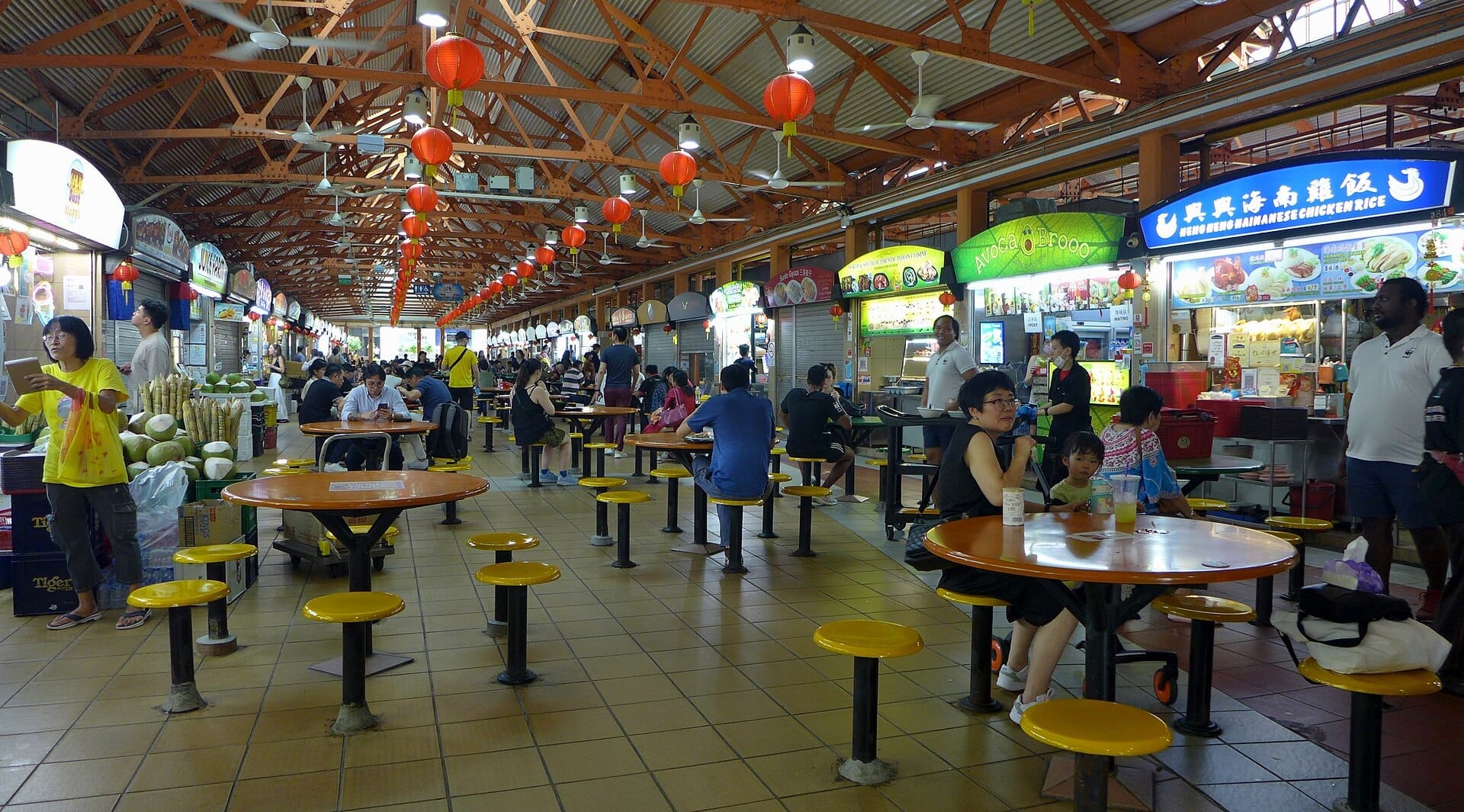
Maxwell Food Centre is a government-managed hawker centre housing 103 individual food stalls under one roof, operating daily from 8:00 AM to 2:00 AM. It sits at the corner of Maxwell Road and South Bridge Road in the Tanjong Pagar area, technically just outside the historic core of Chinatown but firmly within its cultural orbit. The building itself is a squat, colonnaded colonial-era structure that has been renovated but retains its original footprint and communal character.
Unlike a food court in a shopping mall, this is a true hawker centre: open-air sections, ceiling fans and industrial ventilators doing the heavy lifting against the equatorial heat, plastic stools at shared laminate tables, and the kind of low-margin, high-skill cooking that Singapore has turned into a legitimate culinary tradition. Entry is free. You pay per dish, per stall, and carry your own tray.
💡 Local tip
Arrive before 11:30 AM on weekdays to beat the lunch rush. By noon, queues at the most popular stalls can stretch 20 to 30 people deep, and seating becomes genuinely competitive.
A Brief History: From Market to Institution
Maxwell Food Centre opened on 17 November 1928 as Maxwell Market, named after the road that flanks it — itself named after Sir William Edward Maxwell, a British colonial administrator. For its first several decades it functioned as a wet market and general market space, typical of Singapore's pre-independence commercial infrastructure.
After 1987 renovation it was rebranded as Maxwell Road Food Centre, consolidating its identity as a food destination rather than a general market. A substantial upgrade in 2001 gave the building its current form: cleaner, more structured, with over 100 stalls that visitors find today. The renaming to Maxwell Food Centre followed that upgrade. Nearly a century of continuous operation means some families have been running stalls here across three generations.
Tickets & tours
Hand-picked options from our booking partner. Prices are indicative; availability and final rates are confirmed when you complete your booking.
Small-group Singapore local food tour
From 132 €Instant confirmationFree cancellationAdventure Cove Waterpark™ e-ticket
From 27 €Instant confirmationWild Wild Wet Waterpark Entrance Ticket
From 15 €Instant confirmationLion City bike tour in Singapore
From 55 €Instant confirmationFree cancellation
What to Eat: The Stalls Worth Knowing
The stall that draws the longest international attention is Tian Tian Hainanese Chicken Rice (Stall 10 and 11), which received a mention from the late Anthony Bourdain and has since become a pilgrimage stop for food-focused travellers. The chicken is poached to silky precision, served over rice cooked in chicken fat and broth, with a ginger-scallion sauce and chilli that carries real heat. Expect a queue of 15 to 45 minutes depending on the hour. It closes when it sells out, usually by early afternoon.
Beyond the famous stall, Maxwell rewards wandering. Look for popiah (fresh spring rolls with turnip, egg, and prawn), oyster omelette (chai tow kway), Teochew porridge stalls where you compose your own meal from surrounding small dishes, traditional kaya toast with soft-boiled eggs and strong kopi in the morning, and various noodle preparations including laksa and wonton mee. The diversity is genuine: Maxwell serves a cross-section of Chinese dialect cuisine (Hokkien, Teochew, Cantonese, Hainanese) alongside Malay and Indian options.
ℹ️ Good to know
Most stalls are cash-preferred, though many now accept PayNow QR payments. Bring small Singapore dollar notes to avoid issues. ATMs are nearby on South Bridge Road.
How the Atmosphere Changes Through the Day
Early morning, roughly 8:00 AM to 10:00 AM, Maxwell belongs to the neighbourhood. The clientele is almost entirely local: older residents reading Chinese-language newspapers over kopi, office workers from the nearby Central Business District grabbing breakfast before the MRT fills up, and the occasional construction crew fuelling up for the day. The air smells of charcoal-roasted coffee beans and the faint sweetness of pandan from kaya toast preparation. It is the quietest and most authentic window into how the centre functions day-to-day.
The lunch hour, 11:30 AM to 1:30 PM on weekdays, is the most intense. CBD office workers descend in volume, queues form at every recognisable stall, and the noise level climbs considerably as the ventilation fans struggle against a full house. Seating requires strategy: position yourself near a table showing signs of finishing, make eye contact, and move decisively. On weekends, the lunch crowd shifts later and includes more tourists and families.
Late afternoon, between 3:00 PM and 5:30 PM, is the centre's quietest period. Many breakfast and lunch stalls close or wind down, but a second wave of dinner-oriented vendors begins prep. This is a good time to explore without pressure, observe the mechanics of the kitchen spaces, and get a table without competition. Evening hours bring a different crowd: families, couples, and groups sharing multiple dishes across a table rather than the solitary quick-lunch format of midday.
Getting There and Navigating the Space
The most straightforward approach is via Tanjong Pagar MRT Station (East-West Line, EW15). Exit at the station and walk approximately five minutes north along Maxwell Road. The centre is immediately visible on the left as you approach the South Bridge Road intersection. Alternatively, it sits within comfortable walking distance of the Chinatown Street Market and the Buddha Tooth Relic Temple, making it a logical meal stop during a Chinatown walking day.
Inside, the layout is a single large hall with stalls arranged around the perimeter and in interior rows, all facing a central communal seating area. There is no map at the entrance, but the stall numbers are displayed above each counter. Navigation is straightforward: walk the perimeter once to survey what is available before committing to a queue. Tables are shared with strangers, which is standard practice. Placing a packet of tissues on a table seat is the local signal for 'taken' — a custom known as chope.
The centre is ground-level and largely flat, making wheelchair access manageable, though the close-set table configurations can be tight during peak hours. No lifts are required. Toilets are available within the building.
Maxwell in Context: What It Represents and Who It Is For
Singapore's hawker culture was inscribed on UNESCO's Representative List of the Intangible Cultural Heritage of Humanity in 2020, making Maxwell Food Centre part of a recognised living tradition rather than a tourist novelty. The government body NEA (National Environment Agency) manages the centre and licenses stalls, which means food safety standards are enforced, prices are generally kept accessible, and the model is deliberately non-commercial in the food court sense. For context on how Maxwell fits into the broader food landscape, the Singapore hawker centres guide covers the full range of options across the island.
Maxwell is genuinely well-regarded and genuinely crowded with tourists at peak hours, particularly around the chicken rice stall. This is not a criticism: the food quality is real, and the crowds reflect legitimate reputation rather than pure marketing. But travellers expecting a quiet, undiscovered local experience should calibrate expectations accordingly. The centre is known. The question is whether you visit at the right time and with the right approach.
For those who want to compare or who are building a food-focused itinerary, Maxwell pairs naturally with a visit to Chinatown Complex Food Centre a short walk away, which is larger, less internationally known, and offers a slightly more local atmosphere during the same hours. Neither is objectively better; they serve different needs and slightly different stall compositions.
⚠️ What to skip
Tian Tian chicken rice typically sells out by early-to-mid afternoon and closes when stock is gone. If this is your primary goal, arrive before 11:30 AM on weekdays or accept that it may not be available during weekend afternoon visits.
Photography and Practical Notes
Maxwell photographs well in the early morning when the light enters at a low angle through the open sides of the building, catching steam rising from soup pots and the warm-toned glow of stall signage. A standard smartphone camera handles the conditions adequately; the interior is well-lit by fluorescent fixtures, though colour temperature shifts noticeably from the natural light at the edges. Photographing food at a stall is generally fine and expected at this point, but photograph the stallholders themselves only with a nod of acknowledgement first.
Maxwell sits at a natural junction for a half-day Chinatown itinerary. Before or after eating, the Sri Mariamman Temple is a six-minute walk north, and the Chinatown Heritage Centre is similarly close. Both are low-cost and contextualise what you are eating and where you are eating it.
Insider Tips
- The tissue-chope system is real: a packet of tissues on a seat means it is reserved. Keep a packet in your bag or arrive during off-peak hours when tables are plentiful and you can choose without stress.
- Many stalls keep limited hours within the 8 AM to 2 AM window. Breakfast stalls often close by noon; some dinner stalls do not open until 5 PM. If you have a specific stall in mind, check its individual hours separately from the centre's overall opening times.
- Order your drinks from one of the dedicated drink stalls rather than from the food stalls. A glass of barley water, fresh sugar cane juice, or traditional kopi (local coffee) from a specialist drink vendor is markedly better than an afterthought beverage added to a food order.
- Walk the entire centre once before queuing for anything. The perimeter and interior rows take about four minutes to walk fully, and you will frequently find shorter queues at equally good stalls nearby the most famous ones.
- Weekday mornings between 9:00 AM and 11:00 AM represent the sweet spot: enough stalls open to give you real choice, minimal tourist presence, and easy seating. This is when the centre most resembles what it has always been.
Who Is Maxwell Food Centre For?
- First-time visitors to Singapore who want a genuine introduction to hawker culture in a single sitting
- Budget travellers: a full, satisfying meal with drinks costs well under S$15
- Food-focused travellers building a systematic tour of Singapore's hawker scene
- Families with children, given the relaxed atmosphere, wide variety of mild dishes, and no dress code or booking requirements
- Those combining a Chinatown walking itinerary with a practical meal stop between cultural sites
Nearby Attractions
Other things to see while in Chinatown:
- Buddha Tooth Relic Temple
The Buddha Tooth Relic Temple and Museum on South Bridge Road is one of Singapore's most architecturally striking religious sites. Built in 2007 in Tang Dynasty style, it houses what is believed to be the left canine tooth of the Gautama Buddha, displayed in a 3,500-kilogram gold stupa. Admission is free, and six floors of museum galleries, ceremonial halls, and a rooftop garden make it worth more than a passing glance.
- Chinatown Complex Food Centre
With over 260 stalls spread across a single floor, Chinatown Complex Food Centre is the biggest hawker centre in Singapore. Built in 1983 to rehouse the city's street vendors, it remains one of the most authentic and affordable places to eat in the country. No tourist markup, no reservations, just real food at real prices.
- Chinatown Heritage Centre
Housed in three restored pre-war shophouses on Pagoda Street, the Chinatown Heritage Centre reconstructs life in 1950s Chinatown with meticulous detail. Cramped sleeping cubicles, preserved opium dens, and the recorded voices of real migrants make this one of Singapore's most affecting indoor cultural experiences.
- Chinatown Street Market
Chinatown Street Market sprawls across Pagoda, Trengganu, Sago, Temple, and Smith Streets in Singapore's historic Chinatown district. Free to enter and open daily, it offers souvenirs, snacks, and colonial streetscapes framed by red lanterns — at its best around dusk when the lights come on.