Chinatown Complex Food Centre: Singapore's Largest Hawker Centre
With over 260 stalls spread across a single floor, Chinatown Complex Food Centre is the biggest hawker centre in Singapore. Built in 1983 to rehouse the city's street vendors, it remains one of the most authentic and affordable places to eat in the country. No tourist markup, no reservations, just real food at real prices.
Quick Facts
- Location
- 335 Smith Street, Chinatown, Singapore 050335
- Getting There
- Chinatown MRT (NE4/DT19), under 5-min walk
- Time Needed
- 45 minutes to 1.5 hours
- Cost
- Free entry; dishes from S$3–S$8 per plate
- Best for
- Solo diners, food lovers, budget travellers, families
What Is Chinatown Complex Food Centre?
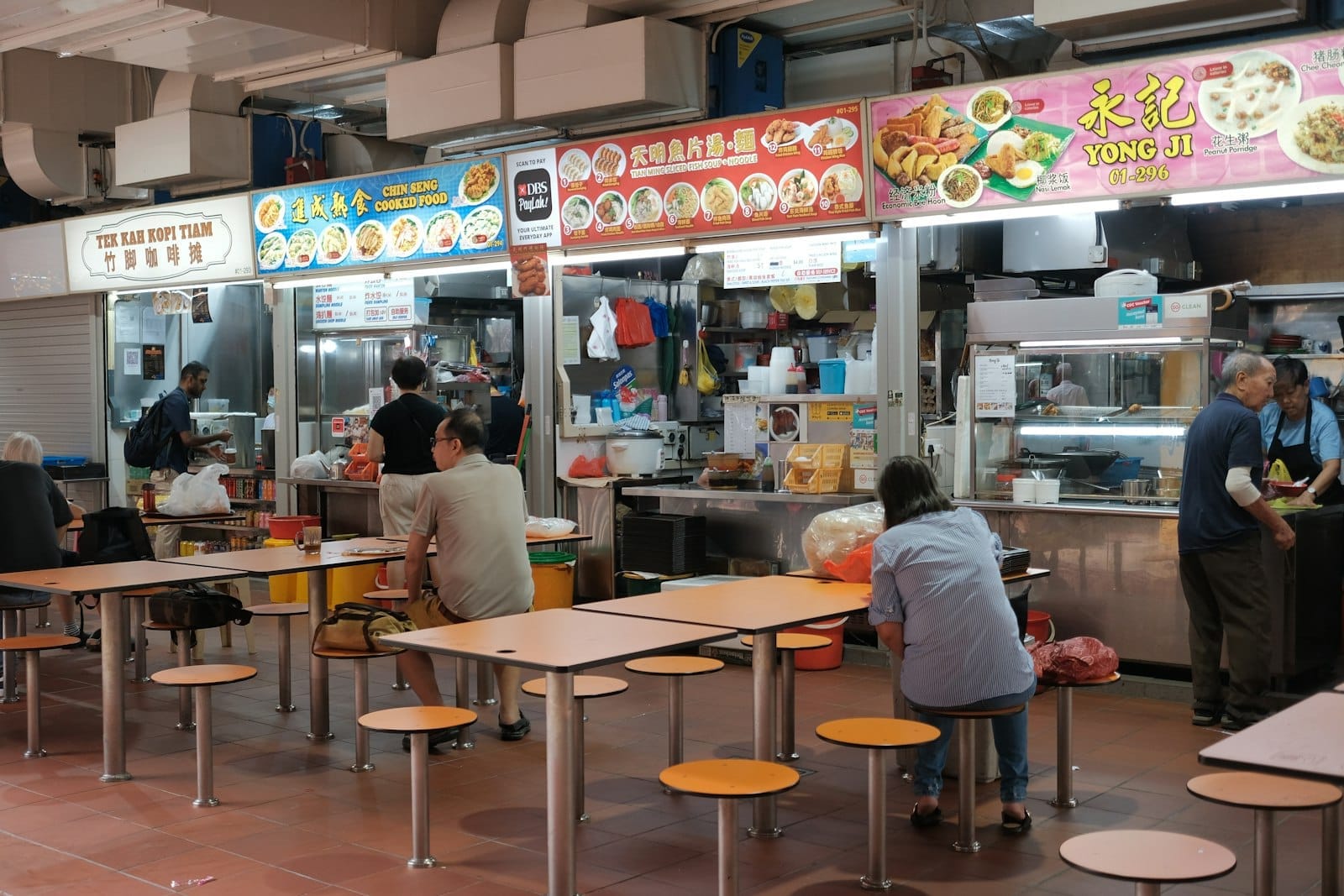
Chinatown Complex Food Centre, known in Chinese as 牛车水大厦熟食中心, occupies the ground floor of a multi-storey complex on Smith Street in the heart of Chinatown. With more than 260 individual stalls under one roof, it holds the distinction of being Singapore's largest hawker centre. The layout is dense and utilitarian: rows of stalls face each other across narrow aisles, with communal tables packed into every available space. There is no decor to speak of, no background music, and no air conditioning. What the place offers instead is food that ranges from competent to genuinely exceptional, at prices that have not kept pace with the rest of the city's inflation.
This is not a curated food hall or a renovated heritage market. It is a working hawker centre of the kind that Singapore's national food culture was built on. Understanding that context makes the experience considerably richer. For background on why hawker centres matter so much to Singaporean identity, the Singapore hawker centres guide covers the history and etiquette in depth.
A Brief History: From Street to Stall
The centre opened on 1 October 1983 as part of Singapore's systematic effort to relocate itinerant food hawkers off the streets and into managed, hygienic facilities. Through the 1960s and 1970s, thousands of unlicensed vendors cooked and sold food from pushcarts and roadside setups across the city. The government's hawker resettlement programme, which began in earnest in the 1970s, moved these vendors into purpose-built centres with running water, proper waste disposal, and individual licenced stalls. Chinatown Complex was one of the flagship projects of that programme.
The result is that many of the stalls here represent second- or third-generation operations. A wonton noodle stall that started on Chinatown's streets in the 1950s may now be run by the original hawker's grandchildren. This continuity is part of what gives the food here a different quality from newer food courts. Recipes have not been standardised for volume or adjusted for a tourist audience. They have been refined incrementally over decades of daily service.
Tickets & tours
Hand-picked options from our booking partner. Prices are indicative; availability and final rates are confirmed when you complete your booking.
Small-group Singapore local food tour
From 132 €Instant confirmationFree cancellationAdventure Cove Waterpark™ e-ticket
From 27 €Instant confirmationWild Wild Wet Waterpark Entrance Ticket
From 15 €Instant confirmationLion City bike tour in Singapore
From 55 €Instant confirmationFree cancellation
Navigating the Centre: Layout and What to Expect
💡 Local tip
Arrive before 12:00 on weekdays if you want to eat without queueing. By 12:30, popular stalls can have lines of 20 or more people. On weekends, peak crowds start slightly later, around 12:00–13:00.
The food centre occupies a large rectangular floor plan. Stalls are numbered and loosely grouped by cuisine type, though the groupings are not always intuitive. Chinese dishes dominate: roasted meats, wonton noodles, char kway teow, congee, claypot rice, and a range of regional Chinese specialities. There are also Malay, Indian, and mixed-heritage Peranakan stalls, a section dedicated to drinks and desserts, and a cluster of vegetarian options near the centre's far end.
The process works the same way at almost every stall. Find a table first, leaving a tissue packet or an umbrella on a chair to mark it as taken, then walk the aisles to choose what you want. Order and pay at the stall counter, collect your food when it is ready (or when the hawker calls out), and bring it back to your table. There are no servers. Trays are sometimes available. Used crockery goes to the designated return stations at the ends of the seating rows. Cleanup staff circulate regularly.
The floor is often wet near the drink stalls and the kitchen areas. Closed-toe shoes are more comfortable than sandals. Bring cash: while some stalls have adopted PayNow or NETS QR codes, a significant number remain cash-only, and there is no ATM inside the complex itself. The nearest ATMs are along New Bridge Road, a short walk away.
What to Eat: Stall Highlights
Chinatown Complex is home to Hawker Chan, the stall run by Chef Chan Hon Meng that became the world's first hawker stall to receive a Michelin star, in 2016. The stall serves soy sauce chicken rice and noodles at prices that still start under S$5. The queue is real and can stretch to 45 minutes or more during peak hours, but the chicken, lacquered a deep amber and served over jasmine rice with a light soy dressing, is genuinely worth the wait.
That said, the centre's food quality is not concentrated at one stall. The roasted meats stalls scattered across the centre produce creditable char siu and crispy-skinned roast pork. The lor mee stalls, serving thick yellow noodles in a starchy, vinegared braised gravy, are among the best in the city. Dessert options include tau huay (silken tofu pudding), cheng tng (a clear herbal sweet soup), and ice kachang. For a broader orientation to Singapore's food culture before your visit, the Singapore food guide explains the key dishes and what to look for.
Budget around S$8–S$12 for a full meal with a drink, which is roughly half what you would pay at a casual restaurant nearby.
How the Atmosphere Changes Through the Day
Morning visits, between 07:00 and 09:30, are quiet in a specific, productive way. A fraction of the stalls are open, mainly the congee and porridge counters, the toast and kaya stalls, and the coffee and tea vendors. Regulars from the surrounding HDB flats come down for breakfast before work. Seating is easy to find. The smell at this hour is dominated by charcoal-roasted bread and freshly brewed kopi, the local blend of dark-roasted coffee with condensed milk.
Lunch service from around 11:00 is when the centre operates at full capacity. The noise level rises sharply: the clatter of woks, the hiss of steam, and conversation in Cantonese, Hokkien, Mandarin, and English overlap continuously. The air becomes heavy with the combined smoke and steam from dozens of simultaneous cooking operations. This is when the centre feels most alive, and also when it is hardest to find a seat.
By mid-afternoon, around 14:30 to 17:00, the crowds thin noticeably. Many stalls sell out of their signature dishes before 14:00, particularly on weekdays. This quieter window is a good time to explore the rest of the complex, which includes a wet market on the upper floors selling fresh produce, meat, seafood, and dry goods. The evening session begins around 17:30 as the dinner crowd arrives, though fewer stalls operate in the evening than at lunch.
Getting There and Getting Around
The most straightforward route is via Chinatown MRT Station, served by the North East Line (NE4) and Downtown Line (DT19). Take Exit A and walk south along Pagoda Street, then turn onto Smith Street. The walk takes under five minutes. The surrounding Chinatown neighbourhood is compact and easy to navigate on foot.
Taxis and ride-hailing apps can drop you on Smith Street or New Bridge Road. There is no dedicated car park for the food centre itself, though several public car parks are nearby on Eu Tong Sen Street and along the surrounding streets. Walking is strongly preferred given the short distances involved.
ℹ️ Good to know
The food centre is on the ground floor of the Chinatown Complex building. The wet market occupies the upper floors of the same structure. If you arrive via the Smith Street entrance, you are already at the food centre level.
Who Should Skip This
Travellers who are uncomfortable with noise, heat, and tightly packed seating will find the experience stressful rather than enjoyable. The centre has no air conditioning, and at peak hours the combination of cooking heat and tropical humidity can be genuinely uncomfortable. Those with significant mobility limitations should note that the floor is often uneven and wet in sections, and seating at communal benches requires stepping over or around other diners. If you need a quieter or more controlled dining environment, a sit-down restaurant nearby will serve you better.
The food centre is also not the right choice if you are looking for a wide range of dietary options beyond Chinese and South Asian cuisines. Vegetarian and vegan diners will find limited but workable options; fully gluten-free eating is difficult here given the prevalence of soy-based sauces and wheat noodles.
Insider Tips
- The tissue packet system is genuine local etiquette, not a tourist myth. Place a packet of tissues on a chair to reserve your seat before you queue. Leaving a personal item like a bag works equally well.
- Hawker Chan's queue moves fastest on weekday mornings between 10:30 and 11:30, just before the lunch rush starts. Avoid Saturday and Sunday lunch entirely if you want to eat there without a substantial wait.
- The drink stalls near the centre entrance serve kopi-o kosong (black coffee, no sugar) and teh tarik. These are among the cheapest beverages in Chinatown at around S$1–S$1.50, and quality is consistently good.
- Many stalls close on Mondays or Tuesdays as their rest day. If there is a specific dish you are coming for, arrive with a backup option in mind.
- The wet market on the upper floors of the complex is worth a brief visit even if you are not buying. The variety of fresh produce, whole fish, and dried goods gives a clear picture of what actually goes into Singapore's home cooking.
Who Is Chinatown Complex Food Centre For?
- Solo travellers wanting a fast, affordable, and authentic meal
- Food enthusiasts tracking down Michelin-recognised hawker food
- Families comfortable with communal seating and a self-service format
- Budget travellers looking to eat well for under S$10
- Visitors who want to observe everyday Singaporean life rather than tourist-facing versions of it
Nearby Attractions
Other things to see while in Chinatown:
- Buddha Tooth Relic Temple
The Buddha Tooth Relic Temple and Museum on South Bridge Road is one of Singapore's most architecturally striking religious sites. Built in 2007 in Tang Dynasty style, it houses what is believed to be the left canine tooth of the Gautama Buddha, displayed in a 3,500-kilogram gold stupa. Admission is free, and six floors of museum galleries, ceremonial halls, and a rooftop garden make it worth more than a passing glance.
- Chinatown Heritage Centre
Housed in three restored pre-war shophouses on Pagoda Street, the Chinatown Heritage Centre reconstructs life in 1950s Chinatown with meticulous detail. Cramped sleeping cubicles, preserved opium dens, and the recorded voices of real migrants make this one of Singapore's most affecting indoor cultural experiences.
- Chinatown Street Market
Chinatown Street Market sprawls across Pagoda, Trengganu, Sago, Temple, and Smith Streets in Singapore's historic Chinatown district. Free to enter and open daily, it offers souvenirs, snacks, and colonial streetscapes framed by red lanterns — at its best around dusk when the lights come on.
- Liao Fan Hawker Chan
Liao Fan Hawker Chan is the stall-turned-restaurant behind what the Michelin Guide called the world's most affordable starred meal. Located in Chinatown, it draws long queues for its glossy soya sauce chicken rice and noodles, served at prices that make fine dining comparisons almost absurd.