Tindari: Ancient Greek City, Roman Theatre, and Tyrrhenian Panoramas
Perched on a dramatic promontory around 250–270 metres above the Gulf of Patti, Tindari — officially the Parco Archeologico di Tindari — combines the well-preserved remains of a Greek colonial city with a famous Marian sanctuary and some of the most unexpected coastal scenery in northern Sicily. Few sites on the island layer archaeology, religion, and natural spectacle so completely in one place.
Quick Facts
- Location
- Tindari (Patti), Province of Messina, north-east Sicily — on the coastal promontory above the Gulf of Patti
- Getting There
- By car from the A20 Messina–Palermo motorway (Falcone–Patti exit); regional trains on the Messina–Palermo line stop at Oliveri–Tindari station (closer) and Patti–San Piero Patti station; from either, you must continue by road (taxi or bus/shuttle) to the promontory, as there is no rail station at the summit.
- Time Needed
- 2–3 hours for the archaeological park alone; add 1 hour if visiting the Sanctuary of the Black Madonna
- Cost
- Ticket prices are not published by the official park; third-party platforms list combined tickets (archaeological area plus theatre) at around €10–13, but verify current official rates directly with the park or at the entrance
- Best for
- History enthusiasts, photography, scenic drives, cultural pilgrimage
What Is Tindari and Why Does It Matter?
The Parco Archeologico di Tindari preserves the remains of ancient Tyndaris, a Greek colonial city founded in 396 BC by the Syracusan tyrant Dionysius I. It sits on a narrow headland that juts into the Tyrrhenian Sea along Sicily's north-eastern coast, rising sharply to roughly 250–270 metres above sea level. From almost any point inside the ruins you can see the water — a visual context that makes the archaeology feel alive in a way that flat inland sites rarely manage.
Tyndaris was laid out with a rigorous grid of decumani (east-west roads) and cardines (north-south roads), the hallmark of Greek urban planning. It passed more firmly into Roman hands during the mid–3rd century BC, traditionally dated to around 254 BC, and continued to develop well into the imperial period, which is why the site today contains both Hellenistic and Roman layers. The theatre was constructed between the late 4th and early 3rd century BC, then substantially remodelled by the Romans for spectacles that had nothing to do with Greek drama — the orchestra was enclosed and the stage adapted for circus games.
The site is neither as famous as the Valley of the Temples nor as large as Selinunte, and that is part of its appeal. Crowds are manageable for most of the year, the setting is extraordinary, and the combination of ruins, a working sanctuary, and a lagoon far below creates a visit that is genuinely difficult to summarise in a single category.
The Archaeological Park: What You Actually See
The park's most complete structure is the theatre, which is generally estimated to have seated a few thousand spectators. Unlike theatres that have been heavily reconstructed for modern use, Tindari's retains much of its original cavea, carved into the hillside in the Greek manner so that the audience looked out over the sea as well as the stage. In summer, the theatre is used for live performances — if your dates align with the festival season, it is worth checking the programme, because watching a performance here with the Tyrrhenian glittering behind the stage is a different experience from any indoor venue.
The Basilica is the other headline structure — a large Roman public building from the Augustan period, likely used for civic and commercial functions, that remained in use until the 5th century AD. Its surviving arches and facade give a strong sense of Roman monumental ambition on what was, by imperial standards, a fairly provincial promontory. The decorative elements visible on the facade suggest a building that was meant to impress arriving visitors from the sea road below.
Beyond these two structures, the park contains stretches of the ancient street grid, domestic and commercial building foundations, stretches of city walls, and the site museum — a small but well-curated collection that includes terracotta votive figures, inscriptions, and household objects recovered from excavations. The museum is air-conditioned, which becomes a meaningful detail in July and August.
💡 Local tip
Start with the museum before walking the ruins. The contextual information about the city's layout and historical phases makes the outdoor site considerably easier to read.
Tickets & tours
Hand-picked options from our booking partner. Prices are indicative; availability and final rates are confirmed when you complete your booking.
Etna South Upper Craters Guided Excursion from Taormina
From 42 €Instant confirmationFree cancellationTaormina private tour with an expert guide
From 42 €Instant confirmationFree cancellationIsola Bella boat tour and snorkeling
From 55 €Instant confirmationFree cancellationSyracuse and Ortygia Island guided tour from Taormina
From 65 €Instant confirmationFree cancellation
Time of Day and Seasonal Experience
Morning visits, especially before 10 am, offer the best combination of light, temperature, and solitude. The ruins face roughly north over the gulf, which means the early light catches the stone at a low angle and brings out texture in the theatre's cavea and the Basilica's brickwork. By midday in summer the promontory is fully exposed to the sun, there is almost no shade within the archaeological zone, and the heat becomes oppressive.
In spring (April to early June) and autumn (September to October) the conditions are considerably more forgiving, and the surrounding hillside vegetation — macchia scrub, wild herbs, and the occasional pine — is either flowering or turning in a way that adds colour to photographs. Winter visits are quieter still, the views are often sharper when the air is clear after rain, and the sanctuary sees its own rhythm of local pilgrims rather than tourists.
If you are visiting in summer and cannot avoid midday, bring water, sunscreen, and a hat. There is limited shade and no kiosk reliably open inside the park itself. The sanctuary complex at the entrance has a bar and basic services.
⚠️ What to skip
Opening hours are not published on the official park website and may vary by season. Confirm current hours before making a specific journey, particularly outside the main summer months.
The Sanctuary of the Black Madonna
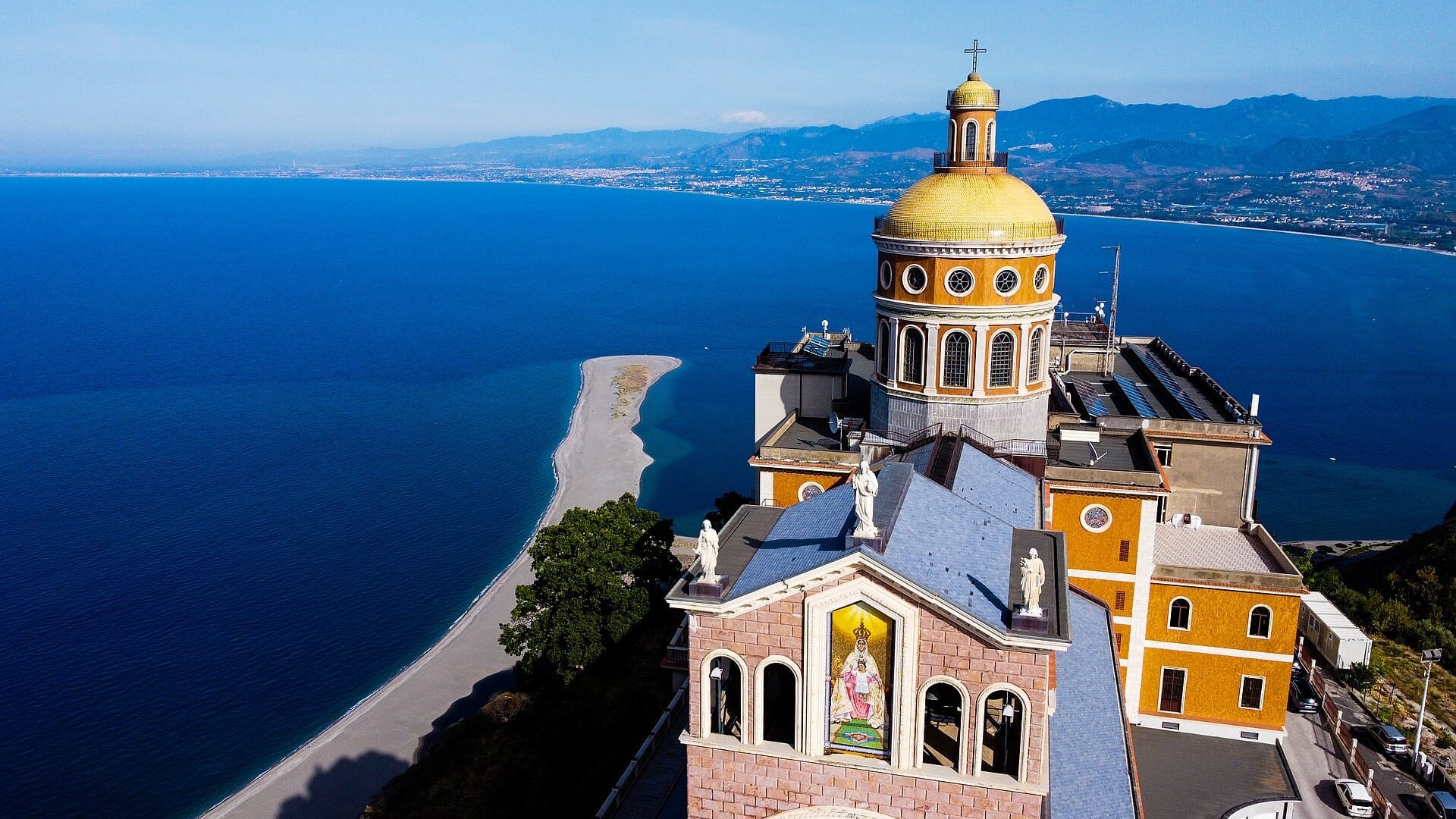
At the entrance to the promontory stands the Santuario di Maria Santissima di Tindari, a modern basilica whose current church was completed in the late 20th century that houses a dark Byzantine icon of the Madonna and Child. The image is traditionally dated to the early medieval period, though its precise origin is debated by art historians. What is not debated is its importance to Sicilian Catholic devotion — the sanctuary draws large numbers of pilgrims throughout the year, and on certain feast days the road up to the promontory is lined with coaches.
The sanctuary and the archaeological park sit at opposite ends of the same promontory and are visited separately, though many travellers do both on the same trip. The juxtaposition is one of the stranger and more interesting aspects of Tindari: Greek theatre ruins a few hundred metres from a pilgrimage basilica, with a Tyrrhenian panorama shared between them.
Inside the basilica the atmosphere shifts entirely from the archaeological site outside. Pilgrims pray quietly, candles are lit, and the Byzantine icon occupies a central position above the altar. Modest dress is required: shoulders and knees covered. Even visitors who are not religious often find the interior calm and the icon's presence — partly due to its age and partly its veneration context — quietly compelling.
The Lagoon Below: Marinello and the Sand Spits
From the promontory's northern edge, particularly from the viewpoint near the sanctuary, you look down onto the Riserva Naturale Orientata Laghetti di Marinello — a series of coastal lagoons and sand spits that curve around the base of the headland. The lagoons change shape seasonally as wind and wave patterns shift the sand, creating configurations that have inspired considerable local mythology linking the Virgin's footprint to the landscape below.
The lagoons are accessible from the beach road below and are worth the separate detour if you have time. Swimming is possible on the beach sections, and the shallow lagoon water warms quickly in summer. However, Tindari is primarily an archaeological and cultural site, and the beach below should be treated as a separate stop rather than a combined visit unless you have a full day.
For context on planning a full day on Sicily's northern coast, the day trips from Palermo guide covers routes that pass through this stretch of the Tyrrhenian coast and can help you sequence Tindari alongside nearby stops.
Getting There and Practical Logistics
Tindari is most conveniently reached by car. The A20 motorway connects Messina and Palermo, and the Falcone–Patti exit puts you within a short drive of the promontory road. Parking is available near the sanctuary entrance, though it fills quickly on weekends and during summer peak hours.
By train, regional services on the Messina–Palermo coastal line stop at Oliveri–Tindari (the closest station) and Patti–San Piero Patti. From either station you need a local taxi or, on certain days, a shuttle or bus service to reach the promontory itself — confirm local transport options before relying on this route, as the station is several kilometres below the site.
The site is in the province of Messina, between Messina and Cefalù, though closer to Messina than to Cefalù. This makes it a natural stopping point on a coastal road trip rather than a standalone day trip from Palermo, though it is manageable from Palermo in a full day by car (approximately 1.5 to 2 hours each way depending on traffic).
ℹ️ Good to know
Accessibility: The promontory site involves uneven paved and unpaved historical terrain, slopes, and some steps. The theatre in particular requires descending into the cavea. Visitors with limited mobility should contact the park administration directly to ask about accessible routes before visiting, as the official site does not publish this information.
Tindari fits naturally into a broader Sicilian road trip — see the Sicily by car road trip guide for route ideas that incorporate the north-eastern coast.
Photography and What to Expect Visually
The theatre is the most photogenic single structure, particularly from the upper rows of the cavea looking down toward the stage and the sea beyond. The view compresses beautifully: stone seating in the foreground, the rectangular orchestra, and then open water. A standard wide-angle lens handles this well; a telephoto is useful for isolating details on the Basilica facade.
The viewpoint over the Marinello lagoons from the sanctuary terrace is one of the most photographed spots in the province of Messina. The sand spit configurations are best captured at midday when the light is overhead and the water colour is most saturated — the exception to the usual rule about avoiding harsh light. Early morning and late afternoon create long shadows that obscure the lagoon's shape.
If archaeological landscapes are a priority during your trip, compare Tindari with the scale of Selinunte Archaeological Park in western Sicily, or the more accessible urban setting of the Neapolis Archaeological Park in Syracuse.
Who Should Reconsider the Visit
Tindari is not the right choice for travellers whose primary interest is beach time or nightlife. The ruins require genuine engagement — if you are not interested in reading a landscape historically or in the religious dimension of the sanctuary, the site can feel like a long drive for a relatively modest payoff. The site museum is small, and without broader context the ruins may seem fragmentary compared to showpiece sites like the Valley of the Temples or the Greek theatre at Taormina.
Those primarily interested in theatre architecture may find the Greek Theatre at Taormina more immediately spectacular, with its famous view over the sea toward Etna — though Tindari's theatre is better preserved in its original configuration.
Insider Tips
- Check the summer performance calendar for the Tindari theatre before booking accommodation in the area. Attending a performance inside the actual ancient theatre adds a dimension that no daytime visit can replicate.
- The road up to the promontory is narrow and can back up significantly on Sunday mornings when pilgrims arrive for mass at the sanctuary. Aim for a weekday visit or arrive by 8:30 am on weekends.
- The viewpoint over the Marinello lagoons is accessible without entering the paid archaeological zone — it is visible from the sanctuary terrace. If budget or time is limited, you can see the famous lagoon view without a ticket.
- The site museum labels are in Italian; download or bring a guidebook with English translations of the key finds before visiting, as audio guides are not always available.
- Combine Tindari with a stop at the Marinello beach below on the same day, but treat them as two separate stops with a gap for lunch in Patti — trying to rush both in succession is tiring in the heat.
Who Is Tindari For?
- History and archaeology enthusiasts who want a less-crowded alternative to Sicily's headline Greek sites
- Road-trippers driving the Messina–Palermo coastal route looking for a substantive mid-journey stop
- Photographers interested in the combination of ancient ruins, coastal panoramas, and the unusual Marinello lagoon formations below
- Travellers with an interest in Sicilian Catholic pilgrimage culture alongside classical history
- Those planning a two-week Sicily itinerary who want to include the north-eastern coast beyond Taormina and Cefalù
Nearby Attractions
Combine your visit with:
- Spiaggia dei Conigli, Lampedusa
Spiaggia dei Conigli on the island of Lampedusa is widely regarded as one of the finest beaches in the Mediterranean, with shallow turquoise water, white quartz sand, and a protected islet just offshore. Access is tightly controlled in summer to protect nesting loggerhead sea turtles, so planning ahead is not optional — it is essential.
- Madonie Regional Natural Park
Covering about 39,700 hectares in north-central Sicily, the Madonie Regional Natural Park is a UNESCO Global Geopark combining some of the island's highest mountains outside Etna, rare endemic flora, and a string of remarkably preserved medieval hilltowns. Access is free, terrain is varied, and the rewards are proportional to how far you go.
- Piazza Armerina
Located about 3–4 km outside the town of Piazza Armerina in central Sicily, Villa Romana del Casale is a UNESCO World Heritage Site sheltering over 3,500 square metres of remarkably preserved Roman mosaic floors. Dating to the early 4th century AD, it is widely regarded as the largest and most varied collection of Roman mosaics in existence.
- Savoca
Perched roughly 300–350 metres above the Ionian coast near Messina, Savoca is a medieval hilltop village that doubled as Corleone in Francis Ford Coppola's The Godfather. Beyond the film fame, it delivers genuine Norman-era architecture, Capuchin catacombs, and some of the most commanding views of the Sicilian coastline.