Savoca: Sicily's Medieval Village Frozen in Time
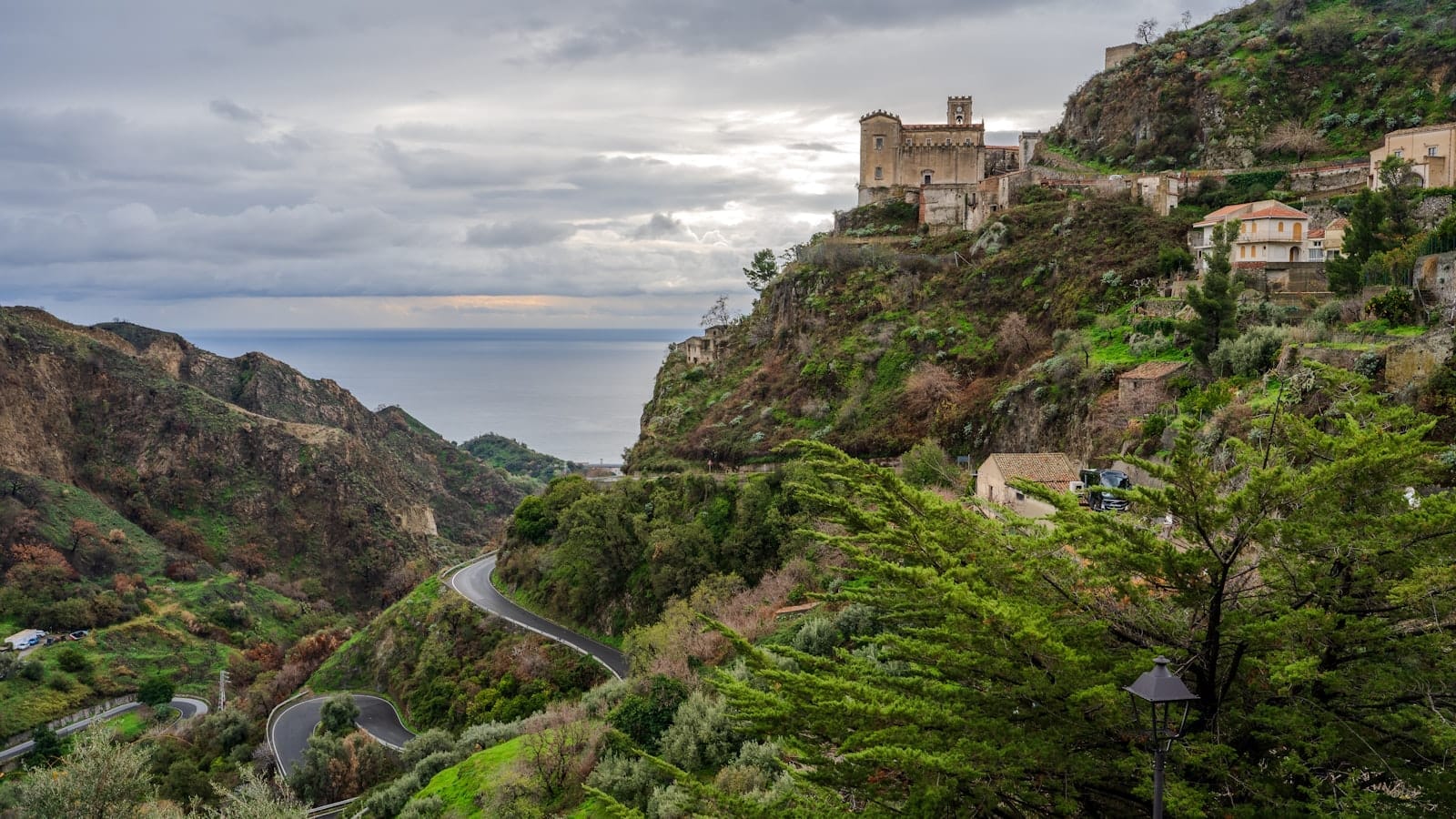
Perched roughly 300–350 metres above the Ionian coast near Messina, Savoca is a medieval hilltop village that doubled as Corleone in Francis Ford Coppola's The Godfather. Beyond the film fame, it delivers genuine Norman-era architecture, Capuchin catacombs, and some of the most commanding views of the Sicilian coastline.
Quick Facts
- Location
- Savoca (ME), Metropolitan City of Messina, Sicily — approx. 20 km north of Taormina
- Getting There
- By car via A18/E45 motorway (exit toward Santa Teresa di Riva, then follow signs uphill); regional buses run from Santa Teresa di Riva — schedules vary by season
- Time Needed
- 2–3 hours for the village; half a day if combining with nearby Forza d'Agrò or Taormina
- Cost
- Free to enter the village; individual sites (catacombs, church museums) charge small separate fees — verify on-site
- Best for
- Film history enthusiasts, medieval architecture lovers, photographers, day-trippers from Taormina
- Official website
- www.comunesavoca.gov.it
What Savoca Actually Is
Savoca is a comune in the Metropolitan City of Messina, sitting on a ridge roughly 300–350 metres above sea level. Its official Italian name is Comune di Savoca. The village has roots going back approximately 2,000 years, though the medieval fabric you walk through today took shape largely under Norman and later Aragonese influence. The name itself comes from the elder plant, known in Sicilian dialect as savucu, which appears in the village's coat of arms.
Most visitors arrive because of one cultural anchor: Francis Ford Coppola chose Savoca's Bar Vitelli and the Church of San Nicolò as key locations when filming The Godfather in 1971. The scenes depicting Michael Corleone's courtship in Sicily were shot on these very streets and in that particular terrace bar. That association has given the village a second life in global consciousness. What surprises most people, once they arrive, is how completely the medieval atmosphere holds up beyond the film references.
💡 Local tip
Savoca works exceptionally well as a half-day stop when combined with Taormina, roughly 30 km to the south. If you're planning a broader Messina province itinerary, check the available day trips from that area before building your route.
The Approach and First Impressions
The drive up to Savoca is itself part of the experience. After leaving the A18 motorway and the coastal strip of Santa Teresa di Riva, the road climbs steeply through terraces of citrus and olive trees. The air temperature drops a few degrees, the noise of the coast disappears, and by the time you reach the upper parking area, the Ionian Sea is already visible as a flat blue strip far below.
The village spreads along a narrow ridge, and most of it must be explored on foot. The lanes are narrow enough that two people passing each other requires one to step aside. Underfoot, the stones are worn smooth and can be slippery when wet. Coming in the morning, before the day-trip coaches from Taormina arrive around mid-morning, the streets are very quiet. You may hear a television through an open window, a dog, the sound of a broom on stone. The medieval quality is not theatrical; people actually live here.
⚠️ What to skip
Savoca is a genuine hill town with steep cobblestone streets and significant elevation changes. Visitors with limited mobility should note that step-free routes through the historic core are limited. Parking near the upper village reduces the walking distance, but inclines remain.
Tickets & tours
Hand-picked options from our booking partner. Prices are indicative; availability and final rates are confirmed when you complete your booking.
Etna South Upper Craters Guided Excursion from Taormina
From 42 €Instant confirmationFree cancellationTaormina private tour with an expert guide
From 42 €Instant confirmationFree cancellationIsola Bella boat tour and snorkeling
From 55 €Instant confirmationFree cancellationSyracuse and Ortygia Island guided tour from Taormina
From 65 €Instant confirmationFree cancellation
Bar Vitelli and the Godfather Trail
Bar Vitelli is the most photographed spot in Savoca, and it earns that attention. The terrace sits above a steep drop, with views of the valley and coastline below. In the film, this is where Michael Corleone first meets Apollonia. Today, the bar is a working café decorated with production photographs from the 1971 shoot. The walls are covered in black-and-white stills of Coppola, Pacino, and the crew working on the terrace you're sitting on.
The coffee is straightforward Sicilian espresso, served properly. The granita, in season, uses local almonds. There is no obligation to make it into a shrine visit; people drink their coffee, look at the photographs, take their own pictures of the view, and move on. The bar is small, and during the high-season afternoon rush it fills quickly. Morning visits, before 10:00, are measurably more relaxed.
If the Godfather connection is why you came to Sicily in the first place, it is worth building a broader itinerary around the island's film locations. A guide to Godfather filming locations across Sicily will help you connect Savoca with the other sites used during production.
The Church of San Nicolò and the Village Core
The Church of San Nicolò stands at the heart of the village, a Baroque-inflected structure whose facade appeared in the wedding scene of The Godfather. Its origins are older than the current facade suggests, and the interior holds several devotional paintings and carved details worth examining. Opening hours vary by season and are not centrally published, so checking locally or arriving during typical morning church hours increases the chance of finding it open.
Walking the main corso and the side lanes off it, you encounter other small churches, a former convent, and residential buildings that demonstrate the layered history of the place. Norman stonework sits next to eighteenth-century plasterwork. Some facades are crumbling; Savoca is not a restored film set but a lived-in village with real maintenance challenges. That unpolished quality is exactly what makes it photographically interesting.
The Capuchin Catacombs
The Capuchin Monastery of Savoca contains a small but striking catacomb where mummified bodies of local citizens, mostly clergy and prominent residents, were preserved in niches in the walls. The practice was common in Sicily between roughly the seventeenth and nineteenth centuries, and Savoca's version is smaller in scale than the famous Capuchin catacombs in Palermo but considerably less visited and therefore more affecting.
The figures are dressed in period clothing, their features partially preserved by the dry conditions. The space is genuinely eerie in a way that is historically illuminating rather than merely macabre. A small fee is typically collected at the entrance. For context on the broader Sicilian tradition of Capuchin funerary practice, the Catacombs of the Capuchins in Palermo offer a much larger version of the same phenomenon.
ℹ️ Good to know
The catacombs are not suitable for very young children or anyone disturbed by preserved human remains. The space is also quite small and can feel crowded when more than a handful of visitors are present simultaneously.
Views, Light, and When to Visit
The views from Savoca's ridge are among the most underrated on this stretch of the Sicilian coast. On a clear day, the panorama extends south toward Taormina and north toward Messina, with the Calabrian coastline visible across the Strait of Messina on the Italian mainland. In the late afternoon, the light turns the terracotta and stone facades a deep orange. That hour, from around 16:00 to 18:00 in summer, is the best for photography and for simply sitting on a wall and absorbing the geography.
Spring and autumn are the most comfortable seasons for the walk. Summer temperatures in Sicily's interior can push well above 30°C by midday, and the climb through the village in August heat is tiring. October is particularly good: the light is softer, the air cooler, and the village is almost entirely free of tourist pressure.
If you're deciding when to plan your Sicilian trip with weather in mind, a detailed breakdown of the best time to visit Sicily covers the trade-offs between seasons across different parts of the island.
Honest Assessment: Is It Worth the Detour?
Savoca is a genuine village, not a theme park, and that distinction matters. There are no large museums, no multi-hour itineraries, no significant shopping. What it offers is atmosphere, a specific historical texture, and the rare sensation of a medieval Sicilian hill town that has not been rebuilt for visitors. For the right traveler, two hours here is more memorable than two hours in a more polished attraction.
Visitors hoping for a major archaeological experience, extensive restaurant options, or an afternoon of varied activities will be disappointed. Savoca is a single-atmosphere destination. It rewards slow walking, attention to detail, and an interest in how places layer their histories over centuries. If you need constant stimulation or find quiet villages underwhelming, this is not the right stop.
Savoca pairs naturally with the Greek Theatre in Taormina as part of a full day on the Messina coast. The contrast between Taormina's grand ancient theatre and Savoca's intimate medieval streets is itself instructive about the range of Sicilian history.
Insider Tips
- Arrive before 10:00 on weekday mornings to have the village almost to yourself. Tour groups from Taormina typically arrive between 10:30 and 11:30, which changes the atmosphere significantly at Bar Vitelli.
- The parking area near the upper village saves considerable uphill walking. If mobility is not a concern, parking lower and walking the full approach gives a better sense of the ridge's topography.
- Bar Vitelli's almond granita is worth ordering in season (spring through early autumn). It is made locally and noticeably different from the commercial versions served in coastal tourist cafés.
- The light is best for photography in the late afternoon, after 16:00 in summer, when the low sun catches the stone facades and the coastal view below is at its most atmospheric.
- If you want to visit the catacombs, confirm opening times locally before making the trip; hours are not reliably published online and vary by season. A quick call to the local comune or checking with your accommodation in the Taormina area beforehand saves a wasted journey.
Who Is Savoca For?
- Film history enthusiasts who want to stand where The Godfather was actually shot
- Photographers looking for an unrestored medieval hill town with strong natural light
- Day-trippers from Taormina wanting a contrast to the coast's busier attractions
- Travelers interested in Sicilian funerary customs and the Capuchin catacomb tradition
- Anyone who prefers quiet, lived-in villages to curated tourist destinations
Nearby Attractions
Combine your visit with:
- Spiaggia dei Conigli, Lampedusa
Spiaggia dei Conigli on the island of Lampedusa is widely regarded as one of the finest beaches in the Mediterranean, with shallow turquoise water, white quartz sand, and a protected islet just offshore. Access is tightly controlled in summer to protect nesting loggerhead sea turtles, so planning ahead is not optional — it is essential.
- Madonie Regional Natural Park
Covering about 39,700 hectares in north-central Sicily, the Madonie Regional Natural Park is a UNESCO Global Geopark combining some of the island's highest mountains outside Etna, rare endemic flora, and a string of remarkably preserved medieval hilltowns. Access is free, terrain is varied, and the rewards are proportional to how far you go.
- Piazza Armerina
Located about 3–4 km outside the town of Piazza Armerina in central Sicily, Villa Romana del Casale is a UNESCO World Heritage Site sheltering over 3,500 square metres of remarkably preserved Roman mosaic floors. Dating to the early 4th century AD, it is widely regarded as the largest and most varied collection of Roman mosaics in existence.
- Scala di Santa Maria del Monte, Caltagirone
The Scalinata di Santa Maria del Monte is a monumental 142-step staircase in the heart of Caltagirone, Sicily, where every riser is clad in hand-painted ceramic tiles drawn from ten centuries of local craft tradition. Free to visit at any hour, it connects the lower town to an 18th-century church at the hilltop and serves as the living symbol of one of Italy's most celebrated ceramic-making cities.