Tin Mal Mosque: The Almohad Ruin That Rewrites the Atlas
Perched above a narrow mountain valley roughly 100 km south of Marrakech, Tin Mal Mosque is one of Morocco's most significant medieval monuments. Built around 1153–1154 CE as a tribute to the Almohad movement's founder, it stands today in partial ruin but with its carved horseshoe arches and geometric stonework still intact enough to feel ancient. The interior has been closed since earthquake damage in 2023, so verify access and the Tizi n'Test road before you make the journey.
Quick Facts
- Location
- Tinmel village, Ijoukak area, High Atlas, Province of Al Haouz – approx. 100 km south of Marrakech
- Getting There
- Private car or organised tour only – no reliable public transport. Roughly 2–2.5 hours by road from Marrakech via Asni and the Tizi n'Test (R203) road
- Time Needed
- 30–60 minutes at the site; most combine with a day trip toward Imlil on the same corridor, not the Ourika Valley
- Cost
- No official ticket; a customary tip to the caretaker has been reported (around 10–20 MAD). Currently closed for interior visits – verify locally before going
- Best for
- History enthusiasts, architecture lovers, travellers combining Atlas mountain drives with cultural sites
- Official website
- whc.unesco.org/en/tentativelists/452
What Is Tin Mal Mosque, and Why Does It Matter?
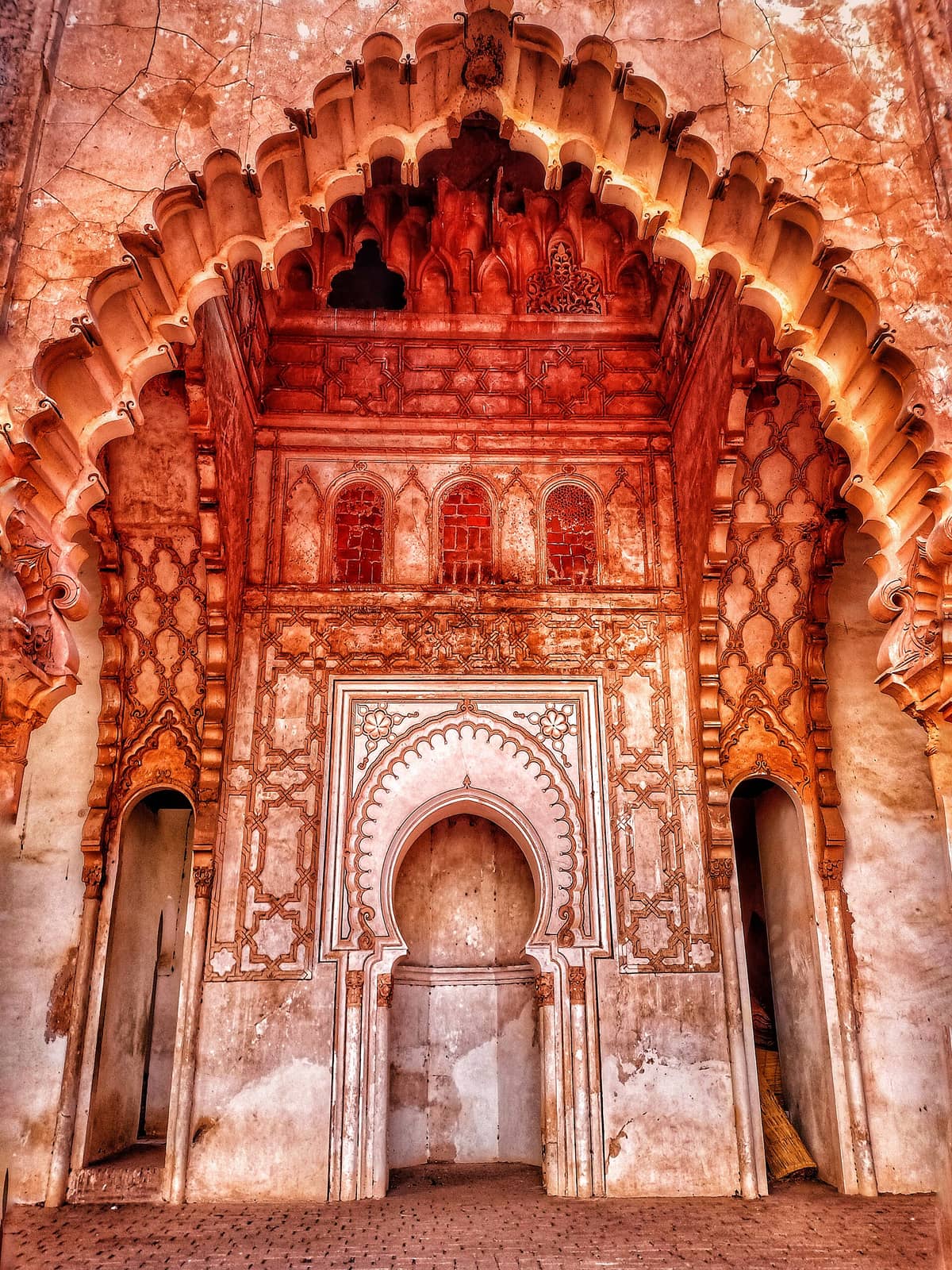
Tin Mal Mosque – also written Tinmal or Tinmel – is a 12th-century Almohad mosque completed around 1153–1154 CE at the command of Abd al-Mu'min, the first caliph of the Almohad dynasty. It was built to honour Ibn Tumart, the Berber scholar and reformist who founded the Almohad movement in this same mountain valley early in the 12th century. That origin story matters: this is not a decorative palace mosque added to an already-powerful city. It is a founding monument, built at the ideological birthplace of a dynasty that went on to rule Morocco, much of the Maghreb, and al-Andalus.
The mosque no longer functions as a place of active worship. It is preserved as a historic monument and was historically one of the very few mosques in Morocco open to non-Muslim visitors, a policy made possible precisely because it is no longer consecrated for regular prayer. However, since sustaining structural damage – worsened by the September 2023 Al Haouz earthquake that devastated communities across this region – interior access has been closed indefinitely while assessment and restoration work continues.
⚠️ What to skip
As of 2026, Tin Mal Mosque remains closed for interior visits after structural damage from the September 2023 Al Haouz earthquake and ongoing restoration. Most recent visitors can only view the exterior, if the site is approachable at all. Verify current access and Tizi n'Test (R203) road conditions locally before making the journey.
The UNESCO World Heritage Centre has included the mosque on its tentative list under the name "Mosquée de Tinmel", recognising its outstanding Almohad architectural significance. For travellers already planning a day trip from Marrakech into the High Atlas, the mosque sits naturally on a route that passes through Asni and the Ijoukak valley, making it a logical and deeply rewarding stop.
The Architecture: What You Actually See
The mosque occupies a roughly square plan of around 50 metres per side, set on a slope above the valley road with the High Atlas peaks as its backdrop. Even in a ruined state, the structure communicates scale and intention. The prayer hall's interior columns define clear aisles, and the carved stucco and stone detailing on surviving arches shows the same geometric vocabulary that later shaped the Koutoubia Mosque in Marrakech and Giralda in Seville. These monuments were built by the same dynasty within decades of each other, which is why architects and historians treat Tin Mal as a direct prototype.
The horseshoe arches here are not decorative afterthoughts. They are structural and symbolic, reflecting Almohad theology's emphasis on unity and formal order. The qibla wall – oriented toward Mecca – remains the most intact section, and its mihrab niche retains carved ornamentation despite centuries of exposure and neglect. Visitors who also make time for the Koutoubia Mosque back in Marrakech will notice the family resemblance immediately: the proportions, the blind arcading, and the restrained surface decoration are clearly from the same architectural school.
The minaret, though incomplete, anchors the northeast corner and gives a sense of how the original skyline would have read from the valley below. From the road, even before you climb up to the structure, the silhouette against the Atlas mountains is striking in a way that photos rarely capture, particularly in morning light when the stone takes on a warm ochre tone.
Tickets & tours
Live prices and dates from our booking partner. If you book, we may earn a commission at no extra cost to you.
Evening Quad Bike at Palmeraie Area with Tea Tasting from Marrakech
From 49 €Instant confirmationFree cancellationEvening Buggy Ride at Palmeraie Area with Tea Tasting from Marrakech
From 119 €Instant confirmationFree cancellationQuad Bike Adventure in Agafay Desert with Tea Tasting From Marrakech
From 59 €Instant confirmationFree cancellationBuggy Ride Adventure in Agafay Desert with Tea Tasting from Marrakech
From 179 €Instant confirmationFree cancellation
Getting Here: The Drive Is Part of the Experience
There is no realistic public transport option for reaching Tin Mal Mosque. The site is accessed via the Tizi n'Test road (R203) running south from Marrakech through Asni and then into the Ijoukak valley. The total drive takes roughly 2 to 2.5 hours in good conditions, covering about 100 km. After the September 2023 Al Haouz earthquake, confirm that the road and site are open before you go. The road is paved but narrow in sections, with switchbacks and sheer drops in places. A standard car handles the route without difficulty, but the drive demands attention. An SUV is not necessary unless you plan to continue on rougher tracks beyond the mosque.
Most travellers arrive either in a rented car or as part of a private guided day tour from Marrakech. Several operators combine Tin Mal with a stop at Imlil village or a walk into the lower Atlas slopes, which makes logistical sense given the travel time involved. If you are hiring a driver for the day, confirm explicitly that they know the Ijoukak road – not all city-based drivers are comfortable on it. Navigation apps do locate the mosque under "Tin Mal Mosque" or "Mosquée de Tinmel", but signal can be unreliable in the valley, so download offline maps before departure.
💡 Local tip
Leave Marrakech by 8:00–8:30 AM to arrive at Tin Mal in the best morning light and before midday heat builds in summer. This also gives you time to add Imlil or a roadside lunch in Asni to the same day.
If you are combining Tin Mal with a trekking or mountain objective, Imlil village sits on the same general route and serves as the standard base for Atlas hikes. The two sites work naturally together on a single long day, though rushing both does neither justice.
What a Visit Feels Like: Time, Light, and Atmosphere
The valley itself is quiet in a way that Marrakech simply is not. The air carries the smell of juniper and dry grass. On the approach up from the road, loose stones shift underfoot and the mosque walls rise above you at an angle that makes the structure look taller than its footprint suggests. In winter, when snow caps the surrounding peaks, the contrast between the pale stone and white mountains is striking. In summer, the same scene under a hard blue sky has its own austere clarity.
At the site, the caretaker has traditionally been the primary point of contact for visitors. When the mosque was open, access to the interior was informal – a small donation to the caretaker rather than an official ticket. That arrangement has paused while the building is closed, but the caretaker or a local guardian is typically still present, and it is worth asking respectfully whether any portion of the structure is accessible. Attitudes can vary, and conditions on the ground may have shifted since any written source was published.
Even restricted to the exterior, most visitors spend 30 to 45 minutes here without feeling shortchanged. The views down the valley toward the Atlas ridgeline are worth the stop alone. Early-to-mid morning produces the best photographic light on the carved facades. By early afternoon in summer, the stone walls reflect heat intensely and the site feels exposed. Bring water, a hat, and sun protection regardless of season.
Historical Context: Ibn Tumart and the Almohad Founding Myth
Ibn Tumart arrived in this valley in the early 12th century after studying in Córdoba and the Islamic east. He gathered followers among the Masmuda Berber tribes of the High Atlas and preached a strict theological reform, condemning what he saw as the anthropomorphic theology and lax practice of the ruling Almoravid dynasty. His movement – the Almohads, from the Arabic al-Muwahhidun, meaning "those who affirm divine unity" – was both a religious revival and a political insurgency.
Ibn Tumart died before the Almohads overthrew the Almoravids, but his successor Abd al-Mu'min completed the conquest of Morocco around 1147 CE and then commissioned Tin Mal Mosque as both a mausoleum-adjacent shrine and a statement of dynastic legitimacy. Building a grand congregational mosque at the movement's birthplace was deliberate symbolism: it anchored the new empire to its mountain origins even as the capital moved to Marrakech. At its height, the Almohad empire stretched across the Maghreb and al-Andalus.
That same Almohad impulse toward formal architectural order shapes much of what visitors still see in Marrakech today. The Islamic architecture of Marrakech owes its geometric rigour and its preference for carved stucco over figurative ornament directly to the aesthetic programme that begins at Tin Mal.
Practical Details: What to Bring and What to Expect
The mosque sits on a slope above the valley floor, which means the approach from the road involves an uneven uphill path. For visitors with mobility impairments, this section is genuinely difficult and there are no adapted facilities. The site is completely rural, with no cafés, toilets, or visitor infrastructure at the monument itself. There is a small settlement nearby but nothing purpose-built for tourists.
Dress modestly as you would for any Islamic historic site: covered shoulders, and trousers or a long skirt rather than shorts. This applies regardless of gender. Even though the mosque is no longer actively used for worship, it remains a place of historical and cultural significance, and local sensibilities apply. Shoes will need to be removed if interior access is ever restored.
Weather in the High Atlas changes fast. Even on a warm Marrakech morning, the valley at 1,200 metres elevation can be noticeably cooler, and cloud can move in during the afternoon. A light layer is worth carrying in your bag in any season. In winter, the Tizi n'Test (R203) road through Ijoukak can occasionally be disrupted by snow or rock debris – check conditions before departing.
ℹ️ Good to know
There is no official ticket booth or entry fee infrastructure at Tin Mal. Past visitors reported leaving a customary tip (typically around 10–20 MAD) with the site's caretaker. Given ongoing closures, the practical situation may have changed. Bring small-denomination dirhams regardless.
Who Should Reconsider This Trip
Travellers with limited time in Marrakech should weigh this carefully. The round trip from Marrakech consumes most of a day, and while the landscape is beautiful, the mosque exterior alone – when the interior is closed – may not justify that investment for visitors primarily interested in urban culture, food, or shopping. If your Marrakech stay is two days or fewer, the medina's own Almohad heritage at the Koutoubia and the souks will occupy your time more efficiently.
Similarly, those who are primarily drawn to Marrakech's gallery scene, its contemporary design districts, or its hammam culture will find the atlas drive a significant detour from what they came for. For context on how to use limited time in the city itself, the 3-day Marrakech itinerary maps out which city-based sites deliver the most reward in compact time.
Visitors with mobility concerns should note the slope access and completely uneven terrain. The site is not wheelchair accessible, and there are no adapted facilities of any kind.
Insider Tips
- Confirm the access situation directly with your riad or hotel the evening before you plan to go – staff often have up-to-date local information that no website carries, particularly regarding whether the caretaker is present and any portions of the site are visible.
- The light on Tin Mal's carved stone walls is most photogenic between 9 AM and 11 AM, when the sun strikes the qibla wall at an angle that brings out the texture of the surviving plasterwork. Afternoon visits flatten the detail considerably.
- Combine the trip with a stop in Asni's weekly market (Saturdays) on the way up or back. It adds almost no time and gives a ground-level view of High Atlas rural life that pure monument tourism misses entirely.
- Download offline maps for the Ijoukak valley before leaving Marrakech. Mobile data signal becomes unreliable about 30 km south of Asni, and navigation apps that rely on live data will simply stop working on the narrower sections of the approach road.
- If you are traveling in a group, consider hiring a local guide from Imlil rather than a city guide from Marrakech. Guides based in the mountains tend to have deeper knowledge of the Almohad history and the physical landscape, and their fee typically stays within the local economy.
Who Is Tin Mal Mosque For?
- Architecture and Islamic history enthusiasts who want to see the Almohad prototype that preceded the Koutoubia
- Travellers combining a mountain day trip with cultural depth, particularly alongside a stop in Imlil
- Photographers attracted to medieval ruins in dramatic natural settings
- Anyone interested in the pre-Marrakech roots of Moroccan civilisation and the Almohad empire
- Slow travellers with several days in the region who can absorb the drive as part of the experience rather than treating it as overhead
Nearby Attractions
Combine your visit with:
- Agafay Desert
Just 30 to 40 kilometres southwest of Marrakech, the Agafay Desert is a rocky plateau of roughly 300 to 400 square kilometres that delivers dramatic open-sky landscapes without a multi-day Sahara expedition. It is not the sand-dune desert many visitors picture, but that distinction is part of its appeal: a raw, mineral terrain framed by the snow-capped peaks of the High Atlas, accessible within an hour of the city.
- Aït Benhaddou
Rising from the southern slopes of the High Atlas, the Ksar of Aït Benhaddou is a UNESCO World Heritage Site and one of Morocco's most architecturally striking places. Built from pisé earth and palm wood, this fortified village has stood at the crossroads of trans-Saharan trade for centuries — and remains partly inhabited today.
- Anima Garden
Set along the Ourika road 27 km south of Marrakech, Anima Garden is a three-hectare art-and-nature space created by Austrian artist André Heller. Sculptures, water features, and carefully curated plantings coexist in a setting that feels both otherworldly and deeply rooted in Moroccan landscape. It rewards slow exploration and offers a genuine contrast to the pace of the medina.
- Essaouira
Essaouira is a UNESCO-listed fortified coastal city on Morocco's Atlantic coast, roughly 2.5 to 3 hours from Marrakech by road. Its 18th-century medina, ocean-facing ramparts, and salt-aired souks offer a complete change of pace from the heat and intensity of the inland city. Entry to the medina is free.
Planning a trip? Discover personalized activities with the Nomado app.