Agafay Desert: The Stone Wilderness on Marrakech's Doorstep
Just 30 to 40 kilometres southwest of Marrakech, the Agafay Desert is a rocky plateau of roughly 300 to 400 square kilometres that delivers dramatic open-sky landscapes without a multi-day Sahara expedition. It is not the sand-dune desert many visitors picture, but that distinction is part of its appeal: a raw, mineral terrain framed by the snow-capped peaks of the High Atlas, accessible within an hour of the city.
Quick Facts
- Location
- 30–40 km southwest of Marrakech, along Route d'Amizmiz toward Lalla Takerkoust
- Getting There
- Private transfer (most common), grand taxi (~250–350 MAD negotiated), or rental car. Limited public bus service (e.g. regional bus 33) but routes do not serve most desert camps and are impractical for most visitors; no train service.
- Time Needed
- Half-day minimum; full day or overnight for the full experience
- Cost
- Free to access; transport from ~130 MAD (shared tour) or typically €50–80 (private transfer per vehicle). Activities extra.
- Best for
- Sunset seekers, couples, photographers, families escaping the medina
- Official website
- visitmarrakech.com/en/destinations/agafay
What the Agafay Desert Actually Is
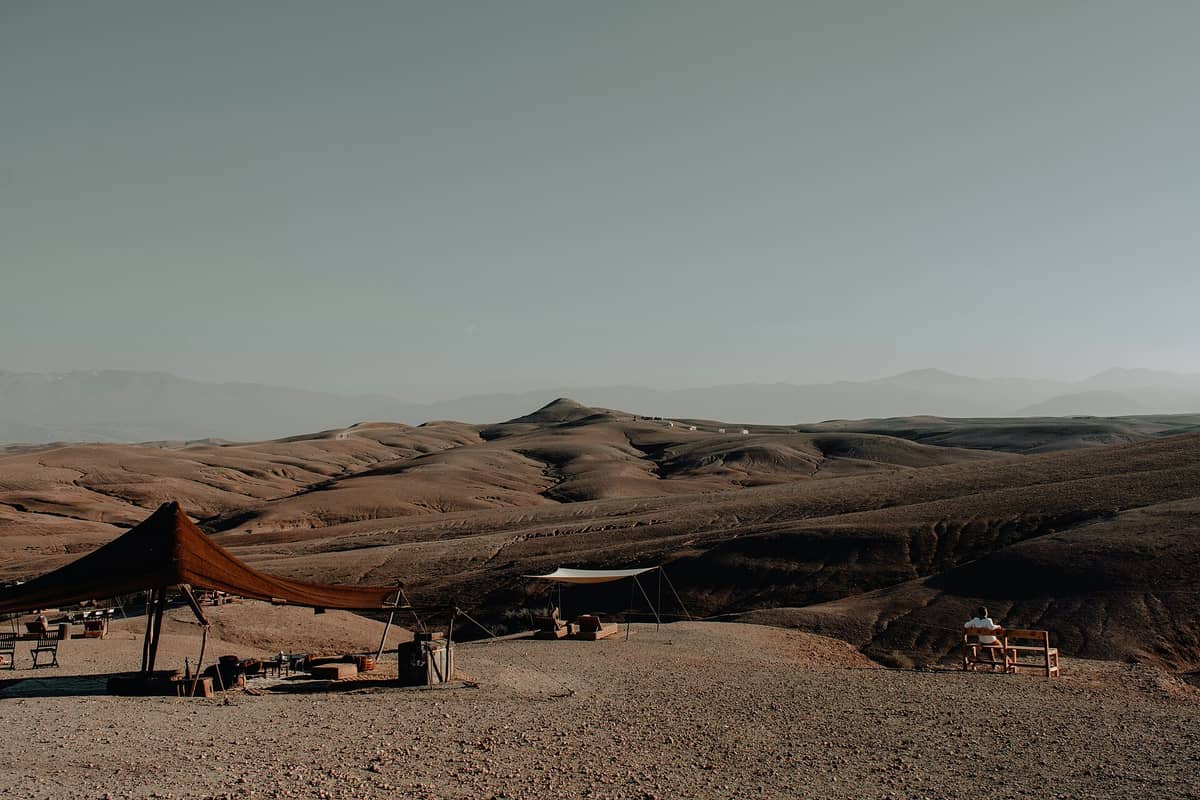
The Agafay Desert is not the Sahara. That is the single most important thing to understand before you go. There are no towering sand dunes, no camel trains silhouetted against rolling orange hills. What you get instead is a vast, pale stone plateau, cracked and mineral, where the earth shifts between pale grey, ochre, and dusty white depending on the light. Scrubby drought-resistant plants dot the surface. Dry riverbeds cut shallow grooves across the plain. In every direction, the land stretches out flat and enormous, and to the south, when the air is clear, the High Atlas Mountains rise as a sharp, snow-dusted wall.
In Arabic, it is sometimes called Sahraa Agafay, and in French, Désert d'Agafay. The rocky plateau covers roughly 300 to 400 square kilometres between Marrakech and the Atlas foothills. Geologically, it is a hammada, a type of desert characterised by exposed bedrock and sparse vegetation rather than sand. The absence of sand is not a flaw. It creates a starkness that photographers and solitude-seekers tend to find more compelling than the more photogenic but harder-to-reach Saharan dunes near Merzouga.
ℹ️ Good to know
The Agafay Desert is a natural open area with no gates, ticket office, or set opening hours. You access it via paved public roads. Costs are determined entirely by how you get there and which camp or activity operator you choose.
How It Changes Through the Day
Arrive in the morning, roughly between 8 and 10am, and the plateau has a cool, stripped-down quality. The light is soft and horizontal, throwing long shadows across the rock surface. The Atlas peaks are most clearly visible in the early hours before haze builds, and if you are there in winter or early spring, the snow line sits noticeably low. The air smells of dust and dry herb, faintly mineral. At this hour the camps are quiet, breakfast still being cleared away, and the tracks through the plateau belong mostly to local herders moving small flocks.
Midday in summer is harsh. The sun reflects hard off pale rock and temperatures can climb well above 35°C between June and August. Most visitors during those months arrive late in the afternoon deliberately, timing the drive from Marrakech to arrive around 4pm when the heat softens. Autumn and spring, from September to November and March to May, are the most physically comfortable seasons for extended outdoor time.
Sunset is when the Agafay delivers its strongest visual argument. The stone plateau turns amber and gold in the final forty minutes of light, the Atlas silhouette deepens to a dark purple, and the sky above can go through pink, copper, and a clear indigo in rapid succession. Camps set up low tables, cushioned seating, and lanterns for this moment. It is theatrical, and it earns the reputation. Stay after dark and the sky is another event entirely: at 30 kilometres from a city of one million people, light pollution is present but manageable, and on moonless nights the stars are genuinely dense.
Tickets & tours
Live prices and dates from our booking partner. If you book, we may earn a commission at no extra cost to you.
Evening camel ride Agafay desert with a traditional dinner
From 95 €Instant confirmationFree cancellationAgafay desert private sunset quad bike tour from Marrakech
From 50 €Instant confirmationFree cancellationAgafay desert day trip From Marrakech
From 110 €Instant confirmationFree cancellationSunset camel ride and dinner in the desert of Agafay
From 145 €Instant confirmationFree cancellation
Getting There from Marrakech
The Agafay Desert sits approximately 30 to 40 kilometres southwest of Marrakech city centre, reachable in around 40 to 50 minutes by road depending on traffic. The main route leaves the city via Avenue Mohammed VI heading south, then continues on Route d'Amizmiz toward Lalla Takerkoust along paved regional roads. The roads are fully paved the entire way, which matters: you do not need a 4x4 to reach the main camps.
The most practical option for most visitors is a private transfer arranged through a hotel, riad, or tour operator, with round-trip costs typically in the range of €50 to €80 per vehicle. A grand taxi from Marrakech negotiated for the one-way fare typically runs around 250–350 MAD, though you will need to agree the return pickup or find your own way back. Group minivan tours from Marrakech bring the per-person cost down to around 130 MAD. There is no direct public bus or train service to Agafay. If you want full flexibility, renting a car is straightforward. For a broader look at your transport choices within the city and beyond, the guide to getting around Marrakech covers current options in detail.
💡 Local tip
If you are hiring a grand taxi, agree the return journey and time before you leave Marrakech. Getting stranded in Agafay without a confirmed pickup is a real possibility, especially in the evening when taxis from the city are less willing to make the trip.
What to Do There
The Agafay Desert has built up a small but well-organised tourism infrastructure over the past decade. Luxury desert camps and mid-range lodges are spread across the plateau, most offering day-visit packages that include lunch or dinner, a pool, and access to activities. Camel rides are available at most camps, covering short circuits across the plateau, and quad biking is popular for those wanting to cover more ground across the rock surface. The routes are not technically demanding but the corrugated stone track gives the bikes a genuine workout.
Hot air balloon flights over the plateau and surrounding landscape are offered by several operators, typically launching at dawn and providing views of both the desert and the Atlas foothills that are difficult to match from ground level. If that is on your list, the Marrakech hot air balloon guide sets out how to book and what to expect. Horse riding is another option at some camps, and several properties offer hammam treatments and spa facilities if the aim is recovery rather than activity.
For travellers who simply want to walk, the plateau is free to explore on foot directly from the road. The terrain is uneven, rocky, and there are no marked trails, so this suits people who are comfortable with rough ground. Wear closed shoes with good grip; the rock surface can be slippery when wet and sharp-edged in dry conditions. There is almost no shade once you leave a camp's structures, so sun protection is essential from spring onwards.
Camps, Stays, and Dining in the Desert
The camp and lodge landscape in Agafay ranges from basic Berber-style tent setups aimed at day-trippers to genuinely luxurious properties with private pools, individual tented suites, and restaurant-quality kitchens. The gap between the two ends of the market is significant. Mid-range camps typically offer cushioned floor seating in open-sided tents, a set menu of tagine and couscous, mint tea, and a fire at night. Higher-end properties serve multi-course meals, have proper beds with linen, and some have architects in their design credits.
Many visitors choose a half-day or full-day visit that includes lunch or dinner without an overnight stay. This structure makes Agafay one of the more straightforward day trips from Marrakech, since the road time is short enough that it does not consume the majority of the day. Overnight stays add a layer of experience that a day visit cannot replicate: the quiet after the last camp vehicles leave, the temperature drop after midnight, the absence of city noise.
⚠️ What to skip
Camp quality in Agafay is highly variable. Read recent reviews specifically for the camp you are booking, not for Agafay in general. Some budget camps have faced criticism for thin food, poor service, and hard sells on activities. The higher-end options are generally more consistent but cost significantly more.
Practical Details: Weather, What to Bring, and Caveats
Agafay sits at moderate elevation on a plateau exposed on all sides, which means wind is a factor, especially in winter. Evenings from October through March can be genuinely cold after the sun drops, and the temperature difference between 4pm and 9pm is sharper than most visitors expect. If you are going for a sunset dinner, bring a proper layer: a light summer jacket will not be enough in December or January.
Summer visits (June to August) require heat management. The middle of the day between roughly 11am and 4pm is uncomfortable for outdoor activity, and camps without pools offer limited relief. If you plan a summer trip, structure the day around arrival in the late afternoon. For a broader view of how the season shapes the Marrakech experience, the best time to visit Marrakech guide breaks down month-by-month conditions.
Bring more water than you think you need if you are exploring outside a camp. The rocky surface reflects heat and there are no water sources on the plateau itself. A hat, sunscreen with a high SPF, and sunglasses are not optional in spring, summer, or early autumn. Camera equipment benefits from a dust bag or zip-lock protection, as fine grit can work into lenses when the wind picks up.
Accessibility varies by camp. The approach roads are paved and manageable for standard vehicles, but the desert surface itself is rough, uneven rock. Wheelchair users and those with significant mobility limitations should confirm specific facilities directly with their chosen camp before booking. Do not assume step-free access based on photos alone.
Is it overhyped? For some visitors, yes. If you are travelling from North Africa or have seen other desert landscapes, the visual impact of Agafay may feel modest. If you are on a short Marrakech city trip and cannot justify three days to reach Merzouga and the Erg Chebbi dunes, Agafay fills the desert experience slot respectably. For context on how it fits into a broader Marrakech itinerary, the Marrakech Agafay Desert guide covers planning in more detail.
Insider Tips
- The plateau looks completely different in the two hours before a spring rainstorm: the sky turns a greenish-grey, the rock takes on a dark metallic sheen, and the Atlas peaks disappear into cloud. If you catch this, stay for it. It is rarer and more striking than a standard sunset.
- Most camp transfers leave Marrakech between 3 and 4pm to catch sunset. If you arrange your own transport and arrive by 10am, you will have the landscape largely to yourself for several hours before the day-trip crowds appear.
- The Lalla Takerkoust reservoir sits just beyond the western edge of the Agafay plateau. Some drivers pass it en route and it is worth stopping: a long blue lake backed by dry hills, with small waterside cafés that make a useful break on the return drive.
- If you are photographing the Atlas from Agafay, the clearest views come in November to March when the peaks carry snow and the air is less hazy. Bring a longer focal length: the mountains are distant and appear deceptively small on a standard wide lens.
- Many camps have a fixed dinner time and the ride back to Marrakech is often a shared minibus on a schedule. If you want to stay after dinner and watch the stars, confirm with your operator in advance that a later return is possible, or arrange private transport specifically for the trip back.
Who Is Agafay Desert For?
- Couples looking for a romantic sunset dinner outside the city
- Photographers wanting Atlas Mountain backdrops and open-sky night shooting
- Families with children who want camel or quad bike experiences without a long journey
- Travellers on a short Marrakech stay who want desert landscape without a multi-day trip to the Sahara
- City-weary visitors needing a half-day of space and quiet between days in the medina
Nearby Attractions
Combine your visit with:
- Aït Benhaddou
Rising from the southern slopes of the High Atlas, the Ksar of Aït Benhaddou is a UNESCO World Heritage Site and one of Morocco's most architecturally striking places. Built from pisé earth and palm wood, this fortified village has stood at the crossroads of trans-Saharan trade for centuries — and remains partly inhabited today.
- Anima Garden
Set along the Ourika road 27 km south of Marrakech, Anima Garden is a three-hectare art-and-nature space created by Austrian artist André Heller. Sculptures, water features, and carefully curated plantings coexist in a setting that feels both otherworldly and deeply rooted in Moroccan landscape. It rewards slow exploration and offers a genuine contrast to the pace of the medina.
- Essaouira
Essaouira is a UNESCO-listed fortified coastal city on Morocco's Atlantic coast, roughly 2.5 to 3 hours from Marrakech by road. Its 18th-century medina, ocean-facing ramparts, and salt-aired souks offer a complete change of pace from the heat and intensity of the inland city. Entry to the medina is free.
- Imlil Village
Perched at roughly 1,740 metres in the High Atlas Mountains, Imlil Village is the main staging point for treks to Jebel Toubkal, North Africa's highest peak. It's a working Amazigh (Berber) mountain community that has gradually absorbed trekkers, guesthouses, and mule handlers into its daily rhythm, without losing the feel of the agricultural valley it was built around.
Planning a trip? Discover personalized activities with the Nomado app.