Tigre and the Paraná Delta: Buenos Aires' Waterway Escape
Just 30 kilometres north of Buenos Aires, the Tigre Delta is a labyrinth of rivers, islands, and wetlands that feels worlds apart from the city. Boats replace buses, herons replace pigeons, and the pace drops to something close to silence. It is one of the most accessible large-delta ecosystems in South America, and one of the most rewarding half-day or full-day trips from the capital.
Quick Facts
- Location
- Tigre, Buenos Aires Province, Argentina — approx. 30 km north of central Buenos Aires
- Getting There
- Mitre Line commuter train from Retiro station to Tigre terminus (approx. 50–60 min). Puerto de Frutos is a 10-min walk from Tigre station.
- Time Needed
- Half day (4–5 hours) minimum; a full day allows boat exploration of the inner delta
- Cost
- Free to enter Tigre town and Puerto de Frutos. Boat tours and lanchas colectivas (water taxis) carry additional fares — verify current prices locally
- Best for
- Nature lovers, families, travellers wanting a break from city sightseeing, photographers
- Official website
- vivitigre.gob.ar/en/home
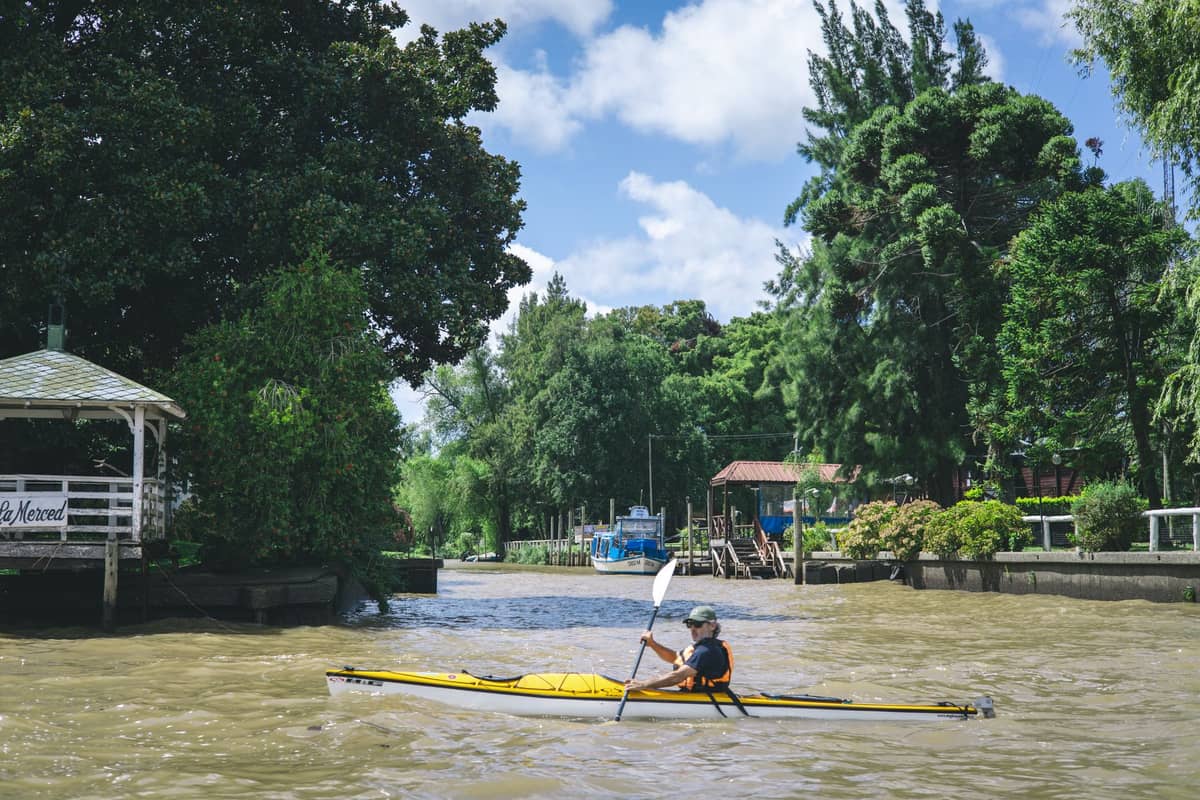
What the Tigre Delta Actually Is
The Paraná Delta is one of the largest river deltas on the planet — Buenos Aires Tourism describes it as one of the largest in the world — and it is unique among major deltas in that it flows into fresh water rather than the sea. The delta is formed by countless channels, streams, and islands created over millennia by the Paraná River as it fans out before meeting the Río de la Plata. The portion accessible from Tigre town is officially called the Delta de Tigre, specifically its first island section, and it is the main entry point for visitors from Buenos Aires.
The ecosystem here supports willows and ceibo trees (Argentina's national flower) along the banks, capybaras grazing in the undergrowth, and dozens of bird species including southern lapwings, great egrets, and kingfishers. This is not a manicured park. The vegetation is dense and low-lying, the channels narrow in places to a few boat-widths, and the waterways shift in character depending on recent rainfall. After heavy rain, currents strengthen and water levels rise, temporarily submerging low riverside docks.
ℹ️ Good to know
The Paraná Delta is one of the largest deltas in the world and the only major one that flows into fresh water rather than the sea. Entry to Tigre town and Puerto de Frutos (Sarmiento 160, Tigre) is free.
Getting There from Buenos Aires
The straightforward way to reach Tigre is the Mitre Line commuter train from Retiro station in central Buenos Aires. Trains run frequently throughout the day and the journey takes roughly 50 to 60 minutes depending on the service. The line terminates at Tigre station, which places you a short walk from the riverfront, the Puerto de Frutos market, and the main boat docks. This is by far the most practical option for independent travellers. If you are staying near Retiro, you can be on the water in under 90 minutes from leaving your hotel.
An alternative route uses the Tren de la Costa, a scenic heritage railway that runs from Maipú station (reachable from Retiro via a short Mitre Line segment to Bartolomé Mitre station) along the river suburbs to Tigre. The Tren de la Costa stops at small riverside stations and is slower, but if you want to see the northern suburbs rather than simply reach the delta, it adds character to the outward journey. Bus connections also exist but are considerably slower and less straightforward.
💡 Local tip
Public transport fares are paid with the SUBE rechargeable card. Load credit before you travel — Retiro station has top-up points. Fares change regularly in Argentina; verify the current amount at the station rather than relying on any figure quoted online.
Tickets & tours
Live prices and dates from our booking partner. If you book, we may earn a commission at no extra cost to you.
Tigre Town: Before You Board a Boat
Most visitors step off the train and head straight for the water, but Tigre town itself is worth 30 to 45 minutes of your time. The waterfront promenade along the Luján River has a slightly faded elegance — nineteenth-century rowing clubs with wooden boathouses, a small amusement park, and cafes that face the constant movement of boats on the water. The Museo de Arte Tigre (MAT), housed in a 1912 Belle Époque building that was once a social club, is worth noting if you want a cultural anchor to your visit, though opening hours and admission should be confirmed before arriving.
Puerto de Frutos, the riverside market at Sarmiento 160, is open daily and free to enter. The market originally traded in the fruit and timber that arrived by boat from the delta islands; today it sells crafts, wicker furniture, regional food products, and plants. It is a functional local market rather than a tourist spectacle. On weekday mornings it is quiet enough to browse unhurried. On weekend afternoons it fills with families from Buenos Aires seeking a day out, and the restaurant terrace that faces the river becomes the obvious spot to eat before or after a boat trip. Municipal information gives opening hours as Monday to Friday 10:00 to 18:00, and Saturday, Sunday and holidays 10:00 to 20:00, though this may vary slightly by season.
On the Water: Lanchas Colectivas and Boat Tours
The defining experience of any Tigre visit is getting onto the water. There are two main ways to do this: the lanchas colectivas (shared water taxis) that serve the delta communities, or organised boat tours that follow fixed routes with commentary.
The lanchas colectivas are the working transport of the delta. Residents who live on the islands rely on them for groceries, school runs, and medical appointments. Taking one as a visitor costs a small fare, puts you on a vessel with locals, and takes you into channels where no tour boat goes. There are no paved roads on the islands, no cars, and very little infrastructure. Families live in wooden houses raised on stilts, supply boats deliver everything from gas cylinders to mattresses, and children wave from docks. The Estación Fluvial (river station) near the train terminus is the departure point for most lanchas.
Organised tours depart from multiple points near the main waterfront and range from one-hour panoramic circuits to half-day excursions that stop at restaurants or estancias (river lodges) deep in the delta. If your goal is photography or pure scenery, a tour offers a more predictable itinerary. If you want something that feels genuinely exploratory rather than curated, a lancha colectiva to a far stop and a slow return on a different route is more satisfying. Prices for both vary; verify current rates at the docks on the day.
💡 Local tip
For accessibility: some municipal ferry boats offer free travel for holders of a Buenos Aires disability certificate. Private company boats do not have this arrangement. Confirm which services apply before booking.
How the Delta Changes Through the Day
Early morning on the delta is the best time for wildlife and light. Between 7:00 and 9:00 the channels are calm, the bird activity peaks along the banks, and the low angle of the sun turns the brown water of the Paraná channels copper and gold. The lanchas begin their runs early, so access is not a problem. The downside of a very early start is that Puerto de Frutos and most restaurants are not open yet.
Midday in summer (December through February) brings real heat and humidity. Temperatures in the delta can feel higher than in the city because the still air over the water retains moisture. This is not a reason to avoid a summer visit, but it does mean planning your boat time for morning and your lunch break in the shade. Spring (September to November) and autumn (March to May) offer the most comfortable conditions on the water — temperatures typically between 15 and 25 degrees Celsius, low wind, and good visibility.
Winter visits (June to August) are underrated. The delta empties of weekend crowds, the vegetation thins slightly, and the light has a clarity that summer haze removes. It is cool on open boats, so a layer is essential. Rain can arrive at any time of year; afternoon thunderstorms are common in summer. Check the forecast before setting out, and be aware that after heavy rain, some channels can be affected by stronger currents. For broader context on planning around Buenos Aires weather, see the best time to visit Buenos Aires guide.
Photography, Practicalities, and What to Bring
The delta rewards photographers willing to be patient. The best images come not from the main channels but from the narrower waterways where vegetation presses close on both sides and reflections in the still water are unbroken. A telephoto or zoom lens is useful for birds on distant banks. Morning light (before 10:00) is directional and warm; midday light is flat. Keep your camera in a dry bag or at least a waterproof sleeve when on open boats — spray from faster vessels is a constant reality.
Wear sunscreen and bring a hat regardless of season. Mosquito repellent is worth packing for any time between October and April when insect activity is higher near the water. Comfortable, non-slip shoes are more practical than sandals if you are stepping on and off boats. There is no need for specialist gear or hiking equipment — the accessible delta is navigated almost entirely by water, not on foot.
The delta is a strong option for families. Children respond well to the novelty of transport by boat, wildlife is visible without requiring silence or long walks, and the pace is flexible. It pairs naturally with other activity-based experiences around Buenos Aires. Travelling with kids? The Buenos Aires with kids guide covers further family-friendly options in and around the city.
Assessment: Who Will Love It and Who Might Not
The Tigre Delta is genuinely impressive as a natural ecosystem. The sense of being inside a working river delta — where people actually live, where the water is the road, and where the city has not colonised every bank — is unusual and worth the trip. That said, the experience can be overstated by some guides. The sections of the delta accessible on short tours are relatively tamed. The more remote inner islands require longer stays and prior arrangement. If you are expecting jungle-level density or a completely wild landscape, manage expectations: the first-island section has restaurants, weekend homes, and well-worn tour routes.
Travellers who dislike heat and humidity should be cautious about summer visits without planning for it. Those looking for a primarily urban cultural experience may find the day better spent in the city itself — Buenos Aires has more than enough for a full week, as outlined in the one week in Buenos Aires itinerary. And visitors with very limited mobility should note that boat boarding and disembarking involves steps and movement on unsteady surfaces; discuss accessibility requirements directly with boat operators before booking.
For those who do make the trip: Tigre is one of the clearest examples of a day trip from Buenos Aires that offers something fundamentally different from the city itself, rather than simply more of it.
Insider Tips
- Take the lancha colectiva rather than a tourist boat on at least part of the trip. Buy a ticket to a distant stop, ride to the end, and take a different service back. You will see residential delta life that tour routes skip entirely.
- The restaurants inside Puerto de Frutos are convenient but generic. Walk five minutes toward the river and you will find smaller parrillas (grill restaurants) with outdoor terraces facing the water — better food and better atmosphere at similar prices.
- If you visit on a weekday, the delta is noticeably quieter. Weekend afternoons in summer bring large crowds from Buenos Aires, and the main waterfront at Tigre can feel more like a fairground than a nature destination.
- Bring Argentine pesos in cash for lanchas, small food vendors, and entry to any paid museum in town. Card readers are not universal among smaller operators.
- The Tren de la Costa is slower than the Mitre Line but runs through several pleasant riverside suburbs. Consider it for the return journey as a way to see a different slice of Greater Buenos Aires without backtracking.
Who Is Tigre and the Paraná Delta For?
- Travellers who want a break from urban sightseeing without leaving the Buenos Aires region
- Families with children who respond well to boats and open-air environments
- Wildlife and nature photographers seeking wetland landscapes
- Anyone on a longer Buenos Aires stay (5 days or more) who has covered the main city attractions
- Visitors curious about how delta communities actually live, rather than just what they look like from a tour boat
Nearby Attractions
Combine your visit with:
- Cementerio de la Chacarita
Larger and less visited than its famous counterpart in Recoleta, Cementerio de la Chacarita is a vast urban cemetery spanning multiple city blocks in the Chacarita neighborhood. Free to enter, it holds the tombs of cultural icons including tango legend Carlos Gardel, and its monumental mausoleums, wide internal avenues, and layers of Argentine social history make it one of the most atmospheric and underappreciated sites in the city.
- Colonia del Sacramento (Uruguay)
Colonia del Sacramento, Uruguay's oldest city and a UNESCO World Heritage Site, sits just across the Río de la Plata from Buenos Aires. Its Barrio Histórico packs cobblestone lanes, Portuguese-era walls, and a working lighthouse into a compact quarter that most visitors can absorb in a single afternoon.
- Espacio Memoria y Derechos Humanos (ex-ESMA)
Built on the grounds of one of Argentina's most notorious clandestine detention centers, Espacio Memoria y Derechos Humanos (ex-ESMA) is a 17-hectare memorial complex in northern Buenos Aires dedicated to human rights and collective memory. Entry is free, the site has regular daily opening hours, and a visit here is one of the most sobering and important experiences the city offers.
- Estadio Monumental (River Plate)
The Estadio Más Monumental Antonio Vespucio Liberti is more than a football ground. Home to Club Atlético River Plate and the largest stadium in South America, it holds around 85,000 spectators and carries decades of Argentine football history. Whether you visit on a quiet Tuesday morning or a roaring match day, the scale and atmosphere of El Monumental is unlike anything else in Buenos Aires.
Planning a trip? Discover personalized activities with the Nomado app.