Théâtre Royal de Marrakech: Gueliz's Grand Cultural Landmark
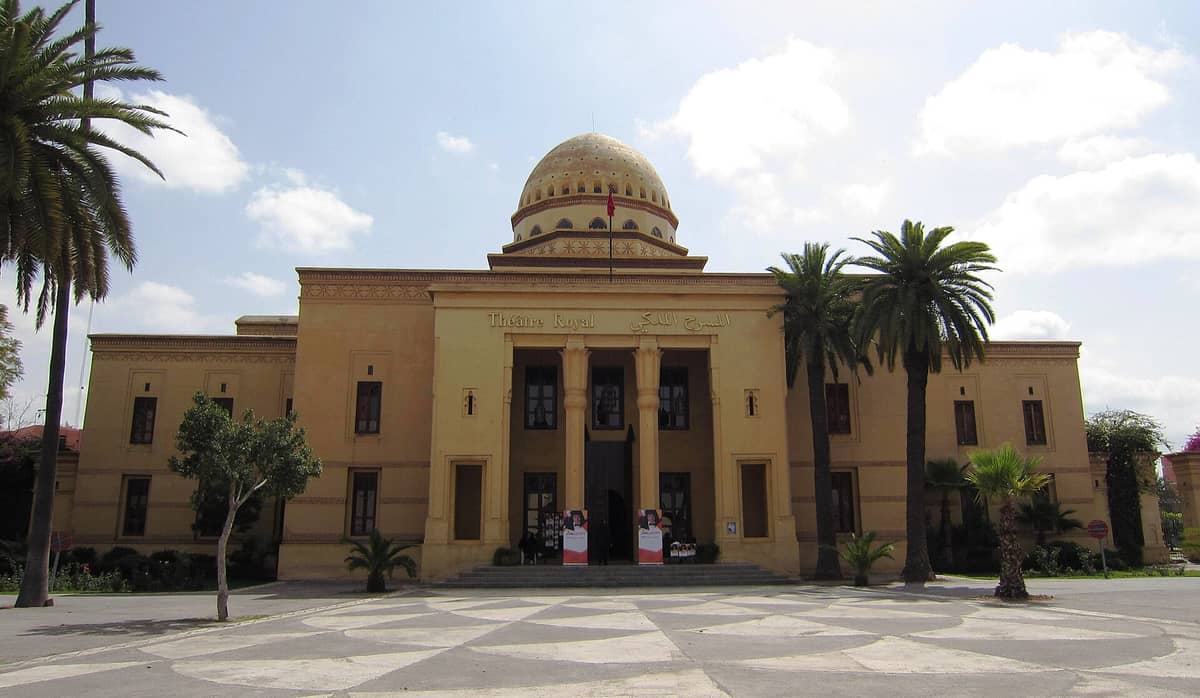
Standing at the heart of Gueliz on Boulevard Mohammed VI, the Théâtre Royal de Marrakech is one of Morocco's most architecturally ambitious modern buildings. Its soaring dome, elaborate zellige tilework, and vast entrance hall make it worth visiting even when the curtain is down.
Quick Facts
- Location
- 40 Boulevard Mohammed VI, Guéliz, Marrakech 40000, Morocco
- Getting There
- 3–5-minute walk from Marrakech railway station; petit taxi from Jemaa el-Fna takes roughly 10 minutes
- Time Needed
- 30–60 minutes for the building; longer if attending a performance
- Cost
- Entry to view the building is often reported as free when no performance is on; performance tickets vary by event — confirm at the box office
- Best for
- Architecture lovers, culture-seekers, evening strollers in Gueliz
What Is the Théâtre Royal de Marrakech?
The Théâtre Royal de Marrakech is a large, state-commissioned performing arts venue positioned on Boulevard Mohammed VI, the grand tree-lined avenue that forms the spine of modern Gueliz. It was built as a statement of cultural ambition for a city that, for most visitors, is still synonymous with medina alleyways and ancient souks. Here, the contrast is deliberate and striking.
The theatre occupies a prime corner plot near the intersection of Boulevard Mohammed VI and Avenue Hassan II, standing directly opposite the railway station and at the edge of the modern commercial heart of the city. That central position means you're likely to walk past it at least once during any stay in Gueliz, and once you see the scale of the dome rising above the boulevard palms, you'll want to stop.
Unlike many of Marrakech's historic monuments, the Théâtre Royal is a product of the modern era. There are no medieval foundations beneath it. What it offers instead is a very deliberate vision of what Moroccan civic architecture can look like when tradition and contemporary scale are woven together.
The Architecture: What You Actually See
The exterior presents a monumental facade that reads differently depending on your angle of approach. Walking north along Boulevard Mohammed VI in the afternoon, the dome catches the sun at a low angle and throws the geometric detailing into sharp relief. The overall form is large and self-assured, with archways and decorative stonework that reference classical Moroccan architectural vocabulary without simply copying it.
Step inside the entrance hall and the scale shifts again. The interior opens into a generous atrium where the floor is laid with intricate zellige tilework in muted ochres and blues. The tilework is the kind that takes patience to photograph properly because the patterns only resolve fully when you step back and look at the whole composition rather than individual tiles. Wide staircases rise on either side, their balustrades carved with repeating geometric motifs. The ceiling overhead is painted and panelled in a style that recalls the great riads of the medina, scaled up to civic proportions.
💡 Local tip
The entrance hall and public foyer areas are where much of the architectural detail is concentrated. Come prepared to look up: the ceiling work in the main atrium is easy to miss if you walk straight through.
The indoor opera hall has long remained unfinished; visitors typically see the foyer, entrance hall, and outdoor amphitheatre rather than a completed auditorium. Events are irregular. Conditions inside can change, and some areas may be partially inaccessible depending on when you visit. Check before you make a special trip.
Tickets & tours
Live prices and dates from our booking partner. If you book, we may earn a commission at no extra cost to you.
Full day tour of Ouarzazate from Marrakech
From 51 €Instant confirmationFree cancellationEvening Quad Bike at Palmeraie Area with Tea Tasting from Marrakech
From 49 €Instant confirmationFree cancellationFull Day Economic Tour in Essaouira from Marrakech
From 29 €Instant confirmationFree cancellationFull Day Economic Tour of Ourika Valley from Marrakech
From 25 €Instant confirmationFree cancellation
How the Experience Changes Through the Day
The theatre sits differently in the morning than it does at dusk. In the early hours, the boulevard is relatively quiet — delivery vehicles, a few joggers, office workers cutting through on their way to the commercial streets behind. The building looks almost austere in flat morning light, the dome a pale cream against the sky. It's a good time to photograph the exterior without pedestrian clutter.
Late afternoon, when the sun drops toward the Atlas direction, is when the facade comes alive. The warm orange light picks out the carved detailing and gives the stone a depth it lacks at midday. If there's a performance scheduled for the evening, this is also when the theatre begins to show signs of life: staff moving, lights coming on inside, occasionally the sound of rehearsal filtering out through an open side door.
On performance evenings, the front plaza fills with a different Marrakech crowd than the one you encounter in the medina: well-dressed Moroccan families, groups from the city's professional class, occasional visiting artists. The building functions as a genuine civic gathering point, not a tourist attraction, and that distinction is noticeable in the atmosphere.
ℹ️ Good to know
Guided tours at 15:00 and 18:00 have been reported by visitors on review platforms, possibly excluding Fridays. This is user-reported information and may change. Contact the venue directly at +212 5 24 43 15 16 to confirm current arrangements before visiting.
Attending a Performance
When events are scheduled, the Théâtre Royal hosts a mix of theatre, dance, and musical performances, often in the outdoor amphitheatre or public spaces rather than a finished indoor opera house. Programming tends to reflect both Moroccan cultural production and international touring work, though the schedule is not fixed year-round and can be sparse during quiet periods. There is no permanent company in residence.
Ticket prices vary substantially by event and are not published as a standard rate. The safest approach is to check what is on during your dates, either by visiting the box office in person or by asking your hotel or riad for assistance with the current program. Box office staff generally speak French, and some speak English.
If you're planning your trip around cultural events in Marrakech more broadly, the Marrakech art scene guide covers the wider landscape of galleries, festivals, and performance venues across the city.
Getting There and the Surrounding Area
The theatre's location on Boulevard Mohammed VI makes it one of the easiest major landmarks in Marrakech to reach on foot if you're based in Gueliz. From the Marrakech railway station, the walk takes about three to five minutes along the boulevard, past café terraces and the broad plane trees that line the central median.
From the medina, a petit taxi from Jemaa el-Fna will typically reach the theatre in around ten minutes, depending on traffic. Negotiate the fare before you get in, or insist on the meter. The return journey on foot back toward the medina is feasible for those who want to explore the transition between Gueliz and the old city walls, a walk of around twenty-five to thirty-five minutes.
The boulevard itself rewards a slow walk. Gueliz has a very different texture from the medina: wider pavements, shaded café terraces, contemporary gallery spaces mixed in among the boutiques. If you have time, the Marrakech walking tour guide offers a structured route that takes in both the modern district and the historic core.
⚠️ What to skip
The building has wide entrance stairs and tiled floor surfaces. Detailed step-free access or wheelchair-specific facilities are not confirmed in available sources. If accessibility is a concern, contact the venue directly before visiting.
Is It Worth Your Time?
As a standalone tourist attraction in the conventional sense, the Théâtre Royal is not in the same tier as the Bahia Palace or the Ben Youssef Madrasa. There are no exhibits to walk through, no historical narrative laid out for visitors, and on a quiet day with no performances scheduled, the experience amounts to looking at a handsome building inside and out.
But that framing misses what it actually is. The Théâtre Royal is one of the most architecturally serious modern buildings in Marrakech, and it represents a side of the city that many itineraries skip entirely. Pairing a visit here with time at the Yves Saint Laurent Museum nearby gives you a coherent afternoon in Gueliz that engages seriously with contemporary Moroccan cultural production rather than simply revisiting the medina's greatest hits.
If you happen to be in Marrakech when a performance is scheduled — particularly anything featuring Moroccan music, classical dance, or local theatrical companies — attending is strongly recommended. The building comes into its own as a performance space, and the audience experience feels different from a tourist activity.
Travelers on short itineraries who are pressed for time and focused primarily on the medina's historic monuments should treat this as a pleasant detour rather than a priority. Those based in Gueliz, or with a full week in the city, will find it a worthwhile addition to any cultural afternoon.
Photography and Practical Notes
The exterior photographs best in the hour before sunset, when the warm light catches the dome and the carved stonework. Bring a wide-angle lens or use the far side of the boulevard to get the whole facade in frame without distortion. The interior zellige tilework rewards a macro lens if you have one, though the patterns are complex enough that even standard smartphone cameras capture their quality well.
Dress modestly, as is appropriate across most of Marrakech. The building is a formal civic venue, and while there is no strict dress code for daytime visits to the public areas, clothing that would be appropriate for a theatre or concert hall is sensible if you are attending a performance.
For guidance on what to wear more generally across different parts of the city, the Marrakech dress code guide covers the range from medina visits to modern district evenings.
Insider Tips
- The late afternoon light on the south-facing facade, roughly one hour before sunset, is the single best time for exterior photography. The dome takes on a deep amber tone that disappears entirely by early evening.
- If no performance is scheduled, you can often walk through the entrance hall and foyer areas without any ticket or booking.
- Check the building's exterior notice boards on the way in — upcoming performances are often posted there even when nothing appears online. Box office staff also respond well to direct questions in French about the next week's schedule.
- The café and restaurant options on Boulevard Mohammed VI nearby are significantly more relaxed and less tourist-priced than their equivalents near Jemaa el-Fna. Build in time for a coffee or a meal before or after a visit.
- If you're attending an evening performance, consider arriving early to watch the pre-show crowd gather on the front plaza. The mix of Marrakchi families, students, and occasional visiting artists gives a genuine sense of the city's cosmopolitan character that purely medina-focused itineraries rarely capture.
Who Is Théâtre Royal de Marrakech For?
- Architecture and design enthusiasts interested in contemporary Moroccan civic building
- Cultural travelers who want to attend a live performance in a formal venue
- Visitors spending multiple days in Marrakech who have already covered the main medina sites
- Evening strollers based in Gueliz looking for a landmark to anchor a walking route
- Photographers seeking modern architectural subjects as a counterpoint to historic medina imagery
Nearby Attractions
Other things to see while in Gueliz (Ville Nouvelle):
- Jardin Majorelle
Once a painter's private sanctuary, Jardin Majorelle is now one of Marrakech's most photographed gardens. Set on Rue Yves Saint Laurent in Marrakech's modern Gueliz area, it pairs electric-blue architecture with an extraordinary collection of cacti and subtropical plants — and a world-class museum of Berber culture at its centre.
- MACMA – Musée d'Art et de Culture de Marrakech
Founded in 2016 by private collector Nabil El Mallouki, MACMA is one of Marrakech's most coherent art museums, presenting orientalist works, early photography and contemporary Moroccan painting in a quiet courtyard setting in Gueliz. It offers a genuine counterpoint to the city's more touristic attractions.
- Berber Museum (Musée Berbère)
Housed in the iconic Blue Villa inside Jardin Majorelle, the Pierre Bergé Museum of Berber Arts presents one of Morocco's most carefully curated collections of Amazigh jewelry, textiles, and ceremonial objects. Small in scale but dense in meaning, it rewards visitors who take time to look closely.
- Marrakech Railway Station
Marrakech Railway Station (Gare de Marrakech) is the southern terminus of Morocco's national rail network, sitting in the modern Gueliz district about 3.5 km from the medina. This guide covers everything travelers need: how to reach it, what to expect inside, which trains run where, and the practical details that make the difference between a smooth departure and a stressful one.
Planning a trip? Discover personalized activities with the Nomado app.