Terres d'Amanar Adventure Park: Atlas Thrills Beyond the City
Perched on a 120-hectare plateau in the foothills of the High Atlas, Terres d'Amanar is an outdoor activity park roughly 37 km from Marrakech. It offers aerial courses, zip lines, and nature immersion beside Toubkal National Park, making it one of the few places near Marrakech where the mountains stop feeling like a backdrop and start feeling like the point.
Quick Facts
- Location
- Douar Akli, commune Tahannaout, Province Al Haouz — approx. 37 km from Marrakech on the road to Asni
- Getting There
- Taxi or private transfer from Marrakech (40–60 min). Budget option: shared taxi to Tahannaout, then local taxi. No direct bus to the gate.
- Time Needed
- Half day minimum (3–4 hours on site); full day if combining activities and lunch
- Cost
- Aerial zip line course typically from around 300 MAD per person (recent indication). Prices vary by activity; confirm directly with the park.
- Best for
- Families with older children, active couples, and travellers wanting Atlas scenery without a full trekking commitment
- Official website
- www.terresdamanar.com
What Terres d'Amanar Actually Is
Terres d'Amanar is not a theme park, and it is not a hiking trailhead. It occupies its own category: a large private estate turned outdoor activity centre, spread across roughly 120 hectares of plateau terrain at the edge of Toubkal National Park. The park borders approximately 100,000 hectares of protected national park terrain, which means the treeline you are moving through during the aerial courses is not ornamental — it is part of a functioning ecological buffer zone.
The main draws are the aerial park (a series of zip lines and suspended obstacle courses through the trees) and the accropark (lower ropes and climbing challenges suited to younger children and first-timers). Beyond the activity structures, the estate includes picnic areas, accommodation options, and open terrain with clear sightlines toward the Atlas peaks. On a clear day in autumn or spring, the snow-capped ridgeline to the south is a constant presence.
For travellers already planning time outside the city, Terres d'Amanar pairs well with other Atlas-adjacent stops. Do not confuse the Asni–Tahannaout road with the Ourika Valley, which lies further east on a different road. The park sits on the Asni road, reasonably close to the base villages used for Imlil Village access. Planning the day so Terres d'Amanar is the morning activity and a mountain village is the afternoon stop is a practical itinerary.
The Drive South and First Impressions
The journey from Marrakech is part of the experience in a way that cannot be skipped. The city gives way quickly once you pass the southern suburbs, and within about 30 minutes the road opens into dry plains backed by increasingly clear mountain profiles. The air temperature drops noticeably as you gain altitude approaching Tahannaout, and the scrubby roadside vegetation shifts from the irrigated gardens of the city edge to wilder holm oak and juniper slopes.
The final 1 to 2 kilometres to the park gate involve a road that can be unpaved or rutted depending on recent weather and maintenance. Low-clearance vehicles may find this awkward. Arriving by taxi is the most practical option; if you are self-driving in a rental car, check the road condition with the park before setting out. The gate area is signed, and staff direct visitors to parking before the ticket point.
💡 Local tip
Book activities in advance during Moroccan school holidays and weekends in spring or autumn. The park can fill up with family groups, and last activity ticket sales reportedly close around 16:00–17:00. Arriving before noon gives the most flexibility.
Tickets & tours
Live prices and dates from our booking partner. If you book, we may earn a commission at no extra cost to you.
1-day trip from Marrakech to Terres d'Amanar with zip-line
From 70 €Instant confirmationFree cancellationFull day tour of Ouarzazate from Marrakech
From 51 €Instant confirmationFree cancellationEvening Quad Bike at Palmeraie Area with Tea Tasting from Marrakech
From 49 €Instant confirmationFree cancellationFull Day Economic Tour in Essaouira from Marrakech
From 29 €Instant confirmationFree cancellation
The Activities: What the Courses Feel Like
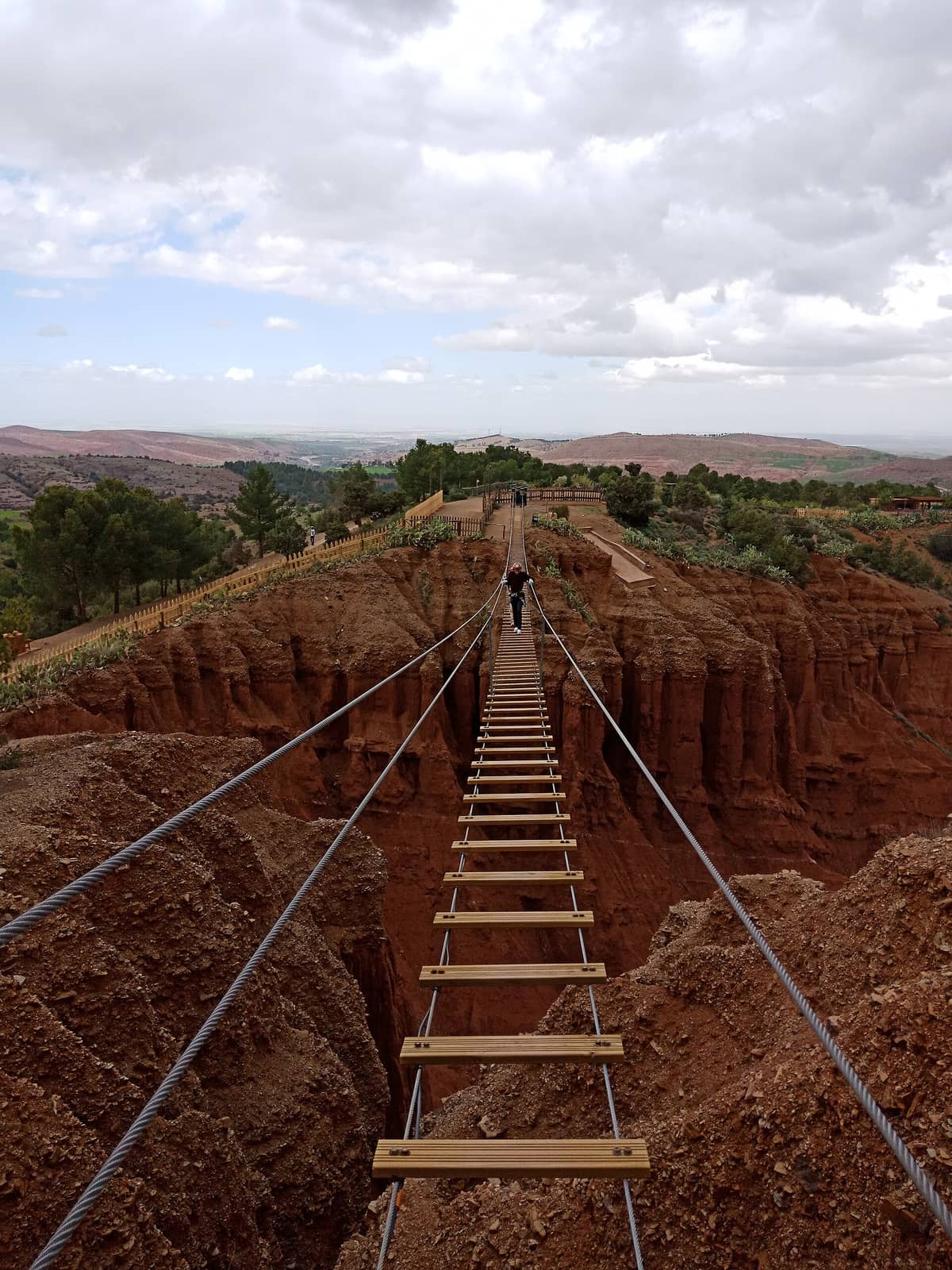
The aerial park is the centrepiece. Participants are harnessed into a continuous belay system and move through a sequence of suspended platforms, rope bridges, log crossings, and zip line runs between trees. The courses are graded by difficulty, which means adults and teenagers can attempt more challenging circuits while younger children stay on lower, simpler routes. The harness system is self-guided once briefed, though staff patrol the course and assist when needed.
Physically, the aerial course demands grip strength, balance, and a reasonable comfort with height. It is not extreme by international adventure park standards, but it is not passive either. Weight limits apply: approximately 120 kg for the main aerial structures. These are safety specifications, not guidelines — staff enforce them.
The sensation of moving through the forest canopy with Atlas ridgelines visible through the branches is unusual. Unlike indoor climbing centres or urban rope courses, the setting here adds an ambient quality that urban equivalents lack: the sound of wind through oak trees, the smell of forest soil, the occasional hawk riding thermals above the plateau. Morning visits, before the midday heat builds in summer, allow the most comfortable time on the course.
⚠️ What to skip
Summer temperatures at Terres d'Amanar are lower than in Marrakech city, but the plateau can still reach uncomfortable levels between noon and 15:00 in July and August. Physical activity on the aerial course in direct sun is exhausting at peak heat. Early morning starts are strongly advisable in summer months.
How the Park Changes by Time of Day
Early morning, in the first hour after opening, is the quietest window. The light is soft across the plateau, the air is cool, and the forest section has a stillness that disappears once larger groups arrive. This window suits photographers and anyone who wants the aerial course with minimal queuing at transition points.
From mid-morning onward, family groups accumulate, particularly on weekends and during Moroccan school breaks. The energy shifts considerably: children's laughter, the click of carabiners, staff calling instructions. This is not unpleasant, but it is a different atmosphere. The grounds around the picnic areas and viewing terraces become social spaces, with people resting between activity sessions.
The late afternoon, from around 15:00 until early evening, brings a shift in light quality across the Atlas that is worth staying for even if activities are done.
Practical Walkthrough: Getting There and Back
From Marrakech, the most straightforward option is a private taxi or transfer booked through your accommodation. Journey time ranges from 40 minutes in light traffic to around 60 minutes when the southern road is congested, which happens on Friday afternoons and during public holidays. Agree on a return pickup time before the driver leaves, or negotiate a full-day rate — waiting options are limited in the immediate area.
The budget approach involves taking a shared taxi (grand taxi) from the main departure points in Marrakech toward Tahannaout, then a local taxi for the final kilometres to Douar Akli. This requires more logistical patience and is less practical if you are travelling with children or gear, but it is feasible. Some travellers on budget Morocco itineraries use this method with success.
If you are planning a fuller day in the Atlas region, pairing the park with Imlil is the natural same-road option. Combining it with the Ourika Valley means a separate valley to the east and a less direct routing. For broader context on organising a day away from the city, the day trips from Marrakech guide covers route options and timing in detail.
Clothing, Gear, and What to Bring
Closed-toe shoes with a firm sole are essential for the aerial and accropark circuits. Sandals and flip-flops are not compatible with the course equipment and will likely be refused at the safety briefing. Long trousers or leggings are more comfortable than shorts on the rope elements. A light layer for the morning and a sun hat for midday are practical additions; the plateau is open enough that sun exposure accumulates quickly.
Bring water. The drive south is dry country, and physical activity on the courses is more demanding than it appears. The park has catering facilities, but having your own supply ensures you are not rationing between stations. For families, pack snacks for children — the gap between finishing a course and finding food can feel long at peak visitor times.
ℹ️ Good to know
The park’s activity area is open 7 days a week, from 10:00 to 17:00 according to the official site, with last activity tickets around 16:20. Confirm current hours directly with the park before travel, as seasonal adjustments may apply.
Who This Works For — and Who Should Skip It
Terres d'Amanar works best for travellers who want physical engagement with the Atlas landscape rather than passive observation. If you have children old enough to manage harness activity (typically primary school age and above), this is one of the more memorable outdoor options within day-trip range of Marrakech. It also suits couples or small groups who want a contrast to medina sightseeing without committing to multi-day trekking.
Travellers primarily interested in Moroccan architecture, souks, or cultural immersion will find Terres d'Amanar a distraction rather than a complement. A day here is a day away from the medina, from the Ben Youssef Madrasa, and from the concentration of historic sites within Marrakech's old walls. If your time in the city is limited to two or three days, the medina demands priority.
Visitors with mobility limitations, significant fear of heights, or who fall outside the weight limits for the aerial structures will find the activity core of the park inaccessible. The grounds themselves are open and the scenery is accessible to all, but the main draws require physical participation. Anyone expecting a cable car or scenic viewpoint experience will be disappointed.
For context on how this fits into a broader Marrakech trip, the things to do in Marrakech guide and the Marrakech with kids guide offer useful framing for building a varied itinerary.
Insider Tips
- Call or email the park directly before your visit to confirm current activity pricing and last ticket times — the official website lists activities without prices, and rates can change seasonally.
- If you are travelling with a mix of age groups, note that the accropark (lower circuits) is designed for younger or less experienced participants, while the aerial park is the full-height challenge. Both are on-site, so different ability levels can split off and meet afterward.
- The plateau has open sightlines toward the Atlas peaks. For the best photography of the mountain backdrop, position yourself on the western side of the estate in the late afternoon when the light angles favor the ridgeline — morning light hits the eastern slopes instead.
- Arrange your return transport before you start the courses, not after. Once you have been on the aerial circuit for two to three hours, finding a taxi from a rural plateau with no signal is a frustrating end to the day. Hotels in Marrakech can typically coordinate a driver who will wait.
- If you are visiting in spring, the plateau vegetation is at its greenest and the Atlas still carries snow on the upper peaks. This combination — vivid forest green below, white summits above — is the most photogenic version of the park.
Who Is Terres d'Amanar Adventure Park For?
- Families with children aged roughly 6 and above who want an active outdoor day
- Active couples looking for an Atlas experience without overnight trekking
- Travellers on a longer stay (4+ days) who have already covered the major medina sites
- Groups who want a shared physical challenge rather than a sightseeing itinerary
- Visitors in spring or autumn who want to make the most of the mild temperatures with outdoor activity
Nearby Attractions
Combine your visit with:
- Agafay Desert
Just 30 to 40 kilometres southwest of Marrakech, the Agafay Desert is a rocky plateau of roughly 300 to 400 square kilometres that delivers dramatic open-sky landscapes without a multi-day Sahara expedition. It is not the sand-dune desert many visitors picture, but that distinction is part of its appeal: a raw, mineral terrain framed by the snow-capped peaks of the High Atlas, accessible within an hour of the city.
- Aït Benhaddou
Rising from the southern slopes of the High Atlas, the Ksar of Aït Benhaddou is a UNESCO World Heritage Site and one of Morocco's most architecturally striking places. Built from pisé earth and palm wood, this fortified village has stood at the crossroads of trans-Saharan trade for centuries — and remains partly inhabited today.
- Anima Garden
Set along the Ourika road 27 km south of Marrakech, Anima Garden is a three-hectare art-and-nature space created by Austrian artist André Heller. Sculptures, water features, and carefully curated plantings coexist in a setting that feels both otherworldly and deeply rooted in Moroccan landscape. It rewards slow exploration and offers a genuine contrast to the pace of the medina.
- Essaouira
Essaouira is a UNESCO-listed fortified coastal city on Morocco's Atlantic coast, roughly 2.5 to 3 hours from Marrakech by road. Its 18th-century medina, ocean-facing ramparts, and salt-aired souks offer a complete change of pace from the heat and intensity of the inland city. Entry to the medina is free.
Planning a trip? Discover personalized activities with the Nomado app.