Teatro Real: Inside Madrid's Royal Opera House
Standing at Plaza de Isabel II opposite the Royal Palace, Teatro Real is Spain's premier opera house, with a history stretching back to the early 19th century and a stage of 1,430 m² hosting productions that rival any in Europe. Whether you attend a performance or take a daytime audio tour, the building itself rewards the visit.
Quick Facts
- Location
- Plaza de Isabel II s/n, 28013 Madrid (Sol-Centro)
- Getting There
- Ópera station (Metro lines 2 and 5) — 2-minute walk
- Time Needed
- 45–60 min for a guided tour; 2.5–4 hours for a full opera performance
- Cost
- Audio tour: €10 general, €9 reduced, free under 5. Performance tickets vary by production and seat.
- Best for
- Opera and classical music fans, architecture enthusiasts, and anyone curious about Madrid's cultural history
- Official website
- www.teatroreal.es/en/teatro-real
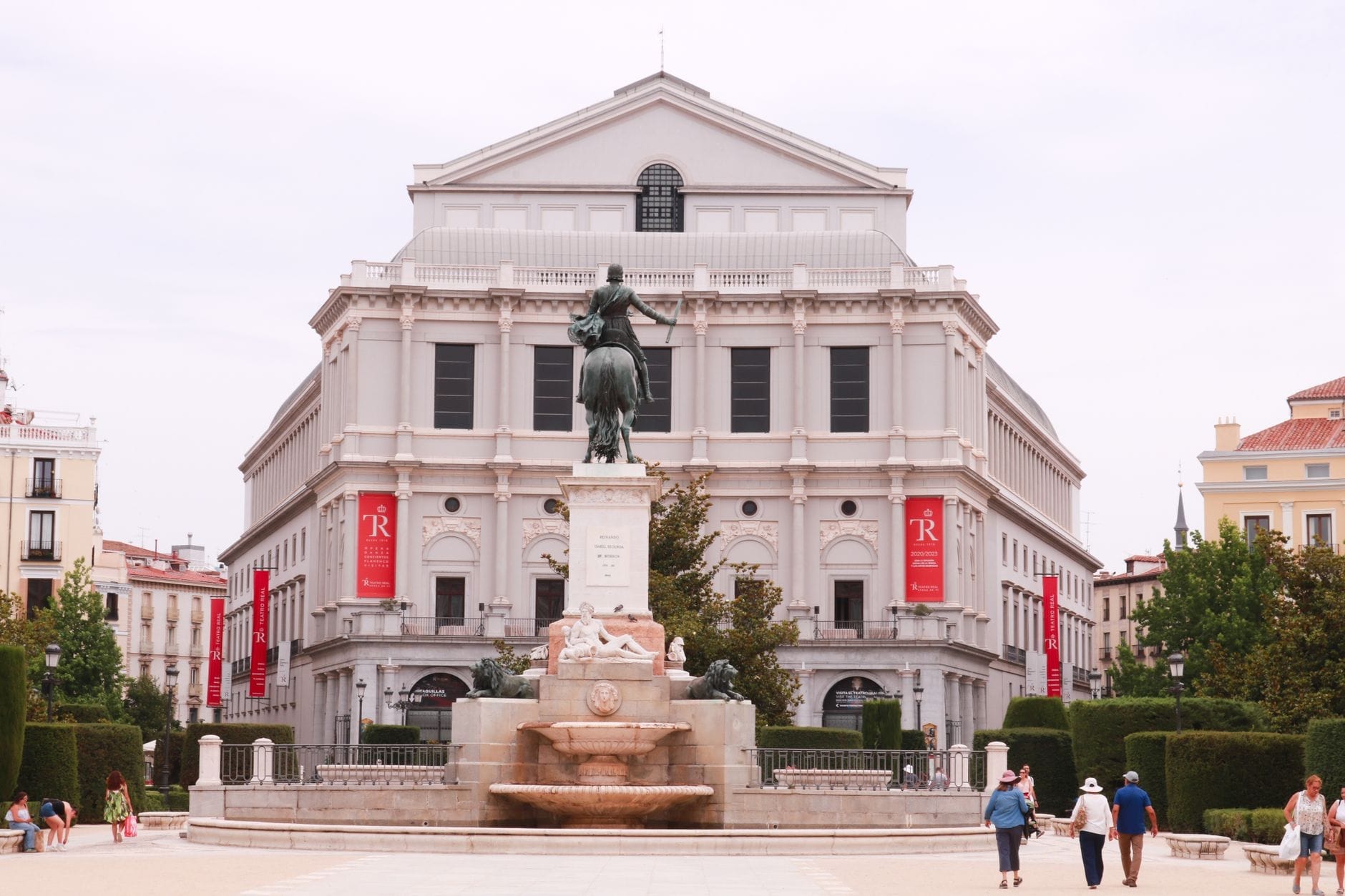
What Teatro Real Actually Is
Teatro Real is Spain's national opera house and one of Europe's most significant lyric theatres. Its full name in Spanish is simply Teatro Real, though it is also known informally as the Royal Theatre or Royal Opera House. Sitting on Plaza de Isabel II in central Madrid, it faces the Royal Palace across the plaza, occupying a symbolic position at the city's historical and ceremonial heart.
The building covers approximately 78,210 m², with a stage of around 1,430 m² and a maximum seating capacity of roughly 1,958 people. For a point of comparison, that stage is larger than the one at Vienna's Staatsoper. Productions here are not local affairs: the Teatro Real regularly co-produces work with the Paris Opéra, the Royal Opera House at Covent Garden, and La Scala in Milan.
The theatre sits at the edge of the Sol-Centro neighbourhood, walkable from Plaza Mayor and directly across from the Palacio Real. That clustering makes it easy to combine with a morning of sightseeing before an evening performance.
💡 Local tip
If you are not attending a performance, the self-guided audio tour (available in Spanish and English) is the most practical way to access the main hall, backstage corridors, and rooftop terrace. Tours run on a schedule; check current times on the official website before you go.
A History Built in Three Acts
The Teatro Real has had a complicated life. The first stone was laid on 23 April 1818 under King Ferdinand VII, but construction dragged on for decades due to funding shortfalls, political instability, and persistent geological problems — the building sits atop an aquifer. It finally opened as an opera house on 19 November 1850, when Queen Isabella II presided over a performance of Donizetti's 'La favorita'. For the next 75 years it was Madrid's principal cultural stage, hosting premieres of Verdi's works and performances by the great voices of the 19th century.
In 1925, structural damage forced the theatre to close. It sat in a kind of institutional limbo before reopening on 13 October 1966, not as an opera house but as a symphonic concert hall. Opera had been effectively exiled from its own home. A major restoration project began in 1991 and ran until 1997, a six-year effort to modernise the stage machinery, acoustics, and public spaces. The theatre reopened in its current form on 11 October 1997 and has functioned as a full opera house ever since.
That layered history shows inside. The neoclassical facade and horseshoe auditorium preserve the 19th-century aesthetic while the backstage infrastructure is entirely contemporary: hydraulic stage platforms, computerised fly systems, and acoustic engineering that was not possible at the original construction. The contrast is part of what makes the tour worthwhile even for visitors with no particular interest in opera.
Tickets & tours
Hand-picked options from our booking partner. Prices are indicative; availability and final rates are confirmed when you complete your booking.
Flexible time Real Madrid: Bernabeu Stadium & Museum Entry
From 42 €Instant confirmationMonasterio de las Descalzas Reales guided tour
From 13 €Instant confirmationReal Madrid Bernabeu Stadium tour and gourmet tasting
From 79 €Instant confirmationFree cancellationMonasterio de las Descalzas tickets and guided tour
From 19 €Instant confirmationFree cancellation
The Daytime Tour: What You See and Hear
The audio tour takes you through areas most performance-goers never reach. You move from the public foyers — with their cream-coloured marble, gilded details, and the kind of hush that large stone buildings hold even when crowded — into the main auditorium itself. Seeing the horseshoe of red and gold seating tiers from the stalls level, without an audience, gives you a very different sense of the scale than sitting in it during a performance. The ceiling fresco and the chandeliers are best appreciated in the flat white light of the day.
Depending on the tour schedule and whether the stage is in use for rehearsals, you may access backstage corridors where the mechanics of the operation become visible: ropes, counterweights, the understage machinery that can raise or lower entire sections of the floor. The smell changes distinctly in these areas — sawdust, paint, machine oil — a reminder that a theatre is as much a workshop as a performance space.
The rooftop terrace is the final stop and arguably the highlight for anyone visiting during the day. From there you look directly across at the Palacio Real and out over the Plaza de Oriente, with views reaching west toward the Casa de Campo. On clear mornings, the light from the east catches the palace façade cleanly. Arrive when the tour starts rather than catching a later slot; by midday in summer the terrace is exposed and warm.
⚠️ What to skip
Tour access to specific areas — including the stage and rooftop — depends on rehearsal schedules. Access to certain spaces can be restricted without notice. There is no guarantee the main stage will be visible on any given day. Check the official site for the day's tour format.
Attending a Performance: What to Expect
The difference between attending a performance at Teatro Real and visiting as a tourist during the day is significant. At night, the building transforms. The foyers fill with people in formal and semi-formal dress — there is no enforced dress code, but the local audience tends to dress up, particularly for premiere nights. The smell of fresh perfume mixes with the marble dust in the warm, well-lit foyers. Bar service operates between acts, and the terrace is accessible during intervals.
The acoustics in the main auditorium reward close attention. The 1991–1997 renovation prioritised sound quality, and the result is a hall where voices carry cleanly from the stage to the upper tiers without electronic amplification. If budget is a consideration, the upper-level seats are substantially cheaper than stalls or lower boxes and the acoustic difference is marginal. The sightline from the third and fourth tiers is steep but unobstructed.
Ticket prices vary considerably by production, date, and seat category. There is no fixed price list — the box office and official website are the only reliable sources. The ticket office is open Monday to Friday from 10:00 to 18:30 (until the end of the entr'acte on performance days), on Saturdays from 12:00 until the end of the entr'acte, and on Sundays and public holidays from two hours before the performance begins until the end of the entr'acte.
For context on Madrid's broader performing arts and nightlife scene, the Madrid nightlife guide covers music venues, flamenco tablaos, and theatre options across the city.
Getting There and Getting In
The most direct metro access is Ópera station, served by lines 2 and 5. The station exit deposits you in Plaza de Isabel II, with the Teatro Real immediately beside you as you face the Royal Palace. The walk from the station to the theatre entrance takes under two minutes. If you are coming from Puerta del Sol, the walk takes about eight minutes along Calle del Arenal.
EMT buses on routes 3, 25, 39, and 148 also serve the area. If you are arriving by taxi or ride-hailing app, ask to be dropped at Plaza de Isabel II rather than Plaza de Oriente to get to the main entrance directly.
Accessibility has been addressed with specific infrastructure: there is a ramp at the Felipe V Door and ground-level entry at the Carlos III Door. Lifts provide vertical circulation throughout the building, and lifting platforms allow wheelchair users to access the main hall. If you have specific accessibility requirements, it is worth contacting the theatre in advance to confirm arrangements for your visit date.
ℹ️ Good to know
Photography rules inside the auditorium vary by event. During tours, photography is generally permitted in the main hall and foyers. During performances, all photography and recording is prohibited. Follow staff guidance and posted signage.
Is It Worth Your Time?
For anyone with even a passing interest in classical music, architecture, or Spanish cultural history, the answer is yes — with caveats. The audio tour at €10 is good value for what it covers, but it works best when stage access is available. If you are arriving in Madrid for a short trip and trying to prioritise, attending a performance here will be a more memorable experience than visiting on a daytime tour, though obviously it requires more planning and budget.
If you are not a fan of opera or classical music and are largely motivated by the architecture, the exterior of the Teatro Real can be appreciated for free from the Plaza de Oriente, and the neighbourhood itself — with the palace, the jardines de Sabatini to the north, and the old centre to the east — is worth an hour of walking on its own terms.
Travellers building a broader cultural itinerary in Madrid should also consider the best museums in Madrid and the Madrid architecture guide to contextualise the Teatro Real alongside the city's other major sites.
Worth noting: visitors who expect the Teatro Real to function like an open-access tourist attraction may find it limiting. Unlike a museum, it operates primarily as a working theatre. Large sections are inaccessible without a tour ticket, and tour availability depends on the rehearsal calendar. Plan ahead rather than arriving speculatively.
Insider Tips
- Book performance tickets well in advance for major productions. The Teatro Real's season runs roughly from September to July, and premiere nights and popular operas sell out weeks or months ahead. The official website releases tickets in batches — set up an account and check regularly.
- The rooftop terrace on the audio tour offers one of the cleaner views of the Palacio Real from an elevated position, without the crowds of Plaza de Oriente below. Morning tours in spring and autumn get the best light on the palace façade.
- Upper-tier seats (third and fourth levels) offer significantly lower prices than the stalls or lower boxes. The acoustics hold up well in these sections, and the steep angle gives a bird's-eye perspective on the stage design that stalls seats do not provide.
- If you want to experience the building's atmosphere without paying for a full tour or performance, have a coffee at the theatre's café on the ground floor during opening hours. The interior foyer spaces are accessible, and you get a sense of the scale and materials without a ticket.
- Combine the Teatro Real visit with the Plaza de Oriente and the nearby Jardines de Sabatini for a coherent half-day in the area. The neighbourhood is quieter and less trafficked than the Puerta del Sol corridor, and it reads as a more composed version of central Madrid.
Who Is Teatro Real For?
- Opera and classical music fans looking for a world-class production in a historic European house
- Architecture enthusiasts interested in 19th-century neoclassical design and its interaction with modern theatrical engineering
- First-time visitors to Madrid who want to understand the city's relationship with its royal and cultural history
- Couples looking for a high-quality evening out — attending a performance here is one of the most formal and impressive cultural experiences in the city
- Travellers with limited time who want to combine the theatre visit with the Royal Palace and Plaza de Oriente in a single half-day loop
Nearby Attractions
Other things to see while in Sol & Centro:
- Catedral de la Almudena
The Almudena Cathedral took more than a century from the laying of its foundation stone to its consecration in 1993, making it one of Europe's newest major cathedrals. Free to enter and directly opposite the Royal Palace, it rewards visitors who look beyond its mismatched facade to discover a surprisingly bold and colorful interior.
- Campo del Moro Gardens
The Jardines del Campo del Moro spread across more than 20 hectares directly behind the Royal Palace, offering one of the most dramatic views of the Palacio Real in Madrid. Admission is free, crowds are thin compared to the palace itself, and the romantic English-style landscape feels worlds away from the city streets above.
- Círculo de Bellas Artes
Few buildings in central Madrid earn attention on multiple levels at once. The Círculo de Bellas Artes delivers: a landmark Palacios-designed tower within the Paisaje de la Luz UNESCO World Heritage area with a rooftop terrace above the Gran Vía skyline, rotating art exhibitions, and one of the city's most atmospheric cafés. Entry to the building and La Pecera café is free; the rooftop, exhibitions, and combined tickets have separate fees starting from around €6.
- Edificio Metrópolis
Standing at the junction of Calle de Alcalá and Gran Vía, the Edificio Metrópolis is Madrid's most iconic piece of Belle Époque architecture. Its slate dome, gilded detailing, and winged Victory statue make it a landmark that rewards careful observation, even though the building itself is not a public museum. Here is everything you need to know before you go.