House of the Blackheads, Tallinn: The Medieval Hall That Still Hosts Concerts
Built in the early 15th century and used by the Brotherhood of Black Heads from 1406 until Soviet occupation in 1940, the House of the Blackheads on Pikk Street is one of Tallinn's most architecturally striking buildings. Today it functions as a concert and event venue, meaning access depends on the schedule rather than fixed opening hours.
Quick Facts
- Location
- Pikk tn 26, Tallinn Old Town
- Getting There
- 10-minute walk from Viru Gate; Old Town is compact and pedestrian-friendly
- Time Needed
- 30–60 minutes for exterior and any accessible interior
- Cost
- Exterior free; interior access varies by event — check filharmoonia.ee for listings
- Best for
- Architecture lovers, history enthusiasts, classical music fans
- Official website
- www.filharmoonia.ee/en/mustpeademaja
What Is the House of the Blackheads?
The House of the Blackheads (Estonian: Mustpeade maja) stands at Pikk 26 in Tallinn's Old Town, occupying a corner position that has made it a visual landmark for well over five centuries. The Brotherhood of Black Heads, a guild of unmarried foreign merchants and shipowners, used the building as their assembly and meeting hall from 1406 until the Soviet occupation ended their activities in the summer of 1940. For over 500 years, the hall served as a center of merchant culture, ceremonial gatherings, and civic life in one of the Baltic's most important trading cities.
The building is not a museum in the conventional sense. There is no permanent exhibition you can walk into on a whim. Today, the House of the Blackheads functions primarily as a concert and event venue managed by the Tallinn Philharmonic Society. Access to the interior depends entirely on what is programmed for any given day. If nothing is scheduled, the doors stay closed. This is one of the most important practical facts to understand before making it the centerpiece of your itinerary.
⚠️ What to skip
There are no fixed public visiting hours. Always check the event calendar at filharmoonia.ee before planning your visit. Arriving without checking may mean seeing only the exterior.
The Facade: What You See from the Street
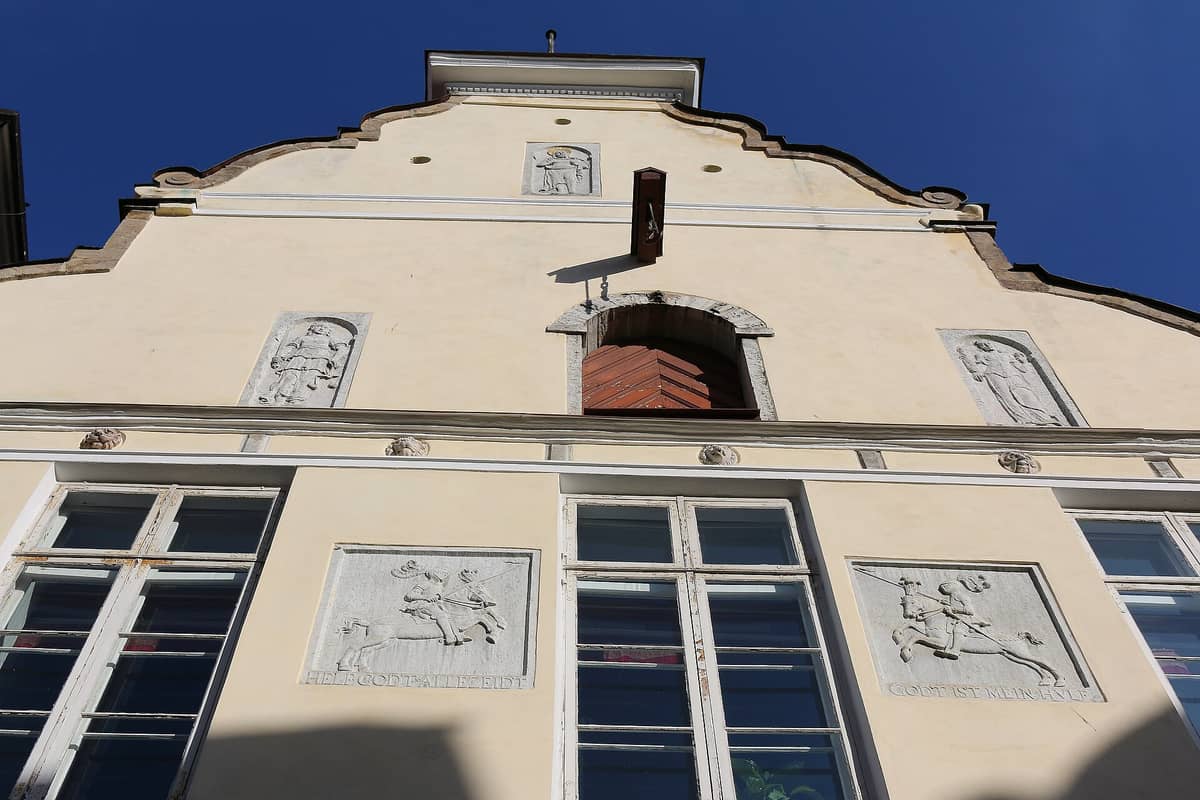
Even if the interior is closed, the exterior of the House of the Blackheads delivers a clear architectural argument for stopping. The facade on Pikk Street is richly ornamented in a style that blends Dutch Renaissance and late Gothic influences, unusual in a city where most Old Town architecture keeps a more austere medieval profile. The stone carvings, detailed portal work, and decorative elements give the building a visual density that rewards slow looking.
The coat of arms above the entrance is worth examining closely. It displays the head of Saint Maurice, the Brotherhood's patron saint, depicted as a Black African figure, which explains both the Brotherhood's name and the iconography repeated in decorative details across the building. In morning light, when the low Baltic sun hits the facade from an angle, the relief work becomes dramatically three-dimensional. By midday the effect flattens considerably.
The building sits along Pikk Street, one of the Old Town's main arteries, connecting the Lower Town with the port area. The street itself is worth exploring: the Great Guild Hall and St. Olaf's Church are both within easy walking distance, making this corridor one of the most historically concentrated stretches in the city.
Tickets & tours
Hand-picked options from our booking partner. Prices are indicative; availability and final rates are confirmed when you complete your booking.
Self-guided Discovery Walk of Tallinn city contrasts beyond the medieval walls
From 26 €Instant confirmationFree cancellationTallinn's art and culture tour with a local
From 62 €Instant confirmationFree cancellationHistorical walking tour of Tallinn with a local
From 599 €Instant confirmationFree cancellationIntroductory walking tour of Tallinn with a local guide
From 109 €Instant confirmationFree cancellation
Historical Context: The Brotherhood and the Building
The Brotherhood of Black Heads was a merchant guild composed of unmarried foreign traders, primarily from German-speaking regions, Scandinavia, and the Netherlands. In medieval Tallinn (then known as Reval), such brotherhoods organized the social and commercial life of the merchant class, providing mutual support, ceremonial functions, and civic representation. The Black Heads were distinct from the Great Guild, which admitted married merchants, and their assembly hall reflected their wealth and international connections.
The building complex the Brotherhood occupied from 1406 is considered one of the most significant architectural ensembles in the Old Town. Over the centuries, the hall was renovated and embellished, accumulating the layered character visible today. Its survival through centuries of fire, war, and Soviet administration is itself a form of historical testimony.
Understanding this building properly requires some background in Tallinn's medieval history, particularly the role of Hanseatic trade networks in shaping the city's architecture and social structure. The House of the Blackheads is a direct product of that era, as much as the town walls or the cathedral on Toompea.
Visiting the Interior: Concerts and Events
When the building is open for a concert or event, the interior offers something genuinely worth the effort of planning. The main hall has exceptional acoustic properties and a decorated interior that has survived in remarkable condition. Classical music performances, chamber concerts, and formal ceremonies regularly take place here, and the setting amplifies any performance with a sense of occasion that modern venues rarely achieve.
Ticket prices vary by event and are sold through the Tallinn Philharmonic Society's listings on filharmoonia.ee. There is no general admission tariff. Visiting as part of an audience is currently the primary way to experience the interior, so it is worth checking the calendar weeks ahead if you want this to be part of your visit, particularly if you are traveling during peak summer months when events can sell out.
💡 Local tip
Classical music concerts here often sell out in advance during summer. Book tickets on filharmoonia.ee before arrival rather than hoping for walk-up availability.
Time of Day and Crowds
Pikk Street receives consistent pedestrian traffic throughout the day, particularly between 10:00 and 17:00 when tour groups move through the Old Town. The House of the Blackheads is a standard stop on walking tours, so the pavement directly in front can become congested during midmorning and early afternoon. If photography of the facade is your goal, early morning before 09:00 or early evening after 18:00 will give you cleaner shots with fewer people and better light.
Evening events at the venue draw a more local crowd, which changes the atmosphere around the building noticeably. The surrounding streets quiet down after tourist hours, and arriving for a concert gives you Pikk Street in a very different register: fewer selfie sticks, more people dressed for an evening out, the faint warmth of streetlamps on old stone. It is, by most measures, the better experience.
The Old Town as a whole repays visiting across multiple times of day. For a structured sense of how the area works, a walking tour of Tallinn's Old Town can help you sequence stops efficiently and understand what you are looking at.
Practical Details and Getting There
The House of the Blackheads is at Pikk tn 26, in the Kesklinna district of Tallinn's Old Town. The Old Town is compact and almost entirely pedestrian, so the practical question is how to reach the Old Town perimeter, not how to navigate within it. From Viru Gate, one of the main entry points into the Old Town, the building is roughly a 10-minute walk north along Pikk Street.
Tallinn has a functional network of buses, trams, and trolleybuses; details are available at transport.tallinn.ee. Taxis and the Bolt ride-hailing app are reliable options from elsewhere in the city. If you are staying in or near the Old Town, you will almost certainly pass the building during normal exploration. The Viru Gate is the most convenient entry point if you are approaching from the modern city center.
Accessibility information is not published on the official venue pages reviewed, so visitors with mobility requirements should contact the Tallinn Philharmonic Society directly via filharmoonia.ee before planning a visit. The Old Town's cobblestone streets present challenges in general, and this is worth factoring in.
Who Should and Should Not Prioritize This
The House of the Blackheads is a strong stop for visitors interested in medieval merchant architecture, Hanseatic history, or the visual language of Northern European guild culture. For classical music fans, the combination of a historic interior and serious programming makes attending a concert here a genuinely memorable experience rather than a tourist obligation.
Travelers expecting a conventional museum with labeled displays, fixed hours, and walk-in access will be frustrated. The building does not work that way. Similarly, visitors on very tight itineraries who cannot schedule around an event will have to settle for the exterior, which is rewarding but limited. If interior access matters to you, plan around the event calendar. If you are simply passing through, the facade alone is worth the short detour from the main Old Town circuit.
Insider Tips
- Check the Tallinn Philharmonic Society's event calendar at filharmoonia.ee at least two weeks before your trip. Chamber concerts here book up quickly in July and August.
- The best facade photography happens in early morning before 09:00, when the street is empty and the light hits the carved stone portal at an angle that makes the relief work stand out clearly.
- If you are visiting the Old Town on a walking tour, Pikk Street runs almost the full length of the Lower Town from Viru Gate to the port area. The House of the Blackheads falls naturally into a north-south walk rather than requiring a dedicated detour.
- Evening concert-goers often find a quieter, more atmospheric version of the Old Town on their way to and from the venue. The streets around Pikk Street after 19:00 are noticeably less crowded than during the day.
- The coat of arms above the main entrance is a precise piece of iconography: the Moorish head of Saint Maurice, the Brotherhood's patron, appears in several places on the facade. Knowing what you are looking for makes the decorative details considerably more interesting.
Who Is House of the Blackheads For?
- Architecture enthusiasts drawn to Northern European medieval and Renaissance guild buildings
- Classical music fans looking for a historically significant concert setting
- History travelers researching Hanseatic trade networks and medieval merchant culture
- Photographers seeking the Old Town's most ornate street-level facade
- Couples planning an evening out with a cultural dimension beyond the standard dinner-and-drinks circuit
Nearby Attractions
Other things to see while in Tallinn Old Town:
- Alexander Nevsky Cathedral
Rising above Toompea Hill with five gilded onion domes and a facade that dominates every Old Town panorama, Alexander Nevsky Cathedral is Tallinn's most visually assertive building. Built between 1895 and 1900, it remains an active Orthodox place of worship and a window into the city's layered Russian and Estonian history.
- Danish King's Garden
Tucked into the western slope of Toompea hill, the Danish King's Garden is a small, free public park woven into Tallinn's medieval fortifications. Open around the clock and steps from the Old Town's main streets, it offers a rare moment of calm alongside ancient towers and stone walls with an 800-year-old backstory.
- Fat Margaret
Fat Margaret (Paks Margareeta) is a squat, round cannon tower that has guarded the northern gate of Tallinn's Old Town since the early 16th century. Today it houses the Estonian Maritime Museum, with exhibits on seafaring history and a rooftop terrace overlooking the harbour. It is one of the few surviving medieval structures in Tallinn where you can explore both the architecture and a well-curated permanent collection under the same roof.
- Freedom Square
Freedom Square sits at the southern edge of Tallinn Old Town, anchoring the city's civic identity with the striking War of Independence Victory Column. Open around the clock and free to enter, it serves as a gathering point for national celebrations, winter markets, and everyday Tallinn life.