Symphony Hall Boston: The Acoustic Masterpiece at the Heart of Fenway-Kenmore
Opened in 1900 and designated a National Historic Landmark in 1999, Boston's Symphony Hall is one of the finest concert venues in the world. Home to the Boston Symphony Orchestra and the Boston Pops, the hall rewards visitors with extraordinary sound, gilded Neoclassical architecture, and a program calendar that spans orchestral premieres to holiday spectaculars.
Quick Facts
- Location
- 301 Massachusetts Avenue, Boston, MA 02115 (corner of Massachusetts Ave & Huntington Ave, Fenway–Kenmore)
- Getting There
- MBTA Green Line E branch — Symphony Station (one block away); also Hynes Convention Center (Green Line B/C/D) and Massachusetts Ave bus connections
- Time Needed
- 2–3 hours for a standard concert; 1–1.5 hours for a guided tour
- Cost
- Ticket prices vary by program and seat; no general admission entry. Check the BSO box office for current pricing.
- Best for
- Classical music lovers, architecture enthusiasts, date nights, and travelers with an interest in American cultural history
- Official website
- www.bso.org
Why Symphony Hall Matters
Boston's Symphony Hall is not merely a performance venue. It is a purpose-built acoustic instrument, engineered with the same scientific rigor as the music it hosts. When it opened on October 15, 1900, it became the first concert hall in the world to be designed using principles from modern architectural acoustics, a collaboration between the architectural firm McKim, Mead & White and Harvard physicist Wallace Clement Sabine. More than 120 years later, the hall still ranks consistently among the top concert halls in the world for acoustics, often mentioned alongside Amsterdam's Concertgebouw and Vienna's Musikverein.
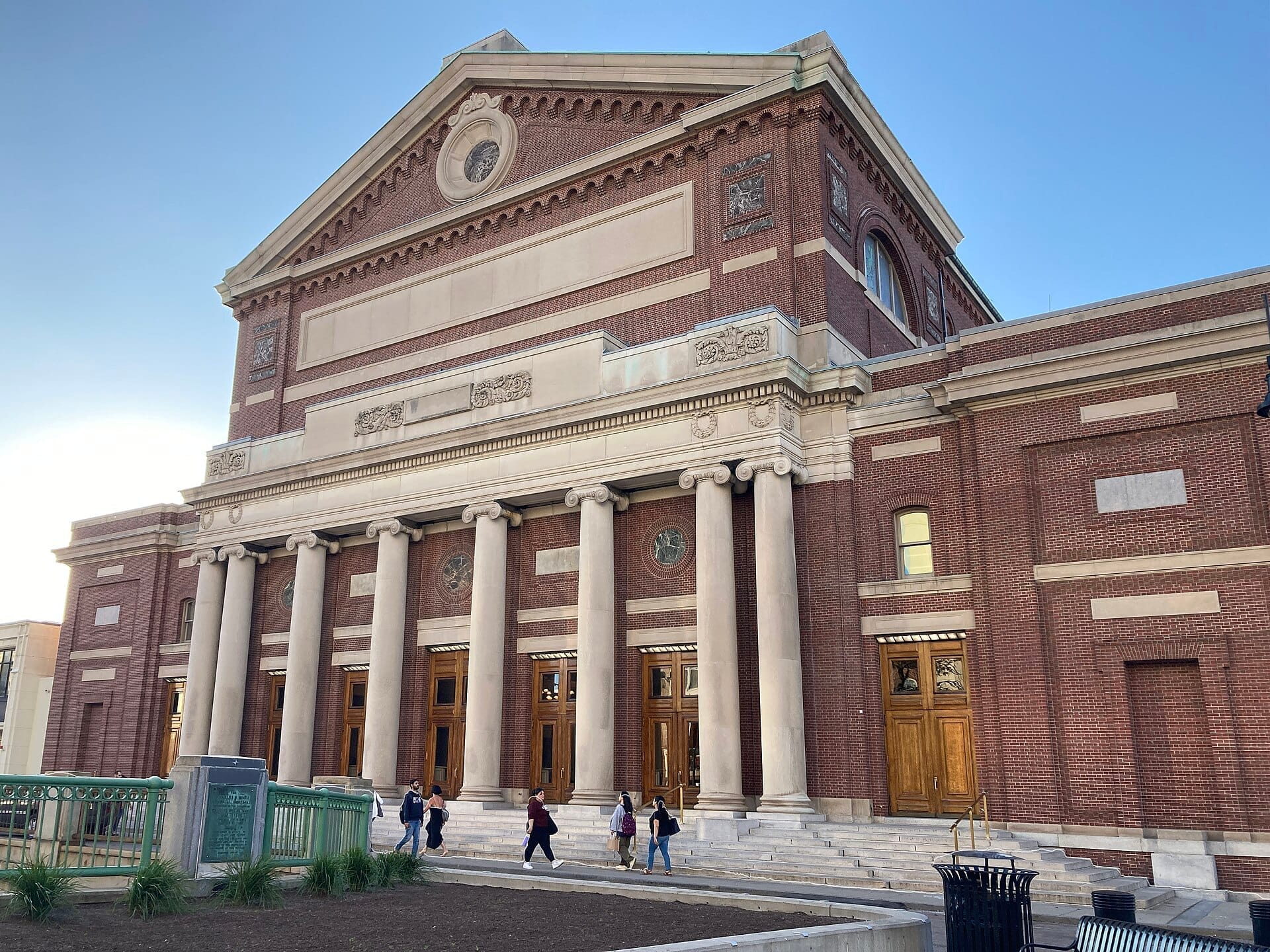
The building sits at the corner of Massachusetts Avenue and Huntington Avenue, a geographic boundary between the Fenway-Kenmore and Back Bay neighborhoods. Its red-brick and limestone facade, trimmed in classical pilasters, signals institutional permanence rather than spectacle. Inside, the contrast is revelatory: a 2,625-seat shoebox-style hall for Symphony season lined with niches holding plaster casts of Greek and Roman statues, bracketed by ornate balconies, and topped with a coffered ceiling that funnels sound with uncanny precision.
ℹ️ Good to know
Symphony Hall is a U.S. National Historic Landmark (designated 1999) and operates under the Boston Symphony Orchestra. Entry is by ticketed performance or guided tour only — there is no walk-in general admission.
The Architecture and Acoustics: What Makes It Special
Wallace Clement Sabine's contribution to Symphony Hall cannot be overstated. Before the hall was built, Sabine had spent years studying the acoustic failures of Harvard's Fogg Art Museum lecture hall, developing what became the foundational equation for reverberation time. When McKim, Mead & White brought him in as acoustical consultant, he specified the shoebox geometry — a long, narrow rectangular room with a high ceiling — as the optimal shape for orchestral music. He calculated the precise volume needed, the ratio of sound-absorbing surfaces to reflective ones, and even accounted for the acoustic weight of an audience.
The result is a hall where sound behaves as if the room itself is performing. Sitting in the main-floor orchestra section, you can hear a solo violin without amplification from the back of the hall. The upper balconies, often considered secondary seats in other venues, actually offer exceptional sound diffusion here. The 34 niches along the walls, each containing a plaster cast reproduction of a classical statue, are not decorative whims: their irregular surfaces scatter sound waves in ways that prevent the flat echoes and dead zones common in simpler rectangular rooms.
The Neoclassical interior design by McKim, Mead & White reflects the same Boston Brahmin cultural ambition that shaped the Museum of Fine Arts and the Boston Public Library during the same era. Gold leaf, dark wood paneling, and velvet upholstery create an atmosphere that feels serious without being oppressive. The organ pipes above the stage, framed by a classical arch, are visual as well as functional: the E.M. Skinner organ, later upgraded and modified, remains in use during certain programs.
Tickets & tours
Hand-picked options from our booking partner. Prices are indicative; availability and final rates are confirmed when you complete your booking.
Boston Summer Night Trolley Tour and River Cruise
From 27 €Instant confirmationFree cancellationLEGOLAND Discovery Center Boston tickets
From 26 €Instant confirmationFree cancellationGhosts and Gravestones tour of Boston
From 39 €Instant confirmationFree cancellationBest of Boston tour
From 182 €Instant confirmationFree cancellation
Attending a Performance: What the Experience Is Actually Like
Arriving at Symphony Hall before a BSO subscription concert feels different from attending most performing arts venues. Patrons tend to arrive 20 to 30 minutes early, filling the marble-floored lobby with conversation and the faint sound of the orchestra warming up. The lobby is modest in scale by modern arena standards, which creates an unexpectedly intimate pre-concert atmosphere. Coat check lines can be slow in winter, so arrive at least 30 minutes before curtain if you are bringing heavy outerwear.
Once inside the hall itself, the first thing most visitors notice is the smell: aged wood, plaster, and a faint trace of rosin, the substance string players apply to their bows. It is a scent specific to old concert halls. The seats are narrower than contemporary stadium seating, reflecting the body dimensions of 1900 rather than 2024, so visitors who prefer extra space should look at end-of-row seats or first balcony positions when booking.
The Boston Symphony Orchestra performs its main subscription season from late September through early May. The Boston Pops, the BSO's lighter-programming counterpart, takes over the hall from May through July, reconfiguring the main floor by replacing fixed seats with café-style tables and chairs, which reduces capacity to about 2,371. The two formats produce very different social atmospheres: BSO concerts are formal and attentive, while Pops evenings, especially during the holiday season, lean toward celebratory and inclusive.
💡 Local tip
For the best acoustic experience at a moderate price, consider first-balcony center seats. They offer excellent sightlines, strong sound projection, and are typically less expensive than main-floor orchestra rows. Avoid the extreme side sections of the upper balcony if clear sightlines to the stage matter to you.
Symphony Hall sits in the Fenway-Kenmore neighborhood, which means the surrounding blocks offer pre-concert options ranging from casual restaurants on Boylston Street to the cultural density of the Museum of Fine Arts, about a 10-minute walk south. Plan dinner 90 minutes before curtain to avoid a rushed exit from nearby restaurants.
Guided Tours: Seeing the Hall Without a Concert Ticket
The Boston Symphony Orchestra offers guided tours of Symphony Hall, typically available on select weekdays and Saturdays when no rehearsal or performance is scheduled. Tours give access to areas not visible during a concert, including backstage corridors, the organ loft, and the historical archives room. A docent-led tour generally runs 60 to 90 minutes and covers the building's architectural history, the Sabine acoustics story, and the BSO's institutional history dating to the orchestra's founding in 1881.
Tour availability changes seasonally and around the performance schedule, so checking the BSO website before planning a visit is essential. Tours book out in advance during peak tourism months, particularly September and October. Groups require advance reservations. Solo travelers and small parties can often join scheduled public tours on a walk-in basis, but confirming availability ahead of time is advisable.
⚠️ What to skip
The hall does not function as a museum with fixed public hours. Do not arrive unannounced expecting to enter. Check the official tour schedule at bso.org/visit well before your trip.
Getting There and Practical Logistics
Symphony Hall is one of the easiest major venues in Boston to reach by public transit. The MBTA Green Line E branch stops at Symphony Station, which is literally one block from the hall's main entrance on Massachusetts Avenue. On concert nights, the platform and street outside fill noticeably with concert-goers in the 45 minutes before curtain, and again immediately after the performance. If you are traveling from Back Bay or downtown, the Hynes Convention Center stop on the B, C, and D Green Line branches is a slightly longer walk of about 12 minutes but avoids the E branch, which can have schedule gaps.
Driving to Symphony Hall is possible but not particularly convenient. Street parking in the surrounding blocks is metered and competitive on performance nights. Several paid parking garages operate within a 5 to 10 minute walk, including options near the Prudential Center and along Belvidere Street. Budget an extra 20 minutes if arriving by car on a Friday or Saturday evening, when traffic on Huntington Avenue and Massachusetts Avenue is heavy.
Rideshare drop-off works well at Symphony Hall; there is no dedicated rideshare lane, but Massachusetts Avenue has sufficient curb space outside peak gridlock times. For more context on navigating Boston's public transit system, the getting around Boston guide covers MBTA fares, CharlieCard options, and line-by-line tips.
Accessibility services at Symphony Hall include accessible seating options, hearing loop technology for patrons with hearing aids compatible with telecoil settings, and accessible entrances on Massachusetts Avenue. The BSO's visitor services team can arrange specific accommodations with advance notice; details are listed at bso.org/visit.
How the Experience Changes Across the Year
The character of Symphony Hall shifts considerably depending on the season and program. In October, when the BSO's subscription season is just weeks old, audiences skew toward longtime subscribers who treat attendance as ritual. The hall feels deliberately formal. By December, the Boston Pops Holiday concerts bring a noticeably different crowd: families, tourists, first-time visitors, and people who may not attend classical performances at any other time of year. These holiday programs frequently sell out weeks in advance.
Spring Pops evenings in May and June are among the most socially relaxed concerts the hall offers. The café table configuration, casual dress, and lighter programming create an atmosphere closer to a supper club than a classical concert hall. For visitors who feel intimidated by the formality of a full BSO program, a spring or summer Pops evening is a lower-stakes introduction to the space itself.
Summer visitors should note that the BSO leaves Boston for Tanglewood, its outdoor summer home in the Berkshires, from late June through August. Symphony Hall activity drops significantly in those months, though some special events and tours continue. For summer cultural programming in Boston more broadly, see the Boston in summer guide and consider pairing a Symphony Hall tour with a walk through the Isabella Stewart Gardner Museum, which is a 12-minute walk away and shares Symphony Hall's late-19th-century cultural origins.
Who Will Love This, and Who Might Not
Symphony Hall rewards visitors who come with curiosity, not just those who already love orchestral music. The architectural story alone, the physics of sound made physical, is compelling enough to justify a tour or a concert ticket. Architecture enthusiasts who have already visited the nearby Boston Public Library or Trinity Church in Copley Square will find Symphony Hall completes a picture of late-19th-century American civic ambition.
Travelers who thrive on spontaneous, drop-in experiences will find Symphony Hall frustrating. You cannot simply wander in. The experience requires advance planning: buying tickets, checking tour schedules, or at minimum confirming an event is happening on your date. If spontaneity is your priority, the Boston Public Garden and the Newbury Street corridor are better fits for the Fenway-Kenmore and Back Bay area.
Young children at BSO subscription concerts are not a good match. The silence expected during performances is strict, programs typically run 90 to 120 minutes without intermission for the first half, and the seating is not designed for restlessness. Boston Pops Family Concerts, offered on specific dates throughout the year, are specifically designed for families with children and offer a distinctly different format with shorter segments and audience interaction.
Insider Tips
- The BSO's Open Rehearsals — usually held on Thursday mornings before Friday-night concerts — offer full-orchestra rehearsals at a fraction of the concert ticket price. The experience is less polished but often more revealing, as you may hear sections repeated, hear the conductor give notes, and observe the hall at a different kind of attention.
- Rush tickets for BSO subscription concerts are often available at the box office on the day of the performance, typically released 30 to 60 minutes before curtain. These are genuine savings, not obstructed-view consolations, and are worth the gamble if your schedule is flexible.
- The best photographs of the hall's interior are taken from the back of the first balcony, where you can capture the full length of the room, the stage, and the organ pipes in a single frame. A wide-angle lens setting on a phone camera works well in the available light before curtain. Photography during performances is not permitted.
- Winter concert nights can get very cold in the lobby during late arrivals or intermission, as the Massachusetts Avenue entrance doors open repeatedly. A layer you can remove once seated is more practical than a single heavy coat.
- The BSO website lists free pre-concert talks for most subscription series concerts, held in the hall itself about an hour before curtain. These are included with your ticket and offer substantive context on the program, the composers, or the guest soloists. They run about 30 minutes and are informative rather than promotional.
Who Is Symphony Hall For?
- Classical music enthusiasts attending BSO or Boston Pops performances
- Architecture and acoustic history buffs interested in the McKim, Mead & White and Wallace Clement Sabine story
- Couples looking for a considered, special-occasion evening in Boston
- Cultural travelers exploring Boston's late-19th-century institutional legacy
- First-time classical concert attendees who want to experience a world-class hall for a Pops program before committing to full orchestral concerts
Nearby Attractions
Other things to see while in Fenway–Kenmore:
- Fenway Park
Fenway Park has been the home of the Boston Red Sox since 1912, making it the oldest active ballpark in Major League Baseball. Whether you're catching a game under the lights or taking a guided tour on a quiet morning, the experience goes well beyond baseball.
- First Church of Christ, Scientist (Mother Church)
The First Church of Christ, Scientist — known as The Mother Church — anchors a 14-acre urban plaza in Boston's Fenway-Kenmore district, offering a rare combination of Romanesque Revival and Greek Revival with Byzantine influences architecture, free public access, and one of the city's most serene open spaces. Few visitors know it exists, which is precisely why it's worth your time.
- Isabella Stewart Gardner Museum
The Isabella Stewart Gardner Museum is not a conventional art institution. Built in the style of a 15th-century Venetian palazzo around a flower-filled courtyard, it houses one of America's most personal and unconventional private art collections, assembled by a Boston socialite whose will dictated that nothing could ever be moved, sold, or changed.
- Museum of Fine Arts, Boston
The Museum of Fine Arts, Boston is one of the largest and most encyclopedic art museums in the United States, with nearly 500,000 works spanning ancient Egypt to contemporary America. Housed in a landmark Beaux-Arts building in the Fenway-Kenmore neighborhood, it rewards first-time visitors and regulars alike with collections that take days to fully absorb.