The Mother Church: Boston's Most Underappreciated Architectural Landmark
The First Church of Christ, Scientist — known as The Mother Church — anchors a 14-acre urban plaza in Boston's Fenway-Kenmore district, offering a rare combination of Romanesque Revival and Greek Revival with Byzantine influences architecture, free public access, and one of the city's most serene open spaces. Few visitors know it exists, which is precisely why it's worth your time.
Quick Facts
- Location
- 210 Massachusetts Ave, Boston, MA 02115-3012 (Symphony)
- Getting There
- MBTA Green Line – Hynes Convention Center station (5-min walk), or Symphony station (4-min walk)
- Time Needed
- 45 minutes for the exterior and plaza; 2+ hours if you visit the Mapparium at the Mary Baker Eddy Library
- Cost
- Free to enter the church and plaza; Mary Baker Eddy Library / Mapparium charges separate admission
- Best for
- Architecture enthusiasts, quiet seekers, photography, history buffs, curious travelers
- Official website
- www.christianscience.com/the-mother-church-in-boston
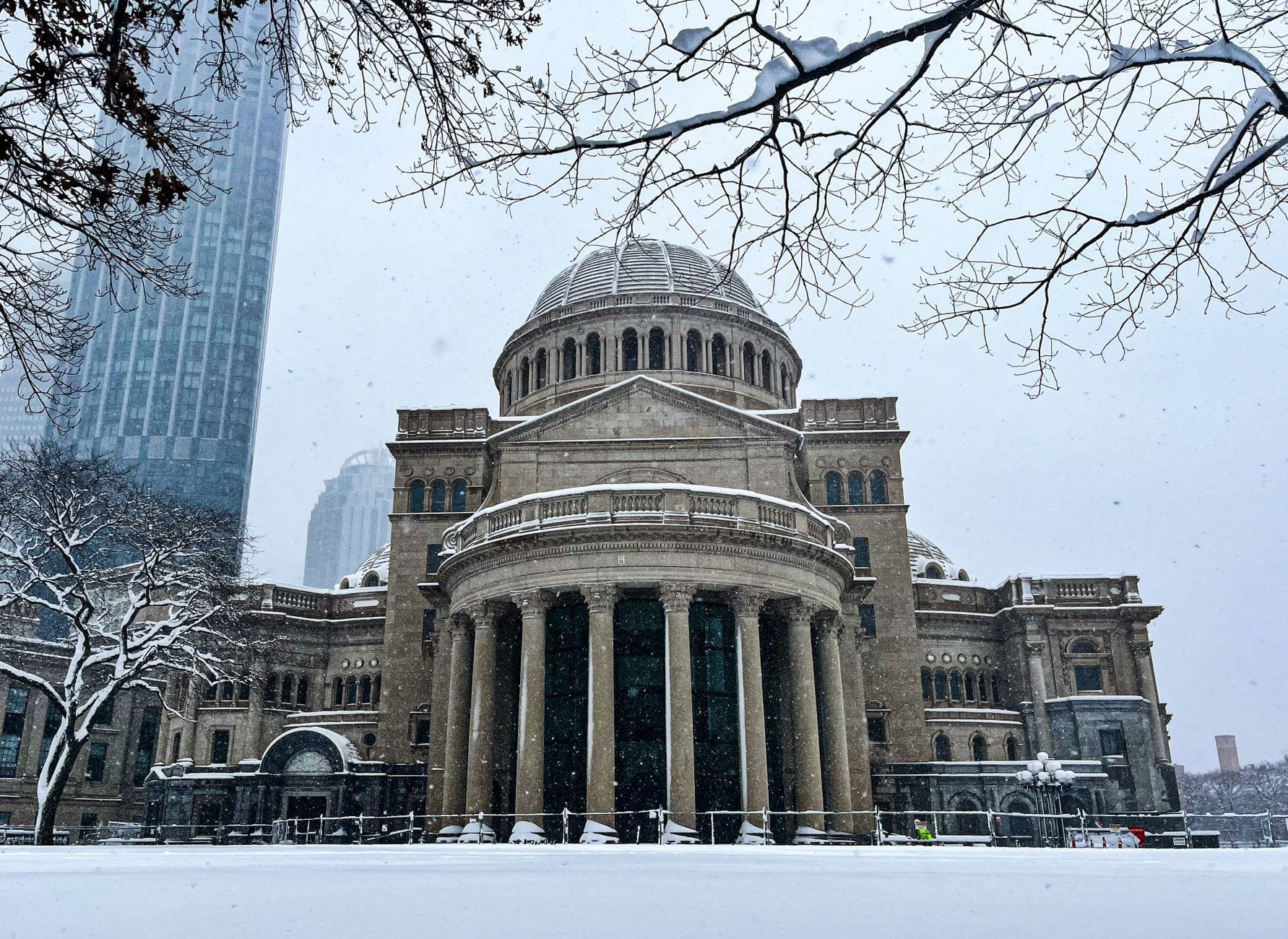
What You're Actually Looking At
The First Church of Christ, Scientist — formally titled The Mother Church — is the global headquarters of the Christian Science movement, founded by Mary Baker Eddy. It sits at the center of a 14-acre plaza that is the largest privately owned, publicly accessible open area in Boston. That statistic alone is worth pausing on: this is more open ground than most Boston parks, and almost no tourists end up here.
The complex consists of two distinct buildings constructed decades apart. The original 1894 edifice is a compact Romanesque Revival structure, built of stone. Immediately adjacent and dwarfing it stands the 1906 extension: a soaring building with a dome that clears 224 feet, and a style later described as Greek Revival with Byzantine influences. The contrast between the two is visually striking rather than jarring — the older building reads almost like a chapel tucked beside a cathedral.
💡 Local tip
The best single photograph of the complex is taken from the far end of the reflecting pool, looking back toward the dome. Arrive before 9 a.m. on a weekday morning for glassy water and minimal foot traffic.
A Brief History Worth Knowing
Mary Baker Eddy founded Christian Science in the 1870s, publishing her foundational text, 'Science and Health with Key to the Scriptures,' in 1875. The land for The Mother Church was acquired in 1886, and the first building was completed in 1894 — a deliberate, if modest, statement of institutional permanence for a young religious movement. By 1906, the movement's growth demanded something more ambitious, and the extension was built to seat thousands of worshippers.
The Christian Science Plaza surrounding the buildings was developed in the 1970s as part of a major urban renewal effort, designed by I.M. Pei and Partners. The reflecting pool, the broad granite surfaces, and the low-slung administrative buildings that frame the complex all date from this period. A comprehensive preservation and restoration of The Mother Church itself was completed in 2023, meaning the building is currently in excellent condition, the stonework clean and details sharp.
The church sits in the Fenway-Kenmore neighborhood, a part of Boston dense with cultural institutions — the Museum of Fine Arts, the Isabella Stewart Gardner Museum, and Symphony Hall are all within a 15-minute walk. If you're already planning a visit to the Museum of Fine Arts, adding a detour to the Christian Science Plaza costs you almost nothing in time.
Tickets & tours
Hand-picked options from our booking partner. Prices are indicative; availability and final rates are confirmed when you complete your booking.
Boston Summer Night Trolley Tour and River Cruise
From 27 €Instant confirmationFree cancellationLEGOLAND Discovery Center Boston tickets
From 26 €Instant confirmationFree cancellationGhosts and Gravestones tour of Boston
From 39 €Instant confirmationFree cancellationBest of Boston tour
From 182 €Instant confirmationFree cancellation
The Plaza: More Than a Foreground
Most visitors treat the plaza as a path to the buildings, but it rewards slower attention. The reflecting pool stretches the full length of the complex, and on calm days the dome's reflection sits cleanly on the surface. The granite is broad and slightly rough underfoot, warm when the sun hits it in the afternoon. Pigeons work the space heavily midday; mornings are quieter, with a few joggers cutting through from nearby Fenway.
In warmer months, office workers from the nearby administrative buildings eat lunch along the pool's edge. On Sunday mornings, the mood shifts entirely: quieter, more purposeful, with church attendees moving toward the entrance in small groups. If you visit mid-week mid-morning, you may have the plaza nearly to yourself — unusual for any major architectural site in Boston. Winter brings a stark quality to the stone and water that makes for moody photographs, though the wind off the open plaza can be cutting.
ℹ️ Good to know
The Christian Science Plaza is described as the largest privately owned, publicly accessible open area in Boston. Unlike a park, it has no formal posted hours — the outdoor plaza is accessible at any time.
Inside the Church
The interior of the 1906 extension is the more impressive of the two spaces. The main auditorium is immense — designed to hold thousands — with a pipe organ that ranks among the largest in New England. The ceiling rises into the dome above, and the light from the upper windows has the diffused, even quality that makes large ecclesiastical spaces feel weightless rather than heavy. The acoustics are extraordinary even in silence.
The original 1894 building, accessed separately, has an entirely different character: lower ceilings, tighter dimensions, dark wood, and the intimate scale of a 19th-century New England meeting house. The contrast between the two interiors reinforces the architectural contrast visible from outside.
The church is an active place of worship. Sunday services and Wednesday testimony meetings are held regularly. Non-members are welcome to attend services, but visitors purely sightseeing should be conscious of timing — arriving during or immediately before a service and moving through as a tourist is not appropriate. Check the official website for current service times before visiting, and plan your arrival outside those windows if you are not attending for worship.
⚠️ What to skip
Interior visiting hours and access are not fixed and can vary. Do not assume the building will be open when you arrive. Confirm current visiting times at christianscience.com before your trip.
The Mapparium: Don't Skip This
On the same plaza, the Mary Baker Eddy Library houses the Mapparium, a three-story stained glass globe that visitors walk through on a glass bridge. The globe depicts the world as it was in 1935, and the acoustic properties of the spherical room create a whispering gallery effect where sounds from one end carry cleanly to the other. It is a unusual experience — there is nothing else like it in Boston, and very few comparable objects anywhere. The Library charges separate admission for the Mapparium; current pricing should be confirmed directly with the Library.
If you're building a broader day around the area, the plaza pairs well with a walk through the Isabella Stewart Gardner Museum and a stop at Symphony Hall, both within easy walking distance. For context on how this fits into Boston's broader cultural landscape, the guide to Boston's best museums covers the full range of options in the area.
Getting There and Getting Around
The most straightforward transit option is the MBTA Green Line to Hynes Convention Center station, roughly a five-minute walk from the plaza entrance, or Symphony station, roughly a four-minute walk away. The B, C, and D branches all stop at Hynes Convention Center. Alternatively, the No. 1 bus along Massachusetts Avenue runs directly past the address at 210 Massachusetts Ave.
The area is highly walkable from Back Bay and the South End. From Copley Square, the walk takes about 10 minutes along Huntington Avenue or Massachusetts Avenue. There is no dedicated parking on the plaza itself; street parking in the area is metered and competitive, particularly on weekday afternoons. Arriving by transit or on foot is strongly preferable.
For a broader orientation to getting around the city, the guide to getting around Boston covers all transit options in practical detail.
Photography and Practical Notes
The plaza's open geometry rewards wide-angle compositions. The reflecting pool axis gives you a clean symmetrical shot of the dome from distance; closer in, the 1894 building's Romanesque stone work and arched windows offer strong detail shots. The light is best in the late afternoon from the western side of the plaza, when the low sun catches the dome's stone directly. Overcast days flatten the contrast but remove glare from the pool surface, which can read as blown out in bright midday light.
There are no restrictions on outdoor photography of the buildings and plaza. Interior photography policies should be confirmed with church staff on the day of your visit, as these can vary by space and by whether services are in session.
Accessibility to the plaza itself is straightforward — the granite surface is level and wide. For interior accessibility specifics, including elevator access and seating accommodations, contact the church directly in advance. The 2023 restoration addressed structural elements of the building, but published accessibility details for visitors with mobility needs are not comprehensively listed in publicly available sources.
Insider Tips
- The dome of the 1906 extension is best appreciated from inside during a quiet weekday morning visit, when you can stand in the main auditorium without crowds and look directly up through the full height of the space.
- Book the Mapparium at the Mary Baker Eddy Library separately and in advance, especially on weekends — it sells out more often than visitors expect for a relatively unknown attraction.
- The western side of the plaza, facing away from Massachusetts Avenue, is significantly quieter and less trafficked than the main entrance side — a better place to sit and take in the full complex without foot traffic.
- If you visit in early autumn, the low-angle morning light across the reflecting pool creates exceptional conditions for photography, with foliage beginning to turn in nearby Fenway adding warm tones to the background.
- Wednesday evening testimony meetings are open to the public and offer a genuine glimpse into an active Christian Science congregation — a different kind of cultural experience than a daytime architectural visit.
Who Is First Church of Christ, Scientist (Mother Church) For?
- Architecture and design enthusiasts who appreciate Romanesque Revival and Neoclassical buildings in genuine urban context
- Photographers looking for a large-scale, uncrowded subject with strong geometric possibilities
- Travelers wanting a quiet, open space in a dense city — the plaza functions almost like a secular town square
- History-minded visitors interested in American religious movements and 19th-century institutional architecture
- Anyone already visiting the nearby Museum of Fine Arts or Isabella Stewart Gardner Museum who has an extra hour
Nearby Attractions
Other things to see while in Fenway–Kenmore:
- Fenway Park
Fenway Park has been the home of the Boston Red Sox since 1912, making it the oldest active ballpark in Major League Baseball. Whether you're catching a game under the lights or taking a guided tour on a quiet morning, the experience goes well beyond baseball.
- Isabella Stewart Gardner Museum
The Isabella Stewart Gardner Museum is not a conventional art institution. Built in the style of a 15th-century Venetian palazzo around a flower-filled courtyard, it houses one of America's most personal and unconventional private art collections, assembled by a Boston socialite whose will dictated that nothing could ever be moved, sold, or changed.
- Museum of Fine Arts, Boston
The Museum of Fine Arts, Boston is one of the largest and most encyclopedic art museums in the United States, with nearly 500,000 works spanning ancient Egypt to contemporary America. Housed in a landmark Beaux-Arts building in the Fenway-Kenmore neighborhood, it rewards first-time visitors and regulars alike with collections that take days to fully absorb.
- Symphony Hall
Opened in 1900 and designated a National Historic Landmark in 1999, Boston's Symphony Hall is one of the finest concert venues in the world. Home to the Boston Symphony Orchestra and the Boston Pops, the hall rewards visitors with extraordinary sound, gilded Neoclassical architecture, and a program calendar that spans orchestral premieres to holiday spectaculars.