Sydney Observatory: Stargazing, History, and Harbour Views Above The Rocks
Perched on Observatory Hill in Millers Point, Sydney Observatory is one of Australia's oldest working observatories, built between 1857 and 1859. Open Wednesday through Sunday for pre-booked tours, it combines a fascinating history of timekeeping and astronomy with sweeping views over Sydney Harbour. Whether you're curious about the night sky or just looking for a quiet elevated escape near The Rocks, it rewards a visit.
Quick Facts
- Location
- 1003 Upper Fort Street, Millers Point NSW 2000 (Observatory Hill, above The Rocks)
- Getting There
- Wynyard Station (10-min walk) or Circular Quay Station (15-min walk)
- Time Needed
- 1 to 2 hours for the museum; longer if attending a night session
- Cost
- Paid pre-booked tours ($24–$36); check the official site for current options and pricing
- Best for
- Science curious visitors, history lovers, harbour views, families with older kids
- Official website
- powerhouse.com.au/visit/sydney-observatory
What Sydney Observatory Actually Is
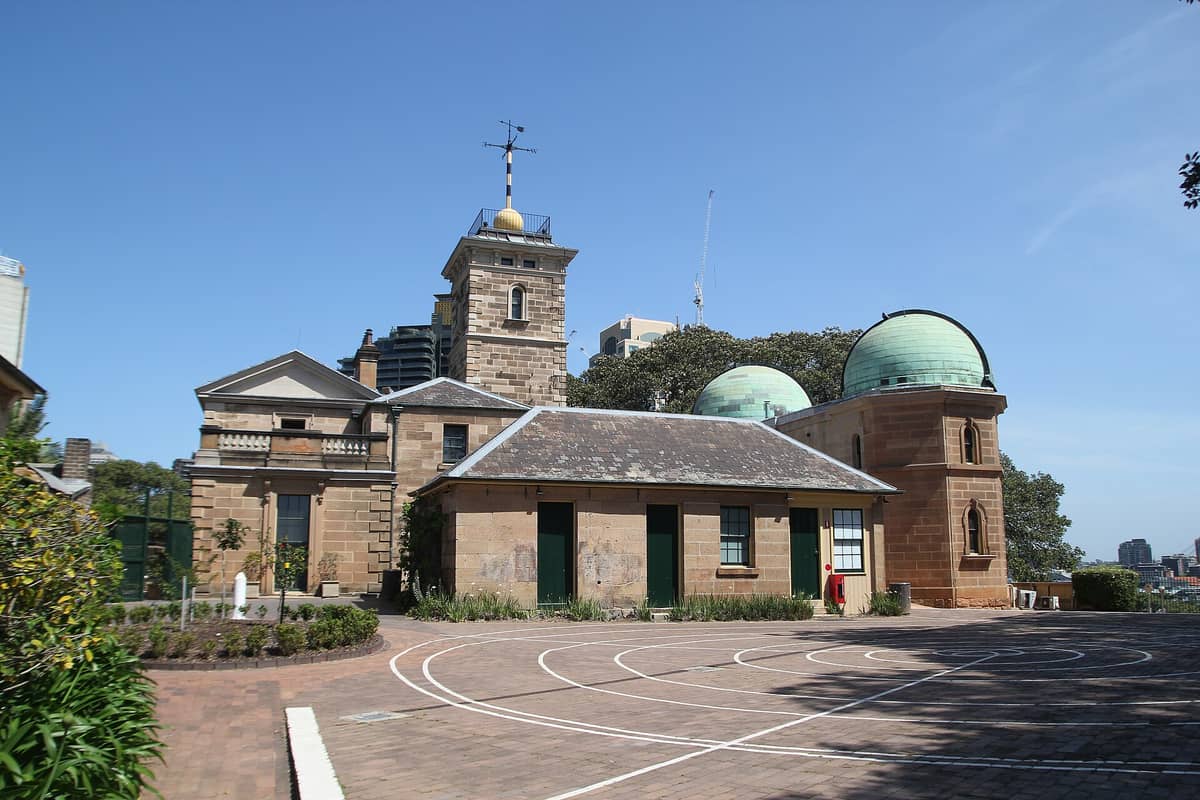
Sydney Observatory is not just a historic building with a telescope inside. It is a historic museum under the Powerhouse umbrella, occupying a sandstone building that dates to between 1857 and 1859 — making it one of the oldest surviving observatories in Australia. Situated at the top of Observatory Hill in Millers Point, it was originally built to serve two practical purposes: tracking astronomical data to help set accurate time for the colony, and supporting maritime navigation for ships entering Sydney Harbour.
The building itself is part of the story. Its Italianate sandstone towers, copper dome, and time ball tower — a mechanism that once dropped a ball at 1pm each day so ships in the harbour could synchronize their chronometers — speak to a period when Sydney was building the infrastructure of a serious colonial city. That time ball still drops daily, though now it is more ceremony than necessity.
ℹ️ Good to know
Sydney Observatory is open for pre-booked tours Wednesday through Sunday. Tour times are subject to change — check the Powerhouse Museum website before you visit, especially on public holidays or during school term breaks when schedules sometimes change.
The Experience: Ground Level to Dome
Arriving at Observatory Hill is its own small pleasure. The park that surrounds the building is open daily and free to anyone. On weekday mornings, you will often find office workers from the CBD eating lunch on the grass, or parents with prams walking the perimeter path. On weekend afternoons, the elevated lawn fills gradually with families and tourists who have wandered up from The Rocks below. The harbour view from here, looking across to the North Shore and the arch of the Sydney Harbour Bridge, is genuinely arresting. Unlike the busy waterfront at Circular Quay, there is no crowd pushing past you — just a wide, quiet grass platform above the city.
Inside the observatory building, the permanent exhibitions explain the history of astronomy in colonial and modern Australia, the science of timekeeping, and the mechanics of the telescopes on site. The displays are clear and well-labelled without being overly simplified, which makes them work reasonably well for adults and curious teenagers alike. Younger children may find some of the text-heavy panels less engaging, but the physical instruments — including historic telescopes you can examine closely — tend to hold attention. Families with younger kids might want to balance this stop with something more kinetic nearby, like a walk through The Rocks precinct below.
The telescope dome at the top of the building is one of the highlights for many visitors. During the day, you can typically peer through telescopes at the sun using safe solar filters — an experience that is more striking than it sounds when you see sunspots or solar granulation for the first time. The dome itself is modest in scale, but the craftsmanship of the original structure gives it a weight and atmosphere that a newer facility would struggle to replicate.
Tickets & tours
Live prices and dates from our booking partner. If you book, we may earn a commission at no extra cost to you.
Sydney whale-watching cruise with breakfast or lunch
From 62 €Instant confirmationFree cancellationBlue Mountains guided tour with Sydney Zoo and Scenic World visit
From 134 €Instant confirmationFree cancellationSydney Harbour scenic flight - private 20 minutes tour
From 404 €Instant confirmationFree cancellationSydney's Razor Gangs true crime tour
From 21 €Instant confirmationFree cancellation
Day vs Evening: Two Very Different Visits
The daytime visit is calm, educational, and well-suited to anyone passing through The Rocks area. Morning, especially mid-week, is the quietest window. The light inside the sandstone building is soft, the park paths are relatively empty, and you can take your time with the exhibits without navigating around school groups. By early afternoon on weekends, tour groups and families begin to arrive, though the building never feels crowded in the way that the Opera House or Darling Harbour attractions can.
The evening experience is structurally different. Sydney Observatory runs telescope viewing sessions after dark, which need to be booked in advance through the Powerhouse Museum website. These sessions use both the historic telescopes and modern equipment to observe the moon, planets, and star clusters depending on the season and Sydney's light pollution conditions. Be honest with yourself here: Sydney's urban glow significantly limits what you can see compared to a rural dark-sky site. The sessions are still worth attending for the guided context, the atmosphere of the sandstone building at night, and the chance to actually look through a research-grade telescope — but if you are expecting the Milky Way arching overhead, you will be disappointed. The best results come during winter months when the skies tend to be clearer and the galactic centre is positioned favourably.
⚠️ What to skip
Night telescope sessions must be booked in advance and sell out during school holidays and public events. Check the Powerhouse Museum website well ahead of your intended visit date. Rainy evenings can result in session cancellations, as cloud cover makes telescope viewing impossible.
Historical and Architectural Context
The site chosen for the observatory was no accident. Observatory Hill occupies a prominent natural point near the early colonial settlement, providing sightlines across the harbour and western sky. The construction between 1857 and 1859 reflected the colony of New South Wales reaching a level of institutional ambition beyond mere survival: this was scientific infrastructure, meant to anchor Sydney in the same global network of observatories that spanned Greenwich, Paris, and Cape Town.
The sandstone used in the construction came from local quarries, and the building sits on a site that already had military significance — Fort Phillip once occupied this elevated ground. The relationship between scientific, military, and civic uses of high ground is a thread that runs through a great deal of Sydney's early history, visible also at Barangaroo Reserve and the old fortifications around the harbour heads. The observatory represents the moment that thread shifted toward knowledge rather than defence.
The time ball mechanism, still visible on the tower, was a direct communication tool with mariners. When it dropped at 1pm each day, ship navigators who could see the tower from the harbour would use the precise moment to check their chronometers. This kind of time-signalling infrastructure was common to major port cities in the nineteenth century. Sydney's example survived because the building was maintained as a heritage site rather than demolished or converted, and it now forms part of City of Sydney's Observatory Park.
Getting There and Navigating the Hill
The most straightforward approach from the CBD is to walk from Wynyard Station, which takes roughly ten minutes via the pedestrian stairs up Observatory Hill itself. From Circular Quay, allow about fifteen minutes on foot, walking through Circular Quay and The Rocks and then uphill through the park. Both approaches are relatively easy but do involve inclines. The path up through the park is not paved at all points, so comfortable footwear is advisable, particularly if rain has made the grass slippery.
There is no dedicated car park at the observatory. Street parking in Millers Point and The Rocks is limited and time-restricted. Public transport or walking from the CBD is the practical choice for most visitors. For visitors with mobility requirements, Powerhouse notes that some areas are inaccessible to less mobile visitors and wheelchair users; confirm current facilities and access limitations directly before visiting.
💡 Local tip
Photography tip: The northern side of Observatory Hill, looking toward the Harbour Bridge, is best in the morning when the light hits the arch from the east. By late afternoon, you are shooting into the sun. Sunset from the park is still worth catching, but frame toward the west over Barangaroo and the city skyline rather than the bridge.
Is Sydney Observatory Worth Your Time?
For visitors spending several days in Sydney, the observatory fits naturally into a morning or afternoon in The Rocks area, combined with the The Rocks Discovery Museum or a walk down to Circular Quay. The pre-booked tour makes it a considered stop, and the park alone justifies the walk uphill even if the museum itself does not fire your interest.
That said, the observatory is not the kind of attraction that will dominate your memory of Sydney the way the Harbour Bridge or Bondi Beach will. Its appeal is more understated: a well-preserved piece of scientific history, a quiet elevated park, and a chance to engage with the history of astronomy in the middle of one of Australia's largest cities. If you are the kind of traveller who finds satisfaction in understanding how a city actually worked rather than just how it looks, the observatory earns its place on your itinerary.
Visitors on a very short trip to Sydney — one or two days covering the major landmarks — may reasonably prioritise other experiences. Those with more time, or with a specific interest in science, colonial history, or architecture, will find it rewarding. The observatory also pairs logically with the Museum of Sydney for a half-day focused on the city's colonial-era history and early urban development.
If you are building an itinerary that takes in the best this city has to offer across several days, our 3-day Sydney itinerary and overview of free things to do in Sydney both include Observatory Hill as a worthwhile and cost-effective stop.
Insider Tips
- The time ball is a prominent feature of the tower — if you are in the area, position yourself in the park or on the street below with a line of sight to it. It is a small reminder of the time signal that ship navigators relied on over 150 years ago.
- The park around the observatory is unlocked from dawn. Early risers who make it up before 8am on a clear morning get an almost entirely empty hilltop with soft light on the Harbour Bridge and cool air coming off the water. It is one of the quieter elevated spots near the CBD at that hour.
- Evening telescope sessions occasionally feature thematic programming tied to particular astronomical events — planetary oppositions, lunar phases, or meteor showers. Check the Powerhouse Museum events calendar rather than just the general session listing for these dates, as they tend to sell out faster.
- The building interior is not climate-controlled in the way a modern museum would be. In summer, the sandstone holds heat by mid-afternoon. A morning visit in summer is significantly more comfortable than arriving at 2pm.
- Millers Point, the residential neighbourhood immediately surrounding Observatory Hill, is one of Sydney's oldest intact urban streetscapes. If you have extra time, a short walk along Lower Fort Street before or after your observatory visit reveals terrace houses and early colonial architecture that most tourists never reach.
Who Is Sydney Observatory For?
- Science and astronomy enthusiasts wanting a contextual introduction to southern hemisphere stargazing
- History travellers interested in colonial-era Sydney and the infrastructure of early Australian cities
- Photographers looking for elevated harbour views without the crowds of the Pylon Lookout or Sydney Tower
- Families with children aged ten and older who are ready for museum-style engagement with science and history
- Visitors wanting a free, low-key cultural stop in the Circular Quay and The Rocks area
Nearby Attractions
Other things to see while in Circular Quay & The Rocks:
- Barangaroo Reserve
Once a concrete wharf, Barangaroo Reserve is now a six-hectare sandstone headland park hugging Sydney's western harbour foreshore. Open around the clock and free to enter, it offers coastal walking paths, sweeping views of the harbour bridge and North Shore, and a quietly powerful connection to the Gadigal and Cammeraygal peoples whose Country this has always been.
- Cockatoo Island
Cockatoo Island sits in the middle of Sydney Harbour, free to enter and reachable by public ferry. It holds 150 years of convict and industrial history across shipyards, sandstone buildings and water-level dockworks — and the views back toward the CBD are quietly spectacular.
- Justice and Police Museum
Housed in a 19th-century court complex one block from Circular Quay, the Justice & Police Museum unpacks colonial Sydney's criminal underbelly through real evidence, mugshots, and courtroom drama. Entry is free, the building is atmospheric, and the exhibits are far more confronting than most museum visitors expect.
- Museum of Contemporary Art Australia (MCA)
The Museum of Contemporary Art Australia sits at the edge of Sydney Harbour in The Rocks, offering rotating exhibitions of Australian and international contemporary art, a rooftop cafe with Opera House views, and free admission for under-18s. It rewards a few hours of unhurried looking, especially on a Thursday evening when the crowds thin and the harbour light shifts.
Planning a trip? Discover personalized activities with the Nomado app.