Sungnyemun Gate (Namdaemun): Seoul's National Treasure No. 1
Sungnyemun Gate, also known as Namdaemun, is the great southern gate of Seoul's historic city wall and Korea's most symbolically significant architectural monument. Designated National Treasure No. 1 in 1962, it stands at the edge of Jung-gu as a rare piece of Joseon-era craftsmanship surrounded by modern Seoul. Entry is free, and the gate is open Tuesday through Sunday.
Quick Facts
- Location
- 40 Sejong-daero, Jung-gu, Seoul 04528
- Getting There
- Seoul Subway Line 4, Hoehyeon Station, Exit 5 (approx. 403 m walk)
- Time Needed
- 30–60 minutes for the gate itself; longer if combining with nearby attractions
- Cost
- Free admission
- Best for
- History lovers, photographers, first-time Seoul visitors
What Is Sungnyemun Gate?
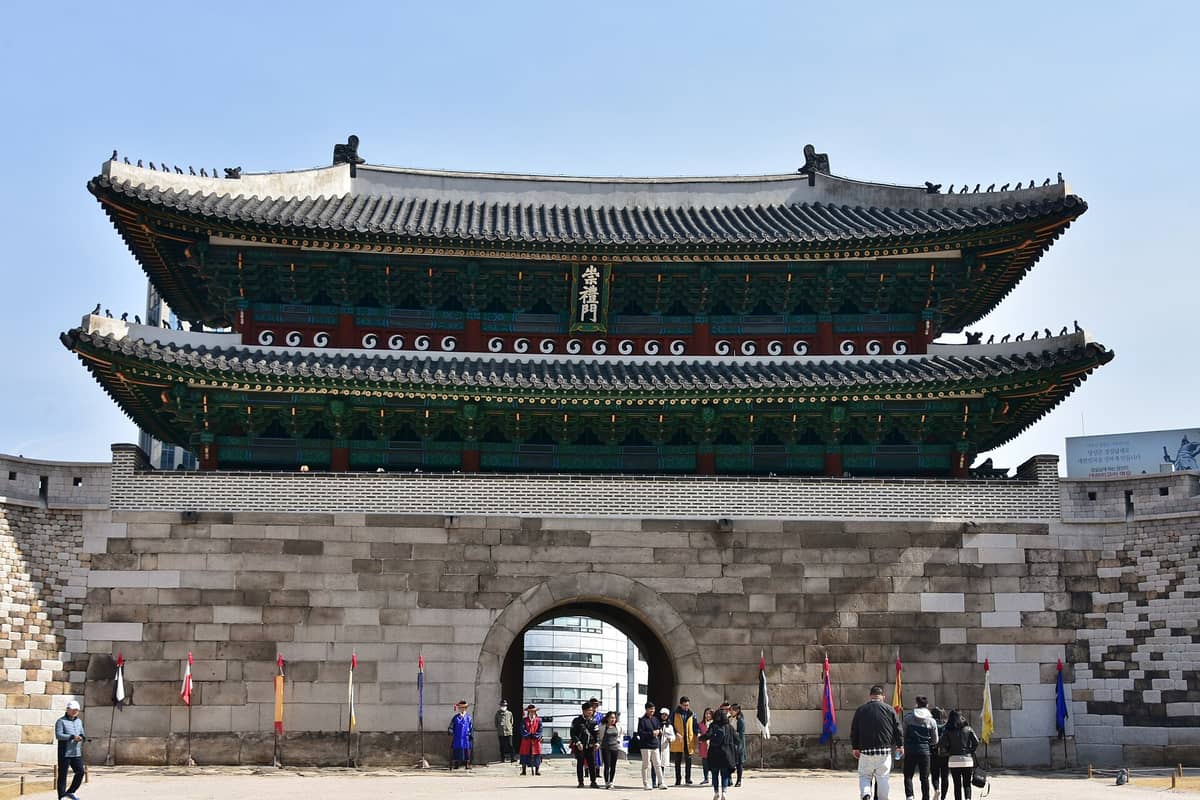
Sungnyemun Gate, formally known as 숭례문 in Korean and commonly called Namdaemun, is the great southern gate of Hanyangdoseong, the historic stone wall that once enclosed the Joseon-dynasty capital of Seoul. Designated National Treasure No. 1 of South Korea in 1962, the gate is not merely a tourist landmark but a legal classification of the country's most prized cultural monument. That ranking alone tells you something about how Koreans regard it: this is the keystone of the national heritage register.
The two-story wooden pavilion sitting atop a broad stone archway dates to the late 14th century, with subsequent restorations across the centuries. The most recent and painful chapter came in February 2008, when an arson fire gutted the upper wooden structure. The rebuilt gate was re-opened in May 2013 after a five-year reconstruction effort that used traditional materials and techniques wherever possible, including hand-hewn timber and traditional roof tiles. The restoration is not universally praised by conservationists, and some color work has been criticized as overly vivid compared to pre-fire photographs, but the structural craftsmanship is considered faithful to Joseon-era methods.
ℹ️ Good to know
Opening hours vary by season. The gate is open Tuesday to Sunday, 09:00–18:00 in summer (June–August), and 09:00–17:30 in winter (November–February). It is closed every Monday. Admission is free.
The Experience: Walking Up to the Gate
The gate sits on a raised stone platform at the center of a circular roundabout on Sejong-daero, one of Seoul's widest and most trafficked boulevards. The first thing most visitors notice is the contrast: six-lane traffic flowing around a 600-year-old stone arch, office towers and chain hotels framing the tiled roof on all sides. It is a collision of eras that Seoul wears unapologetically. The gate does not feel secluded or park-like. It feels urban, exposed, and historically defiant.
At ground level, the paved plaza around the gate allows you to walk completely around the structure. The stone base is the original masonry, rough-textured and stained with centuries of weather. The archway passage through the center was historically the main road into the capital from the south; standing beneath it and looking up into the vaulted stonework, you get a sense of the gate's original function as a controlled threshold, not a decorative monument.
Mornings on weekdays are noticeably quieter. By mid-morning on weekends, tour groups and domestic visitors fill the plaza. The best photography conditions come in the early morning, when the low sun catches the curved eaves of the upper pavilion from the east, and in the late afternoon when the stonework takes on a warmer tone. Overcast days actually flatten shadows usefully and reduce glare on the white plaster sections of the wooden structure.
Tickets & tours
Hand-picked options from our booking partner. Prices are indicative; availability and final rates are confirmed when you complete your booking.
DMZ and Lake Majang Suspension Bridge Tour from Seoul
From 57 €Instant confirmationFree cancellationHalf Day DMZ Tour from Seoul, 3rd Tunnel, Observatory and More
From 47 €Instant confirmationFree cancellationSeoul zombie city exploration game and private tour
From 10 €Instant confirmationFree cancellationLuggage Storage in Seoul
From 7 €Instant confirmationFree cancellation
Historical and Cultural Context
Sungnyemun was originally built in 1398, two years after the founding of the Joseon dynasty, as part of Hanyangdoseong, the city wall system that protected the new capital. The gate's name translates roughly as the Gate of Elevated Rituals, a Confucian naming convention that reflected the ideological values underpinning the new dynasty. Of the eight gates in the original city wall, Sungnyemun was the largest and most ceremonially significant.
The wall itself, known as Hanyangdoseong, the Seoul City Wall, stretched roughly 18 km around the city and incorporated four great gates and four smaller ones. Sungnyemun served as the main southern entrance, facing the road that connected the capital to the southern provinces. Today, sections of the city wall still survive and can be walked in several districts, offering a wider context for understanding what Sungnyemun originally anchored.
The 2008 fire remains a raw cultural memory in South Korea. Broadcast live on national television, the destruction of the upper structure was described by many Korean commentators as a national trauma comparable to losing an irreplaceable piece of collective identity. The arsonist was convicted. The reconstruction, funded and overseen by the Cultural Heritage Administration of Korea, became both a technical challenge and a politically charged exercise in national recovery. Understanding that backstory changes how you look at the gate when you visit.
How to Get There and Where to Start
The most straightforward route is Seoul Subway Line 4 to Hoehyeon Station, Exit 5. From the exit, the gate is approximately 403 meters away on foot, a flat walk of five minutes along Sejong-daero. The gate is visible before you reach it, so navigation is simple.
The surrounding area rewards a longer visit. Namdaemun Market is immediately to the north, one of Seoul's oldest and largest traditional markets, with a dense grid of stalls selling everything from dried seafood to eyeglass frames. Many visitors combine the gate with an hour in the market, then walk east toward Myeongdong for shopping and street food. The gate sits at a natural crossing point between these areas.
💡 Local tip
If you are visiting Sungnyemun as part of a palace circuit, it pairs logically with Deoksugung Palace, a 15-minute walk northwest. Combine both in a half-day itinerary through Jung-gu's historic core.
Photography and What to Look For
The gate's most photogenic angle is from the southwest corner of the plaza, where you can frame the two-story pavilion against open sky with the stone arch in the foreground. The traditional dancheong paintwork on the eaves — formal geometric patterns in red, blue, green, and gold — is sharp and vivid on the restored structure, and it photographs well in soft morning light. A telephoto lens lets you isolate the roof details from the street noise around the base.
Night photography is worth considering. The gate is illuminated after dark, and the warm artificial lighting on the stone base and wooden pavilion creates a dramatically different mood from daytime visits. Traffic around the roundabout adds light trails when shooting with a longer exposure. The gate is not officially open as an attraction after hours, but the exterior is accessible from the surrounding public plaza at any time.
Combining Sungnyemun with the Broader Jung-gu Area
Sungnyemun sits within the broader Jung-gu district, which contains a higher density of historically significant sites than almost any other central neighborhood. A short walk north brings you to Deoksugung Palace, the only Joseon-era palace with a notable Western-style annex, and the pleasant tree-lined path of Deoksugung Doldam-gil. Walking northeast from the gate, you can reach Cheonggyecheon Stream, a restored urban waterway that makes for a pleasant pedestrian corridor through the city center.
For travelers following Seoul's palace circuit, the guide to Seoul's historic palaces provides useful itinerary context. Sungnyemun does not function as a palace, but it was historically the ceremonial entrance point into the capital where palaces were located, making it a meaningful starting point for that kind of heritage walk.
If your interest is in Seoul's layered city wall history rather than individual gates, the Seoul City Wall (Hanyangdoseong) trail connects several surviving sections and offers a very different physical experience from standing in the roundabout at Sungnyemun. Heunginjimun Gate on the eastern side of the wall is the other major surviving gate and makes for a natural comparison visit.
Honest Assessment: Who Should Manage Their Expectations
Sungnyemun is significant, but the experience of visiting it is inherently limited compared to Seoul's palaces. You are looking at a single gate structure in a traffic roundabout, not exploring a compound or grounds. There is no interior to enter, no guided walk through multiple buildings, and no landscaped setting. Visitors who arrive expecting a tranquil heritage experience in a green space may find the car-dominated urban context jarring.
The reconstruction is also a factor worth acknowledging. The gate you see today is largely a 2013 rebuild over original stone foundations. Travelers who place high value on unrestored, aged authenticity will likely find the freshly painted eaves and new timber less affecting than they hoped. That said, the symbolic weight of the gate and its place in Korean cultural consciousness gives it genuine meaning that the physical structure alone does not fully communicate. Reading about the 2008 fire before you visit substantially deepens what you see.
⚠️ What to skip
The gate is closed every Monday. Arriving on a Monday is the most common visitor mistake at this attraction. Double-check the day before building it into your itinerary.
Insider Tips
- Visit on a weekday morning before 10:00 for the fewest crowds and the best light for photography. Weekend afternoons are significantly more crowded and noisier due to tour groups.
- The gate is technically part of the Seoul City Wall trail system. Pick up a city wall map at Hoehyeon Station or download the Seoul City Wall official app to understand the broader historical network Sungnyemun anchors.
- Look closely at the stone base rather than just the wooden pavilion. The original masonry is visibly older than the restored upper structure, and the textures and repair seams in the stone tell the gate's long history more honestly than the bright paintwork above.
- Namdaemun Market is at its most active in the early morning, especially for food stalls. Combining a market breakfast with a Sungnyemun visit before the midday crowds arrive is a more rewarding sequence than doing both in the afternoon.
- The gate is illuminated at night and visible from the street even after official hours. If you are staying in Myeongdong or near Seoul Station, an evening walk past the lit gate costs nothing and offers a completely different visual experience from the daytime visit.
Who Is Sungnyemun Gate (Namdaemun) For?
- First-time visitors to Seoul wanting to understand the city's historical foundations before visiting its palaces
- History and architecture enthusiasts interested in Joseon-era construction and the story of the 2008 fire and reconstruction
- Photographers looking for a strong contrast between ancient architecture and modern urban Seoul
- Travelers building a half-day itinerary through Jung-gu that includes Namdaemun Market and Deoksugung Palace
- Visitors following the Seoul City Wall trail who want to see its most iconic and symbolically significant gate
Nearby Attractions
Other things to see while in Myeongdong & Jung-gu:
- Cheonggyecheon Stream
Cheonggyecheon Stream is an 11-kilometer restored waterway cutting through central Seoul, offering a rare ground-level escape from the city's elevated streets. Free to access around the clock in normal conditions, it draws early-morning joggers, evening strollers, and weekend families in equal measure.
- Deoksugung Palace
Deoksugung Palace sits in the heart of Jung-gu, surrounded by modern Seoul yet preserved as a rare meeting point of Joseon tradition and early 20th-century Western architecture. At 1,000 KRW and open until 9pm (last admission at 8pm), it is one of the few palaces you can visit after work or after dinner.
- Gyeonghuigung Palace
Once a secondary palace for Joseon kings, Gyeonghuigung stands today as Seoul's least-visited royal site, which is precisely what makes it worth your time. Free to enter and rarely crowded, it offers a grounded, unhurried encounter with Korean dynastic architecture in the heart of the city.
- Myeongdong Cathedral
Myeongdong Cathedral is Seoul's most historically significant Catholic church and one of the city's finest examples of Gothic brick architecture. Founded in 1892 and completed in 1898, it sits on a hilltop above the commercial noise of Myeongdong, offering a rare moment of calm in the middle of one of Seoul's busiest districts. Entry is free.